
Did you know that, as per chiefmartec.com, the marketing technology space has over 11,000 tools across nearly 50 categories?
No doubt, it’s easy to get overwhelmed with the sheer volume of marketing tools even if you are researching tools for a specific niche.
This newsletter issue is all about cutting through the noise and selecting a stellar toolkit that'll save you from endless head-scratching. Get ready to streamline operations, understand audiences better, and engage with them in a meaningful way.
Here is a quick overview based on four broad categories:
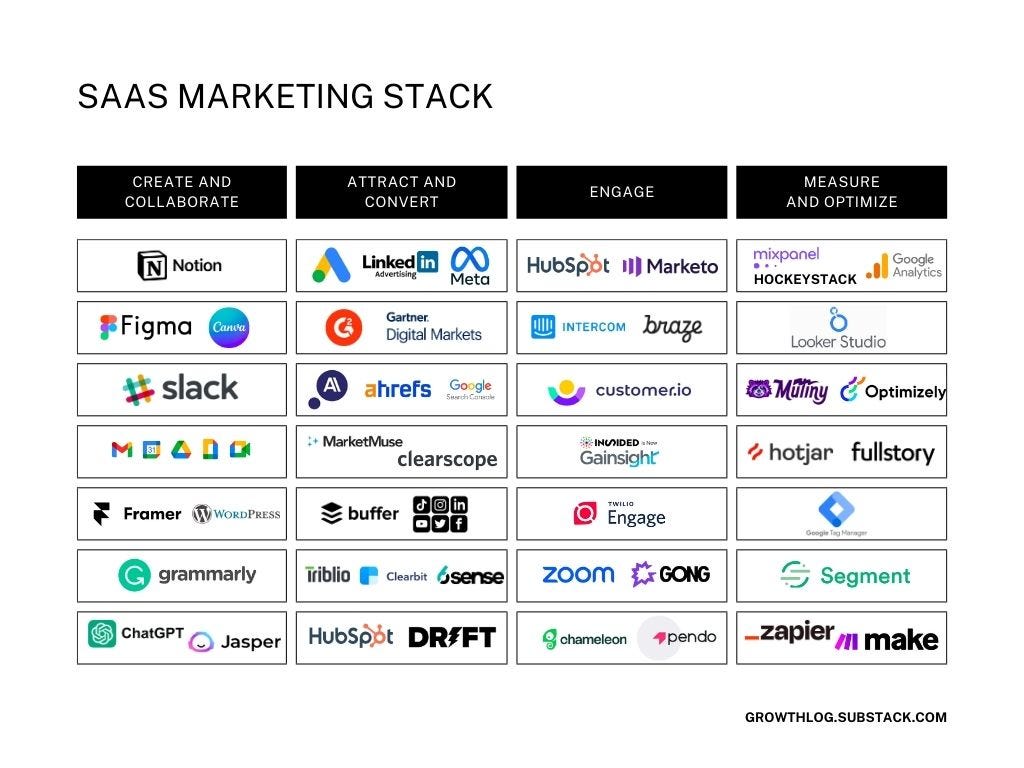
Note: This is not an exhaustive list. However, marketers won’t go wrong this this stack for a growth stage (Series A+) SaaS.
These tools lay a solid foundation for creating content, organizing the content, and enabling the team to collaborate.
Notion: Ditch the clutter of disjointed tools and embrace Notion's versatile platform for docs, tasks, and databases.
Figma: Figma enables real-time design collaboration, making it the go-to for UI/UX professionals.
Canva: Canva comes with its user-friendly design toolkit, ideal for marketing materials.
Google Workspace: Streamline your team's workflow with Google's suite, from Docs for collaborative writing and sheets for data analysis, to Slides for presentations.
Slack: With Slack, cross-functional team conversations are centralized and streamlined. You can also stream various notifications to Slack to keep your team up-to-date.
Framer: Framer is great for building responsive and interactive websites. It streamlines the design-to-code process offering a platform for real-time collaboration.
Goes without saying WordPress and Webflow are amazing solutions as well.
Grammarly: Whether it's emails, proposals, or marketing copy, Grammarly ensures your team's writing is clear, effective, and mistake-free.
ChatGPT: Improve your efficiency and create better content! Generate ideas, draft copy, and improve customer interactions with a personal touch.
This is all about generating and capturing demand and then turning leads into paying customers.
Google Ads: A comprehensive platform that enables businesses to access target audiences across Google's vast network, including search results, websites, and YouTube.
LinkedIn Advertising: A top choice for B2B marketers. You can leverage this ad platform to target decision-makers with precision.
Meta Ads: Utilize the vast reach of social platforms like Facebook and Instagram for brand visibility. You can even integrate WhatsApp to further improve your campaigns.
G2 Crowd: Great platform to showcase product reviews and help potential customers discover your product and compare it with alternatives.
Gartner Digital Markets (Capterra, GetApp, Software Advice): Similar to G2 Crowd, Gartner also offers detailed software listings and user reviews. They also perform research across various industries to help customers find the best vendors.
Ahrefs: They have one of the largest keyword databases (more than 17 billion keywords). A powerful tool to gain SEO insights, find gaps, and outrank competitors.
KeywordInsights.ai: I must say that I love the way it makes keyword discovery and clustering effortless. Note that clustering is critical for improving topical authority.
Google Search Console: Monitor website performance in Google search to maximize organic traffic.
MarketMuse: Optimize your content with AI-driven insights to rank higher and attract more qualified traffic. Clearscope is another great tool in the same niche.
Clearbit: Offers powerful marketing and sales intelligence tools to help businesses identify and engage with potential customers by enriching leads with real-time data.
Triblio: This one is an all-in-one Account-based Marketing (ABM) solution to capture intent data and orchestrate marketing and sales efforts across multiple channels. Useful for engaging high-value accounts with personalized campaigns.
HubSpot: An all-in-one inbound marketing and sales platform to attract visitors, convert leads, and close customers through its suite of tools.
Drift: A powerful customer communication tool that offers conversational marketing and sales tools. Enables businesses to engage with customers in real time via chatbots.
This section explores how to keep the conversation going, provide value, and build a community around your brand.
HubSpot: Improve customer relationships across marketing and sales, and support with automation tools, segmentation, lead scoring, emails, content management, meeting scheduler, and more.
Intercom: A conversational relationship platform that enables personalized communication with customers through chat, email, and social messaging.
Customer.io: A powerful automation platform that enables personalized messaging based on user behaviour. Great platform for tech-savvy marketers to engage customers through emails, SMS, and push notifications.
InSided by Gainsight: Offers a community platform that drives customer engagement and success by fostering user interactions, sharing knowledge, and gathering feedback to improve product and service offerings.
Twilio Engage: A customer engagement tool that leverages comprehensive communication APIs to create personalized interactions across channels like SMS, email, and WhatsApp.
Zoom: Supports meetings, webinars and virtual events to enhance customer engagement and provide value through educational content.
Gong: Utilizes AI to analyze customer interactions across calls, emails, and web conferences to provide insights that help sales teams engage more effectively with prospects.
Chameleon: A tool for creating and managing in-product tours and tooltips, making it easier for users to understand and engage with your product.
These tools are essential for understanding the effectiveness of your marketing strategies and making data-driven decisions.
HockeyStack: Offers insights into customer journeys and the effectiveness of marketing efforts through attribution tech for B2B products.
Mixpanel: Offers comprehensive analytics for mobile and web by tracking user interactions and measuring the impact of product changes on customer behaviour.
Google Tag Manager: Streamlines the process of adding and updating website tags, including analytics, remarketing, and conversion tracking, without the need for coding.
Google Analytics: This one is a staple in web analytics. Provides detailed insights into website traffic, user behaviour, and conversion metrics to optimize marketing efforts. Fathom and Plausible are two alternatives worth checking out.
Looker Studio: Allows you to create customizable reports and dashboards from a variety of data sources, making it easier to visualize and share insights across teams.
FullStory: Captures customer experience data in one powerful, easy-to-use platform, offering insights through session replay, heatmaps, and analytics.
Mutiny: Personalizes websites with optimized messaging for visitors to maximize conversions.
Segment: A Customer Data Platform (CDP) that helps you collect, clean, and control your customer data. Makes it easy to integrate with other tools for personalized marketing campaigns.
Zapier: Automates workflows by connecting your favourite apps and services. Make (formerly Integromat) serves a similar purpose, offering visual automation workflows to connect apps and automate processes (better for complex operations and data transformations).
This was an overview of the essential toolkit for SaaS marketing. To dive deeper into crafting your SaaS marketing tech stack, here are some more resources:
Remember, the most powerful tech stack is one that evolves.
No posts
Comments
Nothing yet. Say the first thing.
Sign in to join the conversation.