
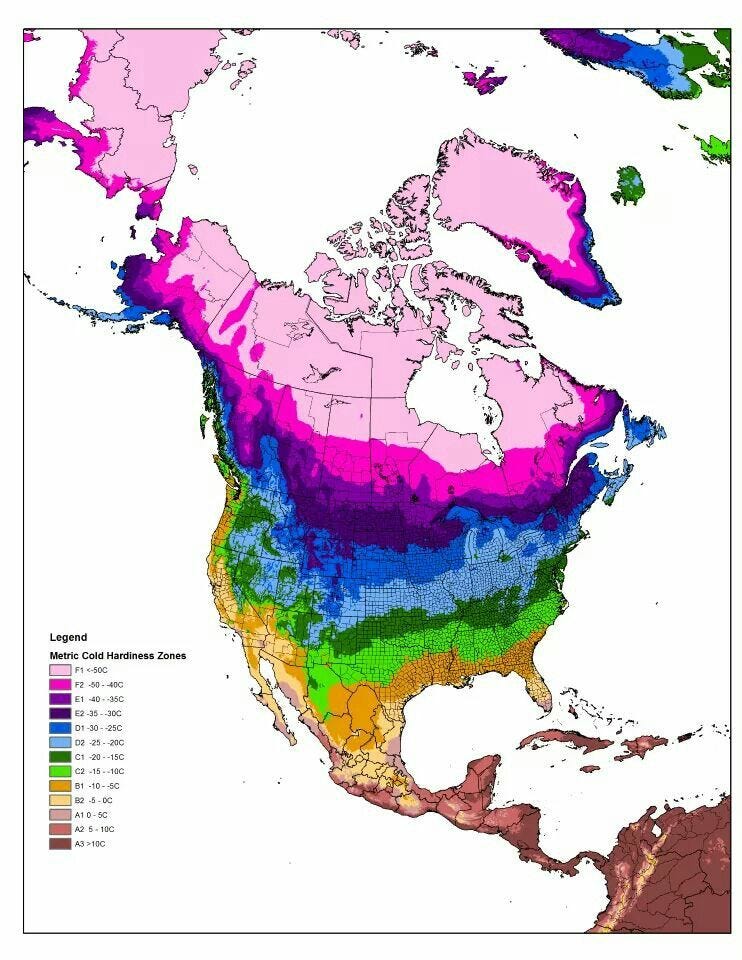
Growing zones are one of those gardening terms we throw around constantly.
“I’m in Zone 5.”
“Will this grow in Zone 4?”
“That plant is hardy to Zone 6.”
“What zone are you in?”
And if you’re a new gardener, you could very reasonably assume your growing zone is some sort of master instruction for your entire garden.
It isn’t.
In fact, I think we make growing zones considerably more complicated than they need to be.
Here is the simplest way I know how to explain them:
Your growing zone is primarily about winter.
More specifically, a plant hardiness zone helps us understand whether a perennial plant can survive the winter conditions where we live and return the following year.
That’s it.
Once I started thinking about zones this way, they became much easier to understand and more importantly, much easier to actually use.
Before growing zones really make sense, we need to understand that not every plant is trying to do the same thing.
Plants generally fall into a few broad life-cycle categories.
Annuals - An annual completes its entire life cycle in one growing season.
It germinates, grows, flowers, produces seed and dies.
For many of the annuals we grow in colder climates, frost ends the show.
Think:
tomatoes
beans
cucumbers
cosmos
zinnias
basil
I can grow tomatoes in my garden even though a tomato plant absolutely cannot survive my Ontario winter.
Why?
Because I don’t need it to.
I only need enough warm weather for that tomato plant to grow and produce tomatoes before cold weather kills it.
That is a growing season question, not really a hardiness zone question.
And I think understanding that distinction clears up a huge amount of gardening confusion.
Hardy Annuals - Hardy annuals still complete their life cycle within a relatively short period, but they can tolerate colder conditions than tender annuals.
Some can handle cool soil, chilly nights and even a light frost.
Think peas, calendula and certain cool-season flowers and vegetables.
Being hardy does not necessarily make a plant a perennial.
It simply means it can tolerate more cold during its growing cycle.
Biennials - Biennials generally complete their life cycle over two growing seasons.
The first year is often focused on vegetative growth.
They survive a winter, then flower and produce seed during their second year before completing their life cycle.
Carrots are actually a great example.
We normally harvest them during their first season, so we don’t necessarily think of them as biennials. Leave one in suitable conditions, though, and its natural life cycle continues.
Parsley is another familiar example.
Perennials - This is where growing zones become especially useful.
A perennial lives for more than two years.
Some seem to live approximately forever.
Your chives come back.
Your sage comes back.
Your asparagus comes back.
Your lavender hopefully comes back.
Your fruit trees, berry bushes and perennial flowers go dormant, survive winter and begin growing again when conditions improve.
Now we need to know whether that plant can actually survive our winter.
Enter the hardiness zone.
This is the light-bulb moment I want every gardener to have.
If I see a perennial labelled hardy to Zone 4, that information is telling me something about its ability to survive cold winter conditions.
If I garden in Zone 5, a plant reliably hardy to Zone 4 is generally within my range from a cold-hardiness perspective.
If I find a perennial only hardy to Zone 7?
Now I have a problem.
I might be able to grow it beautifully all summer.
It could absolutely thrive from June through September.
But unless I protect it, overwinter it somewhere else or happen to have an unusually favourable microclimate, I shouldn’t expect a Zone 7 perennial to behave like a reliable outdoor perennial in my colder garden.
I can grow it. I just can’t necessarily overwinter it.
Those are two different questions and THAT distinction is where I think growing zones finally start making sense.
Let’s use an exaggerated example. Imagine two gardeners living in very different climates, both could potentially grow the exact same tomato variety. Their planting dates might be completely different.
Their frost dates will be different.
The length of their growing seasons may be different.
One might start tomatoes indoors months before the other but neither gardener needs that tomato plant to survive winter.
They need enough suitable weather between planting and harvest.
So when you’re choosing an annual vegetable, questions like these often matter more:
How long is my growing season?
When is my last spring frost?
When is my first autumn frost?
How many days does this variety need to mature?
Does it prefer cool or warm weather?
Do I need to start it indoors?
That information tells you far more about whether you’ll successfully harvest an annual crop than simply knowing your hardiness zone.
This is why someone saying, “I’m Zone 5. Can I grow watermelon?” doesn’t quite give us enough information.
Probably!
But now I want to know how long their frost-free growing season is, what variety they’re growing, its days to maturity and whether they’re starting it indoors.
The zone isn’t useless.
It’s just answering a different question.
This is probably the biggest distinction I want you to take away from this entire article.
Hardiness zone = winter survival.
Growing season = how much usable growing time you have.
They influence each other but they are not interchangeable.
Two gardens can even share a hardiness zone while having different frost dates, different summer temperatures, different rainfall patterns and different growing-season lengths.
Your zone is one piece of information about your garden.
It is not your entire climate.
Hardiness systems group geographical areas according to climatic conditions that influence perennial plant survival.
In Canada, plant hardiness mapping is more nuanced than simply looking at one coldest temperature. The Canadian system considers several climatic factors related to plant survival.
But for everyday garden shopping, you don’t need to turn choosing a perennial into a research thesis.
If you’re standing in a nursery looking at a perennial tag, think:
My zone tells me whether this plant is reasonably suited to surviving winter where I live.
That’s the useful part.
The zone does not promise that the plant will thrive and that brings us to something equally important.
For the cost of one garden centre impulse buy, you’ll unlock the full Growing With Beccalynne experience — garden downloads, practical mini guides, essays, and access full of resources designed to help you grow a more abundant, low-effort garden without overcomplicating it.
Let’s say you’ve found a gorgeous perennial that is hardy in your zone.
Excellent.
That checks one box.
It does not check every box.
The plant can still struggle because of:
poor drainage
too much water
drought
insufficient sunlight
too much sunlight
wind exposure
soil conditions
repeated freeze-thaw cycles
lack of snow cover
winter wet
poorly timed pruning
pest or disease pressure
A Zone 4 plant isn’t magically indestructible in every Zone 4 or warmer garden.
The designation tells us about cold hardiness, not whether you’ve planted a moisture-loving perennial in what is essentially a gravel parking lot.
You still have to garden.
This is where things get fun. Your property doesn’t necessarily have one perfectly uniform climate. The south side of your house might warm earlier in spring.
A protected courtyard could stay warmer than an exposed bed.
A low area may collect cold air.
A windy corner could be considerably harsher in winter.
Deep snow can insulate plants.
A stone wall can absorb heat during the day and release some of it later.
Those little pockets are called microclimates.
They’re one reason gardeners sometimes successfully grow something that appears to be right on the edge of their hardiness zone.
They’re also why your neighbour might keep a particular perennial alive while yours repeatedly dies.
Same general zone.
Different little environment.
This one is especially important if you grow perennial plants, shrubs or fruit trees in pots.
A perennial planted in the ground has a large mass of soil insulating its roots.
A container does not.
The roots inside a pot are exposed to colder and more rapidly fluctuating temperatures than roots protected underground.
So a perennial being hardy in your zone does not automatically mean it is equally hardy sitting above ground in a container all winter.
That doesn’t mean we can’t grow perennial plants in pots.
I do.
It means we may need to give those containers additional winter protection, move them somewhere sheltered or choose plants hardy to colder conditions than our actual garden zone.
Again, the zone gives us information.
Then we use that information to make gardening decisions.
Here’s another fun source of confusion.
You look up a plant you’ve always grown as an annual and suddenly the internet tells you it’s a perennial.
Excuse me?
This happens because annual, biennial and perennial describe the plant’s biological life cycle, while climate determines whether that life cycle can actually continue outdoors where you live.
Some plants are naturally perennial in warm climates but cannot survive winter in colder ones.
We grow them as annuals.
A plant doesn’t magically change its biology when it crosses the Canadian border.
Our winter just kills it.
So when you see conflicting information about whether something is annual or perennial, check the context.
It might be perennial somewhere.
It just isn’t winter-hardy where you garden.
Rather than looking at every seed packet and plant tag and immediately asking, “Is this for my zone?”, separate the problem.
If it’s an annual:
Do I have enough growing season and the right conditions for it to mature?
If it’s a biennial:
Can it survive the conditions necessary to complete its second year?
If it’s a perennial:
Is it hardy enough to survive my winter, and does my garden provide the growing conditions it needs?
Suddenly, zones become a tool instead of a mysterious gardening rule.
This might be my favourite way to think about the whole thing.
Your growing zone isn’t a list of plants you’re allowed to grow.
It doesn’t say:
Zone 5 gardeners may grow these 437 approved plants.
It gives you information about your climate that is especially useful when you’re deciding what should survive outdoors from one year to the next.
That’s why I pay much closer attention to zone information when I’m buying:
fruit trees, berry bushes, perennial herbs, perennial vegetables, shrubs, perennial flowers and anything else I’m expecting to see again next spring.
When I’m buying annual vegetable seeds?
I’m thinking much more about frost tolerance, days to maturity, heat requirements, when to start them and how long my growing season is.
Different plants.
Different questions.
Here’s my ridiculously simplified growing-zone lesson:
Annual? Think growing season.
Perennial? Think winter survival.
Then add the details.
What is your frost-free period?
How much sun does the plant need?
How much water?
What kind of soil?
Is your garden protected or exposed?
Are you planting in the ground or a container?
Growing zones matter.
They’re incredibly useful.
But they are only one tool in the giant gardening toolbox, and I think they’re much easier to understand once we stop asking them to tell us things they were never designed to tell us.
So the next time someone asks:
“What can I grow in my zone?”
Maybe the first question isn’t what zone they’re in.
Maybe it’s:
“Are we talking about something you want to harvest this year, or something you want to survive the winter and come back?”
Because those are two very different gardening questions.
Happy Planting!
Beccalynne🌻
Meet The Author.
Hi there! I’m Becca, the heart behind Growing With Beccalynne.
From Eastern Ontario Canada, gardening has been apart of me my whole life starting with my great grandpa when I was little. I’ve been building and educating through my own garden since 2018. By day, I run my business as a virtual assistant and creating content for you (@growingwithbeccalynne on all platforms). Here, I pour my love for soil science, creating gardens, growing plants and the joys of creating a low effort garden to love long term.
Ways To Keep Growing With Me:
Become a Paid Subscriber: For the cost of a monthly garden centre impulse buy, you can unlock the full Growing With Beccalynne experience — downloads, private essays, seasonal workbooks, and access to the growing Growers Vault of resources designed to help you build a healthier, lower-effort garden.
Explore the Garden Resources I Share : Seasonal notes, how-to guides, soil-building methods, herb-bed layouts, and the real process of growing a backyard garden with ease. These tools are here to help you grow more confidently without overwhelm.
Follow Along on Instagram - Come hang out with me on Instagram for real-time garden updates, photos from the backyard, short-form videos, seasonal reminders, plant rambles, garden experiments, and the honest in-between moments that don’t always make it into a full post.
💬 Feel free to like or comment on this newsletter so more Substack users can find it!
Comments
Nothing yet. Say the first thing.
Sign in to join the conversation.