
Friends,
When I applied for seminary and envisioned what a Master of Divinity (MDiv) degree might look like, I was picturing Bible classes. Lots and lots of Bible classes. Different classes each quarter on different books of the Bible.
(I did spend my twenties in a church whose middle name was “Bible,” after all.)
Different seminary curricula can be very different from one another. But as soon as I started looking more closely at mine, I realized that yes, some Bible classes were involved, but also so many other things.
We took classes in church history, historical theology, spiritual formation, ethics, preaching, languages, pastoral ministry. Amongst all that, I think I only took two classes that each focused on a specific book of the Bible. (For a hot second there, you could ask me anything about Lamentations or 1 Corinthians.)
All this to say, before seminary, I had very little concept of what any sort of systematic theology might entail. So I learned a few things. Many of them from a textbook that, while I found it interesting and helpful at the time,1 someone online later called “hella colonized,”2 and I reckon they’re not wrong.
I don’t think it was necessarily a bad thing for me to learn how the white-dominated, male-dominated, Western Protestant Christian tradition has historically been formed, the mainstream views it has tended to hold.
But I’ve also learned that things are so much more complicated than that. That this set of views has either directly caused or has failed to effectively challenge so much violence, injustice, and oppression in our world.
In light of the history of dominant Western Christianity and its present-day reality, we might wonder: Which of its tenets do we need to push back on, to reimagine, to toss out entirely in favor of finding something more liberating for all people?
What might a theology of real hope, healing, love, and justice look like, if not this?
What parts of the things we were taught are malformed, and how can we build something more whole in its place? (More Whole and Human, if you will?)
Enter Whole and Human: Forty Meditations for Liberating Body & Spirit, a very cool new book by Rohadi Nagassar. It’s not a systematic theology. It doesn’t read anything like a textbook. It’s short and sweet and personal and accessible and practical.
And I really think that, for those of us who want to rebuild a healthier and more liberating form of the Christian faith, it can help us do exactly that.
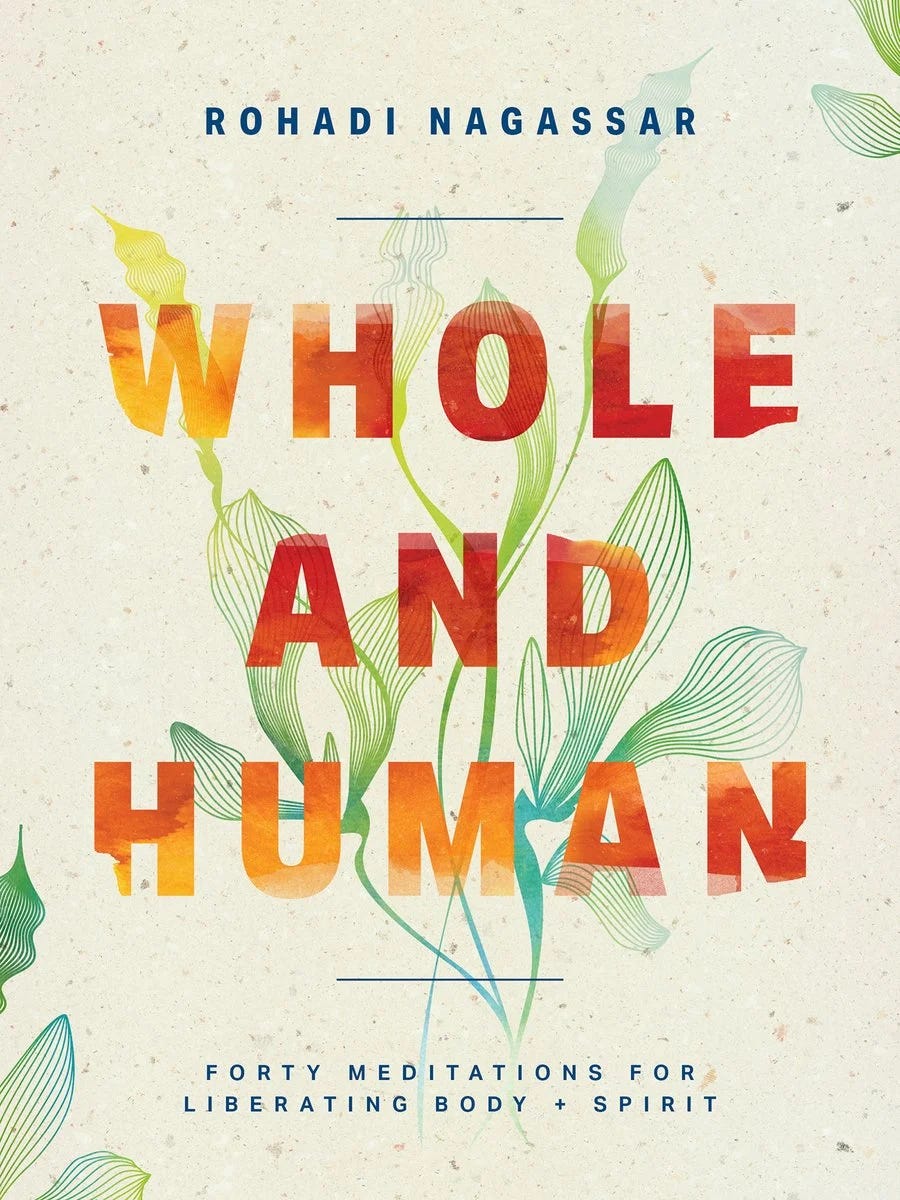
Rohadi was kind enough to answer a few questions I had, and I’m so happy y’all get to hear from him!
Liz: Can you tell us a little about why you wrote this book and who it’s for?
Rohadi: I write for me, but I also think about the increasing number of people who are discovering the church traditions they know are more harmful than good. So what now? What are we going to do about that? I want to invite folks back into the possibilities of a faith that’s curious about the teachings of Jesus in a modern world.
Liz: In the introduction, you say you’re centering your book on three pillars: decolonization, embodiment, and justice. Super here for it. Among all the aspects of life, faith, healing, and wholeness that could serve as a focus for a book like this, how did you land on these three?
Rohadi: When it comes to showing up in a good way in the world today, what aspects are we missing? What will help us in terms of formation?
I land on decolonization because we must decenter supremacist ideologies and cultures in order to show up well. Embodiment is necessary because it accesses our humanity, and it counters so much of religion and culture that demand disembodiment—ignoring your body.
And justice is necessary in this moment especially to counter malformed powers like authoritarian governments and churches from perpetuating harm. Showing up well needs all three (and more).
Liz: I imagine most people reading this Substack relate to the idea of faith deconstruction in some way, but some may not be as familiar with decolonization as relates to faith. Can you talk a little about what decolonization is, why it’s crucial, and/or what it means to you?
Rohadi: Deconstruction means little if you are not broaching the bedrock formation, which includes supremacist ideology like white supremacy, patriarchy, or capitalism.
You can deconstruct without ever having to leave the safe confines of old cultural assumptions, particularly around whiteness. White folks don’t really like to hear that because they are not used to decentering their own selves. But it’s necessary, because most of Christian thought in the west is rooted in Christian supremacy—a bedrock of white supremacy ultimately—with a side of patriarchy and capitalism. That means we have to find renewed ways of being and thinking.
So what are we going to replace our old formation with? And I appeal back to both Indigenous wisdom unique to the lands where you dwell, and the teachings and practices of our own ancestral traditions. Notably telling, many folks no longer have a tether to their ancestors, swapping that identifying piece with cheap substitutes like religious theology or racialization (whiteness).
Liz: You write, “Those who lack a deep love for the self will struggle to love the one next to them. How you love your neighbor is a certain reflection of the type of love you have for yourself.” I appreciate this and feel it. How did this message of self-love become important to you? What do you think it does to us and our communities when we’re lacking this?
Rohadi: Because it’s literally the Greatest Commandment! Yet Christian traditions tend to cast deep suspicion on our bodies, calling them sinful and depraved.
This has built in a function within Christian thought—namely conservative and evangelical traditions—that you are not enough and your body is temporary. Troubling ideas that have taken a stranglehold on thought and practice.
Yet it’s not accurate, depending on how you read scripture, and whether or not you’re part of a tradition that is interested in following the central teachings of Jesus foremost. Many Christians are not interested in Jesus and care more about affiliating with power.
Liz: How has the way you think about sin, guilt, and human goodness changed over time? And how is this transformation reflected in Whole and Human?
Rohadi: Growing up evangelical I was formed to think and believe in opinions like ‘Original Sin’. That’s a choice. And when you note how much harm that does for Christians and those around them, you start to wonder if there’s a better way?
Turns out there is, and it’s been in the stories the whole time. The opening story in the Bible is about our goodness and our hope today to continuously unlock deeper components of our good humanity.
Many Christians today prefer to opt for a posture of hate. They openly hate themselves and spew their hatred on others.
It’s evident that they do not love well because internally they have been formed to hate themselves. So I think when we have alternatives that still work in scripture, that displace self-hatred and the stranglehold of individual sin, we open the door for freedom and liberation.
(back to Liz again)
So much richness and goodness and thought-provoking-ness here.
The conversation felt appropriate to me for the 4th of July and America’s 250th birthday and all that. Much to think about, perhaps especially for those of us who are white and/or have been formed in some white-dominated Christian traditions.
If something struck you or raised questions for you, or you find yourself still chewing on it hours or days later, I’d love to hear.
In this with you.
For anyone interested in the deets here, I went to Fuller Theological Seminary, and we used this book. Could have been much worse, for sure.
Unfortunately I don’t remember who said this, otherwise I’d give them a shout-out!
Comments
Nothing yet. Say the first thing.
Sign in to join the conversation.