
Another world is not only possible, she is on her way. On a quiet day, I can hear her breathing. -Arundhati Roy
I love this quote. I think of it often.
It speaks to what my soul needs to hear in these bonkers times. And it speaks to what I try to write about here. The possibility of another kind of world: a world where humans are kind, compassionate, community-oriented, justice-minded, connected with one another and with our whole Earth in healthy ways.
I love the quote so much I referenced it in my forthcoming book, Maybe We Could Pray Again. And that’s where I started to get into trouble.
It turns out that, when you work with a proper publisher with proper editors, “Aw, come on, it’s everywhere on the internet” is not actually a proper citation. Who knew?
And who knew the place where this quote came from would be so hard to find?
I Googled, and I Googled some more. I kept finding the same quote, attributed to the same person, but without any sort of reference as to where it came from. Maybe it was just something Indian author and activist Arundhati Roy posted online at some point, I wondered.
Along the way, I did find one lead (it might have been from Gemini? Never trust an AI agent!) that pointed me to a book that my local library doesn’t carry, so I ordered it off of Thriftbooks. Only to have the book arrive, check the page number I was given, and find that the quote was not even remotely there.
I skimmed the whole essay to make sure it wasn’t just the page number that was off. No luck.
So I did some more Googling and came up with another suggested citation. Another Arundhati Roy book not carried by my library. Another online used book purchase. This time, the quote really was there.
Well, sort of. The book, War Talk—and more specifically, the essay “Come September”—is indeed the source of this lovely, inspiring, encouraging quote. But the quote itself is not exactly as it’s portrayed everywhere on the internet.
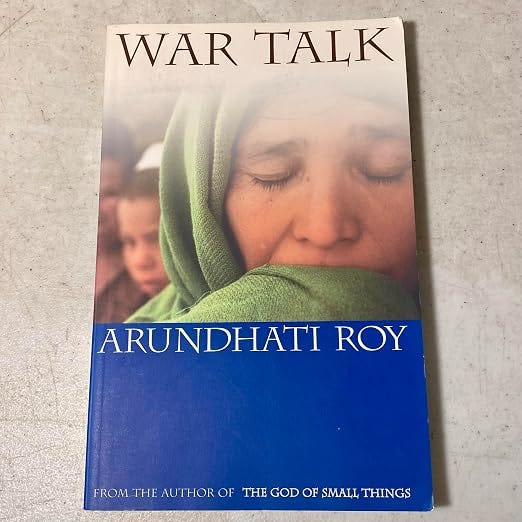
This is the original quote:
Another world is not only possible, she’s on her way. Maybe many of us won’t be here to greet her, but on a quiet day, if I listen very carefully, I can hear her breathing.
There’s a line that tends to get left out: “Maybe many of us won’t be here to greet her.” And it feels like a vibe-changer to me.
In Maybe We Could Pray Again, I’ve got a chapter called “Why Is It So Hard to Be Honest?”
It starts with a story about a time, in college, when I was tagged in a Facebook post with a slightly disingenuous caption. Something about how God miraculously healed my twisted leg.
(In reality, I pulled a muscle, some people prayed for me, and it might have felt a little better right afterwards but I was still several weeks away from a full recovery.)
From there I get into…all sorts of things that I’ll save for the book, for now. But they all circle around that question: Why is it so hard to be honest? And specifically, when it comes to prayer: Why is it so hard to be honest about what does and doesn’t happen when we pray?
Along the way I draw on the work of some Very Cool People, like epically tattooed Lutheran pastor Nadia Bolz-Weber, “Professor Crunk” Brittney Cooper, and disabled scholar Amy Kenny. And on some fascinating stories from the Hebrew scriptures, like that of Naomi, and of an unnamed widow at Zarapheth.
All this to say, I thought of that chapter when I realized something crucial and sobering gets left out of Arundhati Roy’s words in the way I usually see them quoted.
I went back and read the whole “Come September” essay (brilliant, by the way) and realized that this sobering thread is kind of the point. I don’t know that we can fully articulate the kind of world we long for, dream of, and hope to build together, until we fully acknowledge the kind of world we’re living in now.
Many of us, especially if we grew up in dominant US society like I did, were not taught the fullness of this reality. Thinkers like Arundhati Roy can help us see more clearly. They can help us become more honest about the hard things of our world.
In Roy’s “Come September” essay, for example, I learned about a whole history of what the date September 11th meant to particular groups of people long before the year 2001. So many historical instances of oppression, racism, imperialism, and betrayal, that underlie so much of the violence we see today. We were not taught these things.
To dream of the different kind of world who is on her way, we need to resist the urge—that is, the societally-imposed pressure—to bury our heads in the sand and deny the world that presently exists.
It’s often not easy, but we can be honest about our world as it is—and, still, we can listen, together, for that new world who is breathing.
We might not all be here to greet this new world. But we can carry our dreams for it together.
In this with you,
Liz
Comments
Nothing yet. Say the first thing.
Sign in to join the conversation.