
If I could bottle the feeling of a new project, I would never even put it on the market. I would hoard flats of it in my basement. It is my favorite time. It is a little bit like a crush; everything reminds you of it, you’re seeing things in the world you think it would like, you’re more open to the world’s mysterious gifts that seem to be everywhere, all of a sudden.
What if you could take all this material and shape it into what you’re making?
If you have ever seen something cool happening somewhere else and wished it could happen where you live – a club, a resource, a training, a gathering – hodgepodging is a framework for savoring what inspires you so you can make it your own (and shout out your sources along the way).
I never start from scratch and most people are lying if they say they do. This is okay! We are all always hodgepodging from life; the places we go, the experiences that linger with us, all the images we absorb.
When we make this process conscious, it’s like adding a steering wheel to a machine that you didn’t know you could control. Suddenly, you can amp up what you crave more of in your search, whether that’s reaching out to people to learn from or collecting inspiration across even wider apertures. You can give credit, thanks, and pour back into the well for the next lucky maker.
Today I want to make the practice of hodgepodging intentional, because doing so has made planning projects a wildly more pleasurable and fun experience for me. And I really believe meaningful community projects need to feel that way so we rush to work on them. We need to do whatever it takes to get started. Across this newsletter, throwing bingo nights and amateur dance classes, and now starting a space (!), I hodgepodge. And you can too!
The good news is that we actually know exactly how to do this, but we do it for things that aren’t as meaningful as community-building work. Clothes, home space design, shopping, menu planning. We know just where to gather inspiration, combine influences, mix and match our sources between the thrift and craft shop, the garden and the grocery store.
If I had to guess why this is, it’s because civic, activist, and other deeply collaborative projects tend to carry an aura of seriousness or roteness that feels baked in. We’re not able to have fun or dream big or get tangential inspiration because the solution is right in front of us, or the solution isn’t clear at all so we go as small and measured as possible until we sortof find it.
My colleague Michelle Lee runs an exercise called ‘Blast Off!’ when speaking to groups about play. It’s a quasi-meditative warmup where participants are asked to close their eyes, blast off to space, and return to earth. We then discuss what we saw and did while “away”. When doing the same exercise, children have trouble being called back. They hang out in space for as long as possible, checking out the terrain, high fiving aliens, and, you know, exploring what’s out there. Adults tend to make quick work of their trip; they go up to Mars or the moon, take a look around, and plummet right back down.
A similar effect happens when planning projects, especially when they’re boring (meetings, volunteer groups) or about heavy themes (climate collapse, state violence) or are intimidating, maybe because it’s our first time attempting something like this, there’s tension in the group, or we feel we have to act a certain way to be taken seriously.
But what if all this could be inspired, surprising, and expansive too?
There are a few stages I try and hit at every moment in my hodgepodgery:
Collect examples from everywhere
Learn how things actually work
Riff on it to make it its own thing
Give credit + show your work
A note: The content in this piece mostly relates to projects that touch people in our neighborhoods, towns, and relationships because *looks around at newsletter* but I really believe you can apply this to any sort of creative work or personal project. Plus, we all know that flexing your free will on literally anything makes you more of a high agency person which has helpful spillover effects for you and everyone else.
Let’s get to it.
Everything can be an example if you want it to be! Sure, maybe you already save the odd color palette or flyer design, but have you ever thought about every other type of material out there?? If someone made a creative choice about something, you should pay attention to it.
You can draw inspiration from:
Manifestos and philosophies
Spatial layouts
Logos
Names
Gatherings and rituals
Cultural artifacts like group agreements or name tag storage
Merchandise
Signage and instructional posters
Bylaws and documentation
Objects or structures
Materials and textures
Smells!
Language and tone
Models of support, like membership or fundraising
If you’re planning a gathering, borrow your favorite games and openers from other things you’ve gone to. If you’re building an archive, look to your aunt’s unintelligible recipe storage methods and your local libraries and niche wikis.
It’s especially fun to borrow from things that have nothing at all to do with what you’re planning. This is sometimes known as ‘analogous’ inspiration. You can zoom out to really broad levels of tone or theme or energy if you’re feeling big. Soothing projects might benefit from a visit to a spa or zen garden or sound bath. An educational project might learn a lot from board game instructions and rock climbing gyms to see how people approach new problems.
When working on a talk show style project recently, I collected as many tropes and segment ideas that I could think of from everything I’d ever seen. These examples came in handy when the co-op was asked to record a segment for a new public access TV show (it was a real fake tv show-y few months for me over here).
It created huge territory for us to start from, and ultimately ended on a riff of an educational program “teaching” “kids” about “bike safety.”


Collect examples as screenshots and pictures and copied text and links and thick stacks of pamphlets and flyers and postcards you squirrel away in your travels. Throw them in a digital garden or doc or get them printed up for your wall. Start a text thread with friends and drop in random stuff that feels like it’s about the same thing even if it all feels really disparate.
If you are working with collaborators or trying to explain the vision to people who want to support your work, these examples can make more sense than just talking about your idea in the abstract. You might just be too inside of it or the thing itself might be too new and weird to do justice through words alone. You can share a picture or website or snippet of text from an example that inspires you and say “sort of like this” and maybe they’ll say “ah!”
“Ordinary things will be signs for us.”
Once you’ve got a nice spread of inspiration, it’s time to dig into what you won’t learn from image or text alone. This means learning how things actually work.
You can do this by going one level deeper in a way that usually involves either sleuthing or bravery. You want to get behind the scenes. It can look like getting into documentation or blogs or interviews and podcasts, or actually reaching out to people who created or participated in the things you’re interested in and learning from their experience.
Even better, obviously, is if there’s already a toolkit or how-to out there from a project, like everything on Shareable.
As my friend and I are setting up this new gathering space and thinking about how to financially sustain it, my conversation with Alexis about Local Economy’s membership structure set off more possibilities in my head than just looking at their website. Then we looked for other examples that were more formal – like a straight-up coworking space or gym – and dug into their membership agreements. We’re also pulling in our own individual experiences as donors or sustainers of projects and orgs: noticing what software they use, how they treat different levels of engagement, and how we feel about all of that ourselves as human beings supporting things.
Whatever we decide on won’t replicate any of these models, but will shape something new and deeply informed by all of them.
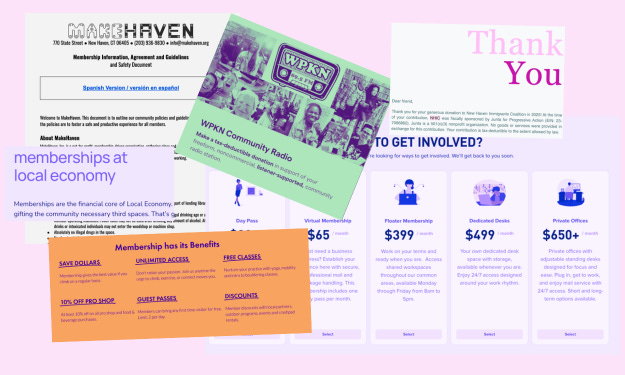
There might be a ratio here that you can play with, something like: direct examples / analogous inspiration / your own experience / random scraps of things you see.
A legendary example that I am not suggesting you do: When The Onion first got started and had no idea how to price or sell ads, they wrote to every newspaper they could think of asking for their media kits. They only got one rate card back from The New Yorker, which they whited out the name of and added their own. This is how they began to sell ads, using how it worked for someone else.
I think the art of the model mash up – and what makes it not a direct rip – is about five general types of creative dissection. You might borrow from:
The basic structure of whatever it is – a style of training, a type of gathering, a fund, a resource
The tools used, like software, platforms, or whatever enables participant experience
The forms of support that sustains something, like membership, alternative pricing structures, forms for community engagement like volunteering or collaboration
The way they communicate about themselves through messaging, content, look and feel
The themes or overall feeling, like if it’s freaky and silly, or studied and rich, or joyful throughout. (I feel like this is why people are so drawn to the work of organizers like Warm Cookies of the Revolution; they demonstrate another way this work can feel.)
A great example of this lately that I love seeing is through microgrants with a civic focus. Even though the basic format – amounts of $50 or $200 for neighbors getting together with neighbors – is the same, organizers all over the country make it their own. Boston funds block parties. Vermont is funding “long-handled spoons” dinners. Charlottesville supported gatherings in neighbors’ homes. Some of them share the same tech or basic frameworks for communicating what it is, but each program curates its own totally specific experience for their local realities.
Borrow what makes sense to you and your context and leave the rest.
Again, hodgepodging is not a euphemism for ripping people off. It’s about learning from the vast amount of resources out there and adapting for your own use. Riffing is the most creative, generative stage of the hodgepodge.
Like I mentioned, I wouldn’t just take the membership model for a gym and make it my own because that’s not the context I’m creating for.
Riffing = what sticks in your brain + what you learn about your context + what you (and your collaborators) are excited to do/are good at.
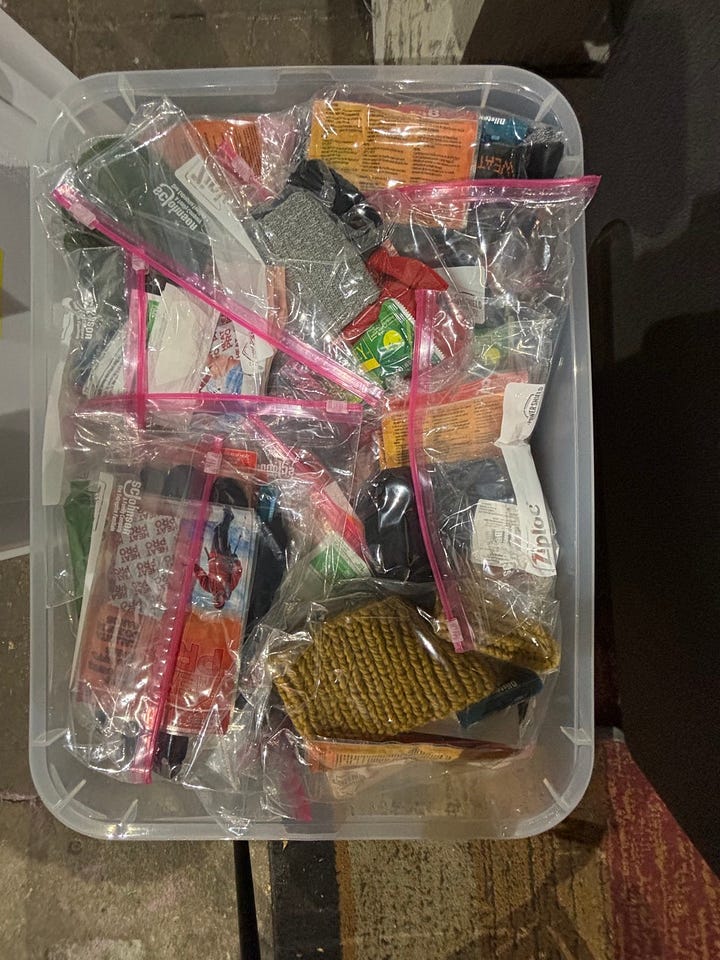
When inspired to put together warming kits last winter, the ease of the format suggested in this #Warm4Holidays toolkit by Mariame Kaba stuck in my brain as well as emailing with other organizers who host a monthly free market about where they source their stuff. I learned about my context by talking to a librarian friend, fellow volunteers at the co-op, and people who are unhoused that I know through the co-op. I was personally excited to keep it light and collaborative and messaged friends to throw $5 my way for materials. We assembled the kits at a co-op volunteer night together, and then dropped them off at the library for distribution and kept half for the co-op to share.
Another organizer might have gone about this totally differently; that’s the art of riffing, people!

The myth of the lone genius exists everywhere and disturbingly more and more these days in the realm of community-building work. (This is deserving of its own post because it is so deeply weird to me.) But there is an antidote to this, and the antidote is giving thanks and showing your work!
First, repeat after me: it’s a beautiful thing that you didn’t come up with this on your own. Nobody ever does! The real legends are those who choose to make this clear.
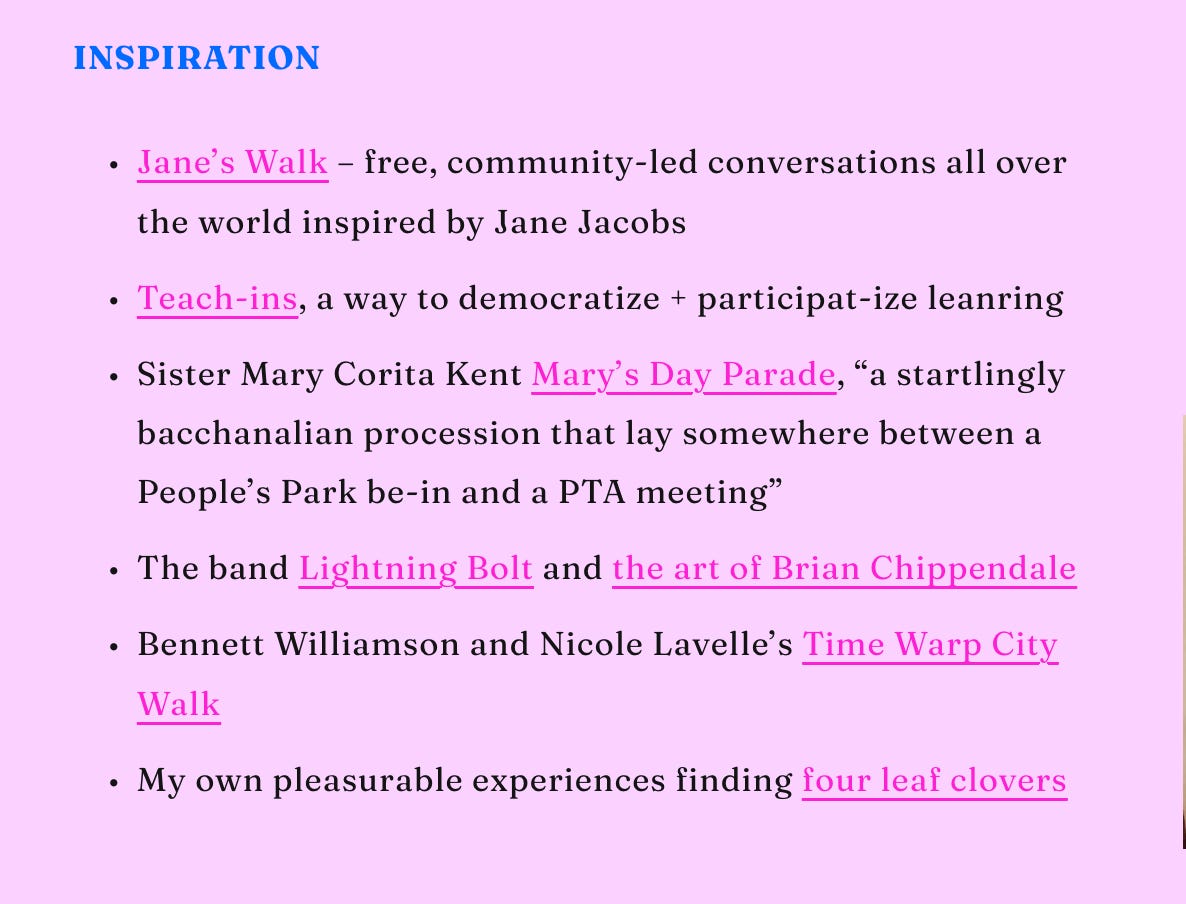
There are so many great ways of giving credit. You can create book lists of your muses and compile links and names to send people off to. You can footnote and add an index of references on the last page of your zine or on its own page on your site or on a sign hanging up in your space. You can talk about your inspiration and similar projects whenever you talk to anyone about your own. You can thank those who inspired you and show them what you made. As I’m trying to get better at archiving my work, here’s how I shared the inspirations for an event I hosted called WALK PARTY:
Hodgepodging means your project isn’t an exact replica of anything else, so this is also a great way to send people off to things that might be more on their level if your project isn’t exactly it. If you’re starting a calendar in your neighborhood, for example, point people to other resources across town that inspired you along the way.
Even better, you can show how the magic got made by showing your own work. Maybe this takes the shape of a toolkit or how-to, but it could also just be as a reflective essay or zine detailing your creative process.
When we reveal our inspirations and back-of-napkin process, we pay forward the gift that brought our own work to life.
I believe when our community projects feel pleasurable and surprising to plan, the end experience is better, which sets off waves of more actions, more meaning made, and more inspiration for the next person.
We’re forever riffing off each other. We’re coming up with better ideas because we’re not starting from scratch. We’re making something genuinely interesting because we combined something we saw at the gas station with a song that moved us in a singing circle with a throwaway joke one of our friends made.
Happy hodgepodging – I would love to hear what you try along the way.
#hodgepodgeyourproj
or simply click that ₊˚.⋆⁺₊💜₊˚.⋆⁺₊ at the top if you indeed liked it, we always appreciate that here at group hug hq!! love to you allp.s. Soft launching a new GROUP HUG look today thanks to the iconic work of my dear friend Zach Hobbs!! More to come here, but so grateful to Zach and his process which is also hodgepodgey as any of us could hope to be. Hit him up!
💸 If you enjoyed this, consider dropping a buck in the GROUP HUG hat! This is an alternative to paid subscriptions to pass support from this newsletter onto groups in my town which I clearly draw all of my inspiration from.
Comments
Nothing yet. Say the first thing.
Sign in to join the conversation.