

In both of the recent interest rate hiking cycles, there has been a strong pushback from left-wing writers and activists against the RBA for more or less doing their job.
I think that the RBA decisions since 2022 are largely justified on the macroeconomic merits and delivering on their bipartisan, agreed-upon mandate with the Labor government - if not erring on the side of dovishness!
But I want to put forward the apparently counterintuitive case for higher interest rates from a progressive point of view leaving economics to one side.
The cost to capital
That brings me to what I think is the first and most obvious way higher interest rates can improve equality: they push down asset prices.
The very first price reaction to an interest rate rise is a fall in the stock market. And who owns the stock market? The wealthy! Ownership of the ASX200 is overwhelmingly dominated by the wealthy elite. A rising interest rate, and thus a falling stock market reduces the wealth of the Australian top 1% an outcome that should be celebrated by Australia’s socialists.
It also leads to lower house prices. Obviously, this is bad for the homeowner. But for the renter, it can be a net positive. Higher interest rates mean house prices are marginally lower, and the interest rate renters receive on their savings account—which they’re often using to save for a house deposit—is a little bit higher. Indeed this impact is far stronger for the top end of the market than the bottom.
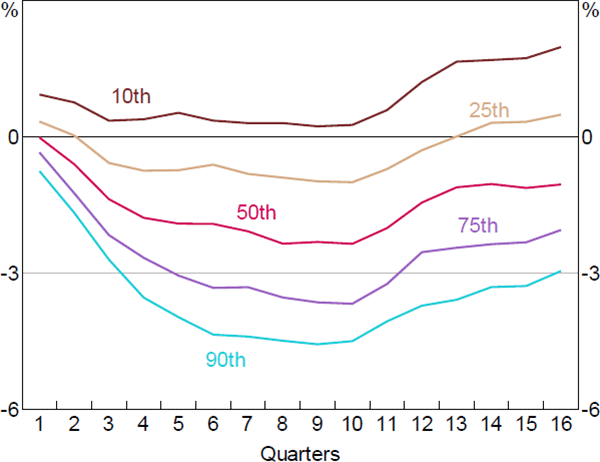
Higher interest rates send expensive homes tumbling in value far more than those at the bottom end of the market (see this chart below He and La Cava 2020). Even within the class of homeowners higher interest rates compress the housing market and reduce wealth inequality.
The same is true for elderly pensioners who keep their savings in relatively liquid, low-risk interest-bearing accounts. Phil Lowe once remarked that used to receive lots of correspondence from elderly pensioners who would decry every interest rate cut as a direct cut to their income. When rates are near zero, a lifetime of careful saving can be punished.
While the bulk of households are homeowners, many of the poorest people in our society are renters and pensioners. And these groups can often be made better off by higher interest rates.
The second quickest price to move—alongside the stock market—is the value of the Australian dollar. Higher interest rates generally mean a stronger Australian dollar, which is good for those who consume imports and costly for those who export.
Clear empirical work is hard to find, but I suspect a strong Australian dollar benefits lower income Australians more than it hurts. Australia imports many essential goods: medicines, fuel, and basic household appliances. A stronger dollar makes these things cheaper in Australian dollar terms.
By contrast the people who benefit from a weaker dollar and stronger export competitiveness tend to be those employed in export-heavy sectors—particularly mining—and those who own the firms involved. These groups are disproportionately represented at the upper end of the income distribution.
Who borrows the most money and is most threatened by higher interest rates?
Highly leveraged property speculators! The antithesis of hard scrabble renters.
And of course, if you think quantitative easing is an inequality-increasing bailout of the financial sector, then higher interest rates are essentially the exact opposite of QE—and so, at least in broad distributional terms, they should tend to have the opposite effect.
In other words, if you want to look at interest rate hikes not just as a macroeconomic stabilisation tool but as a distributional force, the politics start to look a little more complicated than the standard “rate rises hurt the poor” narrative.
Yes, higher rates hurt borrowers. Yes, mortgage holders feel it immediately. And yes, rate rises are not some kind of moral crusade or a substitute for structural housing reform.
But it is simply not true that low interest rates are an unambiguous win for ordinary people. Low rates inflate asset prices, reward leverage, and disproportionately benefit those who already own property and financial assets.
Higher rates, by contrast, reduce the value of those assets, strengthen the dollar, raise returns to savings, and put pressure on speculative borrowing. And those effects—at least on the margin—shift the balance of power away from asset owners and towards everyone else.
This is not to say that this is the optimal way to think about interest rates. But it is a reminder that while the distributional impacts of monetary policy are real, they are far more complex then is often assumed.
No posts
Comments
Nothing yet. Say the first thing.
Sign in to join the conversation.