
APRA has announced new restrictions on high debt-to-income (DTI) lending, designed to constrain what it views as riskier loans that could threaten financial stability. Before diving into the details it should be acknowledged that this is the absolutely the correct arm of macroeconomic policy to use. If highly leveraged households pose systemic risks, macroprudential regulation—rather than interest-rate policy as occurred prior to the pandemic—is the right tool to respond.
The RBA has made it clear that it is no longer going to adjust interest rates in direct response to developments in the housing market or household leverage. Housing-related financial-stability concerns are no longer part of the cash-rate reaction function. That job rightly sits with APRA. To the extent that we now have the appropriate institution targeting the appropriate risk, that is a welcome development.
But do these new restrictions make sense on the merits? Because they come with real costs. Some households want or need to borrow at higher DTI ratios for example households where one member is temporarily not working (say they are caring for a child) but they want to buy a larger home (to provide a bedroom for said child). Some will now be unable to do so; others will only be able to borrow at higher rates. Macroprudential tools are not free.
A Solution in Search of a Problem
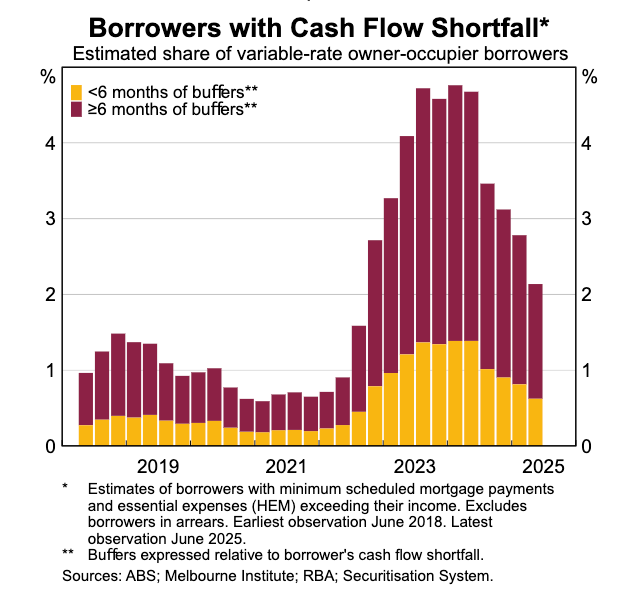
This is why I was surprised by the announcement. In its most recent Financial Stability Review, the RBA painted a fairly reassuring picture of the mortgage market. Borrowers’ cash-flow buffers—though below their COVID-era peak—remain far higher than before the pandemic.
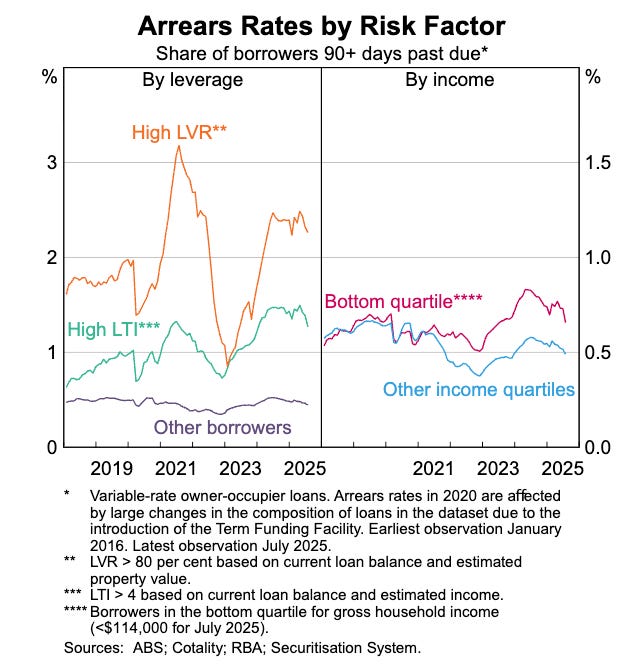
Default rates are slightly elevated but trending down.
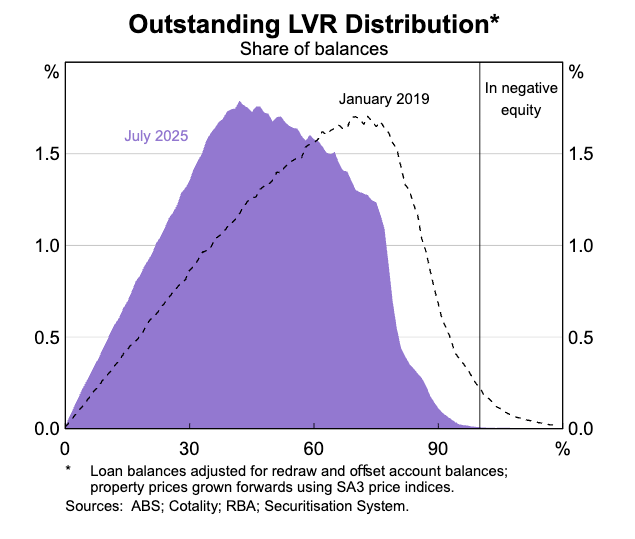
And most households hold substantial positive equity, such that even forced sales would rarely translate into losses for them or for their lenders.
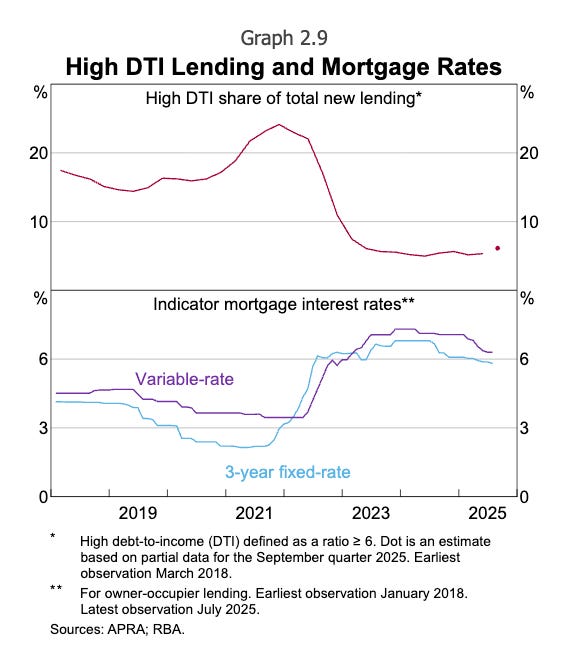
Most curiously, high-DTI lending—the very segment APRA is targeting—is at exceptionally low levels. Before the pandemic, roughly 15 percent of new mortgages were issued at high DTI ratios. That share surged above 20 percent during the era of record-low interest rates. But today it sits at around 6 percent. Even with a recent uptick in investor lending, the aggregate share of high-DTI loans is nowhere near alarming.
The new rules cap these loans at 20 percent of all lending. Right now, investor lending—the segment growing fastest—has only about 10 percent of its new loans in the high-DTI bucket. Some individual banks may push closer to the limit, but the system as a whole is nowhere near the point at which the cap bites.
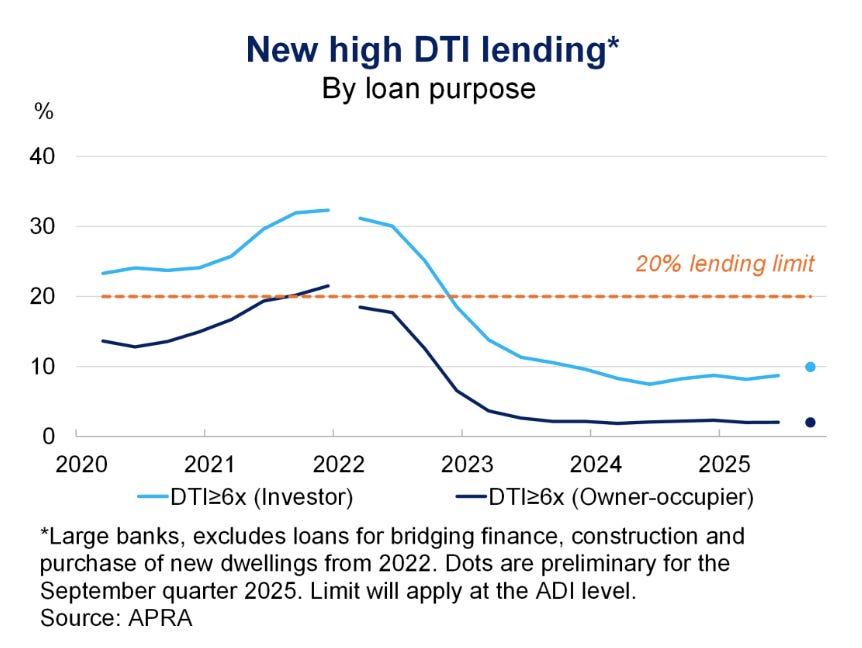
In other words, these new restrictions largely do not constrain anyone at present. But they would have certainly bound during the pandemic - especially for investors.
Credit Constrained Counterfactual
This naturally raises the question of whether we should have had these rules in place earlier. If the 20 percent cap had existed in 2018, it would have been binding during the pandemic. But would that have improved outcomes?
It is genuinely unclear. Ex-post we know that Australia did not experience a mortgage-driven financial crisis during the pandemic or in the years since. But was this the result of good policy (which suggests we don’t need to tighten credit supply) or good luck?
Certainly, if you were trying to design the perfect conditions for a financial crisis, the COVID-19 housing boom is a pretty potent mix.
You start with a sudden, massive shift in housing demand—everyone wants more space, more spare rooms to work in —which is persistent but not permanent.
You drop interest rates to near zero.
You inject the economy with large, temporary stimulus payments.
Households therefore have a sharp, partly transitory surge in demand for housing, plenty of cash to bid up prices, and unusually easy credit conditions to leverage themselves further.
Then, in a very short period of time you get to
4. Interest rates rise extraordinarily quickly—far faster and far higher than anyone expected—while unemployment begins to increase .
5. House prices fall dramatically as a result.
It is a potent combination. High leverage, surprise interest rate payments and a sharp run up and run down in house prices. If you told this story to an economist in 2019 they would have been reasonably concerned about defaults rising and the financial system being at risk of large losses.
Of course they would have been wrong. Per the RBA “(Non-performing loans) remain small relative to banks’ capacity to absorb losses. NPLs as a share of credit … has increased modestly since the 2022 low to 1.2 per cent in June 2025”.
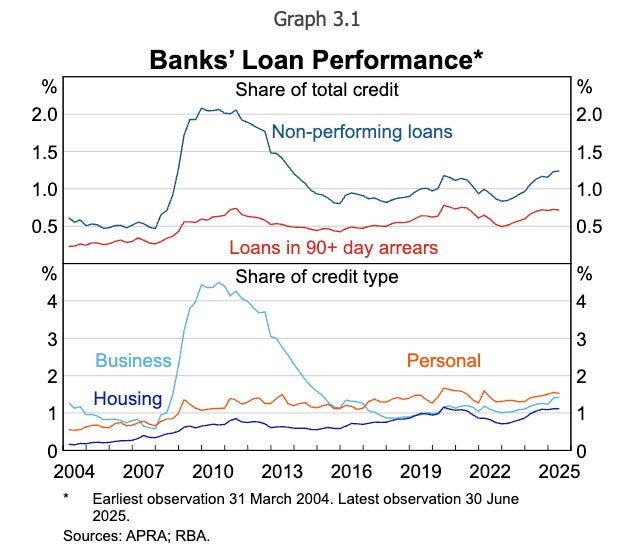
Of course, things could have been worse. If the housing boom had been driven entirely by leverage rather than by income support from governments, the risks could have been higher. If far fewer mortgages had shifted to fixed rates during the pandemic, the sharp rise in interest rates might have had a much more simultaneous and destabilising effect. And if unemployment had increased substantially the financial pressure on households would have been far greater.
Even so, it was a toxic mix from a financial-stability perspective. And yet not only did we fail to see a spike in mortgage delinquencies in Australia; we didn’t see such a spike in any comparable country exposed to similar shocks. This includes countries like New Zealand, which experienced a much larger increase in the unemployment rate over the post-pandemic period.
My takeaway is the case for tighter macroprudential rules is at best unproven. More optimistically, perhaps the Australian Financial System is just more robust than we thought! The double trigger hypothesis (the idea that households need to both lose their jobs and have negative equity before they default on their loans) seems like a pretty strong barrier to widespread default.
Mixed Messages
There are two possible reasons why you might want to introduce new credit restraints:
Short-term risk mitigation: APRA believes current data mask a meaningful near-term financial-stability risk and wants to act preemptively to head it off at the pass.
Long-term structural policy: APRA wants these rules in place for the next decade or two , to prevent the next low-rate boom from producing excessive leverage.
But APRA’s consultation letter does not clearly choose between these. It cites short-term trends—labour-market strength, the possibility of falling interest rates—that latter is already somewhat dated, while simultaneously emphasising that the cap is unlikely to bind in the near term and will not affect borrowers’ access to credit.
It also exempts new builds, which is at odds with both rationale. If you are concerned about financial safety does it really matter if investors are defaulting on new or existing homes?
The explanation is internally inconsistent. Are we worried that people are borrowing too much now? In which case the caps are largely useless as they will only bind one or two ADIs today at most. Or are we worried about the next unexpected run up in credit in the medium term in which case why focus on current conditions?
Perhaps a more cynical justification for this policy is a way of trying to squeeze investors out of the market on the margin. They have much higher DTI ratios in general and would be the first part of the market to be bound by the regulation should credit growth continue to expand.
I do not see a strong case for these restrictions—at least not the one APRA has articulated. A more persuasive argument would require a deeper analytical foundation. One could, for instance, build a lifecycle model that weighs the welfare consequences of restricting high-DTI borrowing across different states of the world. Or estimate how binding DTI caps interact with interest-rate cycles, labour-market risk, and forced-sale probabilities. APRA has not attempted anything like this.
Instead, what we have is a policy that currently solves no active problem, justified with only superficial evidence, and introduced without a clear explanation of what risks it is meant to address or how binding it is intended to be.
The restrictions may be harmless in the near term. But harmless is a low bar. For macroprudential policy to be credible and effective, it needs a compelling rationale grounded in data and theory—not just a desire to “do something” after a stressful few years.
Right now, APRA has not provided one.
No posts
Comments
Nothing yet. Say the first thing.
Sign in to join the conversation.