

Thank you all!!
It is the day before Juneteenth, summer 2026.
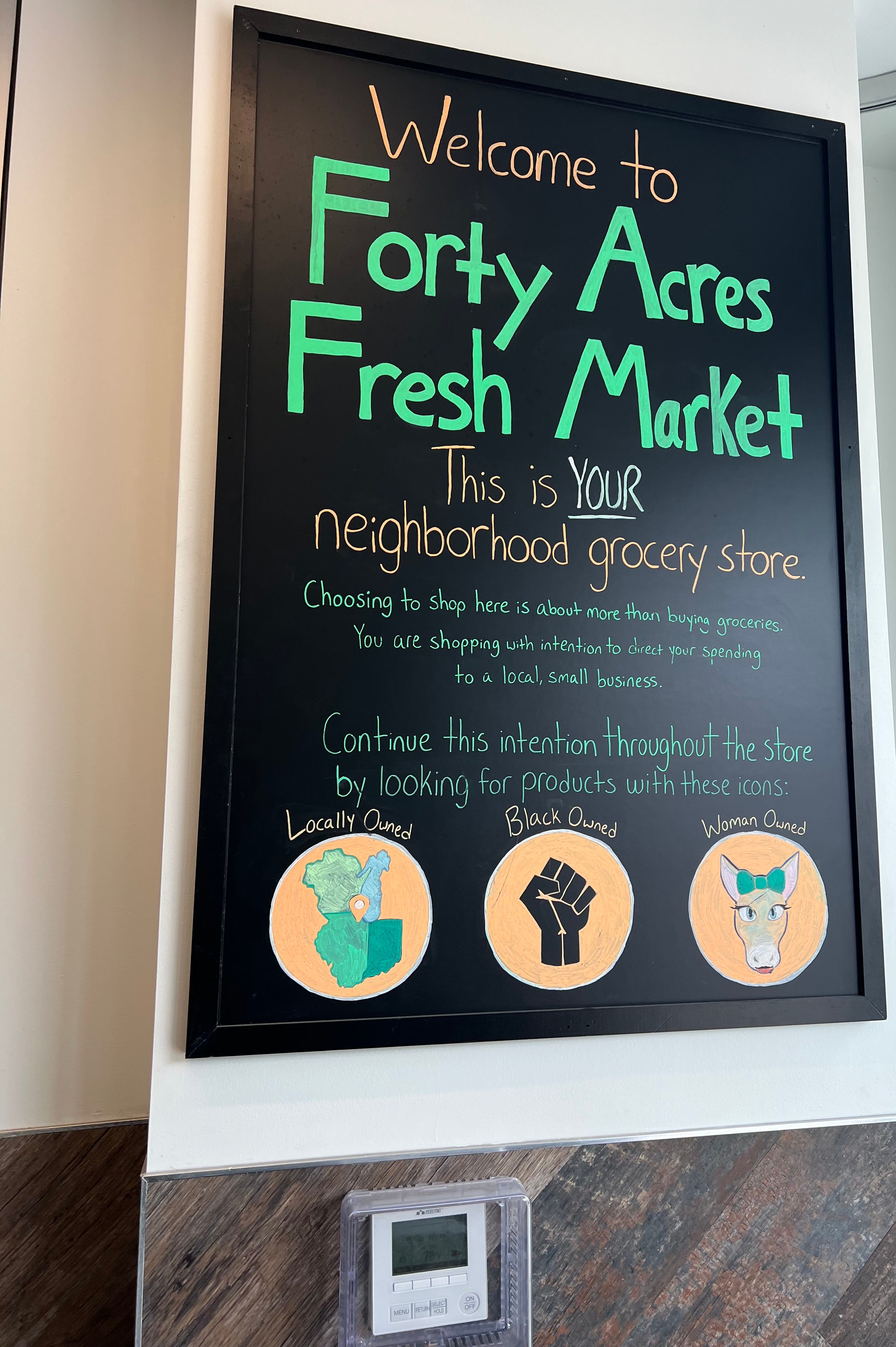
The storefront design is modern, cool, stylish. Big city but not showy. The welcome signage is blunt:
Welcome to Forty Acres Fresh Market.
This is YOUR neighborhood grocery store. Choosing to shop here us about more than buying groceries. You are shopping with intention to direct your spending to a local, small business.
Continue the intention throughout the store by looking for products with these icons: Locally owned, Black owned, Woman Owned.
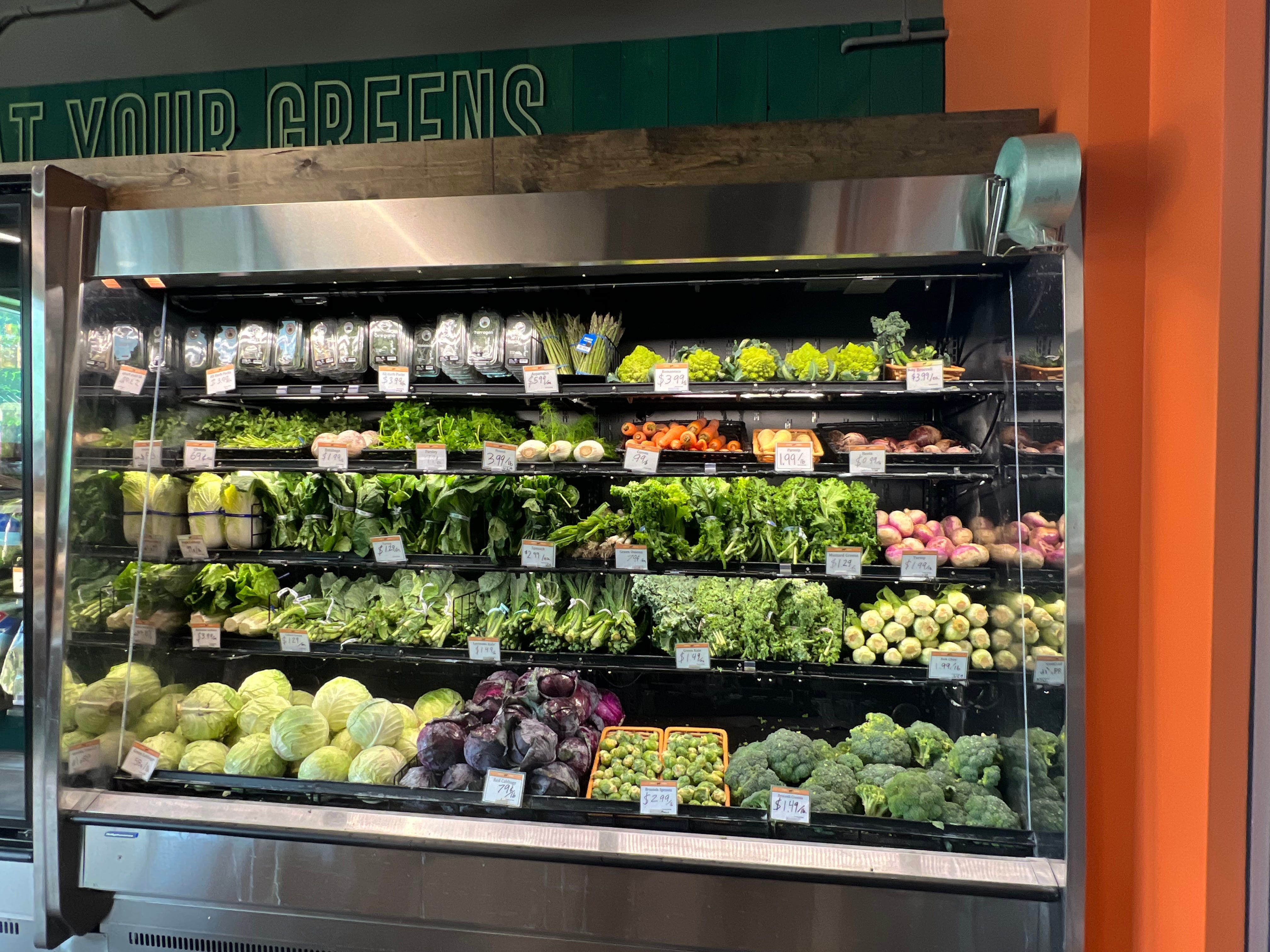
Punchy, direct, articulate, intentional, like verse 2 in that Kendrick Lamar joint, Forty Acres Fresh tells you like it is, and shows you how it should be. The store opens into produce, the wet rack packed to the gills with fresh greens and herbs, heads of green and purple cabbages, thick bundles of collards and turnip greens, brussels, mustards, broccoli, brassicas galore, plus a shelf of loose carrots, turnips, parsnips, bunches of asparagus on the top shelf adjacent to the spiral fractal’d romesco cauliflowers, the prices down to earth, .99 a bunch here, .79 there, 1.29 or $1.49 each, accessible and affordable, stock pot or sautee pan not included. The chilled produce set is likewise competent, 2 pound bags of carrots at $2.49, ears of corn, 3/$1.99, ripe melons for $2.99 each. The department is direct, straight to the point, no bullshit, a lot like the owner, Elizabeth Abunaw.
Liz is a unicorn of sorts. An owner-operator, working the retail floor most days. A black woman, a grocery CPG veteran who cut her teeth in sales at General Mills, then did a stint in tech. But the calling to feed the people, that painfully tempting siren song of retail, lured her back into the game, for better or worse (and some days worse than others), to here in the Austin neighborhood on the West Side of Chicago, the windy city, City of Big Shoulders, gorgeous lakeshore beaches and inedible pizza. A black women who owns a grocery store.
Let this sink in. Less than three dozen grocery stores in the U.S. are black owned, a startingly stark statistic the result of several historical trends: the end of Jim Crow apartheid and economic segregation that ran headlong into the deindustrialization and de-skilling of urban America that in turn kneecap’d the Black working class just as it was getting its sea legs, with the intergenerational poverty, the constant drug trade and state-sanctioned violence faced by Black communities, alongside redlining, gentrification, and the end of the social contract between America’s rich and poor, on top of systemic barriers to accessing capital and financial resources. Black Lives still Matter, yes, not up for debate. Black grocers? Tenfold so.
On top of that, the Chicago grocery market is an odd one. Chicago has its share of stellar indies. But the top 3 operators, Albertsons (Jewel), Walmart and Costco add up to over 55% market share, a textbook case of oligopoly. According to data from Chain Store Age, the top 7, inclusive of Kroger, Target, Whole Foods and Meijer, add up to over 75% share. Everyone else, including those stellar indies, get the leftovers. Unsurprisingly, none of the top chains have locations in the vast, mostly Black, Austin neighborhood, including Whole Foods, who ignominiously closed their underperforming Englewood store on the South Side just a few years after a big opening fanfare.
Meanwhile, the meat case follows the same pattern as produce. Moderate inventory cash outlay, the meat is all cut fresh, bright red, each filet neatly trimmed and laid out on green paper, the prices in the market range, with a full service butcher on staff to talk to and assist customers, whom they know by name. Next door is a modest cheese case, nothing spectacular, just modestly priced, modestly assorted Bel Gioioso, Sartori, Alouette, Divina olives and various feta cheeses, a punchy lesson in specialty 101, this is all you need to get started, don’t overcomplicate it and don’t price gouge, even for the moderately good stuff.
Liz knows her customers by name. She holds court in the space between meat and produce, in front of a row of bulk grains, legumes, nuts and snacks. Liz shares inside jokes, neighborhood gossip, small talk and personal stories with customers as they come in for their shopping, stopping for a conversation with Liz as much a part of the experience as checking out. This community building is as much a part of the retail experience as what they buy, what they spend.
It’s not an easy climb. Forty Acres Fresh has just been open a few months and word is still getting out. The Austin neighborhood is a textbook food desert, an All-American icon of food apartheid in the heart of America’s Second City. Austin is Chi-town’s third largest neighborhood, with over 95,000 residents in just a few square miles. Austin is almost 90% Black. The median income is lower than the South Side, at under $50,000. There are pockets of prosperity, with a sizeable professional class. Chicago’s mayor lives around the corner. He doesn’t shop there (yet), but his security detail does, and Liz knows them all by name.
The Austin neighborhood has just a handful of full service grocers for all those people, 3 or 4 depending on how you measure it, and they are spread out across a vast area, not walkable most of the year because of distance and because Chicago weather is truly horrendous. Forty Acres Fresh is a veritable oasis, a lifeline, a go-to for many, many blocks around, as GIS data from ILSR shows:
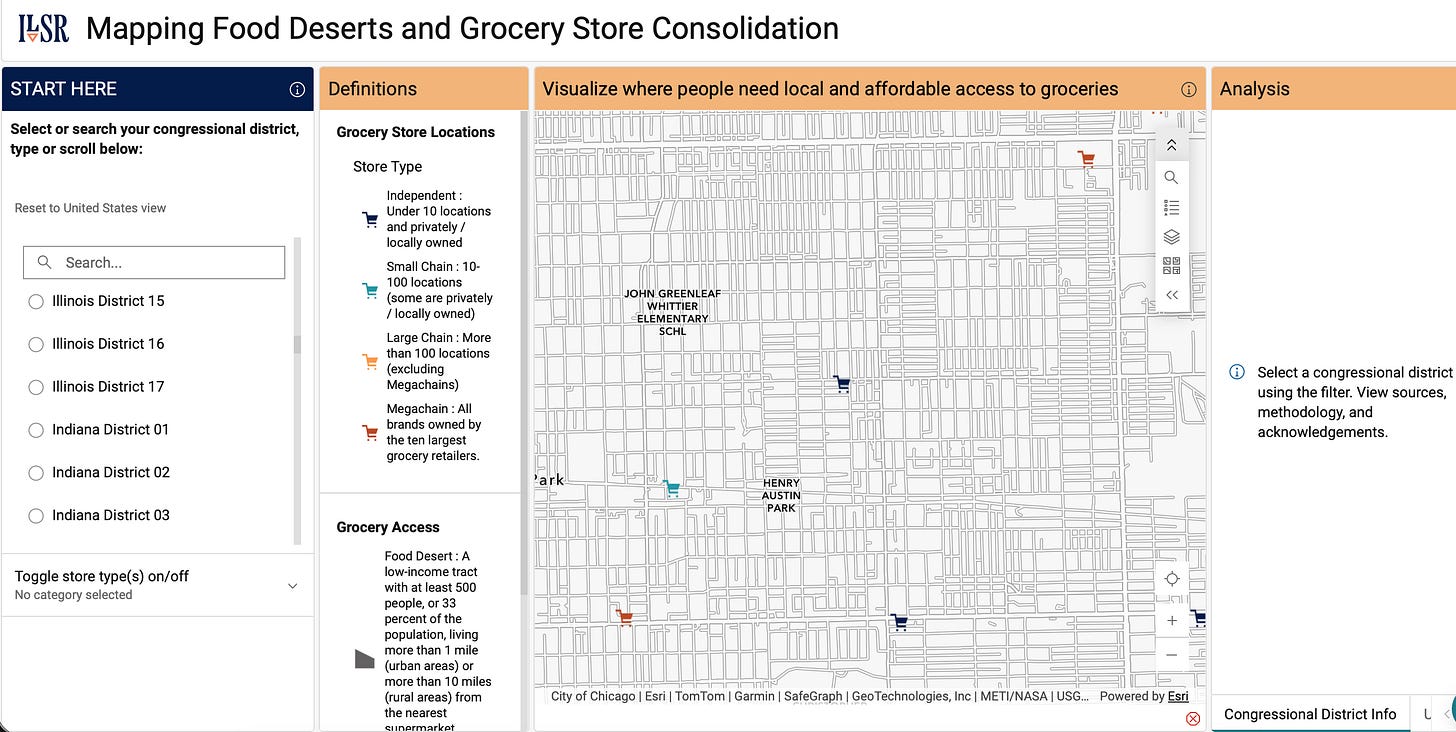
But they are having trouble getting folks into the store so far, despite efforts at marketing and advertising and community outreach.
It’s not surprising. Retail is habit forming. Shopping is habitual. It needs to be in the routine. Routines take time, repetitive conditioning required to build retention. Forty Acres is a baby store, just a few months old, still not even potty trained, still hasn’t even hit their J Curve, that 18 to 24 month timeframe when the collective unconscious wakes up to their latest retail option after months of day in/day out retail execution and grinding it out as sales just barely scrape by and turnover is relentless and everyone is losing their minds and then the sales all of sudden hit their post-pubescent growth spurt and no one can keep up with the volume and customer count skyrockets and incipient demand that was there all along, you just had to keep executing every day until it sunk into enough peoples’ thick fucking skulls that this was their place to shop. Time and time and time again, grind it out and then one day it just explodes and you can’t keep up. But that is still far off in the future, while Forty Acres is still eponymously tethered to the past.
Maybe it’s the Forty Acres conundrum. Named after the post-Civil War broken promise, originating from Union General William “Tecumseh” Sherman, to allot forty acres and an Army surplus mule to formerly enslaved Black people along a 30 mile wide strip of fertile coastal land between Charleston and Jacksonville, in order to encourage independent farming and self-sufficient communities, a radically reparative Homestead Act of sorts that was soon overturned by Confederate sympathizer President Andrew Johnson, who promptly returned the land to the former slavers, who in turn violently and enthusiastically evicted their former slaves and ushered in the Jim Crow era for the next 75 years.
While the Forty Acres broken promise has taken on almost mythological proportions in the Black imagination (see Spike Lee, or that Kendrick Lamar joint) it underscores one key point on why it is so meaningful. This economic self-sufficiency goes hand in hand with the community efforts needed to sustain it. Liz gets that. The store is executing the vision, even with high staff turnover. It’s just not an easy climb, against 150 years of broken promises after 400 years of chattel slavery. Even with the need so great in the neighborhood, getting the community on board is key.
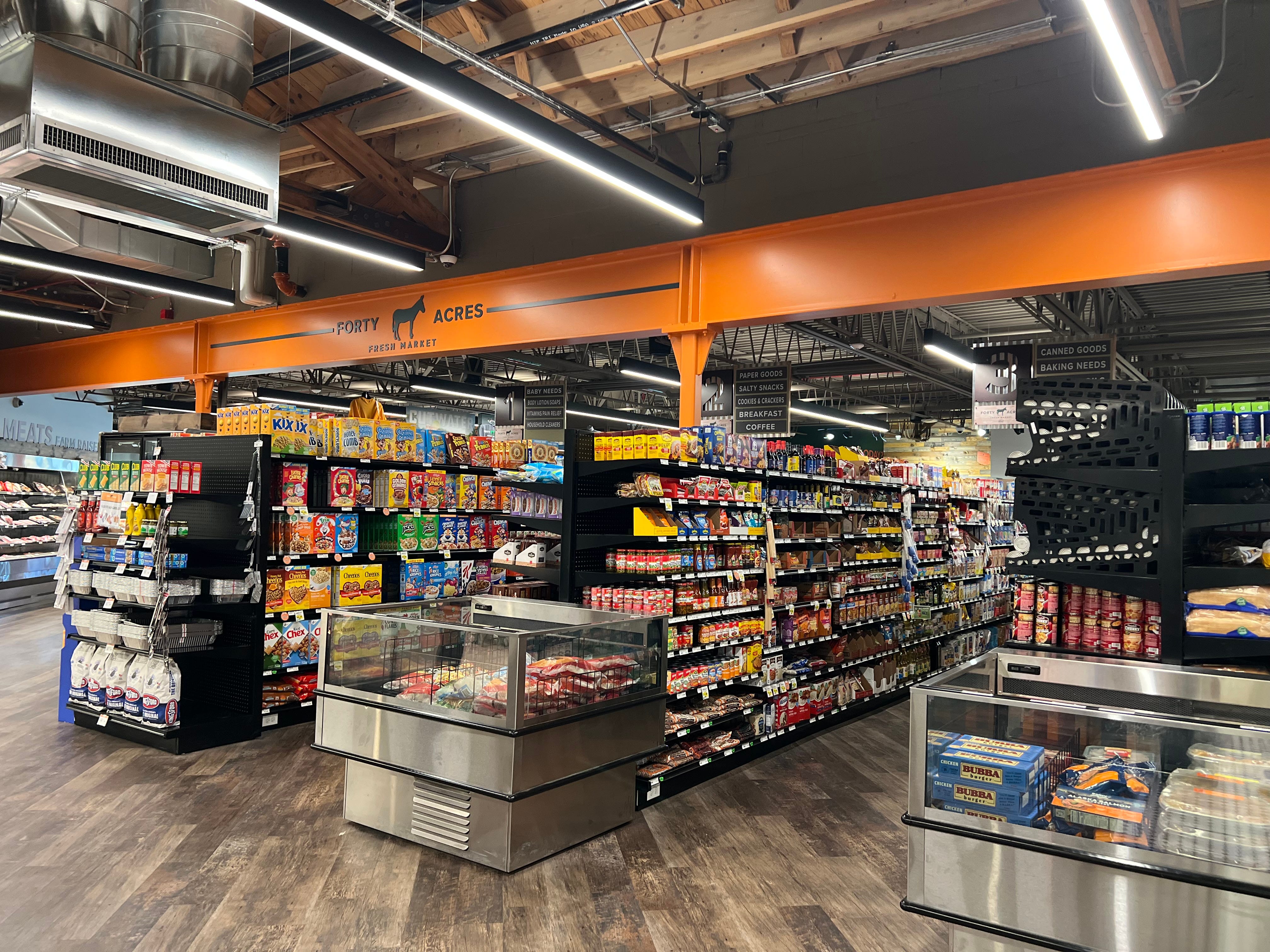
Like all grocery stores, most of the shelf real estate is ambient, frozen and dairy processed foods, the grocery aisles, the consumer packaged goods monolith that Liz came from. Each aisle is a work in progress, the plannograms still a bit haphazard but adequate, balanced between mass market CPG brand names and store brand private labels from TopCo, mostly supplied by Wisconsin wholesale cooperative Certco, who sharpened their distribution skills through their business with Midwest indie icon Woodman’s, but who also works hard to support scrappy indie operators like Liz with a full range of pantry goods at competitive prices.
To wit: TopCo Food Club pasta, $1.79 a box, Creamette pasta on sale for $1.59 a box, Food Club canned vegetables, with a WIC Approved shelf tag, .79 a can, Bush’s beans $1.79, Food Club equivalents $1.39. It’s a work in progress, but it’s a competent, and competitive, start.
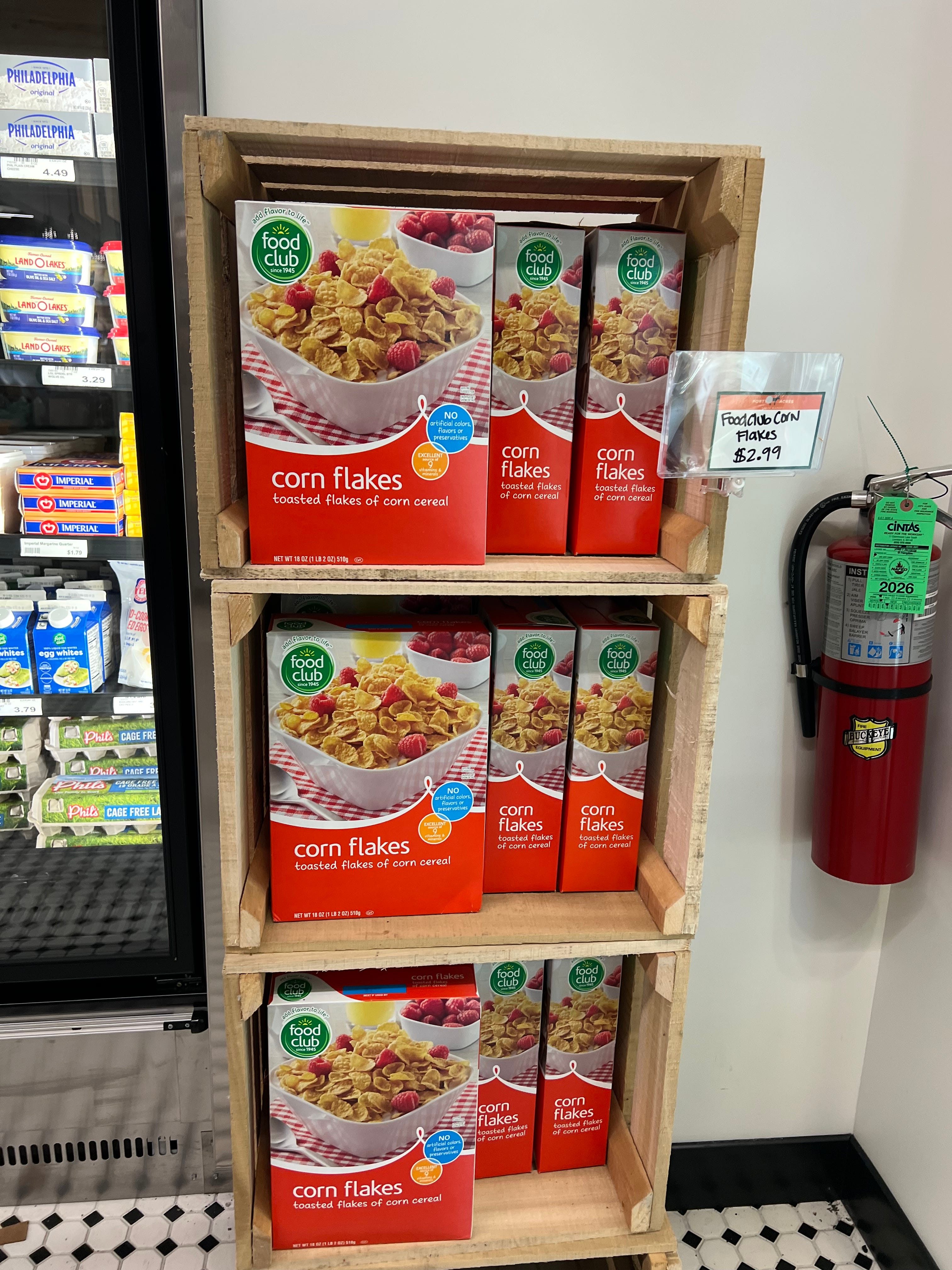
The Certco/TopCo/Forty Acres 1-2-3 punched reaches its apotheosis simply and understatedly with a crate stack of $2.99 Food Club corn flakes for 18 oz boxes. Yes, $2.99, for ultra processed breakfast cereal, in 2026, in Chicago, at Forty Acres Fresh Market. Free market miracle? No, just competence, due to a formula of this: a cost to serve wholesaler that serves indies, a modest in store markup, skilled labor, plus three wooden crates. Retail is not rocket science. Ockham’s razor. Keep it simple.
Liz is not a moralist. Hence, two racks of Bimbo’s best, a full range of dayglo, hyperpalatable Taki’s for the ADHD taste buds, as well as a cardboard shipper of their Sara Lee bread, “Always baked with Love”.
Forty Acres Fresh Market also sells soda, splitting the space for jobbers from Pepsico, Coca-Cola and Dr. Pepper Snapple Group to stock out themselves, or in this case, out of stock themselves, as the store is still too small an account to merit the frequent attention needed to keep the shelves full enough of carbonated high fructose refreshments, alongside several stocked shelves of low glucose “BFY” better for you options from Spindrift, Liz’s favorite bubbly. Forgetting that I am only in Chi-town for the day, I instinctively reach for a case of Spindrift Grapefruit, but I’ll never get that past TSA.
Frozen bunker for the normies, Bubba burgers and Impossible burgers, alongside a handsome crab boil kit, a 5 pound sack of frozen chitterlings (pronounced chit-lins in my experience, like what gefilte fish is for mishpechoah, inedible for undeniable, and just a bit more treif) and 2 pound boxes of “restaurant quality” beef patties, although that is quite a subjective descriptor considering the vast difference between a Whataburger and a Shake Shack, but there are still Alaskan Salmon burgers for the undecided.
The rest of the freezer is just the usual CPG suspects, Ore-Ida and Eggo and Cool Whip and Bomb Pop and Ben & Jerry’s and Marie Callendar, lots of Food Club and Crav’n private labels, shelves of frozen fruits and veggies, a smattering of BFY and organic options, all under an all-caps header, that “healthy isn’t a goal, it’s a way of life”. Indeed.
To be fair, I have a goal too. An agenda. A Mission. I have snaked my way through the store, surreptitiously snapping iPhone pics of sets as I make my way to my real destination, the legendary Mabel’s Meals Fresh Menu. I heard quite a bit about Mabel’s on the car ride over here. I am a sucker for authentic Southern, Creole and Caribbean cuisine, i.e., real food, Black peoples’ food. I can’t help it. I grew up near Gun Hill Road, heart of the Bronx’s West Indian community, and I had friends whose parents would serve up helpings on holidays like the great Darryl McDaniels and Reverend Run once articulated:
It’s Christmastime in Hollis, Queens
Mom’s cookin’ chicken and collard greens
Rice and stuffing, macaroni and cheese
And likewise, here, Mabel’s got it going on like it was Christmas in July (or the day before Juneteenth). I skip the rice, too carby, settling on the stewed beef, a double portion of collard greens, steamed broccoli and a serving of freshly deep fried black eyed pea fritters, reminiscent of the West African akara I used to devour in The Bronx. I just stand there at the counter after paying and scarf it down like it’s going out of style. For an operator like Liz to have snagged this level of quality to-go offerings, it’s a retail coup, a core distinction to draw customers in and through the aisles and send them on their way with more than they came for, and they’ll love you for it. Retail 101.
As I am flying back east the next day, I can’t load up on local goodies from Forty Acres Fresh. I pick up some nectarines, a few carrots, a box of cookies (I am an imperfect being) and a couple bottles of seltzer, exiting Forty Acres Fresh Market into the horrendous Chicago humidity, the store like a tight Kendrick Lamar joint, competent, fresh and to the point. Just add community.
(all perspectives are our own and do not reflect sponsors.)
Comments
Nothing yet. Say the first thing.
Sign in to join the conversation.