
Open this article in Substack to read the whole thing—the email gets cut off!
Audio voiceover available here for paid subs!
The roommate we rarely heard from surveyed the wreckage before retreating upstairs. He descended originally to inspect the arguing overheard from the second floor. I was doing lots of it.
A rite of college life is rhythmically winding up in bleary late-night conversations over sophomoric philosophical disagreements. We were sprawled around the cookie cutter living room with Facebook Marketplace couches shoved against each wall. One girl mentioned that it was okay to get mad at God, and I thought that sounded like heresy. I’d only been following Jesus for two years, so I was in the thick of that phase where everything unfamiliar sounds like heresy. I shot back that getting angry with God was insubordinate—treason-lite—since it showed we didn’t trust His plan and/or will.
She said that anger was just honest—a vulnerable confession of emotion. It admits the conflicted guilt—the frustration that God isn’t showing up more tangibly in your life—in a way that allows you to process and reappraise the feeling in healthy ways. She pointed to a couple imprecatory psalms as proof texts.
I said you might as well skip that part and just get better at trusting God and went to bed.
Later, I found out that she was, of course, exactly right.

For a long stretch of my Christian life, I was closer to embodying a Jesus-y stoicism than Christianity.
One of the most common criticisms I’ve gotten—from friends, mentors, employers—is that I can get so cerebral that I end up analyzing emotions to skip experiencing them. One time I got upset with a therapist because he told me that understanding why I was feeling depressed couldn’t fix depression. I thought that if I kept an intellectual buffer between myself and my experiences, I could control them.
Even today, I’m still an embarrassingly big fan of suppressing emotions. Telling myself I’m not anxious or sad when I’m one or both those things. I prefer it. It sort of feels valiant—like a vague toughness (or “tuffness”).
And sadly, this brand of avoidance isn’t always called out by Christian community. Some considered my affectlessness a kind of strength. It allowed me to rise above the emotional hurdles that got in the way of ministry.
But Christianity isn’t a stoic coping mechanism.1 We need our emotions—all of them, not just the convenient, pleasant kind. The whole spectrum is necessary; they’re gauges that allow us to live well—and put us in closer alignment with Jesus’ orientation to living.
Even when Jesus’ emotions were inconvenient, He didn’t dance around them. His “familiarity with sorrow” attests that experiencing emotion with utmost sincerity isn’t a burden, but an invitation into a textured, paradoxical, abundant life. The good life is upside down.
So, TL;DR: Christian maturity and stoic tendencies can get confused because they really do overlap in several ways. But stoicism forfeits two things Christians can’t afford to lose: an affirmation of
(1) the goodness of creation and
(2) the moral goodness of our embodied suffering, desire, and emotions.
To illustrate, let’s talk about the difference between Jesus and Socrates.
If you hang around philosophy circles, you might come across this observation: many great philosophers were unjustly executed by the empire for spreading counter narratives. And each of them died emotionless, stoic deaths. These lists often include Socrates, Protagoras, Seneca, and Jesus of Nazareth.
🎶One of these is not like the other🎶
The philosopher Charles Taylor specifically called out the comparisons between Socrates and Jesus because their approaches to death were completely different.2
Socrates spent his final moments convincing his friends that he wasn’t losing anything valuable—that death is the cure to the disease of life.3 As such, he can peacefully accept the death-by-drinking-hemlock because, for him, death doesn’t imply the loss of anything good.4
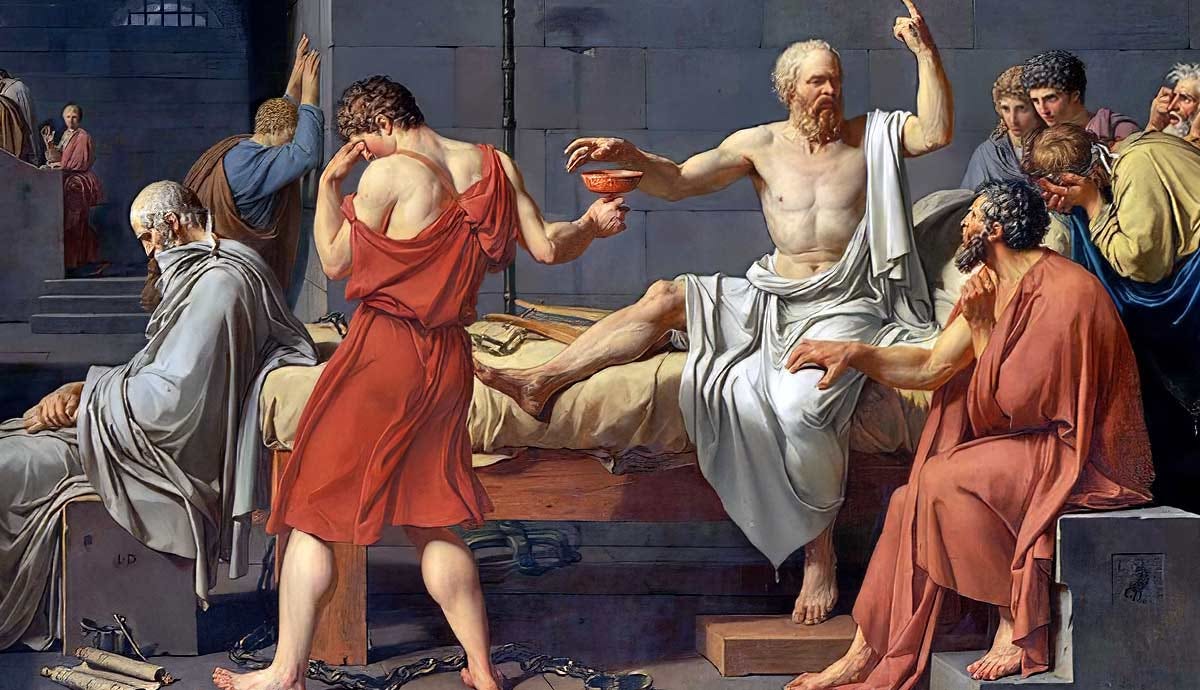
Conversely, Jesus suffered pure agony. He prayed that God would spare Him so intensely that blood poured from His pores. We call the sequence leading up to His burial the “Passion” narrative because it’s absolutely brimming with it.
Sure, He prayed “not my will but yours” and “Father forgive them,” but these aren’t mantras of stoic acceptance—they’re drenched in embodied suffering. And regardless of your interpretation of His last words, it’s hard to deny that they’re emotionally loaded: “My God, why have you forsaken me?”
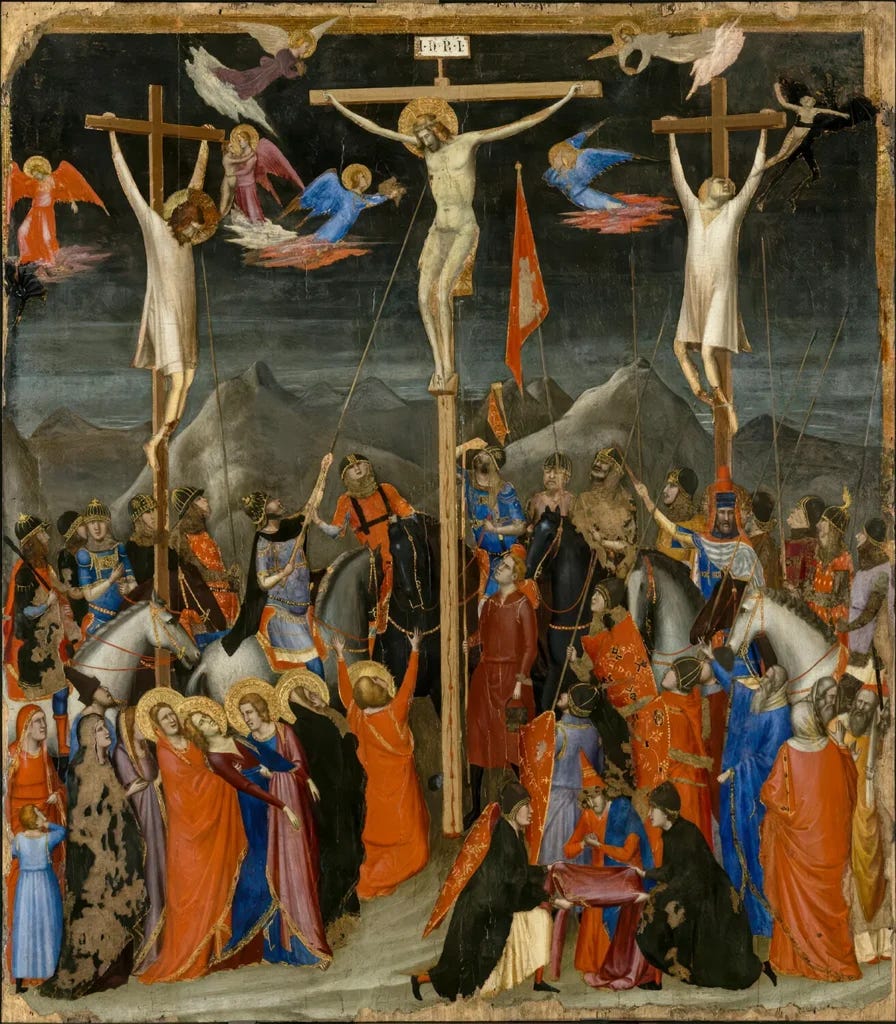
For Socrates, he could leave life serene and unbothered because he didn’t consider this life “good”—which made renouncing it way easier.
For Jesus, He couldn’t not experience agony. In fact, if He didn’t feel anguish over His impending death, then it wouldn’t have been a sacrifice; it would’ve been a mere robotic furthering of God’s will. As Taylor puts it:
The great difference between Stoic and Christian renunciation is this: for the Stoic, what is renounced is not part of the good.
For the Christian, what is renounced is affirmed as good—both in the sense that the renunciation would lose its meaning if we were indifferent and in the sense that the renunciation is in furtherance of God’s will, which precisely affirms the goodness of the kinds of things renounced: health, freedom, life.
For the stoic, loss isn’t all that “bad.”
But for the Christian, loss is always a “breach in the integrity of the good.”5
We mourn not because we need what’s lost but because it’s worth lamenting the loss of anything God calls “good” (Gen. 1). To deny lament is to deny the beauty and intention in the way God crafted those things—whether it’s life (in Jesus’ case), food (in the case of a fast), or rest (in the case that we’re combatting sloth).
As such, the only Christian way to “renounce” something is by affirming the goodness of what we renounce beforehand. This is why it should be impossible for a Christian to self-righteously reject something (think high-horse teetotalers).
C.S. Lewis describes renunciation best: “Marriage is good, though not for me; wine is good, though I must not drink it; feasts are good, though today we fast.”6
It’s also very biblical: “For everything created by God is good, and nothing is to be rejected if it is received with gratitude” (1 Tim. 4:4).
And yet, even though Jesus and Paul affirmed the goodness of creation and embodied existence, how is it that stoic acceptance become a mark of Christian maturity?
Even though Socrates and Jesus are very (very) different, stoicism and platonism (the school inspired by Socrates) influenced a lot of Christian thought. Not in a *clutches pearls!* kind of way, but in the casual way that all pop-culture subtly influences people within that culture. So kind of like the way that two plants that grow side by side tend to intertwine, some stoic ideas snuck into Christianity and became “just the way we do things around here.”7
Which matters because: if our worldview fires off from a stoic starting point, we’ll become way more likely consider the present world bad or unnecessary. From there, we might punch instructions like “don’t love the world” (1 John 2:15-17) into an equation that concludes that the present material world is useless, transient, un-holy. What God called “good” and “very good” gets downgraded to mere distractions or pleasures that we’re called to shun.8
We can see this all over church history. In the 5th century, the theologian John Cassian encountered a Christian monk who was getting praised because he took an insult without reacting at all. While many of the Christians thought it was tough (or “tuff”), Cassian criticized this kind of monastic detachment: “He did not feel the insult because he felt nothing at all.”9
Even Thomas á Kempis’ Imitation of Christ (possibly the highest selling Christian book of all time besides the Bible) contains hints of stoicism: “A wise man heeds little what he feels.”10
Today we see traces of this mindset in the anecdote that “Bible” is an acronym for “Basic Instructions Before Leaving Earth.”11 There’re also some corners of the modern spiritual formation movement that risk treating faith as an emotional numbing agent rather than an invitation toward reality.
All that said, theologians like Ireneaus, Augustine, and Aquinas got it right: creation and everything in it is good.12 It’s the corruption of that good that creates evil. As such, salvation is never an escape from earth, our bodies, brains, or matter—salvation is the restoration and reordering of all things toward God’s reality (2 Pet. 3:13).
And yes, there are plenty similarities between stoicism and Christianity. Those who’ve read Marcus Aurelius’ Meditations (probably the most essential work in the stoic canon), will even notice similarities. “The best revenge is to be unlike him who performed the injustice,”13 writes Marcus. “Never avenge yourselves; instead, if your enemy is hungry, give him something to eat,” writes Paul.
Paul even quotes stoic poets to land his points (Acts 17).14 But he’s not just quoting them to look well-read, like I just did with that Aurelius line; he’s quoting them to show that Christ is supreme—the hope they’re really longing for. Like Justin Martyr argued, Jesus was and is the fulfillment of everything the philosophers were philosophizing toward.15
From the very beginning, the theologian’s job description included showing that Christianity will always “outnarrate” other worldviews. In particular, it supersedes the stoic worldview by encapsulating all its strengths into a healthier container.16
Whereas stoics cultivate self-sufficiency, Christians cultivate a deeper dependence on God (Phil. 4:12-13).17 And it’s a weird upside-down kind of dependency, because as we feel more dependent, we paradoxically come to feel more sufficient.
Rather than let go of the attachments that we desire for the sake of mitigating desire, we rightly order desires around a perfect kingdom.
Rather than live according to the flow of whatever comes our way, we live according to God’s will.
Stoic formation is driven by self-discipline and effort; Christian formation is driven by an overwhelming love of God, grace, and the Spirit’s transformation.
And while both embrace suffering, their approach is totally different.
Stoics embrace suffering as a way to get better at controlling their reactions to suffering. But Christians don’t suffer for the sake of getting really good at suffering; we suffer for the sake of dying with Christ and participating in His glory (Rom. 8:12-17; Col. 1:24-29).
As the Thomistic philosopher Josef Pieper put it, “Suffering for its own sake is nonsense.”18 The martyr doesn’t sacrifice their life because it’s brave; they lay down their lives because they cherish the good of what they’re dying for more (John 15:12-17).19
That’s why we can suffer and suffer well. We suffer lovingly.20 We don’t reject or mute or discipline ourselves to hold back tears whenever something bothers us. We acquaint ourselves with grief until it reframes our experience of everything as more rich, full, colorful.
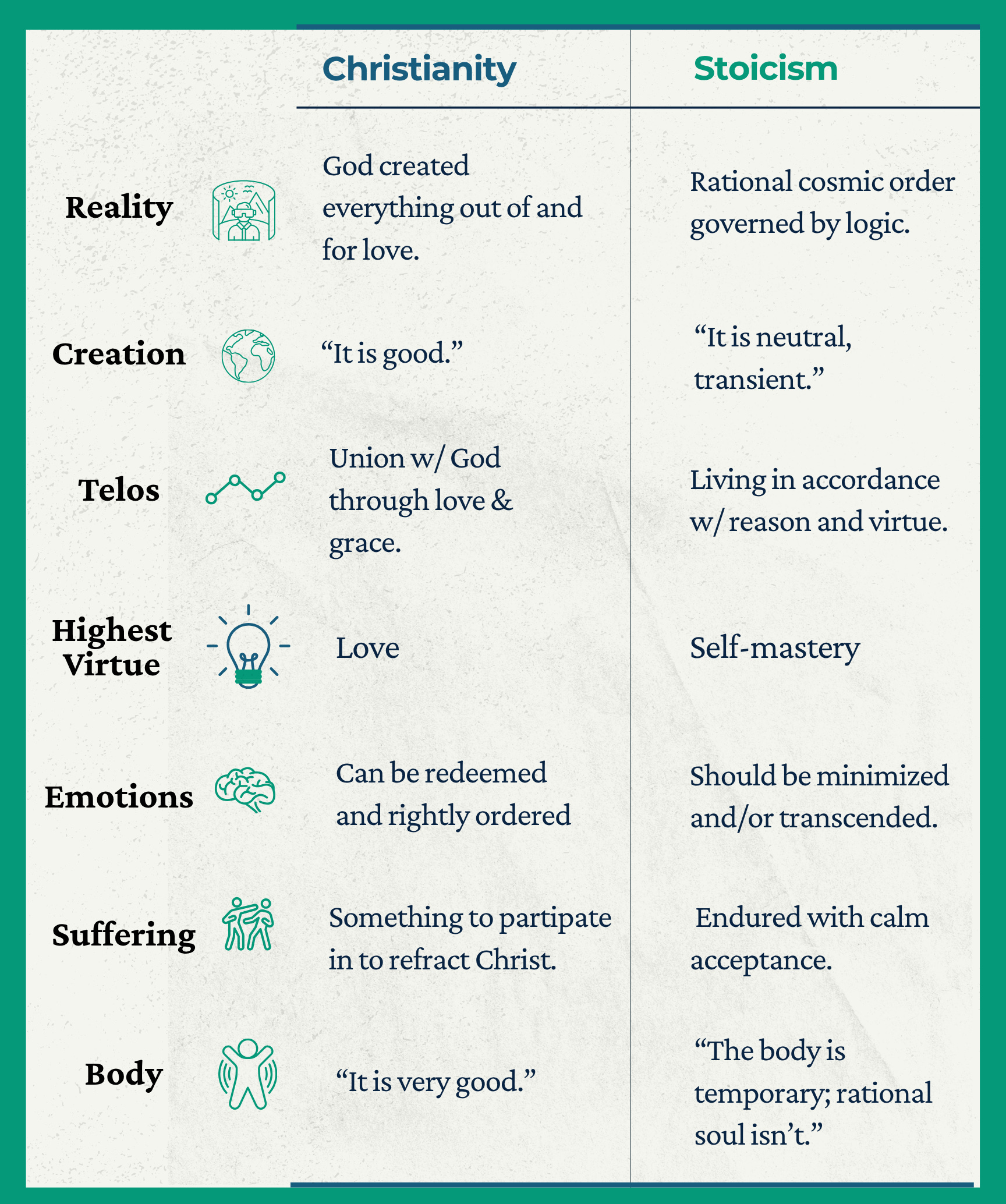
Our maximize pleasure, minimize pain culture usually thinks of negative emotions a useless detour from the good life. But Christianity metabolizes all those dips and valleys and emo modes so that we can discover as much value in grief as the classically desirable positive emotions.21
Surprisingly, happiness and negative emotions can more than coexist. A 2026 study in the Journal of Happiness Studies even found that that minimizing pain and pursuing pleasure does not lead to the happiest kind of life.22 Apparently, brief encounters with negative experiences leads to higher overall wellbeing because they give our positive emotions something to compare themselves to.
To illustrate, when I lived in LA, I never once thought “Thank God it’s sunny.” The sun in Southern California is a constant. But when I moved to Michigan around December, I immediately went through 4 months of reminders about why the sun was so great. In the same way that it’s harder to appreciate summer without winter, so the bitter of negative emotions makes happiness all the sweeter.
As such, strong-arming negativity away doesn’t create a flourishing life. What does is affirming the goodness of created existence without ever becoming indifferent to loss and grief and mourning—inhabiting our imperfect bodies and imperfects days with a knowledge that we’re licensed to rejoice.
I’ve noticed that as I’ve gotten older, when people ask me how I’m doing, I just say “I’m great.”
There’s a rationale behind it. Even if I’m not subjectively doing “great,” I’m still technically not that far off from objectively doing great.
For example, a few months ago, when my college’s registrar asked me how my Christmas was, I said, “Oh I got vicious food poisoning, but it was great.”
She paused and tilted her head and said, “Oh, so…not great then…?” And I said, “Well, no, it was still great—just couldn’t get out of bed for a couple days.” She sort of nodded at the oddness of this response and the conversation fizzled out.
Now, this response isn’t a continuation of college days emotional suppression. I didn’t skip or bypass my frustration; I expressed anger that God hadn’t led me away from the food poisoning, and that anger allowed me to process and reappraise the situation.
But over and beyond that, I just legitimately believe that our worldview affirms that life in general is both good and bad, but the good objectively outweighs the bad; and therefore, I’m pretty much always close to an objective sense of doing “great.”
Yes, Christmas did suck this year. I threw up constantly and couldn’t walk without getting dizzy. But at the same time, it was great: I got to talk to the God of the universe amidst my melodramatic groaning; I was reminded that I had a wonderful wife and friends and family that cared enough about me to express sadness that I couldn’t make it out of bed.
So having a “great Christmas” isn’t denial; to me, it’s just a way to “rejoice always” and “give thanks in all circumstances.” Because, you know, our lives are a perpetual celebration of the Resurrection—the historical happening that now reverberates, proclaiming that even despite all our pain and hardship and loss and grief and turmoil, all of it can and will eventually bloom into good in the long run.
The good life isn’t the absence of pain and control of emotion; it’s the presence of God in the midst of it; the reality of His created goodness and promises to restore it all in the future.23 That’s a hope that makes every drop of suffering, grief, and unmet desire eternally worth it.
That’s why Christianity outnarrates stoicism.
Note: for this article, I’m describing a sloppy, street-level kind of stoicism—not the kind of capital-s Stoicism you’d see from Epictetus or Seneca. This is thanks to the reality that much stoicism today is different from the lived reality of someone like Marcus Aurelius. It’s a whole can of worms I’m deeply uninterested in opening. See here and here and here, if you’re curious. As such, I’m hoping that this article will land less like a criticism of pure Stoicism than its present-day cultural mutations.
Charles Taylor, Sources of Self (Cambridge, MA: Harvard University Press, 1981), 219.
At this point I’ll note that Socrates, of course, was not a pure stoic. But his life, values, and demeanors went on to inspire many stoics as a forerunner of their school of thought. As such, there is a lot of overlap between stoicism, platonism, and of course neo-platonism.
Taylor, Sources of Self, 219.
C.S. Lewis, God in the Dock (Grand Rapids, MI: Eerdmen’s, 2010), 158.
Among those who says this includes Alfred North Whitehead, Nietzsche, Emerson, and my history prof. This is also partly why Nietzsche called Christianity “platonism for the masses.” Friedrich Nietzsche, Beyond Good and Evil, trans. Walter Kaufmann (New York: Vintage Books, 1989), Preface. See also Troels Engberg-Pedersen, ed(s). From Stoicism to Platonism: The Development of Philosophy, 100 BCE-100 CE (New York: Cambridge University Press, 2017).
Some may be tempted to point to 1 John 5:19, John 12:31, 17:9, Luke 4:6 to insist that the world is corrupted by its being ruled by the evil one, but this theory is only feasible within a framework that accepts creation/the world’s substance as taking on the necessary property (or essence or nature) of “evil,” when instead these verses simply note that the substance of creation is merely distorted by outside substances (the flesh, the devil) and thus necessarily retains its essential essence and property of “good.”
It’s likely that this is apocryphal. But some theories suggest that the monk in question may have been Abba Agathon. See The Sayings of the Desert Fathers, trans. Benedicta Ward (Kalamazoo: Cistercian Publications, 1975), Agathon, 23. For interesting thought on Cassian’s stoic-seeming ideals, see also John Cassian, Conferences, trans. Colm Luibheid (New York: Paulist Press, 1985), I.7–8.
Thomas à Kempis, The Imitation of Christ (London: Penguin, 1952), 1.6; 1.11.
This caricature of Christianity hating the world and all the good in it became so normal point that one of Denis Diderot’s critiques of Christianity reads more like a critique of Jesus-y stoicism than orthodoxy: “I don’t know what this thing is you call religion, but I can only think badly of it, since it prevents you from tasting an innocent pleasure, to which nature, the sovereign mistress, invites us all;...you ignore your duty towards a host who has given you a good welcome, and to enrich a nation, by bestowing upon it one subject more.” Denis Diderot, Supplément au voyage de Bougainville, in Oeuvres philosophiques (Paris: Garnier, 1964), 476.
Irenaeus, Against Heresies, 4.39.2, in The Apostolic Fathers, trans. Alexander Roberts and William H. Rambaut, Ante-Nicene Fathers, vol. 1 (Peabody, MA: Hendrickson, 1994); Augustine, Confessions, trans. Henry Chadwick (Oxford: Oxford University Press, 1991), 7.12.18; Augustine, On the Nature of Good, chap. 1, in Augustine: Earlier Writings, trans. John H. S. Burleigh (Philadelphia: Westminster Press, 1953); Augustine, Enchiridion, chap. 11, in Nicene and Post-Nicene Fathers, 1st series, vol. 3 (Peabody, MA: Hendrickson, 1994); Aquinas, ST I, q. 5, a. 3; I, q. 2, a. 3, ad 1.
Marcus Aurelius, Meditations, trans. Gregory Hays (New York: Modern Library, 2002), 6.6.
Timothy Brookins also makes a compelling case for a ”sub-stoic” reading of 1 Corinthians that is very fascinating but far too tangential to include here. See Timothy A. Brookins, Rediscovering the Wisdom of the Corinthians: Paul, Stoicism, and Spiritual Hierarchy (Grand Rapids, MI: Eerdmans, 2024).
See throughout Justin Martyr, “First Apology,” in The First and Second Apologies, trans. Leslie William Barnard (New York: Paulist Press, 1997), Ch. 14-22, 42-46; Arthur J. Drodge, “Justin Martyr and the Restoration of Philosophy,” Church History 56 no. 3 (1987): 303–319.
I first learned “outnarrating“ from Christopher Watkin’s Biblical Critical Theory; if memory serves, the idea originated from William Cavanaugh.
For more on this, see Nolan, Kirk J. Review of Protestant Virtue and Stoic Ethics, by Elizabeth Agnew Cochran. Journal of the Society of Christian Ethics 40, no. 1 (2020): 173-174.
Josef Pieper, The Four Cardinal Virtues (South Bend, IN: Notre Dame Press, 1981), 120.
In Augustine’s words, “Not the injury, but the cause makes martyrs.” Augustine, Enarrationes in Psalmos 34, 13.
A beautiful line from Abandonment to Divine Providence by Jean-Pierre de Caussade
Kind of a complex overview, but for more on the complex role of despair and happiness in the Christian life, see Andrew Root, Evangelism in an Age of Despair (Grand Rapids, MI: Baker Academic, 2025).
Interestingly, the ideal ratio suggested is about 10-13% negative emotions and the rest split up between positive and neutral emotions. J. Liu, R. B. Nes, and J. Vittersø, et al. Positively Negative: Why Negative Affect is Linked to Higher Wellbeing,” Journal of Happiness Studies, 27 no. 61 (2026).
One last clarification for the nerds: Kirk Nolan writes, “For Seneca, sustained emotional responses are symptoms of a disordered soul. Take anger. Even if anger is properly informed, the desire to seek revenge by harming others is never suitable, as it only causes further harm. Thus, the proper virtuous response to anger is self-examination, not retaliation. Luther, Calvin, and Edwards also worry about the power of the emotions, but do not seek to remove them from the Christian life. Jesus’s own life, as evidenced at Gethsemane, points to their affirmation. One solution to emotional volatility is Edwards’s distinctive understanding of the religious affections, which roots emotions in a lasting disposition of the will, rooted in a love for God.” Nolan, “Protestant Virtue,” 172-173.
Comments
Nothing yet. Say the first thing.
Sign in to join the conversation.