
How do you use Stanley Morgan on a football field?
Born on February 17, 1955 in Easley, South Carolina, Stanley was small as a baby. He remained small through his entire childhood, and once he got to his teenage years, it became clear he was going to remain small his entire life. In the pro ranks, he will be listed at 5’11", and 180 pounds. I believe both marks to be generous, and in the rough and tumble game of the 1970s, just how do you use a man this small on the football field?
In high school it was easy. Stanley won his high school team the state championship by being faster, and running past everybody. This got him recruited to play football at the University of Tennessee, but at the college level, ‘I am faster’ is no longer a real offensive strategy. Athletes are better at this level, and cannot be beaten with athleticism alone, especially if you’re not even six feet tall by a generous measurement.
Teams cannot pry themselves away from his raw talents, but once again, how do you actually use Stanley Morgan to win football games?
Stanley played as a true freshman, and was the leading receiver on a Tennessee Volunteers team that was in the top ten for much of the season. Even at this level, Stanley was still quicker than a hiccup, and could break off a big play at any time. At this point through, that’s all he could do, explaining why he led the team in yards and TDs, but only caught 22 balls all year.
This makes it easy for Tennessee head coach Bill Battle to claim he’s not getting open enough, and demote him. Stanley swears to this day he was demoted because of boosters pulling strings behind the scenes to get players they liked into the lineup. I cannot prove or disprove this allegation, but it must be said that players who lead teams in receiving yards as true freshmen, like Stanley did, don’t often lose their starting spot as a sophomore.
Knowing that the path was blocked for him at WR, Stanley had no choice but to convert to RB. He was a great RB, averaging over five yards per carry in 1974, and leading the team in yards per reception out of the backfield, demonstrating again his big play ability. He was great again in 1975, averaging 6.1 yards per carry, but regardless of how well he played, Stanley hated every minute of this.
Stanley had been a WR his whole life. Stanley wanted to be a WR. He just was not built to be a RB, and he knew it. He was a short, small, track and field runner. By this point, he knew he had NFL prospects, because even at the next level he’s still more athletic than everybody else on the field. He just doesn’t have pro prospects at the RB position.
That leads us into the 1977 Draft, where even after three years of high school ball, and four years of college ball, nobody has figured out the answer to the question.
How do you use Stanley Morgan to win football games?
Some thought he line up at RB, but get his primary value from catching the ball, similar to what Christian McCaffrey would do decades later. However, in the 1970s, this niche was mostly filled by FBs, and at 5’11”, 180 lbs, there’s no way Stanley Morgan was ever going to be a FB. This path is closed.
Other teams thought he was going to be a small, but extremely athletic RB. However, Stanley is not short and stocky in the mold of a Barry Sanders. Stanley is tall (relative to Barry) and thin. This body type is not going to work as a full time ball carrier either.
In the end, Stanley had his pro prospects exactly correct four years ago. If he’s going to make it in the NFL, it’s going to be as a WR, so he falls down the draft board, all the way to the first team that sees him working in their system as a wideout. The track star hyper-athlete falls all the way down to 25th overall, where he is selected by the New England Patriots.
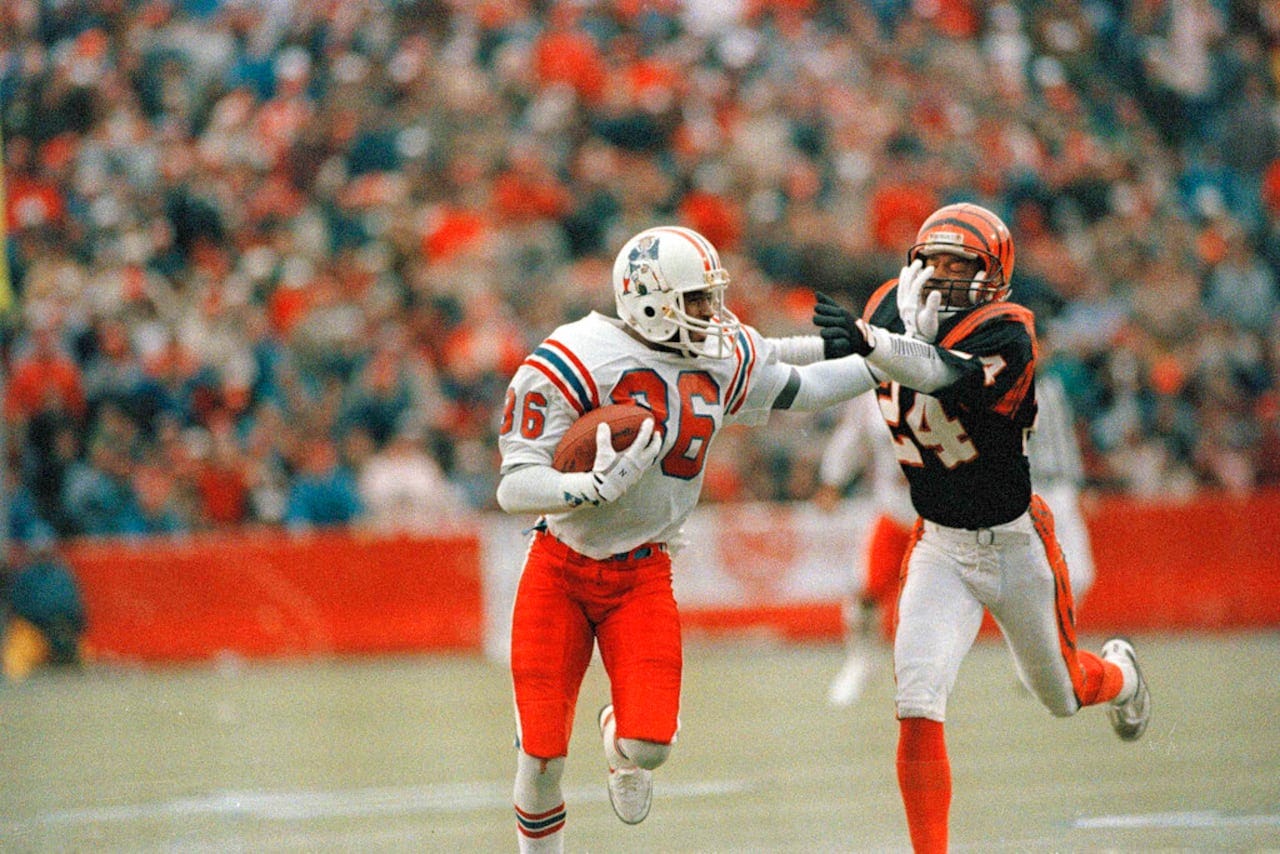
To say Stanley is disappointed is an understatement.
First of all, there were rumours he could go as high as fifth, to the New York Giants. When the Giants passed on him, the main destinations were Denver and San Diego. Only once these teams all passed did Stanley get all the way down to 25, where one of 1976’s best teams (the New England Patriots) couldn’t continue to look this gift horse in the mouth.
Stanley hates the idea of going to New England. As a man who’s rarely been out of the South in his life, the cold weather Boston locale is not enticing, nor is the worst stadium in the NFL, and nor is the Erhardt offence that dictates the team throw just 305 passes to 603 rushing attempts in the 1977 season.
In the 1970s, there’s nothing a player can do about this. If we wants to play pro ball, he must go where he’s drafted, but this turns out to be a blessing in disguise, because Stanley and the Ron Erhardt Patriots turn out to be a match made in heaven.
Stanley struggles as a rookie in 1977, partially because rookies struggle, but partially because 1977 is the final year of true old school football. At year’s end, the league implements the so-called ‘Mel Blount Rules.’ This is a series of several rule changes designed to make passing easier, but the most prominent is making contact with a receiver more than five yards down the field illegal.
It’s impossible to tell whether a small and fast WR like Stanley would’ve been able to thrive under the old rules, but now that DBs can’t rough him up anymore, Stanley Morgan is one of the best WRs in the NFL, immediately.
He still plays for Ron Erhardt, meaning the 1978 Patriots rush 671 times (league average 561), to only 390 passes, and even amongst this miniscule distribution, Stanley finishes third on the team with 75 targets, behind Harold Jackson’s 79 and Russ Francis’s 78. He only nets the 50th most targets in the NFL, but no matter. Amongst this top 50, Stanley leads the group in yards per target, and leads it in Y/R, demonstrating that even in the NFL, he’s a threat to break a big play at any time.
In 1979, he finishes second in yards per target (min. 80 targets), behind teammate Harold Jackson, seventh in DYAR, and once again leads the league in Y/R. In 1980, he’s again second in yards per target, sixth in DYAR, and makes second team All-Pro. In 1981, he’s second place in yards per target again.
Don’t look now (I know yards per target aren’t everything), but yards per target is an extremely important statistic, that correlates very highly with more advanced WR statistics (i.e. DYAR), and from 1978-1981, Stanley ranks 1st, 2nd, 2nd, 2nd in this metric. On balance, there’s no WR in this stretch that can compete with the Stanley Steamer.
Any of the 1978, 1979, 1980, 1981 seasons could’ve been the best year of Stanley’s career, and all could’ve been some of the best WR seasons of all time, if only there’d been more volume.
In 1978, the Patriots rushed the ball 671 times (league average 561). In 1979, it was 604 rushes (league average 555). In 1980, there were 588 rush attempts (league average 515). In 1981, Erhardt finally got with the modern game, rushing only 499 times (league average 517), but the Patriots’ 0-8 one possession game record that year (worst of all time) nuked Ron Erhardt’s entire coaching career. He was never head coach anywhere again after that, and with the firing of the only head coach he had ever played for, things go downhill quick for Stanley.
It’s not the loss of Erhardt himself that causes the problem. It’s the loss of Erhardt’s WR coach (and Hall of Fame WR in his own right) Raymond Berry.
Berry had been Stanley’s WR coach for his entire NFL career, and had been the one to teach the young man how to actually play receiver. Raymond had taught Stanley how to get open without using the speed, so he could save the jets for after he caught the ball. This had worked wonders, making our man into the biggest big play threat in the NFL, but after the poor one possession game luck in 1981, Berry is gone too, thrown out with the Erhardt bathwater, and Stanley is back in a situation similar to the one at Tennessee, mired in New England without his favourite coach, playing a position he doesn’t want to play, in an offence he doesn’t know.
Under new head coach Ron Meyer, all progress made under Erhardt is undone, as the team goes back to rushing 324 times in the strike-shortened 1982 (league average 280), and 538 times in 1983 (league average 511), before Meyer is quickly told his services are no longer required.
In this two year period, to say Stanley was less than his best is an understatement. Meyer had no interest in using the foremost deep threat in the NFL, but did have interest in throwing the ball Stanley’s way 113 times in 1983, the most targets he’d ever had in a season. He’s getting targets, but he’s not running his routes. He’s not playing like Stanley Morgan. He’s being used like a slot guy. The result is a workable number one receiver on an NFL team, but nothing special. A far cry from the man he’d been just a few years before.
Stanley hates this. He doesn’t want to be a workable number one receiver. He wants to be Stanley Morgan. Over this 1982-1983 period, he develops bad habits. Where before 1981 he’d had the discipline to stick to a strict diet, at least during the season, now he grew fleshy around the middle. The extra weight contributes to hamstring injuries, robbing him of his track star speed, and throughout this process, New England fans begin to turn on him. The man who’d once been hailed as the Stanley Steamer was now saddled with the derisive nickname Tug Morgan.
The period of time from 1982-1984 was so miserable that Stanley began to bring his misery home, to wife Rholedia and their two daughters, whereupon she gave him an ultimatum. She was not going to take it, so the two choices were that he get himself traded away from the Patriots, or just retire.
Ron Meyer, who’d already marginalised Stanley in the offence, had no problem at all trading the shadow of the once elite WR, and got several offers to different teams accepted, but we’ve talked about Patriot owner Billy Sullivan on this publication before. He’s a good owner, who loved his Patriots. He believed in Stanley, and refused to allow Meyer to trade him.
Based on my research regarding Billy Sullivan, I interpret this as a kind gesture, in a football world generally devoid of kindness, but I don’t think Billy realised that he was only making things worse, effectively denying Stanley’s trade request, and holding him hostage on a team he hated playing for.
With no recourse (there is no free agency in 1982), but not wanting to quit altogether, Stanley elected to stay in New England, with lagging results, playing in an offence he hated for a coach he hated, before the Sullivans finally realised Meyer had been a mistake, and brought back a remnant of the old Erhardt administration.
In the middle of the 1984 season, to be their next head coach, the Patriots brought in Raymond Berry.
The same Raymond Berry who’d taught Stanley how to play WR in the first place, and had been his favourite coach for half a decade.
It’s a stretch to say everything turns around immediately, because injuries stay, especially a pinkie finger injury that Stanley has been dealing with for years, making it extremely painful to catch the ball, but what does return with Berry is the offence that Stanley wants to play in, an offence willing to use him as the deep threat he is, and as such, it also brings back the motivation that Stanley once had.
There’s an old saying in football. Defence is about perspiration. Offence is about motivation. There is no better proof for this saying than Stanley Morgan.
He goes back to training. Back to dieting. He’s not yet all the way back to what he once was in time to go to the Super Bowl with the Patriots in 1985, but is back to being the top WR on a team good enough to make the Super Bowl. He’s certainly back enough to make the fans forget about all that Tug Morgan stuff, and ultimately proves to be the only Patriot who shows up wanting to play in that 1985 Super Bowl.
This is a good comeback for a WR who’s now on the wrong side of 30, but at the same time, it’s not the Steamer we’re used to. Stanley has 39 catches and 760 yards in 1985. Those are the best numbers on this team, but not the best in the league anymore. Now aged 31, with a lot of his prime wasted under Ron Meyer, it’s possible that this is all Stanley has left to give. Guys over 30 don’t often bounce back to the form they showcased when they were 24.
But Stanley has to know that for himself.
In the 1986 offseason, finally sensing he has something to play for again, Stanley gets fusion surgery on the left pinkie finger that’s been bothering him for years. This surgery prevents him from being able to bend this finger ever again, but it’s worth it, because as soon as he gets on the field in training camp, the difference is immediate. He can feel it right away. The finger is finally strong again. He can catch the football without pain, for the first time in years.
Not to be too spoiler heavy, but look at Stanley’s catch rates in all the seasons after Stanley’s first prime (1978-1981), and see if you can spot this pinkie surgery without my help:
44.4%, 51.3%, 52.1%, 52.7%, 62.2%, 63.7%.
Awfully conspicuous is the jump from a 52.7 percent catch rate in 1985, to 62.2 percent in 1986. 62.2 percent may not blow the doors off a modern fan, but Stanley played in an era where receivers were not allowed to wear glue on their hands. 62.2 percent means he leads the league in catch rate this season.
This is what the pinkie surgery buys him. Never being able to bend your pinkie again is a serious sacrifice. Stanley was not willing to make that sacrifice for Ron Meyer, preferring to just let his career slide into obscurity, but he’s taken this step for Raymond Berry, which provides the first building block for one of the most electric WR runs in football history.
Coming into 1986, the Patriots are the defending AFC champions, but our point differential last year was only positive 72. That’s third in the AFC and sixth in the NFL in 1985, but it still made us a moderate fluke as a Super Bowl participant. Nobody expects us to be a great team in 1986. To begin the year, our odds of winning the Super Bowl are set at +1500. That’s the tenth best, meaning we’re probably a playoff team, but well short of a contender.
Why wouldn’t they think that? We were the fifth seed in the five team AFC playoffs last year, and our roster has undergone minimal change.
Little can be done to change this perception of being a fringe playoff team against the lowly Indianapolis Colts, who are awful on both offence and defence, but week one divisional games are always trap games. We cannot take them lightly, or we will take a loss that in the five team per conference playoff era, is tough to afford.
These Colts are particularly poor at defending the pass, which gives a chance for the Steamer to shine. In the first three quarters, he does shine, with nine targets and seven catches for 116 yards and a touchdown, that touchdown coming on a 43 yard bomb, but as Stanley comes down from catching this TD pass, he gets knocked out cold on the way down, in no position to defend himself, with a hit directly on the chin. This is legal in 1986, but that doesn’t make it less ugly to watch.
He lays there, motionless in the end zone, for several minutes before he can be carted off the field, and does not return to this Indianapolis game. It reminds me a lot of the Trent Green hit in 2006, with much less caution taken and much less concern expressed, a result of 20 fewer years of player safety advancement.
In the end, Stanley’s injuries from this disaster of a play are ‘only’ a stinger and a concussion. Nowadays, Stanley would’ve missed multiple games to recover from injuries like these. In 1986, he does not even miss a practice, and this injury has no real impact on the season of either Stanley individually or the Patriots as a whole.
I won’t bring this incident up again. Just keep in your mind that Stanley accomplishes all you’re about to see, despite being carted off the field in week one, with serious neck and head injuries.
That moves us to week two, a vitally important divisional game, on the road against the New York Jets. In 1985, the Jets were the best team by point differential in the AFC. Third best in the entire NFL. We ended their 1985 season (one of the best in Jets history) by going into their stadium and beating them in a playoff game.
To say they want revenge is an understatement, but this is more than that. The Jets are a good team. They’re not going to take many losses. If we hope to win the AFC East, it’s crucial that we put losses on them when we have the chance. This week two game, on the road again, is our chance to make the statement that we’re not just a team that went on a fluke playoff run to the Super Bowl.
The AFC East is ours now. For real.
Welcome to Stanley Morgan’s Year.
This Jets game is the first instance of what will become a season-long pattern for our offence. Stanley is the only Patriot receiver in this game who finishes with more than two targets, and let me use our first couple drives to show you how this manifests on the actual football field.
Our first drive is a one play turnover, so I’ll skip over it, but our second one goes as follows. A useless backwards run on first down. A 19 yard completion to Stanley on second and 11. First down. A useless one yard run on the ensuing first and ten. A 12 yard completion to Stanley on second and nine. First down. Three straight incompletions. Punt.
If you were keeping score at home, Stanley’s targets generated 31 yards, and 2.4 total EPA. Plays that were not Stanley targets generated a cumulative total of no yards, and -1.7 total EPA. This is only one example, but it proves a greater truth. There are good players on this Patriot offence (including a sometimes capable WR partner in the extremely streaky Irving Fryar), but it is not a good offence, unless we’re throwing the ball to Stanley Morgan.
Our second drive goes right down the field for a TD, but not without two clutch third down catches from the Steamer, and it’s no coincidence that when he gets only two targets for the entire rest of the half (one 15 yard gain, one incompletion on third and 15), our offence completely falls apart. We don’t get past our own 29 yard line.
It’s tough for a WR to carry a football team, especially a player who plays with the style of Stanley, generally running only deep routes or slant patterns, similar to a much better Desean Jackson in the modern game, but if you wanted to see a WR carry an entire offence, that first half was it. QB Tony Eason throwing to Stanley was five out of seven, for 68 yards. Tony otherwise in this half completed three passes for 20 yards, and scrambled for one additional yard.
21 yards for the rest of the pass offence. 68 for Stanley alone.
This does not stop in the second half either. To everyone’s credit, the second half begins with us getting all the way to the NYJ 24 without Stanley’s help, but once we’re there, he draws a key holding penalty on a second and long, and then catches the ball for ten yards on another second and long, keeping the drive alive long enough for Tony to throw the TD pass to Tony Collins, to take what’s now a 14-6 lead.
At this point, we get a harsh reminder that we’re in 1986, as with a 14-6 lead at 8:35 of the third quarter, with over 23 minutes left in the game, we go into preservation mode, throwing only seven more passes for the remainder of the game. Of these seven, four more go to Stanley, for 26 more yards, before he just sits down for the fourth quarter. No need to have a diminutive big play WR out there when everybody knows we’re running anyway.
In all, in this divisional game on the road against our top competition in the AFC East, Stanley eats up 12 targets, and eight completions, for 104 yards in total, plus a key holding penalty drawn en route to our second touchdown. The rest of the team combines for 12 targets, only six completions, and only 54 yards altogether.
Passes thrown to Stanley generated 9.4 EPA this game. On his 13 targets (including the holding penalty) that’s 0.723 EPA/Play. All other drop backs produced -8.11 total EPA, which is appalling, because there were only 16 of them. That’s -0.507 EPA/Play.
The difference between throwing to Stanley, and doing anything else in the pass game, is massive, and indicative of what this 1986 Patriot offence is. This Jet game, which we win 20-6, is one of the most extreme examples, but the whole season is like this.
This dichotomy between Stanley’s targets and everybody else’s targets leaves opposing defences in a bind. They can double and sometimes triple cover Stanley, but make it a bit easier to succeed for the rest of the team, or they can put standard coverage on Stanley, and watch him singlehandedly beat them, like he’s just done to the New York Jets.
Week three shows one side of this coin. The Seahawks elect to cover Stanley more or less regularly, and he catches seven balls on only nine targets, for 161 yards, including long ball TDs of 27, 44, and 30 yards. That’s 18.6 total EPA on only nine targets. You don’t even want me to translate that into EPA/Play.
Unfortunately, because we’re the Patriots, the 39 drop backs that are not throws to Stanley generate -5.6 EPA cumulatively (despite a 100 yard game from Irving Fryar), and we manage to somehow lose 38-31, despite Stanley having one of the best per target WR performances of all time.
Week four shows the other side of the coin. The Denver Broncos absolutely positively are not going to allow Stanley to be the one to beat them. They keep two and three guys on him all game long, limiting him to only two catches and 14 yards. However, the entire defence swirling around one player allows the rest of our passing offence to generate positive EPA (albeit only 0.06 EPA/Play). Ultimately, this is not enough, as we blow a ten point second half lead and lose 27-20 to the Broncos.
Ouch.
Two one possession losses in a row are a steep come down after winning the key game over the Jets. A 2-2 record is not a death sentence, but it’s much worse in 1986 than it is in 2025. In this era, 10-6 is no guarantee of a playoff position. In this 1986 AFC, there is one team that makes the playoffs at 10-6, but two that miss.
Under normal circumstances, two conference losses (in-conference losses are key, because they are especially bad for tie breaking purposes) in the first four weeks of the year would have put a serious damper on our playoff chances, but thankfully, we have the AFC East to fall back on.
This division is primarily remembered by modern fans for being extremely weak, but for the Patriots, throughout much of the new millennium. This division is also very weak, except for us, in 1986. Through four weeks, the only team with a record better than our 2-2 is the Jets, who are 3-1, undefeated barring one loss to us, but the fact that their loss is to us is the key factor here. It means despite our 2-2 start, the playoffs are wide open for us, but only if we begin winning.
Week five brings us a fantastic opportunity to do just that. It’s a home game against the Miami Dolphins. Normally the Dolphins would be extremely scary. They made the Super Bowl in 1984, and were the only team to defeat the Chicago Bears in 1985, but this is not 1984, and not 1985. The 1986 Miami Dolphins are not a very good football team, despite Dan Marino’s best efforts. They come into this game 1-3, and we have no plans to help them out of their slump.
This game is also a matchup between the game’s two foremost ‘small but extremely dangerous’ WRs, with 5’11”, 180 pound Stanley Steamer going head to head against 5’9”, 185 pound Mark Super Duper, and it’s exceedingly clear who the best two players on the field are, as Mark goes for 102 yards on only seven targets, but on this day, Stanley is better, with 125 yards, including a 27 yard TD catch, and another 45 yarder to boot.
Stanley narrowly wins his matchup against Mark Duper, but in terms of the matchup between the Dolphins and the Patriots, it’s never close. Our first pass of the game is a 19 yard Eason to Morgan connection, which sets the tone for how this day is going to go offensively. By half time, we have a 27-0 lead. It’s one of few times all season that an opponent both cannot stop Stanley, and cannot stop the rest of us.
We do lose Tony Eason to injury midway through the game, but even that cannot slow our roll, because we happen to have the best QB in franchise history (as of 1986), Steve Grogan, waiting in the wings as a backup. He comes in and scores the final ten points of a 34-7 laugher, putting the boots to the Miami Dolphins, and getting us back in the win column in a big way, with another important divisional victory.
If only things could be this nice forever.
3-2 is great, but on the other side of the division, the New York Jets have pulled themselves up to 4-1, and in just week six, it’s already time for our most important game of the year.
These Jets are not better than us. Since their head to head loss against us in week two, they have won every single game, meanwhile we’ve lost two, but their games are a one possession win over Miami (whom we’ve just swept to the side easily), a one possession win over Buffalo (who are awful), and a blowout win over the Indianapolis Colts, which even my grandmother could pull off.
Nevertheless, whether they’re better than us or not, losing to them today means we’d have a 3-3 record, and no more tie breakers over the would-be 5-1 New York Jets. That’d put us two games behind in the division, with three conference losses, meaning we’d be in a terrible position in the wild card race also. We’d likely need an 11-5 record just to make wild card, because our tie breaker situation would be horrendous, meaning we’d require an 8-2 record the rest of the way. Nothing is ever impossible, but that doesn’t feel very realistic, meaning this game has an extreme amount of weight behind it, with regard to our playoff chances.
Regretfully, we’re forced into the position of having to play this vitally important game with backup QB Steve Grogan, as Tony Eason is still out nursing a shoulder injury. In the days before offensive coordinators, our team has been in the odd position for the first few weeks of Steve Grogan calling the plays, for Tony Eason to execute. Now, Steve has to both call the plays, and execute them, which some old school purists believe to be a good thing, but I’m not so sure myself. Thankfully, the Jets are also playing this game with backup QB Pat Ryan, although by just looking at the offensive numbers, it’d be tough to convince me this is a game played between two backup QBs.
Once again, this is a game that takes on duel meaning for Stanley. Not only is it extremely important for playoff positioning. It also serves as a head to head matchup with one of his foremost competitors. Al Toon is a first team All-Pro WR, playing for the Jets. This game provides perfect opportunity for Stanley to prove he’s on that level, dramatically boosting our playoff chances at the same time.
If only things could be so nice.
The Jets’ first drive takes more than ten minutes to score a TD, as our defence just cannot stop Jets RB Johnny Hector. Our drive is three incomplete passes, and takes only 24 seconds. New York then takes six more minutes to score another TD, taking us into the second quarter already, with a 14-0 deficit.
We take only two minutes to jog back off the field again on our next try, to which the Jets respond with another long scoring drive, thankfully only a FG this time, but when we again can use up only two minutes of the clock, and the Jets again score a TD in response, I can’t be the only one thinking what I’m thinking.
By the time we get the ball back, now with a 24-0 deficit and 56 seconds left in the first half, there has not been a single Stanley Morgan target in this entire game. For scale, in the first five games of the year, Stanley has 520 yards, six TDs, and has been the entire offence, despite being targeted only 45 times.
Now we get into the most important game of the season, and can’t find a single excuse to throw to him?
I know he’s double covered on every play, but Stanley knows how to get open. There have been multiple opportunities for Grogan to throw the ball Stanley’s way. He just hasn’t. As if he’s listening to my complaints from the future, the first play of the two minute drill at the end of the first half is a 44 yard Grogan to Morgan connection, but of course, that’s the only offence we muster, and the FG attempt is missed.
One target in an entire half, for 44 yards gained, as we walk into the locker room facing a 24-0 deficit. A perfect encapsulation of Stanley Morgan’s entire NFL career to this point.
As we come out of half, our malady is cured. Stanley accounts for 28 yards on our first drive coming out of the locker room as we narrow the score to 24-3. He catches a 44 yard TD as we narrow the score to 24-10. He draws attention to Irving Fryar can catch a 69 yard TD to narrow the score to 24-17, but it’s just too late. Where was this in the first half?
The Jets pull a 31-17 lead. It’s their only seven points of the whole second half, but it’s enough. We narrow the lead to 31-24, but no farther, and we’ve lost. Despite Stanley’s freakish numbers of seven catches for 162 yards and a TD on only one first half target, and 10.2 total EPA individually compared to 12.76 for the entire passing offence (2.56 EPA on 34 dropbacks that were not Stanley targets), we’ve lost to the New York Jets.
We’re 3-3. We’re two games behind in the division. We’re a game and a half behind the last wild card position, and things look bleak, despite a WR who now has 37 catches for 682 yards and seven touchdowns in only six games. It’s almost impossible to envision a mediocre team with this level of a WR talent on it, but mediocre team is what we are.
Thankfully, we have a weak stretch of schedule coming up, and Stanley’s performance over the opening six games of the season has these poor teams to death. Our next game takes us on the road to play the brutal 1-5 Pittsburgh Steelers, who get so scared after one 27 yard catch from Stanley on the first drive of the game that they make absolutely clear he’s not going to be the one to beat them, limiting him to only two more targets for the rest of the day. Stanley’s individual stats are only two catches for 45 yards, but his double and sometimes triple coverage open up the rest of the field for our offence to generate 0.435 EPA/Play through the air in an easy 34-0 win.
Week eight in Buffalo is the exact same story. Now with Tony Eason back, Stanley catches the defenders napping for one 19 yard reception in the first quarter, and they decide that it’s absolutely not going to be him for the entire game after that. This is another game where he gets only three targets all day, but with catches of 19, 11, and 19 yards, he still manages to end the day as the team’s leading receiver, as we take another easy 23-3 victory over the 2-5 Bills.
Week nine is not a game against an easy team. It’s against 5-2-1 Atlanta, but other than that, the story remains the same once again. Just three catches and 36 yards for Stanley, but a blowout win for the New England Patriots. By week ten, teams have learned their lesson. Selling out to stop Stanley and leaving the field wide open for Irving Fryar is not a winning formula. However, the Indianapolis Colts demonstrate why exactly teams thought it could be a good idea to begin with, as Stanley puts up great numbers again (five catches for 89 yards) as we overhaul a multiple possession deficit to beat the Indianapolis Colts 30-21.
All of a sudden, from nowhere, we’ve gotten on a four game win streak to boost ourselves to 7-3. Unfortunately, the Jets have not stopped winning either, now sitting at 9-1, still undefeated barring the one loss to us, but this streak has finally allowed us to climb into the AFC’s fifth and final playoff position. Our seat is not comfortable, with the 6-4 Bengals and 6-4 Raiders coming for us, but it finally appears we have an offensive formula that works.
If the opposing defence is selling out to stop Stanley Morgan, pivot to a short passing game centred around RB Tony Collins, and throw the deep shots to Irving Fryar. If the opposing defenders choose to play Stanley more or less straight up, let him cook, and everybody else will come along for the ride.
This all coalesces in another extremely important game, on the road in Anaheim against the 7-3 Los Angeles Rams. This game sees us walking into battle against one of the 80s’ most intimidating QB-WR combinations, Jim Everett and Henry Ellard, both of whom (especially Ellard) I think deserve serious Hall of Fame consideration.
To beat an offensive duo like this, we’re going to need to score. Thankfully, we’ve become very good at scoring, not having scored less than 23 points in any game since week four, and not having scored less than 20 points in any game at all. 20 points per game would make us the 14th best offence in 1986, and that’s our worst performance of the season.
We can definitely score, but so can the Rams.
This is showcased on the first play of the game, a 16 yard completion to Stanley, which gets us into FG range on its own for a 3-0 lead. The Rams respond with a 23 yard completion of their own, but miss their FG try. Our second drive sees us pivot to our other type of offence, where Tony Eason completes little passes to RB Tony Collins and TE Greg Baty, and tries a few big ideas to Irving Fryar that don’t work, ultimately settling for another FG and a 6-0 lead. We also block a punt on the ensuing Ram possession, returning it for a TD and a 13-0 lead.
For a split second, this has begun to look easy, just like against Pittsburgh and Buffalo and Atlanta and Indianapolis, but you can never allow yourself to believe that. Not with Everett and Ellard on the other side. Before we can blink, a 34 yard Everett to Ellard connection has narrowed our lead to 13-7, and instantly the recognition comes that this checkdown stuff isn’t going to work. We need to look back Stanley’s way.
Like a metronome, the Steamer is there for us, picking up 16 yards on a third and eight that ultimately leads to nothing on this drive, and 16 yards on a third and seven that ultimately leads to nothing on the next one. It’s not until the two minute drill at the end of the first half where we actually score again, and Stanley accounts for 15 yards on that drive too.
For receivers, there are quietly productive halves, and loudly productive halves. This is more of the quiet variety. There are no 44 yard touchdowns or anything like that, but Stanley has accounted for four catches and 63 yards on only five targets in a half in which we scored 16 points, exiting with a 16-14 lead. Even if he didn’t catch any of the TDs himself, that’s solid work.
However, coming out of the half, our entire offence stalls.
When a deep passing team becomes too enamoured with short passes, these kinds of stalls can happen. Tony Collins is a great receiver, for a RB, but he’s not a great receiver in general, and with him as our primary guy, we slow down, only getting one first down (on a Stanley catch) in the entire third quarter, following which we trail 28-16.
At the beginning of the fourth quarter, still this continues. It continues until the Rams finally fall asleep for just an instant, leaving a crease in their defence wide enough for Stanley to burst through for a 28 yard catch and run. Before long, we’re in the end zone, with the deficit narrowed to 28-23. This TD is scored at 7:06 of the fourth. With Eric Dickerson, the Rams are able to run a bunch of time off the clock, but do end up giving the ball back to us, deficit unchanged, at the two minute warning.
This is an important game for us. Both the Bengals and the Raiders won their games today, meaning that if we lose, even though it’s not a conference loss, we’ve surrendered the right to control our own destiny to the playoffs again. That cannot happen, so with 1:45 remaining, on our own 13 yard line, we get to work.
On this final drive, you can really see the gravity Stanley commands. The entire defence warps around him. He’s got two men directly worrying about him, plus a third man shading that way, at all times. He does catch one ball himself in thick traffic, but by and large this drive looks like a modern two minute drill. The defence is sagging, allowing 10-15 yard catches, and tackling everybody in bounds.
This ultimately culminates in first and ten, with three seconds left, from the Ram 25. One offensive play remaining, and only two possible outcomes. Either we score a TD, move to 8-3, and keep a solid grip on the AFC’s final wild card position, or we do not, fall to 7-4, into a four way tie for that final position, which we’re not winning at the moment.
As we line up to throw, the Rams don’t even pretend to be playing real defence. They put three men on the line of scrimmage to rush Tony Eason, and line the other eight up standing on the goal line. Tony (notoriously not a big fan of contact) gets the yips at Kevin Greene almost getting through the line and into his face, and lets this ball go early.
The result is one of the most famous plays Patriot history.
This is one of the worst Hail Mary defences I’ve ever seen. The cardinal rule for a defender on a Hail Mary pass is to let no receiver behind him, and the Rams do not just let one receiver behind them, they let two. Both Irving Fryar and Cedric Jones were in position to catch this ball.
I struggle to understand how a prayer pass could be defended so poorly, but as I further zoom into the context of the moment, I believe I do understand, because look at the one man the Rams did keep in front of them.
Nobody in blue was going be the one that let Stanley Morgan get behind him on a Hail Mary pass, and as a result, Stanley runs into a wall of Rams. He is still the best WR on the team, so Tony throws the ball to him anyway, but all Stanley has to do is tap the ball over this wall of Rams, into the waiting arms of either Irving Fryar or Cedric Jones.
It’s actually shockingly easy. The easiest Hail Mary catch you will ever see, and in my opinion, it’s all because of the gravity of one player, or more accurately, the fear the Rams have of that one player. Stanley is small, but he casts a large shadow. The Rams were concerned with not allowing it to be him that beats them. Nobody ever thought he wasn’t even going to try to catch the ball, and instead just tap over their heads to his partner Irving Fryar, but that’s exactly what he did, and as a result, we have completed the miracle, won this game 30-28, and moved to 8-3.
This was as one possession as a one possession game can get, but it’s nice to be the ones with one possession game luck on our side. It’s nice to have that luck on our side in week 12 also, defeating Buffalo 22-19 despite only 45 yards on seven targets for Stanley. The same is true in week 13 against New Orleans, where despite another poor game from the Steamer (51 yards on eight targets) we again win, this time 21-20.
It really does help a team’s fortunes to win three one possession games in a row, because combining this win streak with the four multiple possession wins in a row before that, we have now won seven games in a row, moved to 10-3, and are all but certain to make the playoffs now, especially since the Ken O’Brien shoulder separation has now happened across the division, and the Jets are in freefall, having lost two in a row to fall to 10-3 themselves.
All of a sudden, after pushing a boulder up an endless hill for a month in a row, watching as the Jets countered all of our wins with one of their own, we’re real contenders for the AFC East again, with a game’s worth of cushion on the final wild card position. Everything looks fantastic, until in week 14, we revert back to early season form again, and not in a good way.
It’s 107 yards and 4.9 total EPA for Stanley, compared to just 148 yards and -14.4 total EPA (-0.424 EPA/Play) for the rest of the passing offence, in a game we lose in brutal 31-7 fashion to the Cincinnati Bengals. This not only ends our winning streak. It also compresses everybody in the standings, as now the final wild card position belongs to Cincinnati themselves, who are 9-5 to our 10-4, and also have a head to head victory over us.
We cannot fall down to Cincinnati in the standings. If we do, they will win the tie break, and we will miss the playoffs. This makes week 15’s matchup one of crucial importance, so who do we happen to be facing?
Oh no.
It can’t be.
In week 15, in yet another vitally important game, we play host to the San Francisco 49ers, complete with Joe Montana, Jerry Rice, Roger Craig, Dwight Clark, and everybody else. Everybody you think when you think of the 1980s 49ers is here, walking into Sullivan Stadium for this matchup.
For the first time all season, we enter a game as underdogs, and what a time for this to happen.
Our cushion on the final playoff position is gone. We still control our own destiny to a first round bye in the conference (greatly aided by the Jets losing again), but if we lose today, we fall down to the Bengals’ level, and stand a serious chance of falling out of the playoffs altogether. The 1986 edition is not the best version of the 49ers. In fact, it’s probably the worst, but a lot of that is because Joe Montana missed eight games earlier in the year. He’s back now, and if we still want to control our own destiny to this playoff position, we have to beat him.
We’re late in the year now. It’s December 14, and the cold is bone chilling. Wind chill at kickoff reads ten degrees Fahrenheit (-12 Celsius), with a relatively strong wind as well. These are not favourable passing conditions, which means in my opinion that the weather favours the 49ers, because they run the ball with Roger Craig, meanwhile we’ve been not pass-first but pass-only on offence for weeks now. Our rushing attack is 28th (out of 28). Tony Collins is strictly a receiving back, averaging 2.6 Y/C on handoffs, but we’ve taken to using him as an every down back anyways, because why not? Everybody knows we’re throwing.
Our first drive perfectly showcases our offensive philosophy in the second half of 1986. The first play is a rush that goes nowhere. Our second play is a little five yard dump off to Stanley on a simple crosser, but he turns on the jets, taking it all the way to the 49er eight yard line, from which Tony can throw a simple eight yard TD pass to Greg Baty.
We have no rushing attack. We don’t need one. 7-0 Patriots.
We’re underdogs against the almighty 49ers, but they would be foolish to take us lightly. This is not the best day to be such a pass-heavy offence, but it takes only one missed assignment to give up 50 yards to Stanley on one play. We’ve just seen it. As long as we have this offensive force on our team, we’re a danger to score at any time.
Here’s the problem.
Just because Stanley is extremely dangerous, even in the bad weather, does not mean everybody else is. The rest of the Patriot WRs in this game combine for three catches and 23 yards, in essence leaving non-Stanley targets strictly for the RBs and for TE Grag Baty. That is not the recipe for good offence.
This is shown on our next drive. Tony starts off by completing a solid eight yard hook pattern to Irving Fryar (eight of only 23 yards all day), but cannot find a target on either second or third down, scrambling on second and getting sacked on third, before we have to punt the ball away.
In general, this pattern continues for the rest of the first quarter, as it’s continued for months now. Stanley draws double teams on nearly every play, and the offence is okay but not spectacular with him simply drawing attention away. Greg Baty in particular has a fantastic game, but Irving Fryar is completely silent. The Steamer plays no further part in this game until the first half ends, and we go into our first drive of the second half.
By now behind 16-10, it’s about time we get our offence going, and to do so, we come out in a unique offensive alignment. It’s a two TE set, with our two best offensive players today (Stanley and Greg Baty) lined up as TEs. Even a team as elite as the 49ers are not prepared for the fastest man in the NFL to be lined up at TE, so fall over themselves trying to defend it.
We’re not going to be able to run any deep patterns this way, but the first play is a 17 yard catch and run on a little crosser to Greg Baty. The second play is the exact same thing going the other way, a 21 yard catch and run on a crosser to Stanley. Finally across midfield, we go back to a more traditional alignment, and immediately fall back into our pattern of struggling.
We fall into a third and 14, and then a fourth and one, which we go for and get, but then fall into another third and five, on which Stanley beats his man to man defender (one of few one on one matchups all game) for a 16 yard gain to the SF four yard line. From there, we run it in for a TD and a 17-16 lead.
This Patriot team does not have very many successful offensive plays, but when we do, they go for a lot of yardage. Stanley is almost to 100 already, but at this point, the wind picks up massively. Offence is prohibitively difficult. Neither Tony Eason nor Joe Montana are able to complete a pass of more than about two air yards until the midpoint of the fourth quarter.
Our offence is not designed to operate this way, so we achieve one solitary first down in this entire stretch. The 49ers only achieve a couple, but because of turnovers on our part (none of which Stanley had anything to do with), their scant offence is enough for two FGs and a touchdown, for a 29-17 lead.
This is just too much to overcome.
Even in a game that’s all but over, you cannot take your eyes off Stanley Morgan. Tony finds him wide open in the end zone to reduce the 49er lead to 29-24, but we never see the ball again. For the second time this season, we’ve had a good thing put to rest by two consecutive losses, but none of it is the fault of Stanley Morgan.
Irving Fryar missed most of this game with injury. Stephen Starring is not a real second receiver, so here we were, with the best WR in the game, but saddled with the worst rushing offence in the NFL, and no second receiver to work with, leaving Stanley to be doubled on every play, oftentimes with safety help over the top, for an effective triple team. All this attention allows Greg Baty to have the best game of his rookie season, and one of the best games of his life, but with all due respect to Greg Baty, if he’s your second best receiver, it’s going to prove quite difficult to beat the San Francisco 49ers.
We saw a few times in this game that even if you’re the fantastic defence of the 1980s 49ers (second in NY/A against in 1986), if you miss a single assignment anywhere, Stanley is gone for 20+ yards. Tony Eason knows where his bread is buttered. For all the criticisms Patriot fans always levied against him (there are many), if something goes wrong in coverage and Stanley has a chance at a big play, he will not miss it. This led Morgan to again have 100+ yards, for the eighth time this season. Eight catches for 121 yards and a TD, to be precise, on a day where even Jerry Rice could only generate six catches for 89, and he was going against our 13th ranked NY/A pass defence, not being doubled constantly by one of the best pass defences in the league.
In this game, I believe we see the whole point of what makes Stanley so great.
Stanley’s yardage is quiet. For one of the best WRs in the world, on a team that has to pass to get any offence done, it’s shocking how little talk he gets from the commentators on his games, and how little he’s shown on camera, but despite his work going under the radar a lot of the time, he is a silent killer.
He sneaks up on you, and puts 100+ yards on you, whether you’re the second best pass defence in the NFL or not, whether you’re double teaming him or not, and whether there is anybody else on the field to soak up defensive attention or not, because even if you’re the San Francisco 49ers, nobody is perfect, and if you slip up for even half a second, Stanley is by you. He is the master at getting open without having to use his speed, and once he catches the ball, he is quicker than you. You won’t be catching him.
Very rarely will you see such a small man inspire so much terror. It’s tempting to fall into the trap of comparing him to Tyreek Hill, but try to conceptualise that Tyreek is quite a bit bigger than Stanley Morgan. Nevertheless, the 49ers were horrified, falling all over themselves trying to keep two men on him, and rightly so, because even with their extreme level of caution, it was eight for 121 and a TD.
You guys surely get it by now with these EPA comparisons, but once again, it’s 13.8 EPA on Stanley’s ten targets, compared to -18.09 on all passing plays that were not Stanley targets. That’s -0.603 EPA/Play, compared to 1.38 EPA/Play throwing to Stanley. The word ‘carry’ is not big enough to describe what we’re seeing here.
Our offence as a whole has generated positive EPA one time in the last nine games. It’s much harder to generate positive (unadjusted) EPA in 1986, so even moderately negative should probably still be construed as a good day, but even then, there’s only four games in the marginally negative zone. We’re not a good offence, but imagine where we would be without Stanley.
This is a lot of bad luck for our man individually, but like it’s been all season, this individual bad luck has been tempered by good luck for the team. Both the Jets and the Bengals also took week 15 losses, meaning despite all, we still control our own destiny to a first round bye in the conference. All we have to do is beat Miami on the road on Monday Night Football. However, as we watch week 16’s games on Sunday, the outcomes fall just right, to where with a loss, we’ll fall out of the playoffs altogether.
A first round bye with a win. No playoffs with a loss.
To keep our season alive, we must defeat the Miami Dolphins, on the road, on Monday Night Football.
Since we beat this Miami team 31-7 earlier in the season at our stadium, one of the worst losses of the Don Shula era, Dan Marino has been on a tear. After a struggle in the first few weeks, Dan has shot back up to being the best QB in the league again. The Dolphins have generated negative EPA once since then, and this is in 1986, where even good era-adjusted offences often generate negative EPA.
Contrast this offensive juggernaut with our Patriots, who’ve generated positive EPA on offence just once since that Miami game, and you can see that we’re in desperate trouble. This is not the same Dolphin team that we demolished earlier in the year. That loss (and the return of All-Pro WR Mark Clayton) awakened something in them. They’ve been one of the best teams in the AFC ever since.
They could not come back from 1-4 to make the playoffs. It’s just not possible in this era, so they’re strictly playing spoiler for us, but if you think Dan Marino and Don Shula haven’t been holding this grudge all year long, you don’t know either character.
This is a Dolphin team out to get us. We beat them in the AFC Championship last year, leaving them pissed enough to begin with, and then threw a 31-7 blowout on top of that, stoking the flame even further, so Miami is frothing at the mouth to end our season. On top of that, we have to go into the Orange Bowl, where we did win last year’s playoff game, but where we have not won a regular season game since we were both members of the AFL. We have played 16 regular season NFL games at the Orange Bowl, and as of this moment, the Patriot franchise is 0-16 in those games.
If we make that 0-17, our season is over.
For the second time this season, we enter a game as underdogs, and once again, what a time for that to happen. Just a couple weeks ago we were 10-3. No one was even entertaining thoughts of not being a playoff team, but here we are. It’s us and the Dolphins, in a rematch of last year’s AFC Championship, in the Orange Bowl.
Miami is not going to the playoffs. We still can, with a first round bye to boot, but only if we win. If we lose, the only talk the 1986 Patriots will receive for the rest of history will be to call our AFC Championship defence one of the biggest failures ever.
That is not an option.
The MNF introduction to this game is intimidating, as Dan Marino is introduced by Al Michaels as ‘maybe the best in the game, maybe the best of all time.’ I don’t think there’s any ‘maybe’ that he’s the best player in the game, which makes this game a horrifying experience to watch, as a man with a rooting interest in the Patriots. He is going to score, and score a lot. We have to score points ourselves to keep up with him, but how do we do that?
Don Shula is no fool. He knows exactly how to defend us. The Dolphins choose to play exactly how the 49ers played last week. They show a lot of 3-3 sets in their 3-4 defence, with the extra small man almost exclusively assigned as a second defender on Stanley, just begging for anybody else on our team to beat them.
Early on, nobody can, but after a lucky turnover we get another chance with the game still tied 0-0, and throw in a wrinkle that nobody counted on.
For most of the year, we’ve been waving the white flag in the run game, using pure receiver Tony Collins on every down. Tonight, we come out with Craig James, who ran for 1200+ yards and made the Pro Bowl last year, and we can actually run the football a little bit. The run game gets us into a nice third and short, where Tony can throw an easy third down conversion to Greg Baty. It does the same again on the next two plays, before Tony throws an easy third down conversion to Tony Collins.
This continues all the way into the red zone, where the Dolphins get tired of being so soft. This time, they’re coming after us. They try to get away with one on one coverage on Stanley just one time, but Tony Eason is onto them. He never looks anywhere else. The Dolphins’ primary defensive focus shifted away from Stanley for only one play, but one play is enough. It’s a 22 yard TD, and a 7-0 lead for the Patriots.
We’ve just eaten up a ton of clock, and scored seven. This is a style of offence we’ve not been able to play all season, but it’s the style we’re going to have to play all night, because the Dolphins will rarely make this mistake on Stanley again, and Irving Fryar is having another one of his cold games, with nine targets and only two catches by night’s end. He’s once again a non-factor, and once again this causes us to struggle. We do score a FG off a blocked punt for a 10-0 lead, but then we once again have to make a QB change.
Tony Eason goes down with injury midway through the second quarter. Some Patriot fans (a lot of whom continue to despise Tony, for reasons beyond the scope of this piece) believe this is news to cheer, but our offence screeches to a halt for the rest of the half, with the exception of Stanley finding a hole in the Dolphin zone for an 18 yard gain, which is good enough on its own to net us another FG. That 18 yard catch is one of only two first downs we achieve in the entire second quarter, but due to some very timely takeaways on defence, we enter the locker room with a 13-10 lead over the mighty Dolphins.
Some good. Some bad.
Our offence looked okay, and Stanley himself converted only two real chances into 40 yards receiving, as he is wont to do, but after we lost Tony Eason, it looked as bad as ever, and the run game that’d been sputtering to life before that died off all over again. Luckily for us, changing QBs does not change the character of our offence very much. Steve is slightly less laser-focused on Stanley than Tony Eason is. That’s the only tangible change, but he’s no fool. He still looks Stanley’s way at every possible opportunity.
As has happened to many teams this season, Miami comes out of the break with their guard down. On the first play of the second half, we come out in the strong I, run hard play action, and find Stanley single covered for 12. After a three yard run on the ensuing first down, we do the same thing, and find Stanley for 21. Unfortunately, this drive is squandered by two consecutive targets to Fryar that hit the ground, and then we miss our FG try.
Stanley puts up 32 yards as quick as other people blink, but the rest of this offence just cannot carry it off. Our next drive goes three and out, as the Dolphins score ten points around our failures, to go up 20-13.
This is bad.
This game is everything to us, but we’ve lost our starting QB, the dam has finally burst on our mediocre defence stopping Dan Marino, and now we trail by a TD in the second half. Making up a second half deficit against Dan Marino is close to impossible, especially if you give him a chance to make it two possessions. We are in deep trouble, and need somebody to bail us out immediately.
At this point, I will give Steve Grogan credit. On a second and eight play, he reads all out blitz, and as the play caller, he gets credit for having the perfect play called, using Stanley as a decoy, pulling the whole four-man secondary down the field with him, leaving nobody to defend Irving Fryar, who even on one of the worst nights of his career, cannot drop this one. He goes for 32 yards, deep into Miami territory. Three plays later we’re in the end zone, with the score tied 20-20. We’ve got some fight left in us.
To begin the fourth quarter, we’re going to need that fight again, as the Dolphins pull a 27-20 lead. Stanley has little to do with the game tying TD drive on the box score (with the exception of one key illegal contact penalty), and even his gravity is not as ever-present as it normally is, because Grogan is not as laser-focused on Stanley as Tony would’ve been.
As such, the Dolphins have been getting away with more and more single coverage on Stanley. I’m not saying it’s a bad thing to allow them to get away with this, because this second half is one of our best offensive halves of the season, but I am saying that if Tony were in the game, Stanley would have 200 yards and four TDs against this coverage. There’d just be none left for anybody else.
It’s a matter of opinion as to whether this would be a gain or a loss for the team’s offence, but this is just a showcase of two different ways to play the QB position. The young Eason heavily relies on his number one target. The veteran Grogan less so, but what this second half has done is lull Miami into a false sense of security. We just have to wait for the right moment to take advantage.
Our defence is at last able to stop Marino, so we get the ball back with seven minutes left in the fourth, and the score tied 27-27. This is an awkward amount of time remaining. The goal is obviously to score seven points, but also to score them slowly enough that Marino doesn’t have any time remaining. It’s awkward because it’s tough to draw a drive out to seven minutes, but head coach Berry and play caller Grogan agree.
Let’s go into slow mode.
We normally do not have any slow mode, but today, our rushing offence has been working just barely well enough that this is not a suicide mission. We start tentatively, with a handoff to FB Mosi Tatupu, that goes for six, one of his longest runs of the year. From here comes three handoffs to Craig James, for 17 yards total, and then another handoff to Tatupu to convert a third and one.
The full 40 seconds are running off between each of these plays, leaving us with 3:53 on the clock. First and ten on our own 39. Two more Craig James runs knock this down to near the two minute warning, on third and four from our own 46. Before this play, we spend an extremely long time in the huddle, indicating there may have been some argument about the play call, but by this point, the Dolphins are deeply immersed into that false sense of security, leaving one man on Stanley, so on third and four, we drop back to throw. Steve Grogan looks at nobody else.
When in doubt, throw to the Steamer. It’s 14 yards, and a first down, taking us to the two minute warning.
Our next three plays are all handoffs, for ten yards total, and another first down. This drops the clock all the way down to 50 seconds. I suppose at this point, in the eyes of play caller Grogan, we’ve eaten up enough clock, because on first down and ten, we finally elect to take what the Dolphins have been giving us all along.
MNF commentator Al Michaels is astonished when we drop back to throw, but nobody is surprised when Stanley runs straight by his defender, for the easiest go-ahead TD you will ever see. With how the Dolphins had been defending Stanley, we had to know we had this TD whenever we wanted it. Miami was just giving it to us, perhaps hoping we would take it, a less obvious way of letting us score.
It’s strange that despite the whole league being so scared of Stanley all season long, and the Dolphins themselves being terrified of him through most of the first half of this game, Miami is so flippant about him now, leaving no safety help over the top, and a rookie CB to cover him one on one. It’s no contest, and all that precious time the Dolphins saved by allowing us this easy TD is immediately proven worthless when Dan Marino throws an INT on the first play of his attempted response.
For the first (and only) time in Patriot franchise history, we have won a regular season NFL game at the Orange Bowl. The final score is 34-27. As the game ends, the MNF commentators are ceaseless in their praise of Stanley Morgan, and so am I.
What a night. What a player. What a season.
In this win-and-in playoff game, Stanley went for 148 yards and two TDs, and he made it look easy. It’s his ninth 100+ yard game of the season, which in 1986 is unprecedented. Three men hit this nine game mark in the more pass-happy AFL, but Stanley Morgan is the first NFL player ever to have nine (or even eight) 100 yard games in one season, beating John Stallworth’s mark of seven, set in 1984.
It’s not time to talk about stats yet though, because we have more to do. Last season, Stanley was the only Patriot receiver to amass more than 100 yards in our playoff run, and the only offensive player who came to play in the 1985 Super Bowl. If we want to defend our AFC crown, we’re going to need that from him all over again.
Divisional championships do not guarantee home playoff games in 1986, so after winning at the Orange Bowl in Miami, we get to sit for a week to prepare to go on the road, all the way out to Denver, to try it again with the Denver Broncos.
The mind drifts back to week four, when Denver was the only team all year to hold Stanley truly silent, with just 14 yards that day. With him, they shut down our entire offence, and beat us quite easily. If we want to win this one, we cannot allow that to happen again.
However, this is much easier said than done. We cannot change what our offence is. With a young John Elway at the helm, the Denver offence is not very good either, and so both teams share four first downs between us in the first quarter of this playoff game. One of those Denver first downs is a 39 yard pass, so they exit the quarter with a 3-0 lead.
We’re back with Tony Eason at QB again, and true to form, our offence looks rough, with the exception of when the opposing defence loses track of Stanley, which on our first drive of the second quarter, the Broncos do twice. They try to cover him one one one on the first play of the second quarter, and get burned for 36 yards. On first and ten from the Denver 19, two men lose track of him, and he ends up wide open in the end zone.
Offence looks so easy when it’s Eason to Morgan. Offence looks impossibly difficult when we’re doing anything else. The Denver defence keeps at least four eyes on Stanley at all times for the rest of this half. We score no points, barring three gifted to us by a John Elway INT. We’re lucky we’re playing Denver, our easiest opponent in the last three weeks, as even with this poor offensive half, we go to the locker room with the score tied at ten, because of Denver’s own oft-discussed laggard offence in the Dan Reeves era.
Denver opens the second half with a long drive that eats up almost ten minutes, but in the end they must settle for three. True to form, the opposing defence is not ready to handle Stanley coming out of the halftime break, blinking and giving up a 45 yard TD on a flea flicker play.
This is the way we’ve been playing all year. Opponents score three points in ten minutes. We score seven points in two minutes. Unfortunately, when our offence is almost wholly relying on one player, it’s just not sustainable. Eventually, the third quarter ends. As the fourth quarter starts, we fall behind 20-17, and we just can’t move the football against this Dan Reeves defence.
Not including the aforementioned Elway INT that set us up deep in Denver territory, this 45 yard Eason to Morgan connection is the only play we run on the Bronco side of midfield in the last 44 minutes of this game.
We’ve struggled for sustained drives against everybody, all year long, but this just feels different. We can’t even get over the 50, and this remains the state of affairs until there are four minutes left in the game. We get the ball back with one last chance to try to do something. With how our offence has looked in the second and third and most of the fourth quarter, there is little reason to feel any hope that this chance is going to be different from all the others that we’ve wasted, but with Stanley Morgan on the team, there’s always that puncher’s chance, and on second and two from our own 18 yard line, with 4:16 left to play, we finally do it.
We catch them.
To give the Broncos their due credit, we’ve seen proven time after time throughout this entire season that a half second’s loss of concentration is all it takes to give up a massive chunk of yardage to Stanley, but throughout this entire second half, there has not been even a single misstep out of the Denver defence. It’s taken two guys on almost every play, but they’ve kept Stanley locked up tight, and with him, they’ve shut down our entire offence, just like they did back in October.
Until now.
After a whole half spent waiting for the Broncos to take their eyes off Stanley, we’ve finally caught them. He’s wide open for a TD again. There is no safety over the top, and nobody is going to catch him. Despite a truly miserable offensive performance, our big play WR is about to bail us out again, leaving only one defensive stop between us and the Cleveland Browns in the AFC Championship, but instead, we see something I haven’t seen all season.
Tony Eason overthrows Stanley.
Misses on deep balls have happened, but when Stanley is clear behind the defence, with no defenders in sight, as he is right now, I cannot recall a single occasion in this 1986 season where Tony has missed. By all rights, this was a TD. It was a 24-20 lead. It was an appearance in the AFC Championship for the second year in a row, but for some reason, at the worst possible moment, Tony just couldn’t keep it under control. The Steamer is the fastest man in the NFL. He’s a difficult receiver to overthrow, but this ball is just too far for even him to run under. It hits the ground, and with it, so do our chances at making the Super Bowl again.
After a whole season of not allowing opponents away with even a single mistake, this was our one chance. An easy TD with four minutes remaining in a one possession playoff game, and we let the Broncos off the hook. This feels symbolic. It’s the death of the 1986 Patriots, both figuratively and literally. This mythos of a team and player against whom you cannot relax for even a single moment is dead, and the literal 1986 Patriots are also dead, as we punt the football away, and never see it again, losing this playoff game 22-17.
We’ve been a tight rope team all year, relying on constant big plays to make up for an offence that really struggled to sustain drives. This is a double edged sword, because it makes for some ugly offence when Tony can’t connect with Stanley, but it also provides confidence, even in the worst of situations, with knowledge that no matter how ugly our offence is, it only takes one.
In this Bronco playoff game, we got our one chance that we needed, and the ball hit the ground. Throughout this entire 1986 season, the ball has never hit the ground. This time it did. For a team that danced on a razor’s edge, as we did all year long, we cannot afford even a single mistake like this. Our season is over.
By point differential, we were the best team in the 1986 AFC. Not Denver. Not Cleveland, but the New England Patriots. By rights, it should’ve been us going to Cleveland to play that AFC Championship game, not Denver, and we should’ve won the AFC Championship on the road for the second year in a row.
It would’ve been ugly to try to win a Super Bowl this way, but with a man like Stanley Morgan on the team, he may have been the perfect neutraliser for a defence led by Lawrence Taylor and the pass rush in the Super Bowl. It’s a defence that completely overwhelmed John Elway, but I don’t think it would’ve overwhelmed us. The Giants could’ve sacked Tony Eason a million times in the Super Bowl. It wouldn’t have mattered.
It only takes one.
Instead, we got our one chance against Denver, we blew it, and due to reasons I’ve discussed elsewhere involving the finances of the Sullivan family, this team falls apart immediately. The Patriots will never be elite again under Raymond Berry. Within five years, this team falls to the bottom of the league, and comes within an eyelash of moving to St Louis.
Stanley himself is not immune to this team-wide collapse. He has one more elite season left in him, ranking ninth in DYAR, fifth in DVOA, and fifth in yards per target (min. 60 targets) in 1987, carrying this team as good as he can, despite missing three games to the strike and a further three to injury, but after 1987 it’s over for the Steamer. Father time is undefeated. Stanley was old even in 1986.
It ended quickly after this, but there’s one question I have left to answer. Just how well did Stanley play in this 1986 season?
I intend to claim that this is a top five WR season of all time. Let me count the ways.
The first is obvious. The story we’ve just read. Stanley carried along a very bad New England offence, to score the second most points in the NFL in 1986, oftentimes outperforming the other ten players on offence all on his own. This second ranked offence became the backbone of the best team in the AFC in 1986, despite a roster featuring little change from what was a fringe playoff team in 1985.
Coach Raymond Berry (Hall of Fame WR in his own right) is quoted as ‘never having heard’ of a receiver playing so well. This is extreme praise, because we all know that former athletes have big egos, especially Hall of Famers, and we all know that WRs have bigger egos than almost all of them.
Here’s a Hall of Fame WR, Raymond Berry, legitimately one of the best in football history as of 1986, claiming that Stanley is not only better than he ever was, but also better than any player he ever played against, or watched. We could construe this as a coach bending the truth to hype his player, if only there wasn’t so much truth to it.
DYAR only stretches back to 1978, but at the time it occurred, Stanley’s 544 DYAR was the most in any season by anybody in football history. For reference, the league leader in 1985 had 373. The league leader in 1988 (exempting strike-shortened 1987) had 412. You can see just how far ahead of the pack Stanley’s 544 is, in the context of his own era.
If we include the entire 1978-2003 offensive era that Stanley played in, there are only four seasons of 544 or more DYAR. Stanley finds himself in the lofty company of 1989 Jerry Rice, 1995 Michael Irvin, and 2001 Marvin Harrison. These are the greatest WRs of all time. We’re talking about a non-Hall of Famer rubbing shoulders with them.
And that’s all just on a volume basis.
Taking into account that he only had 135 targets, every WR season above him on the DYAR leaderboard has more, with the exception of 1989 Jerry Rice. Even if we allow post-2004 seasons, this remains the truth. Nobody has had as much as 544 DYAR on as few as 135 targets, except 1986 Stanley Morgan and 1989 Jerry Rice.
If we switch to look at DVOA (in essence, although not exactly, DYAR per target), it makes sense that 1986 Stanley Morgan remains the fifth best season from 1978-present when we set the minimum at 100 targets, behind 1989 Jerry Rice, and three TE seasons (1993 Shannon Sharpe, 2011, 2017 Rob Gronkowski. Yes, Rob Gronkowski does have two of the top four receiver DVOA seasons of all time. I call him the GOAT for a reason).
If we set the minimum for this list at Stanley’s 135 targets, there is no season that comes even close to being as productive as Stanley on a rate basis, on his level of volume. The closest anybody comes is 2011 Calvin Johnson, but considering his DVOA is 32.8%, and Stanley’s is 40.1 percent, Calvin’s not really that close at all.
Stanley is the only human in NFL history to be as much as 40 percent better than the league’s average receiver, per target, on as many as 135 targets. Or 39 percent. Or 38 percent. Or 37 percent. Or 36 percent. Or 35 percent. Or 34 percent. Or 33 percent.
If you’re not one to be convinced either by the narrative of the 1986 season or by Stanley’s advanced numbers in 1986, what about the basic ones?
Stanley’s 1491 receiving yards in 1986 are the third most in NFL history at the time they occur. Funnily enough, that still puts him only second in his own 1986 season, behind Jerry Rice’s 1570, but considering Jerry this season took 17 more targets (two full games’ worth, at Stanley’s per game average) than Stanley to accrue just two more receptions, and only 79 more yards, it’s quite clear that the volume difference between Jerry and Stanley is superficial.
On top of this, Stanley leads all WRs in catch rate (min. 100 targets), and finishes fifth in the entire NFL, behind three TEs and one RB, with 62.2 percent. TEs and RBs should have higher catch rates, because TEs have extremely strong hands due to how big they are, and RBs are catching passes unpressured the majority of the time, but for Stanley Morgan (who is top five in Y/R, min. 100 targets, a deep threat through and through) to lead the league in catch rate is completely absurd.
Deep balls are tough to throw. No matter what, a lot of them hit the ground. Just not when you’re throwing to Stanley Morgan. This is why I was so dumbfounded when we blew the easy TD against Denver. When the ball goes to Stanley, it just doesn’t hit the ground, despite him finishing with 17.9 yards per reception.
In addition to leading the league in catch rate, Stanley leads 1986 in catches for first downs. He leads the league (min. 100 targets) in yards per target, and it’s not just his own league that Stanley leads. Even with all the offensive evolution that’s gone on over the last 40 years, Stanley’s 11.05 yards per target in 1986 remains 15th amongst all seasons with at least 100 targets at the time of writing, and once again, if we account for the fact that Stanley did this not on 100, but on 135 targets, there has been one season in all the years since 1986 that’s bested Stanley’s count of 11.05 yards per target on at least 135 targets. Funnily enough, it’s another non-HOF guy, Torry Holt, with 11.76 yards per target on 139 targets in 2000.
For one final thing, which is not particularly important but illustrates exactly what type of player Stanley was, he led all receivers (not just WRs) in success rate, which is an extremely uncommon thing for a WR to do. Much like catch rate, success rate leaderboards are often monopolised by TEs, but against the odds, Stanley was able to make his way to the top, with a WR success rate of 62.2 percent.
Wait a minute. 62.2 percent?
That’s not possible. Stanley’s catch rate is 62.2 percent. You mean to tell me that Stanley did not catch a single pass all season that did not make his team more likely to score (i.e. that not a single one of his 1491 yards are fake, product of a 15 yard catch on third and 25 or etcetera)?
Yes. That’s exactly what I mean to say.
Not only did Stanley get to 1491 yards receiving, 11.05 yards per target, 544 DYAR, and 40.1 percent DVOA. He did it without a single fake yard all season long. Contrast this with 1986’s leading receiver, Jerry Rice, who had a catch rate of 56.6 percent, but a receiver success rate of only 49.3 percent, meaning there are plenty of what I call ‘fake’ yards on his tally of 1570. These contrasts prove even more stark in the modern game, where receivers rake in more fake yards than ever. 2025’s leading receiver as I write (JSN) has a catch rate of 71.4 percent, but a WR success rate less than Stanley’s. Only 57.1 percent.
In short, it’s almost impossible to conceptualise the player Stanley Morgan was with eyes accustomed to looking at the modern game. We’re used to four yard catches on first and tens, 15 yard catches on third and 25s, and several other methods to add receiving yardage to a player’s tally without doing anything to help the team score. In the old days, there was less of that, and with Stanley Morgan, there was literally none of it. In literal terms, every time Stanley caught the ball, he was helping his team score. There is no stat stuffing here. Not even a single yard’s worth.
I told you repeatedly that teams got burned every time they took their eyes off Stanley for even a half second. That sentence is literal. He burned the opponent every time. 1986 is in the short period of time the NFL was trying to prevent receivers from putting sticky stuff on their hands (before the league gave up and allowed it again), so his catch rate was a scant (especially for a league leader) 62.2 percent, but every time he caught the football, it was trouble for the opponent.
Literally every time.
1986 Stanley Morgan does not have the volume to be the GOAT WR season, but if we set the minimum at his 135 targets, Stanley remains number one in NFL history in receiver DVOA. He is still number two in yards per target. He led his league in catch rate amongst WRs. He led it in success rate amongst all receivers.
I’ve been saying for years that 2021 Cooper Kupp was merely unstoppable on a rate basis, but becomes the GOAT WR season because he had unstoppable rate statistics on an absurd 191 targets. 1986 Stanley Morgan is the exact opposite. Based on rate metrics, this is either the GOAT or second GOAT (1989 Jerry Rice) WR season of all time, but he did it on only 135 targets, which prevents him from being the GOAT, but does not prevent him from being remembered as the unstoppable force of nature that he was.
In terms of fear instilled into his opponents (aided by the ineptitude of the rest of his offensive roster), I don’t believe I’ve ever watched a WR who can compare to Stanley. There have been many great WRs through the years. I’ve watched them all, especially the post-merger ones, and to be fair, modern guys don’t have a real chance, because modern offensive rosters are good enough in whole that devoting this much attention to one man is suicide, but in terms of the guys I’ve watched (with the only possible exception being 1989 Jerry Rice), none of them caused as much fear as Stanley Morgan did.
One blown coverage, and it was 20+ yards. One misstep from one defender, and it was 20+ yards. A single man falling down, and it was 20+ yards, and don’t even dream about employing single coverage, unless you’re trying to give up a free touchdown like the Miami Dolphins. The Patriot offence was such that most teams could effectively limit Stanley’s targets by putting two men on him for an entire season, but no team was going to be perfect forever, and as such, Stanley ended up with one of the best WR seasons of all time, despite his circumstances.
Normally, WRs don’t carry entire football teams. It’s not a position that allows very much agency over a game’s outcome, but every now and again comes a rare case of an unstoppable receiver, in an offensive situation such that his unstoppability is the only chance his team has to win games.
Imagine the 1986 Patriots without Stanley Morgan, with a 13th ranked pass defence, 23rd ranked rushing defence, dog last rushing offence, and a passing offence with Tony Collins and Irving Fryar as its best skill position guys. That’s a team that’d consider itself lucky to win eight games.
Instead, we led the AFC in point differential, and got within one overthrow on the road in Denver of the AFC Championship game, entirely because we scored the second most points in the NFL. Do you think a team with an unusable rushing offence, and a passing offence featuring Tony Eason throwing primarily to Tony Collins and Irving Fryar, would score the second most points in the NFL?
Somehow I doubt that.
I think that ties a nice bow around Stanley Morgan’s 1986 season. The 1986 Patriots were an ugly offence, brutal to watch. The defence was not fantastic either. Good enough not to lose games for us, but that’s about it. ‘Waiting for the big play’ is often derided as an offensive strategy by modern fans and in modern coaching circles, but those modern fans did not watch Stanley Morgan, and those modern coaches did not coach Stanley Morgan.
If they had, they may come to a different conclusion, because despite the ugliness of watching this team play offence for an entire season, there was always the underlying excitement. Maybe the next play is the one where Stanley explodes for 20+, and that explosion actually came on the next play often enough for this to be a viable offensive strategy.
Every offence spends most of its time sparring, and the 1986 Patriots were no different. There were plenty of five yard throws to Greg Baty and eight yard throws to Irving Fryar. I don’t want to be misunderstood on that. but in terms of offensive first downs, we had only 314 of them. Not even 20 first downs per game, and only the 13th most offensive yards in a 28 team NFL.
These offensive numbers translating into the second highest scoring offence in the league is Stanley’s footprint.
There may not be a lot of yards, and there may not be a lot of first downs, but the Patriot offence was terrifying, for fans and opponents alike, because with Stanley Morgan on the field, it only takes one. If any team forgot that, even for one play, it was over for them.
Stanley Morgan spent most of his time smothered with coverage, running routes covered by two defenders, and as such he stands largely forgotten in NFL history, but the fear he inspired lives on in me, in those he played against, in those who watched him play, and hopefully now, all of you.
Never forget it.
Never forget Stanley Morgan’s Year.
Thanks so much for reading.
Comments
Nothing yet. Say the first thing.
Sign in to join the conversation.