
The summer break is the natural moment to take stock, and this week’s reading does exactly that across several different registers.
Motor Sport Magazine delivers the definitive half-season audit of what the 2026 regulations have actually produced, while Jessica Hawkins makes the most direct case yet that a female grand prix driver is closer than the sport officially admits.
Red Bull enter the break anxious about a statistic they have never had to contemplate before, McLaren are making a compelling argument for staying the development course, and Graeme Lowdon is visiting construction sites in Indianapolis.
Here’s the latest
Pablo Elizalde’s half-season assessment for Motor Sport Magazine arrives at a verdict that will satisfy neither the loudest critics nor the marketing department: six months into Formula 1’s biggest regulatory reset in a generation, the new rules have delivered genuine wins and real problems in almost equal measure.
On the positive side, Elizalde identifies several outcomes the sport can legitimately claim. The cars are narrower and lighter than their predecessors, representing at least the correct direction of travel even if more progress is needed. Kimi Antonelli’s emergence as a genuine championship contender has given the sport a new star it could not have scripted more precisely. Lewis Hamilton, 41, has looked revived at Ferrari rather than fading into a difficult farewell chapter, and Lead changes have returned to the front of the field.
The losses are equally substantial. Driver skill, Elizalde argues, has been partially displaced by energy management algorithms, with laps determined by deployment strategy as much as raw pace. Early qualifying dysfunction has been partially addressed by mid-season rule tweaks but not resolved. Driver unrest has been widespread, and Formula 1’s broadcasts have also quietly reduced the technical transparency the sport spent years building as a selling point.
(Source: Motor Sport Magazine)
Jessica Hawkins, Aston Martin’s driver ambassador and the first woman in nearly five years to test modern Formula 1 machinery, has said she is convinced that a female driver will compete in a grand prix within years rather than decades, and dismissed the physical demands of the sport as a barrier that women are already capable of meeting.
Speaking on the Road to Success podcast, the 31-year-old was direct on the timeline. “I think we’re a few years away from it. But I do believe it will happen,” she said. “If I were to say no, it would go against everything I stand for.” The comments carry particular weight given Hawkins drove the Aston Martin AMR21 at the Hungaroring in 2023, the most recent and direct test of how a woman performs in contemporary F1 machinery.
She was equally direct in pushing back on the suggestion that physical strength represents a biological ceiling. Her neck suffered during the test, she acknowledged, but attributed that to a lack of preparation in single-seaters rather than anything to do with her sex. “I am absolutely convinced women are strong enough for Formula 1. Every single person’s first time in a Formula 1 car, their neck struggled. That wasn’t because I was a female. That was because I hadn’t been racing in a Formula 2 championship leading up to it.” She added that a full race distance would have been within her capacity given the right preparation.
(Source: Motorsport.com)
Red Bull technical director Pierre Waché has insisted the Milton Keynes outfit’s ambitions remain intact despite a first half of 2026 that has left them the fourth-fastest team on the grid, still without a race win after eleven rounds.
Speaking at the Hungarian Grand Prix, where Max Verstappen finished second for what has been the team’s best result on multiple occasions this season, Waché acknowledged the scale of the challenge but ruled out accepting a consolidation year. “Going for wins this year is what we aim for,” he said. “We are trying to improve the car. Clearly, we have a development plan until the end of the year.”
A first winless season since 2015 is a genuine possibility, and it would represent Verstappen’s first blank year since his rookie campaign with Toro Rosso that same season. Waché acknowledged that certain aspects of the regulations limit what Red Bull can do in development, but framed them as constraints to work around rather than excuses for the shortfall. “Everything we can do to make the car capable of winning, could be Max or Isack, we are doing,” he said. The team heads into the break with Zandvoort as its most immediate opportunity to end the drought.
(Source: RacingNews365)
McLaren technical director for engineering Neil Houldey has set out the reasoning behind the team’s decision to keep pushing hard on 2026 car development despite having no realistic path to either championship, arguing that the knowledge generated this year transfers directly to the 2027 project.
The team’s difficult start had two causes, Houldey said: the demands of fighting off Verstappen’s late title challenge in 2025, which kept development resources on last year’s car well into the autumn, and a course correction made during the early stages of the 2026 concept. The Hungary upgrade, featuring a revised floor and updated front wing, gave Norris the team’s first race win of the campaign and signalled the direction the package is heading.
Despite sitting 159 points behind championship leader Mercedes, McLaren is not redirecting engineers to next year’s car. “We expect the next few races to be bringing some major parts, and we expect to do that quite late on into the season as well,” said Houldey. The argument for continuing is that what the team learns in 2026 carries into 2027, even though next year’s car will feature a longer wheelbase, revised suspension, and a 300mm shorter front floor as mandated by updated regulations. Aerodynamic and performance understanding, Houldey argues, remains relevant across that transition.
(Source: Autosport)
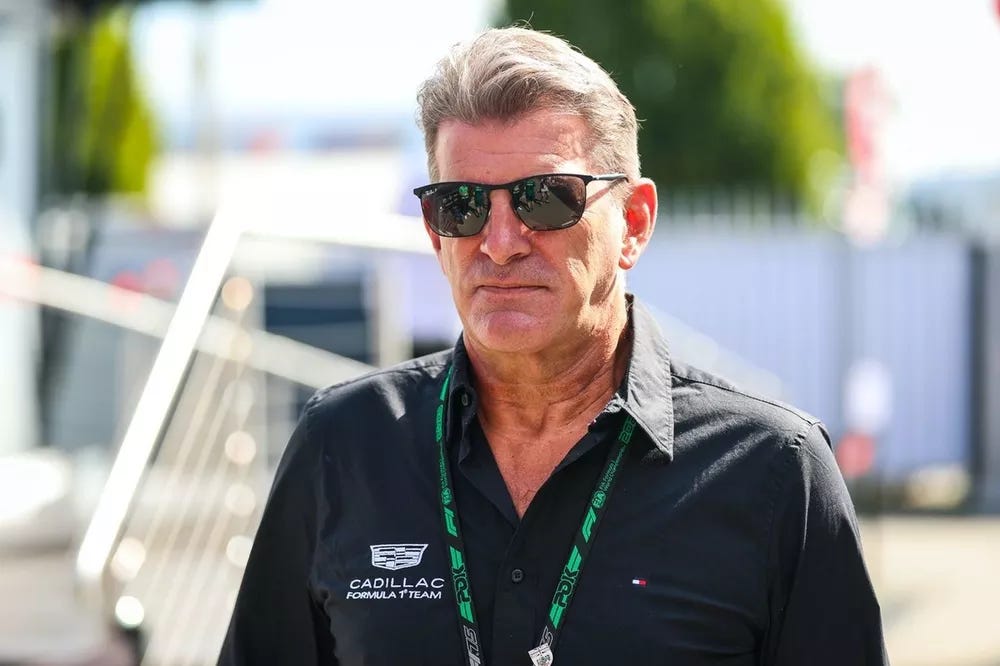
Cadillac team principal Graeme Lowdon has offered a candid account of where Formula 1’s newest team stands structurally, and the picture is one of an operation still very much under construction in the most literal sense.
The team currently operates across several sites. Its primary base is at Silverstone, where additional construction is ongoing, supplemented by General Motors facilities in North Carolina and Michigan, and access to Toyota’s wind tunnel in Cologne. The flagship project is a new 450,000 square foot F1 factory in Fishers, in the Indianapolis suburbs, which Lowdon described as very well advanced in construction terms but still some months from being operational. A power unit development facility is also being built in the Charlotte area, where GM’s motorsport infrastructure is already concentrated.
Lowdon did not pretend the situation is anything other than demanding. “It’s building the plane while flying in it, or the ship while we’re sailing in it,” he said. He keeps steel toecap boots and a hard hat on standby next to his desk. The team is still recruiting heavily. A new simulator is currently being installed at Fishers, with further announcements about the site’s phased opening expected soon.
(Source: Motorsport.com)
Audi’s Driver Development Programme, which launched officially at the start of this year under Allan McNish, is revealing itself as a more considered operation than some comparable efforts elsewhere on the grid, and considerably more thoughtful than the team’s on-track results might lead outsiders to expect.
McNish leads the programme alongside his role as Audi’s Racing Director, a position he took on following Jonathan Wheatley’s departure earlier in the season. Two drivers are currently signed: Freddie Slater, the British F3 driver, and Emma Felbermayr, the 19-year-old Austrian competing in her second season of F1 Academy.
McNish began building the conceptual framework in 2023, with Gabriel Bortoleto, now racing for Audi in F1, on the original shortlist alongside Slater. He describes the programme as “a living organism” rather than a fixed pipeline, something that must adapt as the drivers themselves develop. Slater describes McNish as “a bit like a second dad,” crediting the Scot’s willingness to debrief openly and share the perspective of someone who has made the full journey. Felbermayr highlights physical preparation and the Schreiner mentorship as the most tangible early benefits.
What distinguishes the programme from more commercially aggressive models is the explicit moral obligation McNish places on himself and the team. Felbermayr’s social media exposure was deliberately reduced in her first year to manage the spotlight at the right pace. The programme’s stated dual objective is to develop drivers for F1 and to produce F1 Academy winners, with identifying the next generation of prospects the active next step.
(Source: Formula1.com)
Grid Culture F1 — Covering the business, culture and paddock politics of Formula 1
Comments
Nothing yet. Say the first thing.
Sign in to join the conversation.