
Early this month, four year old Jusi Padlayat died from a stomach ache the medical staff in his remote Northern Quebec community dismissed as trivial. The oversight wasn’t a glitch. It’s a system; a system operating the way it always does in a country that has not yet addressed its colonial past and the inherent racism woven into it.
I spent six years in northern communities when I was young, naive, and ignorant of the realities of our country and its relationship with Indigenous peoples: three on the banks of the Mackenzie River delta and three on the west coast of Hudson Bay. I was too long blind to the privilege with which I arrived. My then partner, a Fish and Wildlife Officer, spent much of his time on the land, visiting fishing camps, connecting with the community in deep and meaningful ways. He engaged with people in their impermanent camps, joining them around their fires, eating their smoked fish, listening to their stories. He built respect, laughed often, and had a reverence for what the people were doing. A few years later, he learned of his own Indigenous heritage. The blood running through his veins recognized his own relations before he did.

While there, I worked at the CBC, scheduling the various programs into the computer in the room with the red light, the one that, if it lit up, signalled a Russian missile was on its way. Inuvik had both a Canadian Forces Base and abandoned residential schools. If you know little about residential schools, read Marie Wilson’s, North of Nowhere: Song of a Truth and Reconciliation Commissioner. Many of my colleagues were Indigenous, had survived residential schools like the ones that sat empty during those years. Knowing now what I didn’t know then about the experiences they and a generation of Indigenous children experienced in those schools is not comforting. It is horrifying.
That knowledge, when I came to it, highlighted the colonial mentality that is brought by white Canadians to the board table, the workspace, the desk of the elected official, and the medical clinic. It is the sniff of superiority, the cologne of privilege. It’s a vision so purposefully and significantly eclipsed that we feel sure of ourselves when we argue it is whole. It’s the assumed understanding, the “right way” that brooks no opposition. And it’s total garbage, written up and signed so that we can get away with it. Even when it leads to the death of a child.
The Two-Row Wampum Treaty came to be when the Haudenosaunee nation sought to live in peace with the Dutch who had arrived in their land by sailing up the Hudson River, presuming rights to what they saw as unclaimed territory. The Haudenosaunee people presented the Two-Row Wampum as a symbolic and binding agreement, ensuring each group was sovereign of its own people. The belt makes clear its message: two nations, travelling together, side by side, each strong, neither interfering with the other. “The first principle was friendship; the Haudenosaunee and their white brothers will live in a friendly way. The second principle is peace; there will be peace between our two people and disagreements will be settled through dialogue. The final principle is forever; that this agreement will last forever for our future generations to live with a calm mind.”1 It speaks to the commitment made and to a future that could be lived in harmony and is represented by a beaded belt.

The belt begins with rows of white to show that we didn’t always live together. Secondly, there will be two rows of purple wampum running down the middle of the belt. In one row is our canoe holding our ways; our language, songs, dances, how we govern, and how we celebrate our Creator. In the other row is your ship holding your ways; your language, songs, dances, how you govern, and how you celebrate the Creator. Each row will be equal in weight to show to all that even though our ways are different, they are equal. Neither of us will try to steer each other’s vessel as we travel side by side down the river of life.2
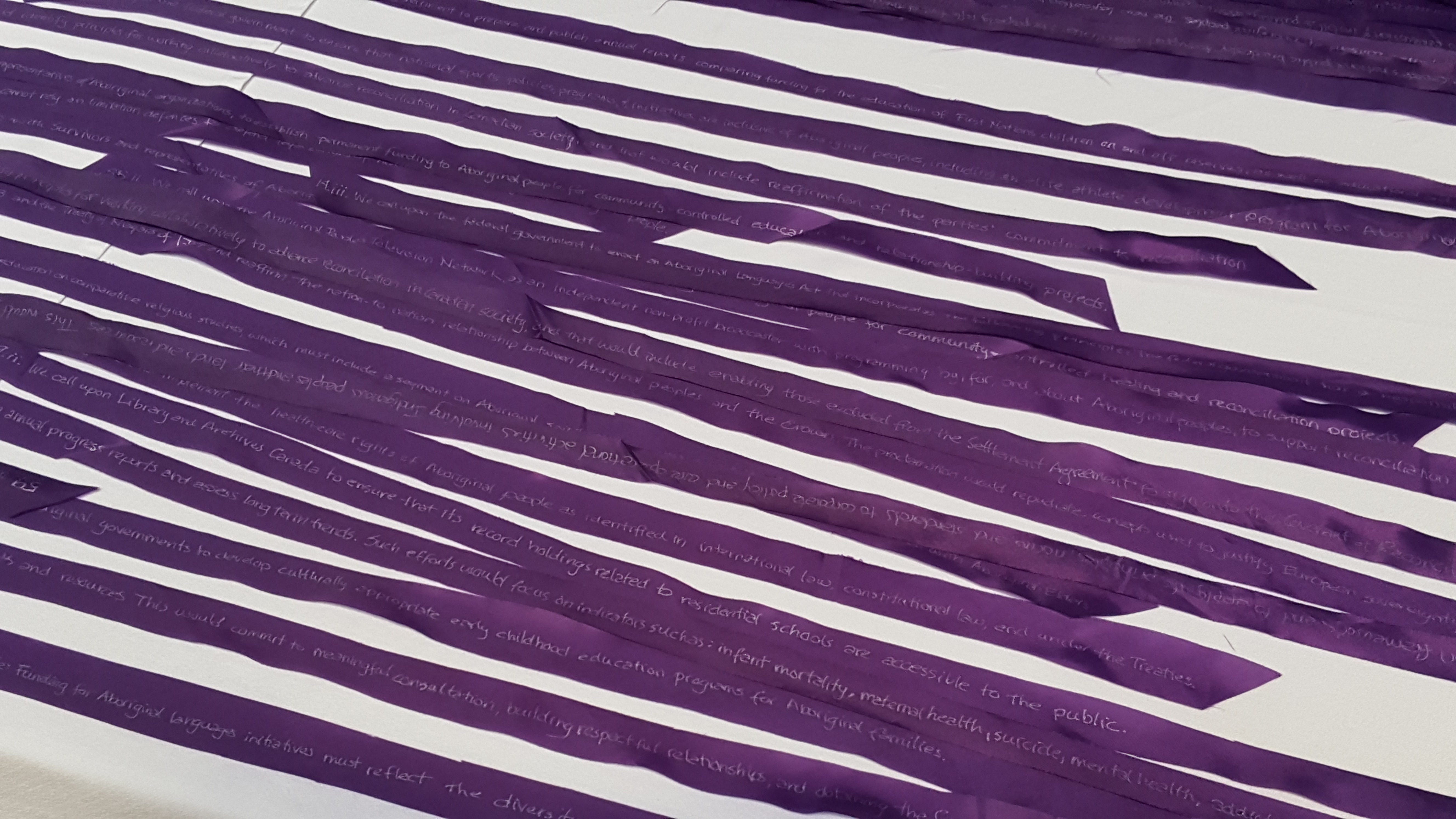
In 2018, I wrote out the 94 Calls to Action identified by Canada’s Truth and Reconciliation Commission of which the aforementioned Marie Wilson was a Commissioner. I wrote them in gold ink on purple ribbons. Not just 94 ribbons. I wrote a ribbon out for every clause in every Call to Action that had been broken down. There were 160 ribbons in total.
On one side of a long table in the middle of the church I was leading, West Hill United, I laid a narrow purple cloth. The Indigenous peoples of Canada had never broken the covenant. The purple cloth on this side of the table represented their commitment to the Two-Row Wampum and indicated their commitment was complete. Upon it, I laid the majority of the commitment ribbons, those commitments made to them by Canada, the expectations they had of the Two-Row Wampum that Canada had not yet met.
On the other side of the table, I laid those of the Truth and Reconciliation commitments that Canada had already fulfilled. Work had been undertaken and changes had already been made. The ribbons representing those commitments that had been addressed, the work completed, and policies in place, were laid, lengthwise, down the other side of the table, flowing with the intention of the wampum belt.
Though I knew what the strips would look like, the impact was stunning. Layers of ribbons lay on the “agreed upon but not yet addressed” side of the table. Less than an eighth of their number lay on the other. I still remember that moment and how hollow and horrible I felt.
When people joined me the following day for our Sunday Gathering, they were met with the image as they entered the room. During the service, they committed to the important work that needed to be done, individuals picking up ribbons from the commitments and moving them, in an act of hope, to the completed side of the table, trying to fill out the second row of the Wampum.
While liturgical engagement can be meaningful and powerful, the work that the Government of Canada still needs to accomplish, demands pressure. The commitment to engage in the work of reconciliation continues to this day at West Hill. At the time of the ribbon service, some eight years ago, West Hill’s First Nations’ Study Group had been raising the congregation’s awareness for a full decade or more. It continues to meet for years after this particular service. They have challenged, supported, marched, and raised awareness for two decades and still, in 2026, Canada’s actions would not yet find all the ribbons placed on the right side of the table, would not find the consistency of dedication to the Two-Row Wampum that it demands.
We have let indifference go on too long. The reports on Murdered and Missing Indigenous Women remind me. Jusi Padlayat’s death reminds me. Much much more needs to be done. Ribbons cannot make a difference. But awareness? Awareness is another story. Awareness surprises. Shocks. Screams. Demands answers. Bring these truths to the awareness of others. Remind them that they, too, are party to the treaties Canada holds with its Indigenous Peoples.
A report released by the RCMP earlier this year, marks the first time that police in Canada have attempted, at the national level, to identify how many First Nations, Inuit or Métis women and girls have been murdered or have gone missing. Here are the facts.
According to a 2019 report, 1,017 women and girls identified as Indigenous were murdered between 1980 and 2012—a homicide rate roughly 4.5 times higher than that of all other women in Canada. In addition, the report stated that as of November 2013, at least 105 Indigenous women and girls remained missing under suspicious circumstances or for undetermined reasons. Between 2019 and 2025, another 325 Indigenous women and girls were murdered. I can’t find the number of murdered or missing Indigenous women or girls counted between 2012 and 2019.
When it comes to convictions, in the deaths of Indigenous women or girls, double the number of cases end in a conviction of manslaughter rather than murder. Murder carries a minimum 10-year sentence. Manslaughter has no minimum sentence unless a gun has been used. When Indigenous women are killed, the men who kill them do not face the same consequences as do non-Indigenous women. Is that a complicit judicial system or are the murderers of Indigenous women accidentally killing their partners?
Thanks for reading Tangled Wonder. Please share this post so that others experiencing this grief might feel less alone in it.
If you were to come to the conclusion that Indigenous women don’t matter when it comes to killing them, I’d say you’d read the court statistics pretty accurately. But now that you know what you know, how might you raise awareness of this situation? How might we raise awareness and build the momentum that can bring about change?
The same way change has ever been brought about: one conversation at a time. This is your challenge to have the conversation, to raise the awareness, to be a force for change in a world that doesn’t cope well with change.
I wrote this Focused Moment in 2018 for the service acknowledging our commitments to Murdered and Missing Indigenous Women. Last week, when news surfaced of the death of Jusi Padlayat, seemingly from an indifference of care, it was time for me to find and share it. For all the communities, all the women, all the children, all who have suffered because Canada has failed to uphold its obligations to the Two-Row Wampum. How many times must we ask, “How Many Times?”
Thank you for being here, for sharing in this grief.
gretta
Deyhowähda·dih – Bradley Powless, “Two Row Wampum – Gaswéñdah”, https://www.onondaganation.org/culture/wampum/two-row-wampum-belt-guswenta/ Accessed August 22, 2026.
Comments
Nothing yet. Say the first thing.
Sign in to join the conversation.