
Hello! I have at age 63 finally partially succeeded in one life’s ambition: to bring forth the history of the short-lived New Music America festival (1979–90) via my Substack and little community radio shows since 2018. The section in my Substack is called “The Secret History of Music of the Eighties” (inspired by Lipstick Traces, a seminal work for me) and a complete index of every single day of all 12 festivals starts here (the NMA articles have no paywalls).
My question is: I’m 66, on pension only with few media contacts (though many NMA friends) and wonder if you’d have any ideas on how I could take this further? Having done the Substacks while living on welfare (and getting almost 80,000 views by now) has been fulfilling, but I’ve always dreamed of a radio documentary series, a book, a tour, a film, and most of all a reunion of whoever’s left of the 1,400 performer-composers for the 50th anniversary of the festival in NYC in 2029. I may live under the minimum wage, but I am relatively happy and always dreaming! Thanks for the inspiring writings in any case, Mr. Marcus! —GEORGES DUPUIS
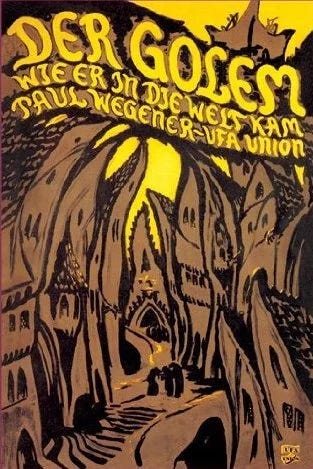
I can’t tell you how to expand your project or receive institutional support, but can say that poking around your archive turns up wonders. I stumbled on the shockingly contemporary expressionist poster for the 1920 German film The Golem and it took me back to first seeing the picture in 1964 and feeling very unnerved, as if someone had been keeping secrets from me all my life. So I can urge people to enter your generous cosmology and get lost.
Before the Beatles, did anyone ever imagine that popular music could change the world? —MICHAEL ROBBINS
All the way back. By setting romantic love against power the troubadours meant to undermine the social order, raised a vision of the world in which the church was irrelevant or ceased to exist—a vision realized in the act of love, in the seeking of the beloved, and one’s self, rather than God—and raised a vision of democracy, where each person had a song to sing, and a need and duty to find that song and sing it to the world. What would this changed world look like? What would people do? Bosch’s The Garden of Earthly Delights was an attempt to show it.
About eight hundred years later, a disaffiliated assemblage of heretics, all raised in the church, stumbled upon the old call, and took up the personal, portable, mostly stringed instruments they could use to tell their stories, and acknowledged a need and a desire to tell stories—to tell the world how the world looked to them—and swept the country and then the world. Do you think Little Richard singing—announcing—hoping?—“All around the world, rock ’n’ roll is all they play” wasn’t an argument that music had already changed the world, or an argument that it could?
I imagine that the first person to really understand that music could and already had changed the world was Elvis. He looked out from the stage and saw a world that he had never seen before, that he could not have expected to see, and realized this was something he had called for and made. He knew perfectly well it was political, that it was revolution without a cause beyond itself: permanent revolution. You can hear it in his voice, his words, as he stands on stage in Tupelo in 1956 for an all-Mississippi homecoming with the crowd so possessed with itself he sounds genuinely afraid that it might consume itself as he introduces “Blue Suede Shoes,” in a phrase that showed how he understood and had embraced the song to its toenails: “This is a song that says you can do anything. But don’t. Just don’t.”
Did rock ’n’ roll end racism? Of course not, as all the black musicians who suffered arrests and violence can testify—as all the blues musicians dead or alive could have testified when Eric Clapton, whose life was saved by the sounds of black Americans, condemned black people—but it dramatized and argued for its absurdity. Elvis knew that when on stage he described his songs as a gnosis that had always been there, announcing one song as something he recorded “back around the time the stock market crashed”—which meant, what? That in his subconscious, or under his tongue, he was saying rock ’n’ roll had caused it?
Changing the world was what rock ’n’ roll was for. It emerged simultaneously in urban centers all over the country because of a feeling, an itch, an intellectual conclusion reached, that the world had to change, which meant it had to be changed, and by singing a song you could enact that change and show people what it looked like.
This is not grand utopian fantasy. It’s simple social fact. And facts, as John Adams said, are stubborn things. Or, as Ronald Reagan put it, stupid things. Like “doo-wop do wah, doo-wop doo wah, doo-wop do WAH”—you know, the beginning of “In the Still of the Night.”
Hi Greil, I know you mentioned Charlie Gillett a couple of months ago. I was wondering if you realised just how important Charlie was in the UK.
When The Sound of The City was published in ’71 I was 17 and genuinely thought that apart from Elvis, the Music World started with the Beatles. No one on mainstream British radio played American music from the ’50s. You couldn’t buy the records. Then this book arrived opening up a lifetime of listening, from Louis Jordan and Amos Milburn onwards.
Charlie then started Honky Tonk on Radio London, playing the sounds of the book. It literally changed the lives of many people. 10 years later Charlie started playing global music on the radio (especially West African) and once again introduced a completely unknown music to the UK.
My question is: Did The Sound of The City land in the US in a similar way?
Please keep well. —RICHARD
Robert Christgau gave a talk on just this question at an EMP conference some years ago and you might look for that on his website. Certainly the book was a shock to me—from the scribbled charts on the cover to the cast of characters I’d never heard of that in Gillett’s telling were central to a story I thought I knew. That I then embarked on a desperate search for the obscure 1950s 45s (no internet, no reissues or archival collections—you had to track down collectors or wait for the right people to read Charlie’s book and get on the case) and found that that many of his crucial fulcrum records really weren’t that great didn’t matter. He both structured the story and opened it up. The hundreds of histories and revisions that followed all go back to this shocking and epochal book.
Hi Greil, Long time fan. Here’s my very simple question. You are in some ways a California writer and I’m wondering if you have any thoughts about Lana Del Rey? She frequently invokes CA mythology (the name itself sounds very old Hollywood, old CA), and at times she seems to invoke Laurel Canyon and Joni Mitchell. I think she’s brilliant, for example the mixture of longing and filth in “White Mustang” or the numb romantic vision of “Video Games.” It never feels ironic but often troubling yet beautiful. Would love to hear your take. —JOHANNES GORANSSON
I’ve written a lot about Lana Del Rey in my Real Life Rock columns and this little forum: she’s one of the most sustaining and sustained performers around that I know of. I love all of her albums and favorites constantly change—and yes, her project of rewriting California, especially the Beach Boys—maybe reinscribing is a better way to say it—is a big part that for me. But from the time I saw her so-mocked first appearance on SNL, I found myself saying, This is interesting, this is different, what’s going to happen next? And then the killer “Young and Beautiful” and all the ways it’s threaded through The Great Gatsby and the story started all over again.
Some time ago, I asked how and why Warren Zevon wasn’t in the R&R HoF. You answered perfectly. And now WZ is finally in. I have the same question about the J. Geils Band. Totally deserving, in my view. Thanks. —VINCENT VIAGGIO
Peter Wolf is an insufferable jerk, as his autobiography, Famous People Who Have Met Me, attests all too well, and that may have gotten in the way of appreciating that his singing on John Lee Hooker’s “Serves You Right to Suffer” is a lot more convincing than it needs to be. That may also get in the way of Magic Dick’s harmonica playing, which ought to get the band through the gilt-plated doors all on its own. And it could be that the whole idea of a white blues band is today just too embarrassing to credit, even though the Paul Butterfield Blues Band and Fleetwood Mac made their own contributions to the form and even the language. Which is to say nothing of the J. Geils Band as they were once described as “the Coasters with an ’80s follow through” for their Top 40 hits “Love Stinks” and “Centerfold,” which are fine enough to burn the Rock Hall down, which it half deserves for establishing its special Garbage Wing and then integrating its inductees along with the Coasters.
I’ve been cynical about the HoF since before it opened. But I’m also aware of how much inclusion and even more so exclusion means to performers, especially those, like the members of the Shangri-Las, who have never been nominated. I’ve looked the late Mary Weiss in the face and seen the pain all through it as she talked about the sense of erasure that brought. So while it would devalue anyone good to be in a hall of fame that includes Journey, I’d vote for the J. Geils Band in a second—I do vote every year. And maybe not vote for anyone else to give them the tiniest leg up.
Came here to ask if there will ever be an update on the Rock and Roll Death Index. And if Lennon was a perfect 30. Yeah, I've been reading your stuff that long. —JOE FITZGERALD
No. That walking tumor who shot John Lennon threw the whole system out of whack and showed how sick it all was.
Most of us are familiar or at least have heard of rock’s “27 Club”—a litany of rock stars who died at that age—and every July one can mark the anniversaries of both Rolling Stones Brian Jones’s and Doors frontman Jim Morrison’s deaths, two years apart, in 1969 and 1971, respectively. A lot (too much) has been written about these doomed stars over the years with there being some speculation that in the cases of Jimi Hendrix and Brian Jones, it was not accidental OD from drugs, but murder most foul to blame while Morrison and Janis Joplin may have shared the same French Connection heroin that led to their deaths.
The “had they lived” what might have beens are all intriguing:
Would Brian Jones have formed a supergroup band after getting fired by the Stones?
Would Hendrix and Joplin have both continued their quest for more ambitious artistic musical outlets?
And what would the Doors’ last two albums they were obligated to record for Elektra have sounded like with their lead singer? No amount of AI today can cover up the fact that those songs w/o Morrison were just not good enough and on the rare occasions when Jim was sober, he not only made the Doors material better with his vocals, but also his songwriting and creative input.
Your old Rolling Stone colleague, Ben Fong-Torres, conducted one of the last interviews with Morrison in February 1971, and listening to the recording of it recently, I was struck by the fact that not only was Jim sober for once, he was well spoken, articulate, and committed to recording those remaining two albums (they had just finished recording LA Woman by then) before he suggested that all four band members would get a chance to pursue solo projects, e.g., film for Morrison, jazz music for drummer John Densmore, etc. He certainly didn’t sound like a guy on his last legs when discussing his future, and I don’t think any of the aforementioned rock casualties, while certainly contributing to their own deaths, wanted to check out just yet and all had ambitions ahead of them. Your thoughts? —JAMES R STACHO
There are books lining out future careers for all the people you mention and a lot more. Some are almost convincing. But if we look at the history of pop music, where it’s by definition a question of widespread if not mass attention, fame, and money, there are very few careers that are sustained over any substantial period of time as creative endeavors that countenance the world beyond the intent that they seemed to define and which defined them. I’m not talking about performers or bands that continue forever replaying the same hits with a changing or even static cast, whether we want to call them legacy or legendary or hack or has been acts. Who continues to engage with the world, the form, themselves? Who has escaped the prisons of excess, flattery, theft, fraud, conspiracy, self-delusion, riches, bankruptcies? I’m not talking about musicians in other fields, like Miles Davis, or artists in other realms, like Martin Scorsese or Gerhard Richter. I’m talking about Bob Dylan, who is both a world figure and a cult artist, Randy Newman, who is a misanthrope working within a bubble of Toy Story money (his recent duet with Taylor Swift on “You’ve Got a Friend” is both fulfilled and perverse from both sides), Elvis, for that brief rebirth in 1968 and the epic musical drama that combines “That’s All Right” and “That’s Not Alright” aka “If I Can Dream.” Who didn’t use themselves up, who wasn’t used up?
The new film Peter Asher: Everywhere Man is a portrait of somebody who outlived and escaped fame and went on to a second career, a second life, and is still around to tell the tale. Otis Redding was peaking both artistically and in the market when he died. He might have gone on to different things, even in different fields. Jimi Hendrix had worlds to conquer and the politics of the years to come might have destroyed him, marginalized him, or allowed him to trivialize almost anyone around him, especially with that album he made with Jim Morrison and Charlie Parker and Amy Winehouse on Buddy Holly’s Prism label.
We could go on. What do you think?
I loved . . . and continue to love . . . Bob Dylan’s Chronicles. It’s a book I’ll gladly reread every few years, and find doing so is much like getting reacquainted with a longtime friend. That Dylan perhaps played loose with the facts is secondary compared to the joy I get from reading this book. In the end, I doubt any life will be harmed or worsened because of Dylan’s omissions and embellishments.
I also continue to enjoy The Philosophy of Modern Song . . . but not quite as much or as often. Unlike Chronicles, I can only read PoMS in small doses. Dylan’s battle-weary, grizzled, blood-feud-fighting Civil War general persona begins to wear thin after two or three entries. Also, unlike Chronicles, I sometimes wonder if parts of PoMS were written by the same writer(s) who helped script the Theme Time Radio Hour programs. Still, I’m glad Philosophy of Modern Song is around for when I’m in the mood.
So, I was initially glad to learn that Dylan would be releasing new prose via his Patreon platform (for those with a paid subscription). Based on the titles, it sounds as though these works come in the form of imagined unsent letters from one historical/cultural figure to another.
Based on their titles, these pieces are often between people who lived in different periods from one another (Harry Houdini & Jackie Wilson, Gene Vincent & Charles Darwin, Benjamin Franklin & Marlene Dietrich) or between people who had no known connection (even if they shared the same oxygen). These pairings often feel as though they stepped out of unused or unwritten verses of Dylan’s “Desolation Row.”
However, just about as soon as my interest in these Patreon pieces was piqued, a deluge of articles and comments from bewildered, head-scratching folks appeared, with most complaining that these Patreon offerings were entirely AI generated. And that was enough to keep me from plunking down $5 a month for a Bob Dylan Patreon subscription.
From perusing Dylan’s Patreon site, it looks as though these pieces are “curated” by Bob, with no claim of Dylan actually writing any of them. It also looks as though the Dylan Patreon page has less than 2,000 paid subscribers, so I’m guessing I’m not the only one who’s been hesitant about taking the Patreon plunge.
Have you read any of these Dylan/Patreon letters and stories (or know of anyone who has)? If so, are they worth reading . . . or are they AI slop . . . or are they something else entirely?
Thanks always for this column. —BILLY INNES
I’ve started a few of these Plato-to-Eddie Cochran (never forget his home state) numbers but came away thinking the correspondences were Dylan’s ideas and the text was by someone or something else. Chronicles is so WRITTEN—you can feel the thought and choice that went into every sentence. Philosophy had that noir snap. There are real books and there is marking time.
Ernest Hemingway once said that the true ending of Mark Twain’s The Adventures of Huckleberry Finn is when Jim is recaptured and the rest is just cheating. I find it hard to disagree. The book became very painful to read when Tom Sawyer recentered the picture. I found it hard to believe that Jim would take Tom’s treatment of him with as much passivity as he appeared to (broken teeth and all) and it wasn’t even funny by Twain’s own comic standards. Ultimately, getting shot with a flesh wound didn’t seem like the right kind of karma for Tom. I didn’t even read past the chapter of Jim’s recapture when I re-read the book earlier this year. Do you agree or disagree with my take? And if you disagree, what is it you think I’m missing? —BEN MERLISS
You take your place in a long line here. It’s one reason Percival Everett had to rewrite Huckleberry Finn as James, in the process saving the book from itself and the country from the book. But think of it this way. Twain opened the story with this: “Persons attempting to find a motive in this narrative will be prosecuted; persons attempting to find a moral in it will be banished; persons attempting to find a plot in it will be shot.” But he didn’t say “Persons attempting to keep the author in the style to which he and his family have been accustomed to will be refused.” The Adventures of Tom Sawyer was a great commercial success and The Adventures of Huckleberry Finn was the basic commercial move: a follow-up, a sequel. It was also an attempt to save Tom Sawyer from itself and the country from itself. But it wasn’t going to work: all the fourteen-year-old boys reading the new one were paging ahead to find out where Tom was. So Twain had to wheel him in and let him fuck everything up. Maybe he was hoping some people would get the joke, see through what was happening. But it was just another book and he was risking everything on getting Grant’s memoirs into print and I imagine he didn’t look back.
First of all, sorry to hear about your health issues. Hope you’re on the mend. My family has had a lot of them this year. Not fun.
I wrote you a couple of years ago and you published a lot of what I wrote and responded to it, which I really appreciated. I have many, many things I’ve wanted to check in on, but I’ll keep this short and hit you with the rest of ’em some other time.
Actually, I am attaching something pretty long that I think you might be interested in. It’s a letter I wrote to Ron Rosenbaum regarding his Things Have Changed book on Dylan. I never write these kinds of letters but there are so many egregious mistakes in his book, never mind his thesis, that I felt like I had to do it. I wonder if you’ve read it. (You needn’t bother, really.) I want to send it to him but I don’t know how to reach him. Trying to track him down through his publisher.
Just a couple of things I wanted to ask and comment on aside from the letter. You may have been asked about them already and I just missed it but in any case . . .
Did you ever see Hendrix? I’m wondering if you might have seen one of the shows he played in Berkeley in May of 1970. I don’t think you’ve written much about him, apart from his SSB performance at Woodstock and your mention of “Little Wing” in Mystery Train. I just wondered if you ever saw him and how it felt.
I’m also wondering what you think of Another Side of Bob Dylan, and what you thought about it when it came out. I’ve been listening to it for the first time in years and I think it’s a really weak album, although it obviously does have a few great songs. The contrast with The Times album, which of course was released only months earlier, is so stark. I’m curious as to how you felt as a fan upon first hearing it.
Also wanted to say that I strongly agree with many of your comments on the Tour ’74 box set. It’s amazing how much better the LA version of “Rolling Stone” released on Before the Flood is when compared to the other performances from the tour. There are some good ones but none as relentless and dynamic as that one. In fact, it might just be my favorite of all the versions he’s ever performed, including even the ’66 performances. (I’m glad I can hear all of them, though. I wouldn’t want to have to choose just one!) From ’66, I think the best ones are from Manchester (of course!) and from Edinburgh. The whole Edinburgh show is fantastic, and the audience seems to have been one of the best on the tour. (In fact, if I remember correctly—I’m not going to check it right now—he says something like that at the end of the show.) The 1966 box set is a gift from God!
I’m also curious about what you think of Springsteen’s (and Landau’s) embrace of “dynamic pricing” (George Orwell would be proud!). Springsteen was about the last guy with any integrity out there but for me he started to lose it with his Super Bowl Chevy ad, and the pricing thing is outrageous. I still love Bruce—his 1978 show was the best I’ve ever seen or hope to see—but it’s really disappointing to me. I wonder what Dave Marsh (former publisher of Rock & Roll Confidential, where he used to call this kind of stuff out) thinks. I have no doubt he thinks it’s OK, since Bruce can do no wrong in his conflicted eyes. I will say that I do very much respect him for going after Trump so strongly. We are living in dangerous and depressing times. Helicopters were hovering over my house last fall when ICE came to Chicago—it was sort of unreal to have them in my face when I walked the dog.
Finally, I saw the Who in Chicago last fall and they were embarrassingly awful. The sound was ridiculously bad, for one thing. Townshend himself said from the stage that if he was in the audience he’d ask for his money back! I’d left by that point, though. I wish I knew how to get in touch with him. I’d give him my Venmo info! The sound issue was especially annoying because I read later that they did a soundcheck for “VIPs” who paid even more money than the already ridiculous ticket prices for the privilege of being there. Maybe if they’d done a real soundcheck they could have fixed the problems.
Well, not as short as I meant it to be! Apologies!
Thought I could attach the Rosenbaum letter but now I can’t figure out how, so I’m just going to cut and paste it because I’d like you to see it, making this submission even longer. Maybe it’s too much. Up to you just how far you’d like to go in!
Here’s the letter. The Neuwirth reference is to a story he tells about Neuwirth putting him down—quite appropriately! I tried to be nice in the letter rather than ripping him. Enough bad vibes out there these days!
To: Ron Rosenbaum
Re: Your Things Have Changed book.Dear Mr. Rosenbaum,
It’s hard work to write a book. I’ve never written a book. So you have my respect for the work you’ve done.
But, as I read your book, I found so many errors and questionable assertions that I felt I needed to write to you.
If this comes across as sarcastic or dismissive I apologize. I’m not gonna go all Neuwirth on you, but it’s hard not to call you out sometimes. Apologies if you’re offended but it is what it is, as they say.
You describe yourself as “an investigative writer . . . who deals with the unexamined or poorly examined,” and yet your book is full of poor examinations and many factual errors. Never mind your thesis, which I will comment on later. You have a right to that and you make your case, such as it is. But it’s hard to believe that a book with so many basic factual mistakes could even be published. Here’s a list of some of them, in no particular order . . .
“Love Is Just a Four-Letter Word” is indeed a great song. Too bad that Dylan never recorded it, even as a demo, never mind releasing in on Bringing It All Back Home! I wish he had! How can you make such a basic mistake? How is it that no one catches it before the book is published?
Dylan’s early ’60s girlfriend’s name is Suze Rotolo, not Rutolo. This mistake is made more than once. Every serious Dylan fan knows or should know this.
The Tour ’74 inaugural show on Jan. 3 in Chicago did NOT open with “Most Likely You Go Your Way (And I’ll Go Mine),” although it was the opener—and closer—for most of the concerts on that tour. It was the LAST song he played that night. You were there but you don’t know that? The opener—on this night and the next—was “Hero Blues,” originally recorded in 1962 but never officially released. (When asked about it Dylan responded “Gotcha, huh?”) It was the perfect song with which to open the tour, and it rocks hard.
George Harrison did not write a song called “Something There Is About You”! Duh! That’s a Dylan song. Harrison’s song is called “Something.” I’d say that’s pretty well known!
The Beatles and Dylan were not “close friends”, though that might describe his later relationship with George Harrison. And the Beatles were certainly not “flabbergasted” by Another Side of Bob Dylan. Who would be? It’s a minor and transitional album. It was The Freewheelin’ Bob Dylan album that brought him to their attention and blew them away when they heard it in Paris in early 1964. Again, this is well known. Many people have written about it over the years and various Beatles have talked about it in interviews.
Dylan was not “jump started” by Rubber Soul. He had already recorded and released Highway 61 Revisited months before Rubber Soul came out. And he was certainly not “jump started” by Revolver! Blonde on Blonde was released before Revolver. The next recordings Dylan made after the release of Revolver were the Basement Tapes, which are hardly influenced by the Beatles. He was inspired by the Beatles’ early stuff—1963–64—which led to him “going electric.”
It’s true that Dylan never recorded a version of “The Death of Emmett Till” after the Witmark demo in December of 1962, but it was recorded six times before the demo, including three times on radio shows. All of these recordings are available on bootlegs. The song was not “re-discovered” in 2007. It was well-known well before that. Anyone who wasn’t aware of it has no business writing a book on Bob Dylan. Moreover, Till was murdered in 1955, not 1956. It’s unlikely that this mistake is a typo, since it’s made more than once in your book.
Regarding the Forest Hills concert in August of 1965 . . . who exactly has called it “the greatest Dylan concert ever”? I’ve read an awful lot of criticism on Dylan and I’ve never seen that. In any case, anyone who would say that is either a fool or deaf. Every 1966 concert is better, every 1974 concert is better, every Rolling Thunder Revue concert is better, etc., etc., etc. If you want to go back to his pre-electric concerts there are the Town Hall and Carnegie Hall shows in 1963, the Halloween show in 1964, and the Gaslight Cafe performance in 1962, to name a few. All of these put the Forest Hills show in the shade. Sure, it’s subjective, but the tapes tell the story. The electric set at Forest Hills isn’t actually even very good, much less part of “the greatest Dylan concert ever.” How could it be? It was his first time playing a full electric set and he played it with a group of musicians who had never played together before. The show pales when compared to literally hundreds of other Dylan concerts.
Also, the Forest Hills show most definitely did NOT feature the first public performance of “Like A Rolling Stone,” as you state more than once in your book. That occurred at Newport a month earlier. The film A Complete Unknown (which you refer to on the first page of your book) leads up to and ends with this moment, which is one of the most famous moments in Dylan’s career, and indeed in the entire the history of rock ’n’ roll! How is it possible that you don’t know this?
Your statement that there was no booing at Forest Hills except for when a fan ran on to the field is easily disproved by even a cursory listen to the performance (available on bootleg). Some in the audience do cheer, but the recording includes lots of booing after every single song in the electric set. Dylan even says “Aw, come on” at the end of “I Don’t Believe You” as fans yell “We want Dylan!” If you were there it’s hard to understand how you wouldn’t have heard this.
“Like a Rolling Stone,” by the way is not “contemporaneous” with “Sympathy For The Devil.” “Rolling Stone,” of course, was recorded and released in 1965. “Sympathy” was recorded and released in 1968.
A minor point, but worth mentioning . . . in “Desolation Row” Dylan doesn’t sing “sellin’ postcards of the hanging”. It’s “sellinG”. Along the same lines, Dylan doesn’t have Hattie Carroll “emptying ashes” in “The Lonesome Death of Hattie Carroll,” it’s “ashtrays.” I do like your many references to the line “on a whole other level” throughout your book, though. It’s the best line in the song.
Regarding your reference to Adolf Eichmann and the murder of “five million Jews”, you’ve lost another million somewhere. It’s SIX million, as most everyone knows and as Dylan himself references in “Talkin’ John Birch Society Blues.”
You also offer many opinions in your book, which I would argue are often dubious, to say the least. To wit . . .
You describe Sid Vicious as “gentle.” That’s a first! Are you kidding? He was aptly named! He attacked the writer Nick Kent with a tire chain! Maybe he had some problems, maybe some things he couldn’t work out, but he can hardly be described as “gentle.”
You speculate that Dylan’s “I could not get across” in “It Takes a Lot to Laugh” might actually be “I could not get a cross.” Again, are you kidding? That reading doesn’t even make sense in the context of the song. No way.
You believe that a member of the audience yelling “Rock ’n’ roll!” is “heavier than a member of the audience yelling that Dylan is ‘Judas’”? Wow.
You write that the only songs from the Basement Tapes that “belong in the pantheon” are “This Wheel’s On Fire” and “I Shall Be Released.” Have you never heard “Tears of Rage”? Not to mention “Down in the Flood,” “Million Dollar Bash,” “I’m Not There,” “Clothes Line Saga,” or “All You Have to Do Is Dream”? These all belong, along with many more.
You write that Planet Waves is “Dad Rock”. First of all, what exactly IS “Dad Rock”? You don’t define it. But whatever your specific definition of that term is, I get the drift and I don’t think so. “Tough Mama”? “Going, Going, Gone”? “Never Say Goodbye”? “Hazel”? “Something There Is About You”? “Dirge”? These songs are “Dad Rock”? No.
You write that “Wedding Song” is “for all too many all the Dylan they know.” Really? Not “Like A Rolling Stone,” “Mr. Tambourine Man,” “The Times They Are A-Changin’,” “A Hard Rain’s A-Gonna Fall,” “Blowin’ in the Wind,” “Knockin’ On Heaven’s Door,” or “Forever Young”? (To name just a few!) I’d argue that “Wedding Song” is actually pretty obscure.
You say you were in attendance at Electric Lady Studios when Dylan and John Lennon co-produced a session for David Peel. Seems doubtful to me. Lennon was wearing a “Free Bob Dylan” button around this time, and he’d put Dylan down by referring to him as “Zimmerman” on the Plastic Ono Band album not so long before any Peel session. Is it likely that they would have been working together at that time? Again, you say you were there, but of course you were there at Forest Hills and you say there was no booing, and you were there at the first Tour ’74 show in Chicago and you think that he opened with “Most Likely You Go Your Way and I’ll Go Mine.” Neither of these statements are true, so I think it’s fair to doubt your Peel story.
I’d love to know what was actually recorded at this supposed session, and whether anything from the session was ever released. Lennon worked with Peel, that’s well known, but I’ve never seen any reference to Dylan and Lennon working with him together, and I’ve read pretty much everything worth reading on Dylan and on Lennon. So, with all due respect, I have to question your recollection. It’s hard to know how to deal with this, really. It’s not like you’re just reporting that it happened, you say you were actually there. Were drugs involved? Perhaps it was a hallucination. Seriously, I don’t know how else to explain it. Memories fade over time, so it’s understandable that you might misremember the opening song of the first concert of the 1974 tour. But it doesn’t seem possible that you would remember being at a session with Bob Dylan and John Lennon if it didn’t actually take place. You clearly believe that it happened . . . but where’s the evidence? If I’m wrong about this I stand corrected and I apologize, but I’m dubious about it and I’d love to see some proof. In the end, I guess I have to give you the benefit of the doubt, but it doesn’t sound right to me.
You write that you have a “proprietary feeling” about your 1978 interview with Dylan. Why? Describing Blonde on Blonde as “thin, wild, mercury music . . . metallic and bright gold and whatever that conjures up” is perfect, but it’s Dylan’s description, not yours. Sure, you asked the questions, but Dylan supplied the answers. They’re HIS words.
You also write that you “still feel somewhat guilty” about perhaps starting Dylan on “the Jesus path” in ’78. How, exactly, would your interview have done that? You’re giving yourself way too much credit, or blame, as you would have it.
Dylan’s Nobel Prize speech mentions Buddy Holly rather than Woody Guthrie as “the dawning of it all” because he heard Buddy first. Simple as that. His Guthrie obsession came later.
Not to judge too harshly, but does your description of your editor Julia Zafferano as “open-minded” mean that she doesn’t think fact-checking is important? What kind of editor allows so many mistakes in a book?
How exactly does the term “Dylanologist” “barely conceal an ignorant sneer”? It’s a pretentious term (A. J. Weberman’s, of course), but I don’t think there’s any sneer implied in it. Is “Bobulator” any better? (Glad you are “recovering”, by the way. Who would want to be known as a “Bobulator”?!)
Dylan tipping his hat on the cover of Nashville Skyline is “ambiguous”? No. He’s saying hello, not goodbye. It’s a welcome—just look at the smile on his face! You’re reading meaning into things that have no special significance.
You write that in the early ’70s downtown NYC “seethed with secret theories about his disappearance from the scene after the (later debunked) motorcycle accident.” I don’t think this is true. It may have been true in 1967, but I don’t think anyone was thinking too much about this in the early ’70s. I mean, by the end of 1970 he’d released four post-accident albums so his “disappearance” was relatively short-lived (only about 18 months). I wasn’t there, so maybe I’m wrong, or maybe it’s just the people you hung out with. In any case, the accident hasn’t been “debunked” either. He had an accident. How serious it was is another question, but it was certainly a watershed for him and led to changes in the way he chose to live. “Seethed” is an interesting choice of words here. A strange choice.
In what way is the film I’m Not There “focused on celebrity”? I don’t see that at all and I’ve never heard of anyone else seeing it that way.
What are you talking about when you refer to the “motorcycle-black leather-jackets-and-shades Dylan of early album covers”? On the cover of Highway 61 Revisited Dylan is wearing a Triumph Motorcycle shirt, and he has shades in his hand, but that’s the closet any of his album covers comes to your description. And there’s no black leather in sight.
On to your opinions regarding Dylan’s “Born Again” period and his involvement with the Vineyard Christian Fellowship . . .
You maintain, first of all, that much of Dylan’s career amounts to an argument with God as to why He or She or Them or It permits the kind of suffering and pain that millions of Jews experienced in the Holocaust. I disagree and I don’t think you make the case. Some of his songs might be seen that way, but hardly a majority, let alone his whole career.
Regarding his “Jesus” period (1979–81), you of course believe that Dylan was “brainwashed” by the Vineyard Christian Fellowship during this time and you’re not shy in making that case. (I do understand that this is what the book is all about, so of course you try to make the case.)
Some of your characterizations . . .
Dylan as a “lapdog of dogmatists.”
The Vineyard Christian Fellowship as a “mind control sect.”
The Vineyard “stole his soul”, and “turned him into a puppet.”
The Vineyard as “those who stole his soul” and “turned him into a robotic preaching automaton.”
“The born-again Jesus freaks stole his soul for three years.”
Dylan had confidence “before the Jesus freaks stole his soul.”
The “sacrifice of his soul” to Jesus.
The Jesus freaks “exploit his misery and steal his soul.”
The Jesus “betrayal.”
Dylan’s born again period as a “catastrophe” and a “cultural crime.”
Dylan “escaped somehow.”
Dylan “re-emerged from these shackles.”
Dylan “eventually recognized it and waged a struggle” to recover.
This period is the “incontestably ludicrous low point Dylan’s career—his three years as a Jesus-freak scold.”
You also write that after watching the concert “preaching” videos from this period “any empathetic human being will be horrified about WHAT’S BEEN DONE TO HIM” (my caps).
Again and again, this assertion that Dylan was “brainwashed” during this time. It’s sort of offensive, really, because it characterizes Dylan as a man with no control over his own life . . . for three years!
You write regarding Sean Wilentz, Greil Marcus, and other critics and writers that “few will let Dylan be Dylan.” This is actually a perfect description of what you do in the book. It’s YOU who won’t let Dylan be Dylan, because you are making the case that Bob Dylan (of all people!) had no agency for three years, that he was completely under the influence of others, people who “stole his soul.”
You also write that you “will accept no temporizing about this theft.” Well, I guess that settles it then! But no, not really. Unfortunately, you have to accept that not everyone shares your opinion. In fact, you have to accept that Dylan himself doesn’t see it that way. I don’t know what it is that so angers you about this period in Dylan’s career but obviously it burns you up. You can’t accept the idea that Dylan himself charted that course, that he knew exactly what he was doing and sincerely had the feelings he had at that time.
I think it’s worth noting that Dylan has always been absolutely secure in his own opinions and actions. He has never cared about what his audience may expect or what critics say. If he was unduly influenced by others from 1979 to 1981 then that would be the only time that’s happened in his 65 years as a recording artist. I don’t believe that it did.
It’s also worth noting that Dylan has always, throughout his career, been interested in God, and in Jesus. The Old Testament God is of course referenced in “Highway 61 Revisited” (“God said to Abraham ..”), but Jesus is in many songs sung or written by Dylan well before his “Jesus period”, including “Jesus Christ” (Woody Guthrie), “People Get Ready” (Curtis Mayfield), “Masters of War” (“Even Jesus would never forgive . . .”), “Sign on the Cross,” “Shelter from the Storm” (“They gambled for my clothes” . . .), “With God on Our Side” (the reference to Judas Iscariot). There may be more examples—these are off the top of my head—but in any case, it’s clear that Dylan was always interested in Jesus.
Regarding “Mississippi,” it was first recorded in October of 1996 for Time Out of Mind. Why would Dylan wait 15 years before recording what you see as a mea culpa for his Born Again period? And it wasn’t released until 2001 on Love and Theft, which means that he didn’t offer that supposed mea culpa publicly until twenty years after the period in question. Does that seem likely?
More specifically, Clinton Heylin’s research (published in Still on the Road) has shown that the song has its roots (well, more than just its roots) in a chain gang song called “Rosie,” “collected” by John and Alan Lomax and released on record in 1934. The song includes the line “Ain’t but the one thing I done wrong / Stayed in Mississippi a day too long.” That’s that, wouldn’t you say? It’s not a song about the Jesus period. It has nothing to do with that. The line you cite was taken whole from another song that Dylan didn’t write!
Again, you’re reading things into Dylan’s work that simply aren’t there. “Mississippi” is not a song about a “mental state of enslavement.” The line “You can always come back, but you can’t come back all the way” isn’t “fairly explicit.” It’s not explicit at all. What you are seeing and hearing is your own projection of what you want Dylan to say and think. He’s never disavowed the work he did in this period, in songs or in interviews.
You’re entitled to your opinions, of course. But I would argue that the facts don’t really justify them. You don’t have to like the songs and you can deplore his “preaching”, but you can’t say with any credibility that he was “brainwashed” at the time he recorded those songs or did that preaching.
As far as the factual errors I pointed out, there’s no excuse for them. We’re not talking about obscure facts: these mistakes are basic. As I wrote earlier, to state that “Love Is Just a Four-Letter Word” appears on Bringing It All Back Home is such an obvious mistake that it’s almost impossible to believe it made it into your book. All of these many mistakes mar the book and diminish your credibility.
One other thing I wanted to note. I offer it not as any kind of I-know-more-about-Dylan-than-you-do gotcha but just because I think you would be interested and I doubt you’re aware of it because if you were I think it would have been in the book.
This is in regard to Salinger’s influence on Dylan (which I do believe is real). At the Royal Albert Hall concert on May 27th, 1966 (the last show of the tour, and Dylan’s last official concert for almost three and a half years), he refers to Salinger in his introduction to “Just Like Tom Thumb’s Blues,” where he tells the audience that “. . . you can just go out and read some books . . . read J. D. Salinger!”. You should check it out, it’s on the Live 1966 box set.
Again, I offer all of this criticism respectfully. I hope you take it in the spirit in which it’s given . . . and perhaps make some factual corrections in the next edition of your book.
—MICHAEL MERTZ
I’m sorry if your compendium of stupefying errors in the Rosenbaum Dylan book doesn’t reach him or his publisher. I wrote a paragraph about the book and how awful it was in the December 2025 number of my Real Life Rock Top 10 column here. I’d started a list of mistakes and repetitions and self-references but it was like looking at the Augean Stables. You’ve done heroic work in the annals of what might be called anti-writing.
I kept missing Jimi Hendrix, arriving late (San Francisco) or leaving early (Woodstock).
I can’t believe Pete Townshend and Roger Daltrey really need the money.
Things people miss about Another Side of Bob Dylan: he looks Byronic on the cover. “My Back Pages” is a wonderful piece of rhythm but lives its real life in the hands of the Byrds and at the Dylan 30th anniversary concert when everyone on earth who was male and ambulatory sang it in turn as if they’d waited years for the chance. When it’s funny—“Motorpsycho Nitemare”—it’s really funny. “It Ain’t Me Babe” seems like a signal performance, but what Dylan did with it with the Hawks in 1965 and 1966 makes you realize it was just a sketch for a mystery he has never ceased trying to solve.
No posts
Comments
Nothing yet. Say the first thing.
Sign in to join the conversation.