
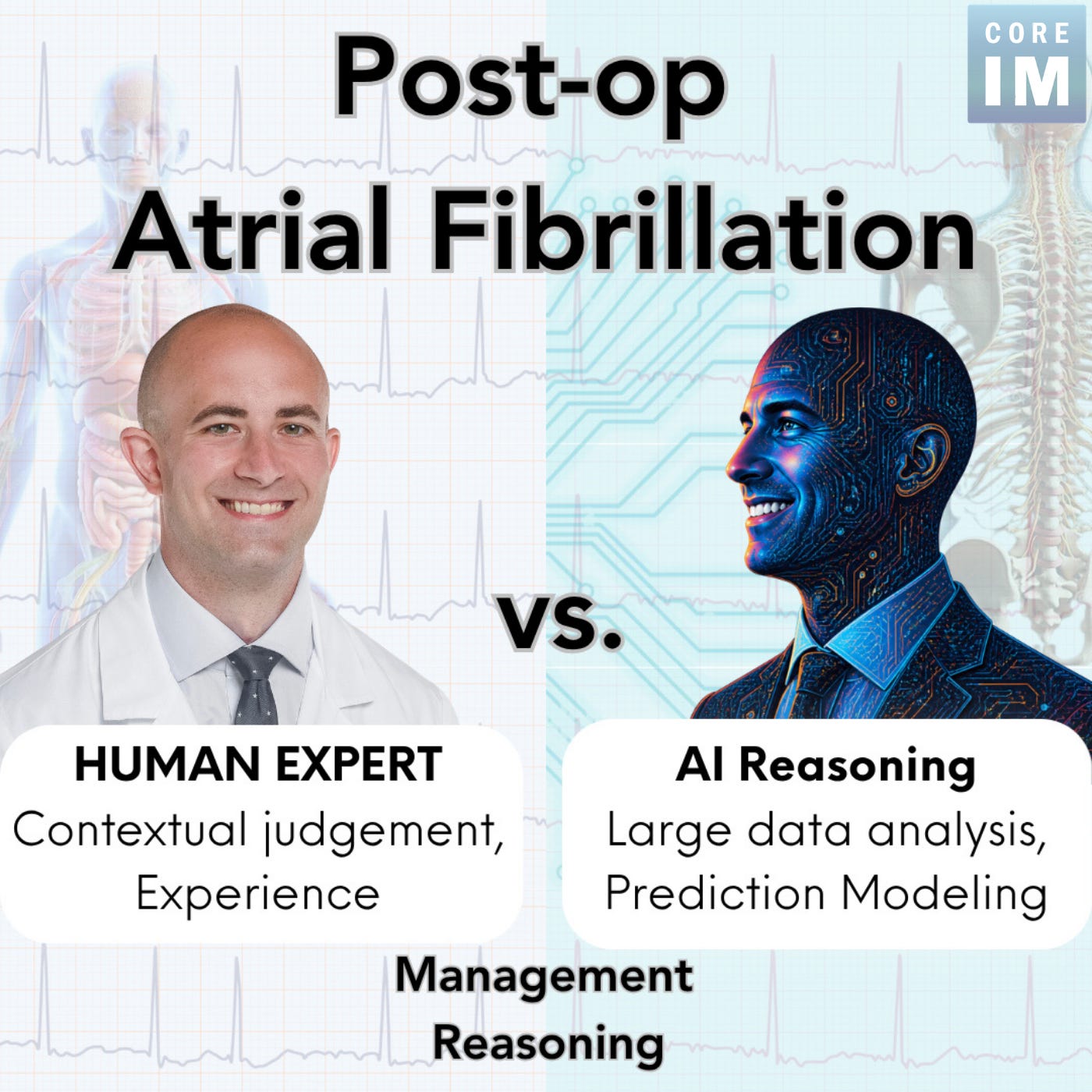
For today’s newsletter, I’m sharing a podcast I worked on recently for CoreIM’s new Bread and Butter series comparing my management reasoning in a common clinical scenario to OpenEvidence’s reasoning.
The case that we discussed was atrial fibrillation after knee surgery. It’s a common post op complication that usually doesn’t mean anything serious, but in rare instances can be a harbinger of a life threatening complication.
It’s the most common type of scenario that you see in clinical practice - something important but not life threatening, where there’s no absolute right or absolute wrong, and no randomized trials to guide your decision making.
In other words, every single aspect of decision making is basically a judgment call.
I thought this was a way more interesting way of thinking about AI in medicine than how it’s often discussed, primarily because this type of ambiguity and uncertainty is really the heart of clinical medicine.
It’s basically man vs. machine for an area where there is no winner, just slightly different ways of doing things.
In the interest of comparing and contrasting human versus AI, I thought it would also be interesting to feed the transcript into Claude and see what it thought I should write as an introduction versus what I thought was the important thing to focus on.
So here is my take and then below you can see Claude’s unedited introduction.
I will often teach that you don’t have an infinite amount of time and an infinite amount of focus from yourself, your patients, or your trainees.
And so what you decide to prioritize is what you think is important.
In this type of scenario - post op Afib - my number 1 priority is to make sure that the patient doesn’t have Afib as a consequence of a life threatening complication like a pulmonary embolism (blood clot in the lungs), significant blood loss related to surgery, or a new infection and sepsis.
Once we’ve ruled that out, we’re basically left with a question about whether to get the person out of Afib with a procedure or whether to leave them in Afib.
I think this boils down to two major questions:
How confident are we that the patient is truly asymptomatic?
Would waiting to do something about the Afib comprise any part of the surgical recovery?
I landed on getting the patient out of afib with a procedure called a cardioversion because of what I knew was coming next for them - rehab after orthopedic surgery.
How someone is able to rehab after surgery is often the difference that impacts long term quality of life.
And if the patient is symptomatic because of Afib, even a little bit, it might compromise their rehab. Since you often can’t truly tell in a hospitalized patient whether there are symptoms - they’re often lying in bed, recovering from a procedure, and unable to tell the difference between the standard feeling of post op recovery and a truly symptomatic irregular heartbeat - then you’re better off doing a low risk procedure to get them out of the irregular heartbeat and remove all doubt that there is something new and cardiac that will hold up their rehab.
Your mileage may vary whether I’m correct - but my thought was that once we’ve ruled out something life threatening, we should think about what might improve quality of life next.
And like many places in medicine, there is no absolute right and absolute wrong. Most of my days compromise a million judgment calls that I’m not certain about. And if AI can help me make more of those a bit better, I am open to its feedback.
I just did something a little different for Core IM’s new Bread & Butter series. I worked through a real post-op AFib case out loud — and then we compared my reasoning, step by step, against what OpenEvidence recommended for the exact same patient. Gurpreet Dhaliwal refereed the human-vs-AI matchup.
The case sounds simple. A 63-year-old man with diabetes and hypertension gets a knee replacement, and afterward he goes into AFib with RVR. The kind of consult you get paged about constantly. But the longer you sit with it, the more you notice how much of what we call “standard management” is really just convention — handed down and codified, often without the level of evidence any of us would want if it were our own family in that bed.
A few things I keep coming back to:
“Can be discharged” and “should be discharged” are not the same sentence. The AI told my resident the patient could go home once he was rate-controlled. Totally defensible. Medico-legally fine. But that’s the floor, not the ceiling — and the gap between the minimum acceptable care and the care you’d actually want for someone you love is where most of the real medicine lives.
CHA₂DS₂-VASc isn’t measuring the left atrial appendage. We get overly concrete about why AFib causes stroke. The clot-in-the-appendage story is one mechanism, but look at what’s actually in the score: nothing about the appendage, nothing about atrial size or emptying velocity. It’s essentially a measure of how much atherosclerotic disease a patient has. Not everyone with AFib who strokes is even in AFib when they stroke. Don’t let the score become the whole conversation.
Sometimes the best stroke-prevention drug isn’t a blood thinner. If this man’s AFib had been a five-minute self-limited run, he’s arguably better served by a GLP-1 than an anticoagulant when it comes to lowering his stroke risk. Stroke prevention in AFib is a whole-patient problem — sleep apnea, lipids, coronary calcium, blood pressure — not just a binary decision about whether to start Eliquis.
The AI never asked whether he was symptomatic. I did, on purpose — and it matters enormously, because plenty of “asymptomatic” patients get cardioverted and only then realize they’d been feeling lousy for weeks. Our job is to help people live longer and live better. You can’t do the “better” half if you never ask how they feel.
What I loved about this format is the thing Gurpreet kept circling back to: uncertainty isn’t a bug in medicine, it’s the job. If there were one provably right answer, you wouldn’t need a doctor. The AI gave confident, defensible advice — and ask it the same question twice and you’ll get two different defensible answers. Judgment is what fills that gap.
🎧 Listen here: Post Op Afib Bread and Butter Series
If it resonates, do me a favor and send it to one colleague — and I’d love to hear how you’d have managed this one in the comments.
Comments
Nothing yet. Say the first thing.
Sign in to join the conversation.