
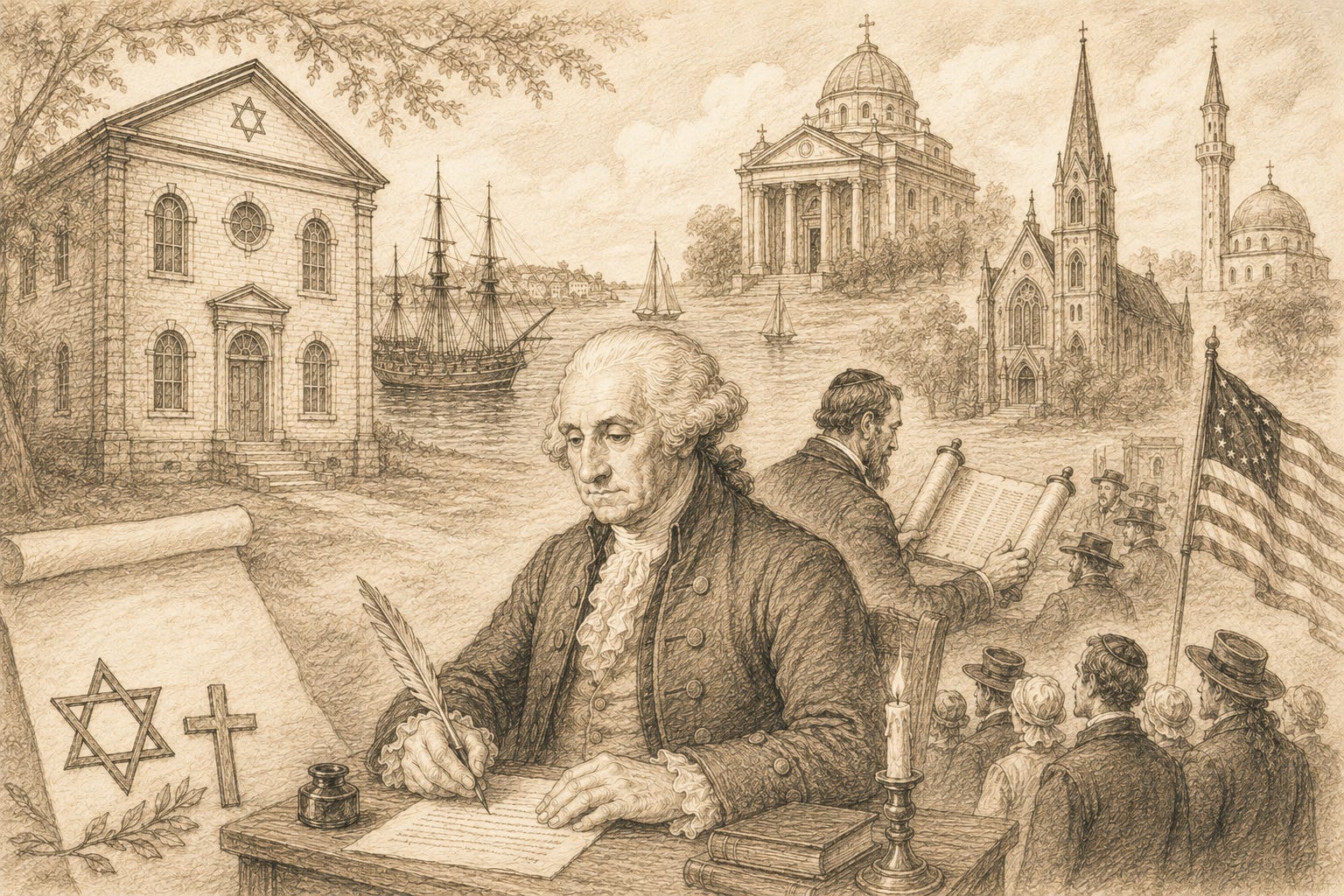
On August 18, 1790, George Washington wrote one of the most remarkable letters of our American Republic’s founding.
It was only a few hundred words.
It was addressed to a small Jewish congregation in Newport, Rhode Island.
In a few words, our first President made an extraordinary promise about what kind of country America intended to become.
Washington had visited Newport after Rhode Island became the last of the original thirteen states to ratify the Constitution. Among those who welcomed him was Moses Seixas, warden of Newport’s Hebrew Congregation, now known as Touro Synagogue.
Seixas wrote to Washington on behalf of a people who knew very well what governments could do to religious minorities.
Religious toleration was considered progress. Washington answered with something more radical.
America, he suggested, would not merely tolerate its Jewish citizens. They belonged here.
“The Government of the United States,” Washington wrote, “gives to bigotry no sanction, to persecution no assistance.”
But the sentence that followed is even clearer:
“It is now no more that toleration is spoken of, as if it was by the indulgence of one class of people, that another enjoyed the exercise of their inherent natural rights.”
There is an entire philosophy of American liberty contained in that distinction.
Religious freedom is not something the state gives you. A right is something that already belongs to you.
A right does not require a cent of support from taxpayers or government.
Washington was saying that a Jewish American did not worship freely because Christians permitted him to do so. His liberty of conscience preceded government. Government’s obligation was not to grant that liberty, but to protect it.
This was 1790.
The Bill of Rights had not yet been ratified.
Across much of the Western world, governments still established churches, imposed religious tests, and restricted the civic rights of religious minorities. Even several American states retained religious establishments or religious qualifications for public office.
In fact, at the time of this letter, most state constitutions lacked alignment with the future Establishment Clause
Washington then closed his letter by reaching into Hebrew Scriptures.
He wished that the children of Abraham might continue to enjoy the goodwill of their fellow citizens:
“while every one shall sit in safety under his own vine and figtree, and there shall be none to make him afraid.”
The image comes from the prophet Micah. It is a quiet image.
Just a person sitting beneath a vine and a fig tree.
Unmolested.
Unfrightened.
Free.
That may be one of the simplest descriptions of liberty ever written.
The test of a free society is not merely whether the majority can live according to its convictions. Majorities rarely require protection.
Whether the synagogue can stand beside a cathedral. A cathedral next to a church.
More than two centuries have passed since that August day.
The poem below, Vine & Fig, was originally published in Red, White & Verse.
Text within this block will maintain its original spacing when published
Vine & Fig

In the start of our freedom’s birth,
Under the expansive, azure earth,
George Washington’s timeless words do sing,
An anthem of plurality that freedoms bring.

Beneath a vine and fig tree’s shade,
In the home our hands have made,
Every man, every woman shall sit unafraid,
By the promise of liberty’s covenant, made.

From the heart of our republic’s humblest hero,
This hymn of freedom, tolerance, a new credo,
Sent to those of the Star of David’s fold,
His words, in golden ink of courage, bold.

Each man, each woman, of every creed, he wrote,
Shall worship freely; let this message denote.
Your faith, your beliefs, held without fear,
This nascent nation holds all voices dear.

From our first President, this affirming note,
Upon the waves of history, does float,
His praise for tolerance, loud and clear,
An ode to diversity, we hold near.

Our strength, he wrote, lies in our varied song,
In the many faiths that to this land belong.
Each creed, each prayer, each sacred rite,
In the quilt of our nation, shines its light.

Religious liberty, he did avow,
Is a human right, here and now.
The government’s duty, plain to see,
To protect this right, for you and me.

This letter, now a beacon in the night,
An enduring symbol of our common fight,
For the freedom to worship, to believe,
Is the bedrock upon which we conceive.

The fabric of our union, sewn with care,
With threads of tolerance, equal and fair,
Enshrined in the First Amendment’s sacred text,
In the principles of our Constitution, next.

Today, in our discourse, rich and wide,
In our struggle for rights, side by side,
We invoke Washington’s powerful message,
His vision, his faith, his lasting presage.

For the humble hero’s words still ring true,
In our land of the red, the white, the blue,
Where every faith, every voice finds its home,
Under a vast, star-spangled dome.
Comments
Nothing yet. Say the first thing.
Sign in to join the conversation.