
We were leaving Japan the way you leave any place you’ve stayed too long: Bags zipped with clothes that smelled of someone else’s detergent, pockets lined with coins we couldn’t spend at home, and a desire to be back home.
Narita’s terminal had an odd smell: Burnt coffee from a kiosk, something sharp and chemical from cleaning products, the diesel odor from tugs on tarmac.
I was eleven.
My mother said we’d be home before dinner if the wind was right. “Almost home,” she told me, kneeling to fix my collar. “Just a nap and a movie. Then we see Dad.” I thought about the pool in our apartment complex, the chlorine that clung to air in August.
At the gate, we lined up.
The boy who would die was in front of us. Sixteen, maybe seventeen. A paperback in one hand, a boarding pass in the other. His shirt tucked too neatly for travel. A thin leather belt cut the line between chest and waist, the buckle polished. He had the posture of a boy in a school uniform.
He tapped the heel of his shoe lightly against the floor, not impatient, just steady.
On the jet bridge, the air was different. Thicker, warm with the smell of the plane itself: Recirculated air, seat fabric, a faint undertone of jet fuel. My seat was by the window, two rows behind the wing. I took the in-flight magazine and began to draw in the margins.
That’s what I remember.
We were somewhere over the Pacific when the sun tilted through windows. The aisle carpet the color of oatmeal. The walls curved in, white plastic with the faint give of something you could press a fingernail into.
My tray table was down. Sprite in a clear cup, the ice cubes clicking like teeth when our plane hit pockets. My mother read from a magazine, legs crossed at the ankle, the way she did when she wanted to keep her shoes from slipping off.
Flight attendants rolled carts.
The boy who would die was on the aisle, two rows up. He’d opened his paperback, the spine soft from being read before. I think the title was “If Tomorrow Comes.”
I traced the outline of a 747 on my magazine page, adding wings that looked wrong but felt right in my hand.
When the captain spoke over the PA, it was to tell us we were making good time. We might even land early. People murmured in that small, polite way when hearing good news.
Everything was intact. The air was normal. The sound was normal. Even the light was normal. The world does not darken before it breaks. It stays bright. It lets you finish drawing.
Then a sound I didn’t have a name for.
Not a crack of thunder. Not a snap of firecracker. It was rounder. Deeper. A sound that hit inside your chest before it reached ears.
The cabin shook in a way that didn’t match turbulence. The walls flexed. The air went white: Light and dust and something finer than dust, hot enough to sting skin.
The boy two rows up had been there a breath ago.
Now his seat held only a suggestion. A shirt flapping where his middle had been. The belt still cinched, vacant. Between chest and hips, only air.
A hole where the window had been. Jagged. Air roaring. The wind bent headrests forward. Ears hurt.
The rest of the missing boy was scattered in ways an eye couldn’t catch. Threads of fabric. A blur of skin and paper. Lots of dark red.
I remember seeing a shoe. Just one. Spinning slow.
My mother’s arm came across me hard, pinning my chest to the seat. Her other hand fumbled for the belt buckle she thought I’d unfastened, even though I hadn’t.
People were screaming. Some were just open-mouthed. Their sound ripped away by wind.
I could taste air. Burned plastic. Jet fuel. Electrical fire. My own shirt was speckled with red. My cheek stung. I touched it; my fingers came away red.
The hole in the fuselage screamed. Not wind. Not a whistle. Something lower, alive.
Someone was praying behind me. The words stacked and breathless. Someone else was calling for their father in a voice so small it almost disappeared.
My mother had both hands on my shoulders. She wasn’t shaking, but was breathing fast.
The air outside the hole howled. Inside, it went strangely quiet. It was like the noise had eaten our oxygen. You could hear small things: Someone unwrapping a candy with hands that couldn’t stop trembling, a wristwatch ticking close, a zipper pulled up slow.
The dead boy’s seat belt was still fastened. It cut across his absence like a line crossing out a missing word.
The cockpit door stayed closed. Sometimes we heard voices from behind it. Not words. Just the rhythm of command. Short. Confident.
I remember thinking: This could be the end of my life.
A sealed tube of air and strangers, cut off from the ground, from everything, moving toward an end I couldn’t see.
Time didn’t move in minutes.
It moved in the length of a breath. It moved in the number of times I could press my tongue to the cut inside my cheek.
Odd, I thought, blood doesn’t taste so bad.
The plane stayed in the air: Steady but heavy, like it was being flown by someone who didn’t love flying. The seatbelt sign had been on for so long it felt permanent.
I counted things.
Rows between us and the cockpit. The ridges on the back of the seat in front of me. The dots in the carpet pattern that ran down the aisle like a narrow road. When I lost count, I started over. It was the only way to make time move.
The man in the row across the aisle was crying without sound. Tears just ran down his face and into his collar. His wife, or maybe his sister, kept touching his hand, not holding it, just tapping two fingers against the back of it like she could bring him back from wherever his mind had gone.
I asked my mother if we were going to die. I asked it quietly, like a secret. She didn’t say yes or no. She just said, “We’ll see Dad soon,” and smoothed my hair with her palm.
There was a point when the plane banked hard enough to make overhead bins rattle. People gasped.
The smell was worse now - fuel, metal, sour breath of people without water for hours.
And under all of it, there was the sound of the dead boy’s belt buckle tapping against the armrest each time the plane shivered. A quiet metronome.
It started with a shift in the air, so slight I thought I’d imagined it.
The engines dropped pitch. A change you didn’t hear so much as feel.
Someone near the front let out a sound: Half gasp, half prayer.
My mother’s hand found mine and didn’t let go. Her palm was cold, damp. Her wedding ring kept slipping against my knuckle with each bump.
We tilted again. The ocean slid into view. A sheet of dull silver under the wing. Then land came. Small, brown shapes that grew until you could see the lines of roads. A sudden flare of sunlight off glass below.
The voice came back on the intercom. The same calm. The same control. “We are landing soon. Stay seated.”
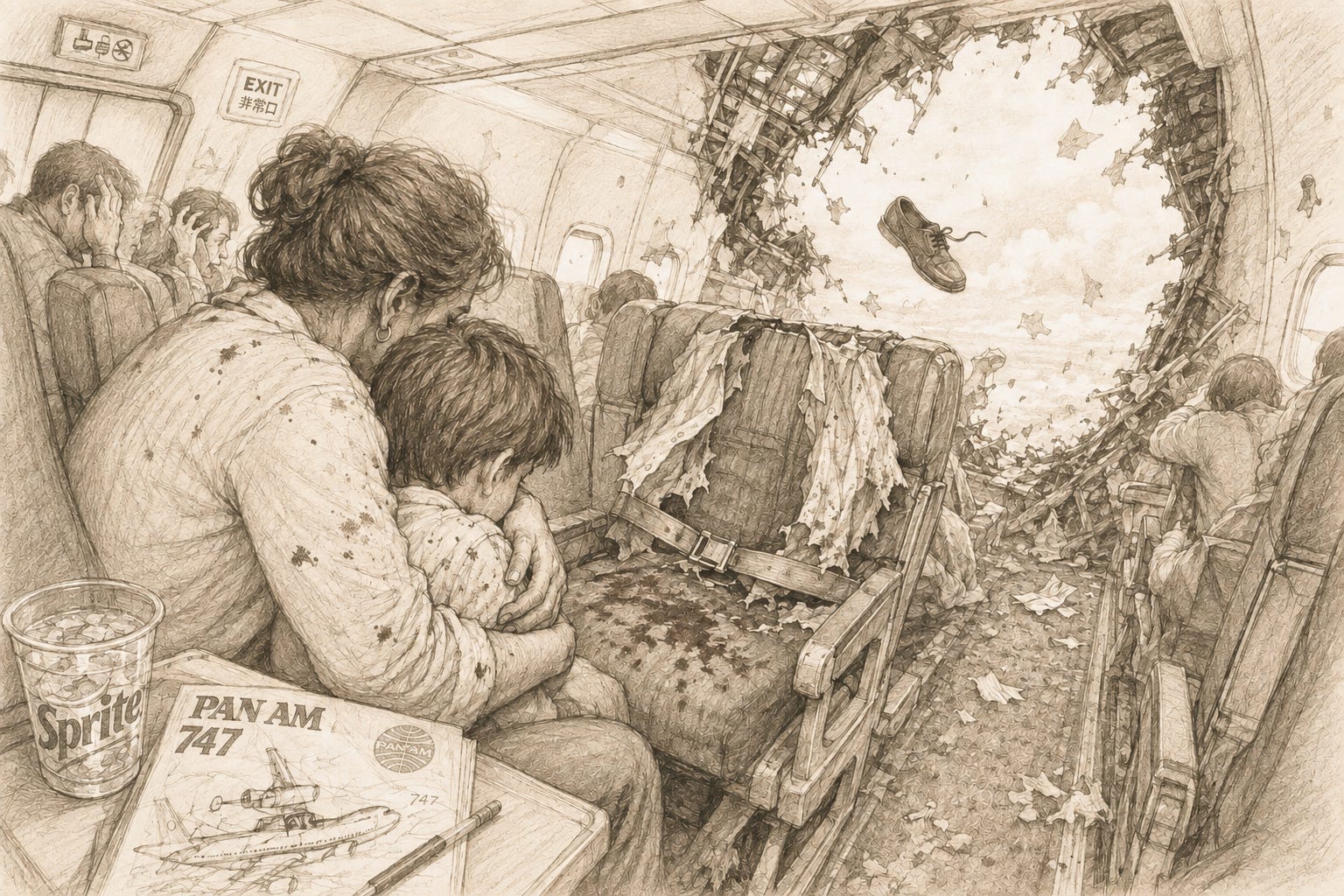
The plane began to drop in slow, deliberate steps. The dead boy’s belt buckle tapped with each vibration.
You could feel the cabin leaning forward.
The wheels hit hard, bounced, then caught. The sudden weight of the earth under us was almost painful. Brakes screamed. The ocean was gone from our windows. Now just tarmac. Concrete. Sky.
The cockpit door stayed closed. No cheers, no clapping.
We slowed. Turned. Stopped.
Through the small oval of my window, I could see movement. Vehicles rushed toward us. Lights spinning.
We were pulled out, this time by hands in heavy gloves. My feet hit the jet bridge floor, and for a second, I didn’t trust it to hold.
Outside, the light was bright. The air too open. The kind of air you don’t realize you’ve missed until you can’t breathe enough of it.
My mother crouched in front of me, her hands on my cheeks, saying my name over and over like it was proof I was still there. Behind her, the plane stood still on the tarmac, door gaping, the dead boy still in my head.
Two rows separated us - the distance between story and storyteller.
I could feel the sun on my face. It felt like nothing. It felt like everything.
We flew home the next day on a different plane.
The crew smiled too much. My mother kept touching my arm.
I looked out the window and tried to spot the ocean, but all I saw was the reflection of my own face.
The blast came back in dreams. Soundless. Other nights it was the belt buckle. Always turning. Always tapping in some slow, private code.
In the months after, I learned words I didn’t know.
Explosive.
Extremist.
Terrorist.
They weren’t abstract.
The bomb was meant to end a life. Instead it left mine - forever scanning rooms for exits.
They didn’t hate me for what I was. They didn’t know me. They hated me for what I was not.
No longer eleven. Older. I still fly.
Because the air belongs to us, not just the ones who fill it with fire.
By taking my seat.
By fastening my belt.
By choosing, again, the window seat - looking out at a wing and knowing that I am here.
NOTE:
In August 1982, Pan Am Flight 830 was en route from Tokyo to Los Angeles when a bomb exploded in the passenger cabin, killing 16-year-old Toru Ozawa of Japan and wounding 16 others.
A Palestinian terrorist group, the 15 May Organization, carried out the attack. The convicted terrorist, Mohammed Rashed, was imprisoned and released in 2013 for the attack.
The Boeing 747 landed safely in Honolulu.
Comments
Nothing yet. Say the first thing.
Sign in to join the conversation.