
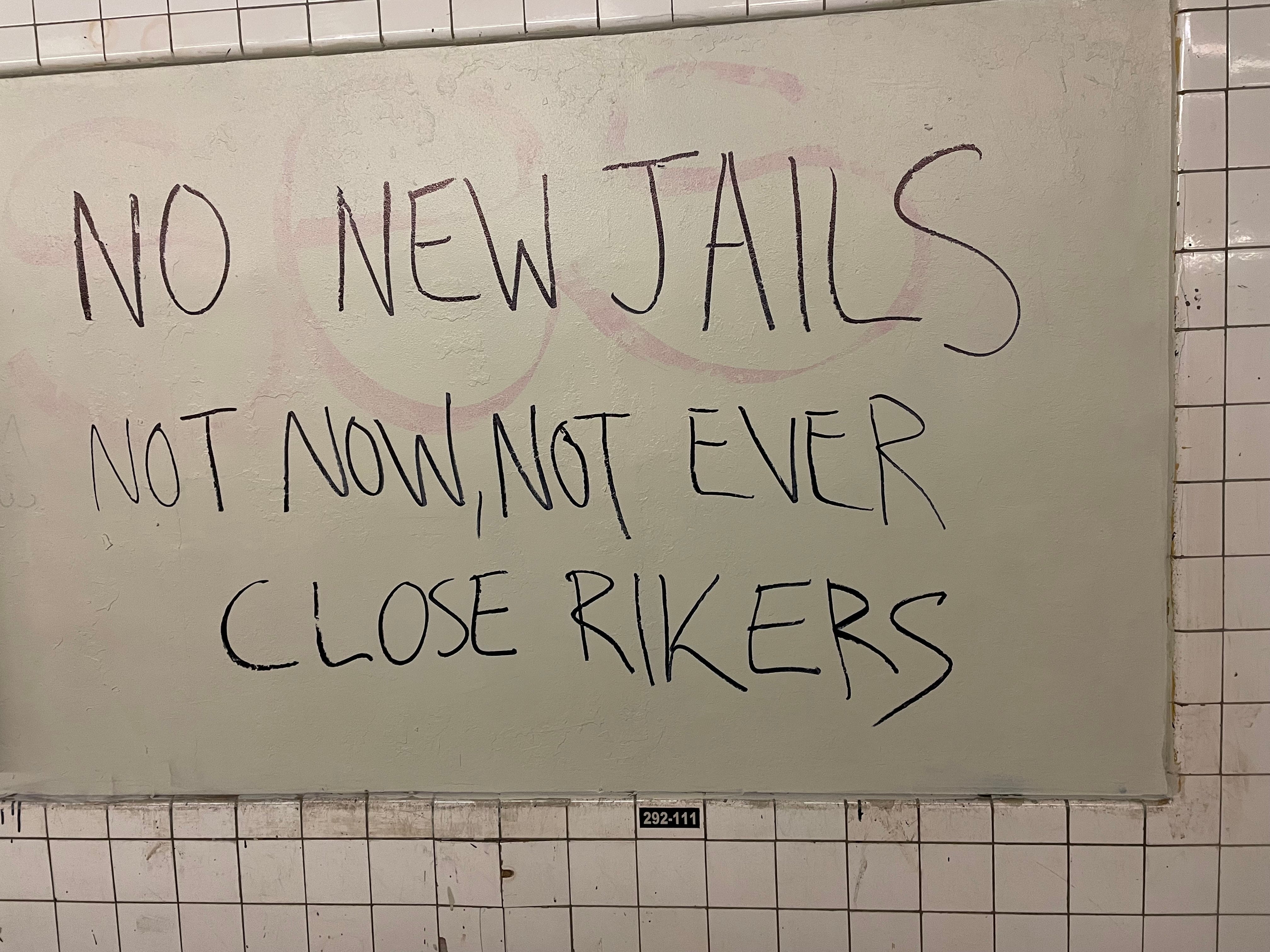
Toward the end of the Bloomberg administration, I was appointed to the New York City Board of Correction. At the time, the Board was a pretty sleepy little oversight body and Rikers Island wasn’t an issue of urgent concern.
I’m embarrassed to recall how little thought I put into the decision when I was asked whether I’d be willing to serve. The stakes seemed fairly low and the time commitment reasonably manageable, so I signed up.
I quickly discovered that I was not a good fit for the assignment.
The local media had already started to write about the horrific conditions on Rikers Island before I arrived on the Board, but their interest soon kicked into overdrive, reaching a crescendo with the New Yorker’s publication of Jennifer Gonnerman’s story about the tragic death of Kalief Browder. It was hard to read that essay and not be roused to anger at the injustice.
How could the violence on Rikers Island be stopped? As the scrutiny by the media and activists intensified, many identified the Board of Correction as a potentially important lever for change. To my surprise, I became the subject of intense lobbying, both by advocates and by administration officials looking to influence the decisions of the Board.
I didn’t really enjoy this dynamic. Nor did I enjoy the atmosphere internally at the Board. In my day job, I was used to being a member of a team working together toward a shared goal, but the Board was full of independent actors with their own agendas. (The nine members of the Board are appointed by different political players in New York City.) The challenge of getting everyone on the same page was made even more difficult because the Board was subject to New York’s open meetings law, which required that any gathering of more than two Board members be open to the public. So it was impossible to have an off-the-record conversation about where the Board should go or what it should do. There was a fair amount of turnover while I was on the Board, which meant that there was constantly rotating cast of characters. It was also my first experience with a work setting where multiple people would leak information to the press, further undermining any sense of trust or unity.
When you added it all up, I just never felt comfortable at the Board of Correction. And when I stepped down, I don’t think anyone was too surprised (or too disappointed) to see me go.
In an effort to try to make sense of my experience, I wrote an essay for the Gotham Gazette entitled “The Challenge of Cultural Change on Rikers Island,” which was published on March 18, 2015.
Earlier this week, I went to look for the piece because I wanted to share it with a friend of mine who is currently being considered for the Board. Unfortunately, the Gotham Gazette shut its doors a few years back and the piece no longer seems to be available on the internet. So I am reprinting it here, mostly for my own future convenience, but also because I think the argument is still relevant. If anything, oversight of Rikers Island has only intensified since I wrote this, but I’m not sure we are any closer to having safe and humane jails in New York City.
After three years of volunteer service, I recently stepped down from the New York City Board of Correction, which is responsible for ensuring that all city jails, including Rikers Island, meet certain minimum standards regulating the care of inmates.
It wasn’t the happiest experience I’ve ever had. While I was on the Board of Correction, Rikers Island became a topic of intense local and national concern. Thanks in no small part to intrepid reporting by Graham Rayman, Jake Pearson, Michael Winerip, Michael Schwirtz and others, there is now widespread agreement that Rikers Island requires significant reform.
One of the statistics we monitored at the Board of Correction is the use of force by correction officers. While I served on the Board, there were a number of horrific incidents where inmates were injured. In several cases, inmates died. Even though I have worked in criminal justice for more than 20 years, I found these incidents shocking and appalling.
On my tours of Rikers Island, I had the chance to meet numerous correction officers. I always sized them up, looking for signs of cruelty. To be honest, what I found more often were signs of compassion. Many (but by no means all) of the correction officers I met expressed real pride in their jobs and real concern for the inmates in their charge. Even in the most horrible of settings – and make no mistake, the jails on Rikers Island are horrible places to be – these officers were capable of small acts of kindness and understanding.
How do we square this reality with The New York Times’ reports of “medieval levels of violence” meted out with “startling ferocity” by guards at Rikers? Or to ask the question another way, how do we encourage more kindness and less brutality by correction officers?
I have come to the conclusion that the answer is not necessarily more rules or more scrutiny.
In truth, there is no shortage of oversight of Rikers. In addition to the New York City Board of Correction, there is the New York State Commission of Correction, the New York City Council, the media, the courts, and the U.S. Attorney’s Office. And this doesn’t even begin to list the advocacy groups that keep tabs on what happens on the Island.
Despite all of this, a recent Times headline reported a hard truth: “Even as Many Eyes Watch, Brutality at Rikers Island Persists.”
There is an old business adage that “culture eats strategy for breakfast.” I fear that the current approach to change on Rikers Island leaves the “deep-seated culture of violence” identified by U.S. Attorney Preet Bharara mostly untouched.
Any effort to change the culture on Rikers must reckon with the deteriorating physical plant, which is beyond antiquated. Even with the reductions in volume that we have seen over the past 20 years, there are still too many people on Rikers – the daily headcount is typically around 10,000 inmates. It is exceedingly difficult to manage this many people humanely in facilities that are falling apart. As the MacArthur Foundation and others have argued, we must explore ways to reduce the number of people in jail, particularly those who are detained pre-trial. And, as former NYC Correction Commissioner Marty Horn has said, we should be looking at options to close Rikers Island and create smaller, county-based facilities with modern amenities (like air conditioning).
Even as we attempt to reduce head counts and improve the physical environment, we should also be having an honest conversation about discretion. A generation ago, in the seminal book Street-Level Bureaucracy, Michael Lipsky pointed out that the exercise of discretion is a critical dimension of the daily life of frontline government workers, be they police officers, social workers, teachers, or correction officers.
While we can and should develop baseline standards for correction officers, the truth is that it is impossible to create protocols for every situation that they will experience on the job – no matter how hard we try, there will always be room for officers to exercise discretion, for good or for ill.
Given this reality, we must work harder to create a clearer sense of mission at the Department of Correction. Rules cannot do this. As professor Mark Kleiman (channeling the spirit of James Q. Wilson) has written: “Organizations prize autonomy...Deprivation of autonomy tends to worsen morale and thus performance. The impulse to over-regulate the public sector is a destructive impulse.”
In visiting Rikers Island, I never once felt I was in a place of “correction,” where the dominant philosophy was one of rehabilitation. To change this will require a significant investment of energy, money, and time. This means taking unglamorous steps that may not yield dividends for years to come, including increasing the salaries of correction officers, changing the union dynamic, raising hiring standards, investing in research to help promote a learning culture, and giving correction officers a meaningful voice in reform plans as a means of increasing their buy-in.
While many demand immediate change, the reality is that Mayor de Blasio inherited problems on Rikers Island that were decades in the making. We should be realistic about what his administration can accomplish in the short term – and encourage the formulation of a long-term plan that truly changes the culture of the institution.
Comments
Nothing yet. Say the first thing.
Sign in to join the conversation.