
The other day I started a thinking session in Ember with a simple question: what do I actually put in my commonplace book?
I’ve written about how to keep a commonplace book, and how to think with one. But this question comes before both, and I realized I’d never answered it directly. So this article is me thinking out loud — what came out of that session.
What actually goes in the thing?
Sometimes the fastest way to define something is to say what it isn’t.
A commonplace book is not a to-do list. Your grocery list doesn’t go in it. Recipes don’t go in it. Long journal entries don’t go in it. Those things belong somewhere — just not here.
A commonplace book is a book of sentences. Sayings, quotes, passages — mostly other people’s words that resonated with you, challenged you, or changed how you see something. (Small ideas of your own can live there too, though Steven Johnson would probably call that a spark file. The line is blurry, and that’s fine.)
Morgan Housel puts the filter perfectly:
People don’t remember books; they remember sentences. — Morgan Housel
That’s the whole test. Nobody walks around with an entire book in their head. We carry sentences. A commonplace book is simply a book made of the sentences you’ve decided to carry — collected from everywhere, bound together by one thing: they moved you.
So where do these sentences come from? Here are mine.
This is the source nobody talks about, so let me start here.
Some of the most profound things in my commonplace book weren’t written by anyone famous. They were said — by a friend across the table, mid-conversation. My wife has said things that stopped me, and I wrote them down.
We tend to think wisdom only comes from people who lived three thousand years ago. But sometimes the person sitting right across from you says something in a way that suddenly makes sense of what you’ve been wrestling with. Why wouldn’t you write that down? It’s somebody else’s words that moved you. That’s the definition of the thing.
If your commonplace book only quotes the dead, you’re missing half the wisdom in your life.
Anytime a lyric moves me — says something I’ve felt but never said that way — there’s a pull in me to write it down. It doesn’t matter what I’m doing. I take a few seconds and capture it.
There’s no set time or day for this. It’s a habit, not a schedule. When it happens, it happens, and I write it down.
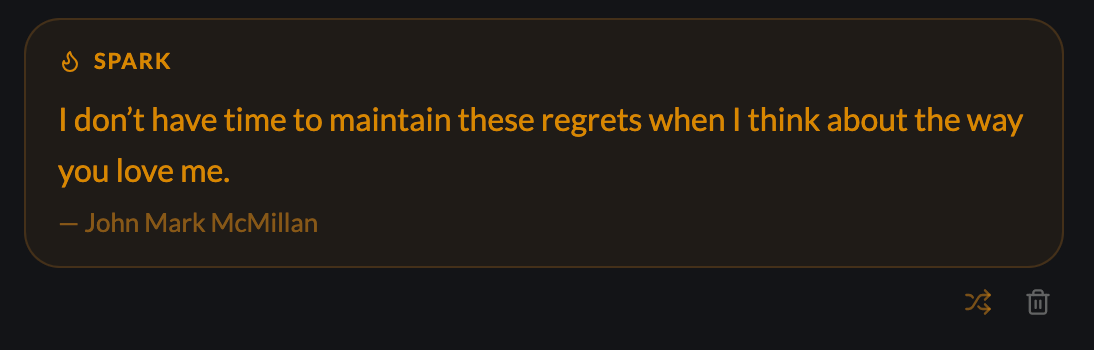
I capture verses and passages from the Bible that I want to sit with. And that phrase — I want to think about that — is actually my signal. If a sentence makes me feel that pull, that’s the key turning in the lock. It means I should pursue it, and pursuing it starts with writing it down.
Books are the classic source, and yes, plenty of my captures come from reading. But some of my favorites came from just being out in the world with my eyes open.
I once found a quote in a random book in a shop in Galveston, Texas — not a bookstore, just a shop. I was flipping through it and something on the page moved me.
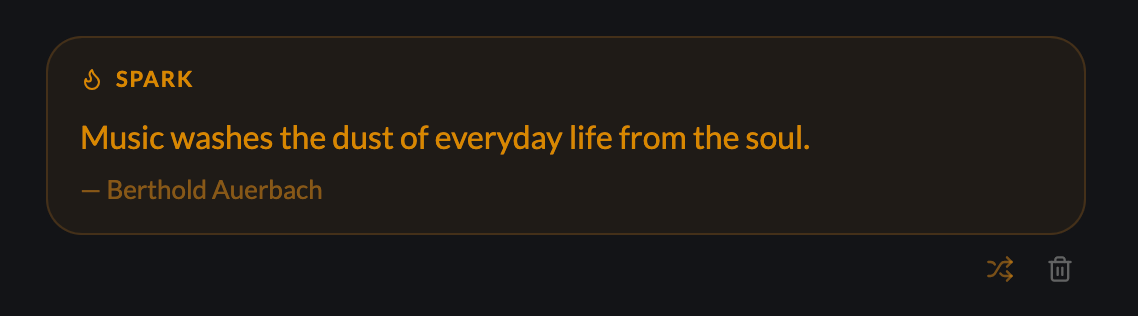
Those moments feel different from reading. I’m not studying — I’m just living my everyday life, and my eyes and ears are quietly on the lookout for things that move me. That’s what keeping a commonplace book slowly does to you. It turns you into a noticer.
Jack London understood this posture:
Keep a notebook. Travel with it, eat with it, sleep with it. Slap into it every stray thought that flutters up in your brain. Cheap paper is less perishable than gray matter, and lead pencil markings endure longer than memory. — Jack London

The commonplace book goes with you everywhere — that’s the deal. For me, it’s Ember. It’s where my lyrics, scriptures, and found quotes all land, and if you read with Readwise, your highlights can flow in too. Every morning Ember emails me one random spark from my collection. Something I captured a month ago resurfaces exactly when I wasn’t looking for it, and suddenly I’m thinking with it again.
But the tool matters far less than the habit. Paper notebook, notes app, index cards — the commonplace book is wherever you faithfully put the sentences.
Keeping one trains you to move through your day — books, songs, shops, conversations at your own dinner table — listening for the sentence that moves you. And when it comes, you honor it the simplest way possible.
You write it down.
No posts
Comments
Nothing yet. Say the first thing.
Sign in to join the conversation.