
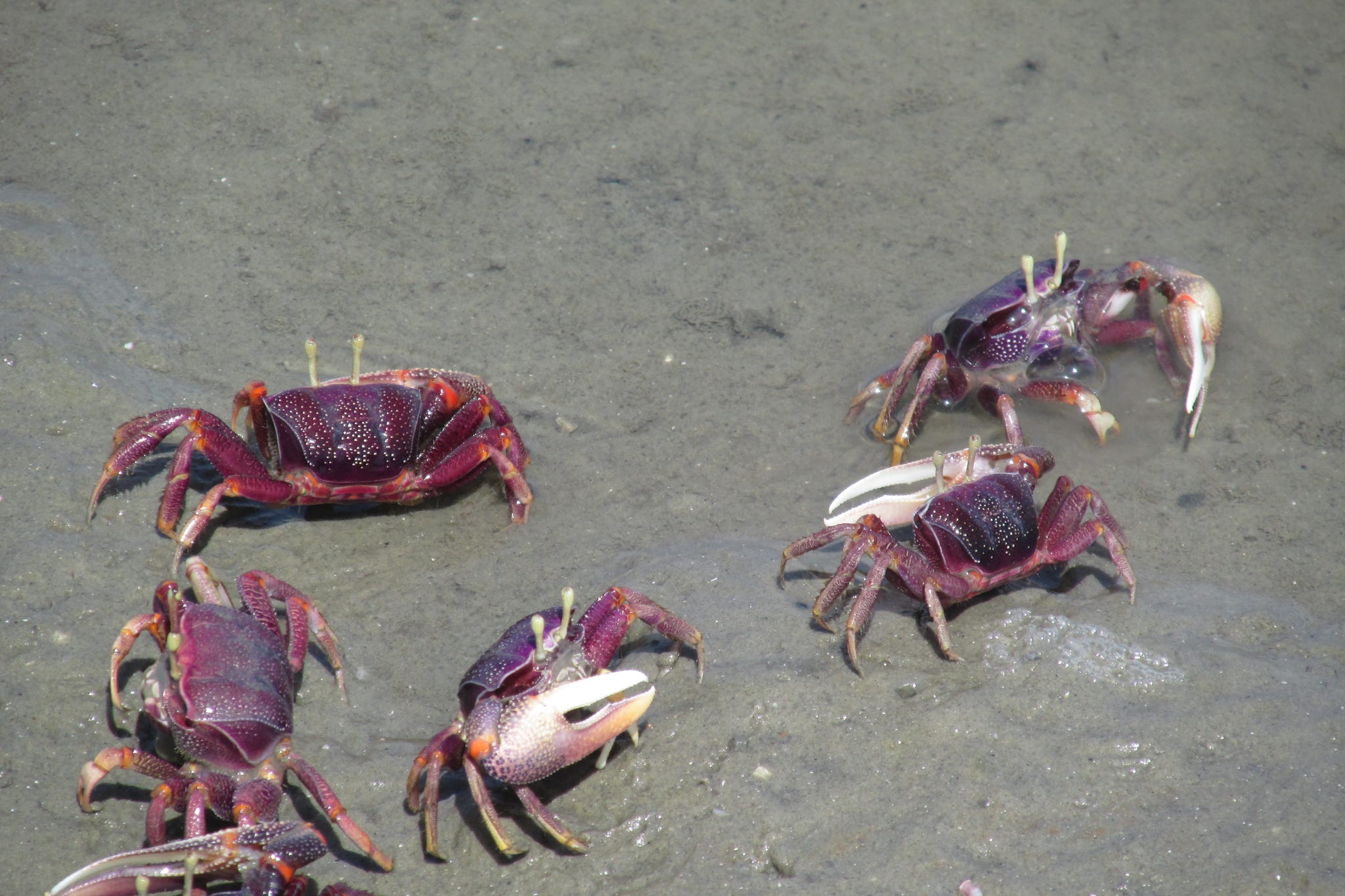
In the tropics, if you happen to be near the coast and decide to visit an area with mudflats, you will find that the flats are waving at you. A thousand tiny arms, waving back and forth as if to hail you as you enter their realm. But they’re not really putting on a show for you, nor are they doing all that waving for fun. For each of them, the waving is strictly business. They are fiddler crabs — a type of crab where the males have one greatly enlarged claw, much larger than the one on the other arm — and they wave their claws to impress females, and to warn rival males that they will not tolerate invasions onto the tiny section of mud they call their own.
Waving that huge claw is no piece of cake. The large claw can weigh up to half the total mass of the crab, so holding it above their heads and waving it must be nothing short of exhausting. But so is the male psyche, stopping at nothing to impress a potential mate. The claw waving is what evolutionary ecologists call an honest signal of fitness, an indicator of the overall quality of the male, for only the strongest males can wave the fastest and the highest. If a female is impressed, she will follow the male back to his burrow, and only after carefully inspecting the quality and depth of that burrow will she decide whether the male is worthy of mating.
Beyond its role as a crab-girl magnet, the enlarged claw has a few other useful functions for the male. It can be used to fight rival males over territorial disputes; it functions as a sort of radiator, helping the crab get rid of the excessive heat of a mudflat baked by the relentless tropical sun during low tide; it can be used to produce sounds for communication; and it can be used to deter predators, especially when the crab hides in its burrow and uses the claw to block the entrance. What the large claw is useless for is feeding. The smaller claws are used to collect food from the sediment and carry it to the mouth, but the large one is too big and clumsy for such fine movements. That means that the males, who only have one small claw, must feed twice as fast to get the same amount of food as the females who have two of those more nimble members.
If you do visit such a tropical mudflat and spend a while observing the fiddler crabs, as I did several times in the Bijagós archipelago of Guinea-Bissau, you will notice that they are not just waving and courting females. They are very often hard at work on their burrows as well. You are in the presence of a methodical engineer. To be more precise, what scientists call an ecosystem engineer. Ecologists define ecosystem engineers as organisms that modify their environment in ways that affect the availability of resources for other species. In other words, they are living things that create, modify, or maintain entire habitats. How do these small crabs achieve such a feat?
Intertidal sediments are so tightly packed that almost no oxygen can get in. In fact, that is the reason for their peculiar, sulphuric smell: without oxygen, bacteria resort to sulfates as a source of energy, releasing hydrogen sulfide gas as a byproduct. The incessant burrowing of the fiddler crabs, whose tunnels can reach 30 centimetres in depth, channels oxygen deep into the mud. This drives beneficial microbial activity and dramatically accelerates the breakdown of organic waste. Their burrowing also creates drainage pathways for trapped water, preventing waterlogging and salt accumulation around plant roots, and the constant digging churns up massive quantities of sediment, bringing trapped nutrients back to the surface, where they fertilize algae and marsh vegetation. As if that wasn’t enough ecosystem engineering, abandoned fiddler crab burrows also provide refuges for smaller animals, such as worms, small snails, and larval fish, protecting them from predators and extreme heat at low tide.
There are plenty of other ecosystem engineers around the world, the most famous of which is an animal that we seldom see or even think about, yet to whom we have much to thank. I am talking about the unassuming earthworm. Earthworms do on land a similar job to that of the fiddler crabs on the tidal flats, but on a much vaster scale. They aerate soils, cycle nutrients and prevent soil erosion, to such an extent that they are sometimes called a “farmer’s best friend”. Other examples of great engineers of the natural world include savanna elephants which, by knocking down trees, uprooting shrubs, and digging for groundwater, prevent forests from overtaking grasslands; beavers that convert fast-moving streams into nutrient-rich wetland ponds, creating critical habitats for amphibians, waterfowl, fish, and aquatic plants; and scleractinian corals that create massive reefs so critical for marine life that perhaps a quarter of marine species depend on them in one way or another.
There are about 100 species of fiddler crab in the world, found throughout tropical coastal areas. They are not strictly tropical, with species reaching as far north as Portugal and the northeastern USA, in the Atlantic, and California and Japan, in the Pacific. The largest one is the West African fiddler crab (Afruca tangeri), the one in the photo that I took in the mangroves of Guinea-Bissau. It’s not exactly a giant among crabs, but with a carapace width of up to 5 cm, it is usually larger than most other fiddler crabs.
I visited Guinea-Bissau several times, always with the goal of studying the ecology of the shorebirds wintering in the vast mudflats around the islands of the Bijagós archipelago. It’s a magical place where the sea is hugged by lush mangroves, not far from vast palm groves and cashew plantations, and with imposing kapok trees leaning over the waters. Clouds of shorebirds paint the sky, under the watchful eye of African fish eagles and Caspian terns, and if you are lucky you might even spot a hippo going for a swim or one of the elusive African manatees. The people there still lead very traditional lives, dependent on the rich seas around their islands and steeped in animistic traditions. Known as karangis di tarafe in the local creole, the fiddler crab is mostly not eaten by humans, who rather collect bivalves, snails and larger crabs. But if the humans leave it alone, that is not the case for many local fish and bird species. The fiddler crab is a key prey for whimbrels, and I’ve also seen gull-billed terns and even palm-nut vultures picking them from the flats.
The West African fiddler crab can be found anywhere from southern Portugal down to Angola, in intertidal mudflats and estuaries, where it tends to favour areas with tidal creeks or saltmarsh. They live in their burrows and try to minimize the time spent on the surface, as that is where they run greater risk of being eaten. Each crab occupies its own burrow except when two or more seek refuge together for a short time. The burrows are not just important for protection, but also help maintain moisture around the gills when the tide gets low, offer shelter during harsh weather, and are critical sites for mating.
They do need to leave their burrows to find food, as they feed by scraping off the top layer of sediment in search of detritus, algae and a type of microalgae known as diatoms. Thus the tiny fiddler crab forever lives in a trade-off dilemma: stay in the burrow and starve, or venture out onto the flats and be eaten. Researchers have found that smaller individuals tend to remain closer to their burrows when feeding, while larger crabs can afford to travel farther away and often forage in groups, true to the maxim that there is safety in numbers. Interestingly, each burrow is only used for about a week, after which the crab moves on to build another. We observed this in Guinea-Bissau, where we left cameras filming the mud to determine if all burrows were in use and found that about half of them were never visited by any crab. Presumably, their owners had either moved on to another burrow or fallen prey to a predator.
Fiddler crabs live a busy life, burrowing, moving, burrowing again and again, all the while sallying out in search of food while trying not to be eaten. In the midst of it all, they still find the time to defend territories, fight rivals, woo mates, and breed. Their hectic lives are a blessing for the surrounding tidal flats, which thrive under their subtle engineering. So, the next time you see a tropical mudflat waving at you, remember it is far more than a flashy courtship display. It is an indispensable engineer, restlessly at work, proving that nature’s greatest builders don’t always erect grand monuments. Sometimes they simply dig, wave, and quietly sustain the world beneath their feet.
If you enjoyed this walk through the mangroves of Guinea-Bissau, consider buying me a coffee. It helps keep these nature stories coming.
No posts
Comments
Nothing yet. Say the first thing.
Sign in to join the conversation.