
Everything was violently different. The sky was a hazy, brownish-orange, under which an endless olive-green global ocean was dotted with chains of volcanic islands made of black basaltic rock. The air was toxic, composed of carbon dioxide, methane, nitrogen and water vapor, with hardly a whiff of oxygen among them; and without an ozone layer, the planet's surface was blasted with lethal amounts of ultraviolet radiation from the Sun. The days were much shorter, perhaps as short as 10 to 12 hours, and at night an enormous moon dominated the sky. Because it was so close, the Moon had an immense gravitational pull, creating apocalyptic tides: colossal bulges of water, possibly reaching heights of one hundred meters, rushed across the globe slamming into coastlines every few hours. Above the waters, the atmosphere was in constant turmoil; the thick air and fast-spinning planet generated hyper-cyclones and perpetual global storms that made today's hurricanes seem like child's play. This brutal, alien landscape was where life first emerged on our planet, some 4 billion years ago.
Life didn't start in that noxious planetary surface, but underwater, cradled in the warm, nutrient-rich waters of the primordial ocean. Life started in the water, and never really left it, it just learned to carry the ocean within. We can live on land because our body is extremely efficient at keeping water inside, but on hot summer days we are constantly reminded of the thin line we must tread. We need to sweat to keep the body at an appropriate temperature, and if that water loss is not quickly compensated through drinking, we soon start to feel the effects of desiccation: dizziness, headaches, and, eventually, loss of consciousness. Other organisms are much worse at keeping their water inside the body, and it's not uncommon to see worms and slugs that lost the battle against the elements and lie dead, dried out on the pavements.
Sometimes, there is a world of difference in how even closely related species handle water loss. For instance, the land slugs that we sometimes find withered on a pavement are close relatives of the land snails. Both are gastropods classified within the suborder Stylommatophora, which is defined by having two pairs of tentacles on their heads, with the eyes located on the tips of the upper pair. In fact, land slugs evolved from snail-like shelled ancestors, trading that armor for extreme flexibility, which allows them to squeeze into tight, moist hiding spaces where predators can't reach them. However, unlike the slugs, which can only thrive in moist places and need to hide away when temperatures rise, snails can deal quite well with hot, dry conditions and are a common sight in the peak of summer. Part of that has to do with having a shell, but snails have other ways to keep their tiny personal ocean inside their bodies.
Snails not only have their protective shell around them, but when conditions are adverse they can seal themselves inside the shell by secreting a specialized layer of mucus that quickly dries and hardens into a membrane called an epiphragm, which locks the moisture inside their bodies and creates a largely airtight seal against the blistering summer heat. When heat reaches lethal levels, snails are able to shut down, entering a state of prolonged torpor known as aestivation. Desert snails can survive in that state for months, until a rainstorm finally brings them back to life. Furthermore, if you ever notice clusters of snails gathering on the top of fence posts or dried bushes on hot summer days, you are witnessing yet another adaptation to resist the heat and save water. Because of thermal stratification, the air just a few centimetres above the baking earth can be significantly cooler, saving the snails from the heat radiating from the ground.
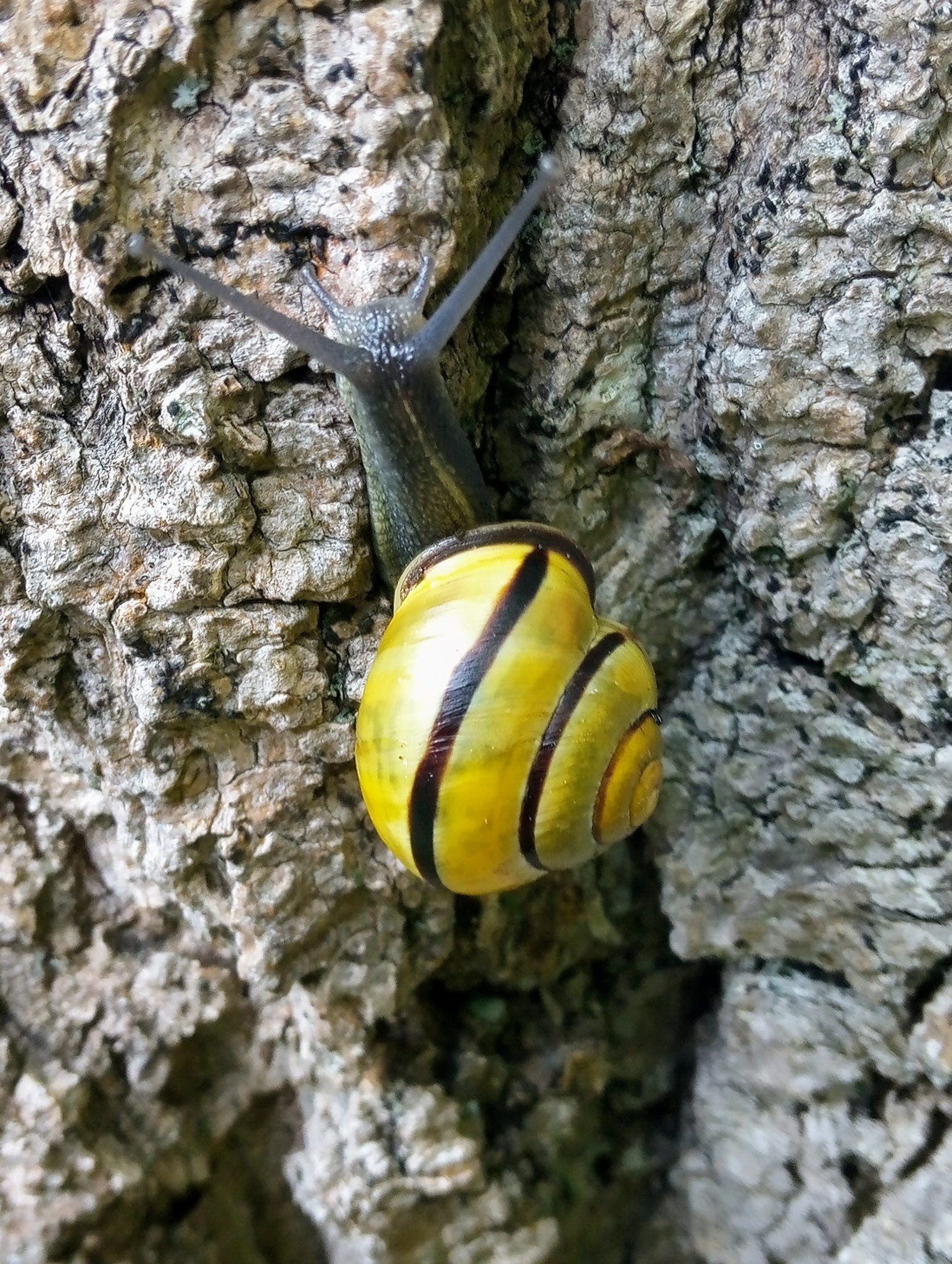
Snails are quite common and widespread, and if you look through your garden you are bound to quickly find several of them munching away at your plants. One such common garden dweller is the brown-lipped snail (Cepaea nemoralis), one of the most common large land snails in Europe. It may look like the one in the photo below, but it can also be quite different, because this is a highly variable species with shells ranging from brown, through pink, to yellow or even whitish, with or without one to five dark-brown bands. In biology, the occurrence of two or more clearly different morphs or forms in the population of a species is known as polymorphism and may arise for different reasons. Brown-lipped snails tend to be darker in woodlands than in open areas, which might be related to camouflage or an adaptation to local climates: paler, more reflective colours in sunny environments reduce water loss and overheating.
This species feeds mainly on dead or senescent plants, so it is actually not a significant threat to your garden. Like all land snails, they are hermaphrodites, meaning each individual has both male and female reproductive organs, but they still need to mate with other individuals to produce viable offspring. Mating mostly happens in late spring and early summer, after which they lay eggs that hatch after 2 to 3 weeks. These snails are relatively long-lived, reaching up to 8 years of age, meaning that some of the snails in your garden might be older than the children playing in it. To survive the winter, they crawl under leaf litter or burrow into loose soil, sealing themselves inside their shells to escape the frost. While they remain largely dormant during the coldest months, an unseasonably warm spell can quickly prompt them to wake up and explore.
The next time a summer heatwave hits your neck of the woods, as you scramble for shade and something cool to drink, remember that you are taking part in yet another chapter of an age-old battle. Ever since our ancestors took the bold step to colonize the land on our planet, we must forever battle to keep that primordial ocean inside our bodies, its water sloshing within each one of our cells. We are far from the worst at waging that good fight, but it is quite humbling to think that a humorously slow and unimposing snail can do it better. Something to ponder as you sip your iced tea on a shaded terrace and spot a bunch of snails hanging from a post under the blistering sun.
If you enjoyed reading about how snails battle heat and desiccation, consider buying me a coffee to keep me hydrated for the next essay.
No posts
Comments
Nothing yet. Say the first thing.
Sign in to join the conversation.