
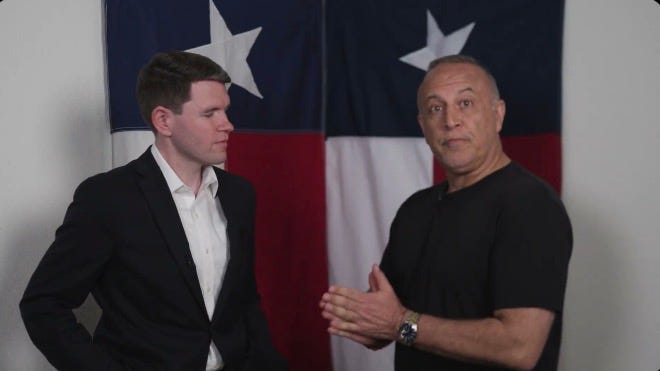
NOTE: INTERVIEW VIDEO BELOW
I caught a 6am flight and flew down to South Texas to see for myself what’s going on in Texas. Specifically with the Hispanic voters I’ve been polling, analyzing, writing about and explaining to America for the past thirty years or so. Sometimes crosstabs and precinct results just aren’t a good substitute for driving the streets in a community, counting the yard signs and smelling the barbecue wafting out from backyards.
I left understanding something else about the people of small town south Texas with names like Beeville, Goliad and Kenedy. It’s these places, small towns on the way to somewhere else that maintain a personal sense of community that are being entrusted with and in many ways are redefining our democracy.
The Rio Grande Valley has become the place every Democratic strategist, every podcaster and political pundit points to when they talk about what went wrong for them as voters of color and working class folks slipped away from them.
These are where the defections that have shocked establishment politics for the past decade reside.
The red counties that used to be blue.
Democrats have been wandering in the wilderness for a decade trying to figure out why they were abandoned and their politicians have been in search of answers. The silver bullet everyone is hunting for, the message that will bring these voters home.
I have spent years explaining to the political class that no silver bullet exists.
But I found something else that I hadn’t considered instead.
Standing backstage at a dance hall in Beeville at a Tejano music concert, was a young politician who clearly doesn’t believe in looking for a silver bullet either.
James Talarico is a man who knows himself. He’s grounded in a perspective that can only come from a lifetime premised on the idea that the whole point of all of this ais answering the question: What can I do to better serve others?
What becomes clear when you talk to him is he isn’t concerned with being right.
He’s concerned about doing right.
That perspective doesn’t make a man confident - it makes him certain. Especially in a time when the contrast between right and wrong has never been more stark.
Talarico’s not building a political movement so much as he’s mobilizing something else entirely. He speaks truth to power in a quiet way that only certain provides. In a time of selfies, performance and chasing clout his recipe for success and connection is taking us back to the before times. Before the interconnectedness. Before the influencers. Before we were all have our souls sucked out by the scrolling in our phones.
Talarico is a Texas state legislator, young, plainspoken, and increasingly hard to ignore. He had a hardscrabble youth (which is odd to say because he’s not yet 40 years old) but rose to attend Harvard and dedicate his life to the study of the ultimate branch of knowledge - theology.
When I met with him for a brief interview to understand what was making him and his message connect with Hispanic voters, I expected at least some of the usual consultant driven answers.
Instead I got a theory of American politics that has nothing to do with the frameworks my generation built.
For thirty years, Democratic strategy on Latino voters has run through consultants who came of age in the 1990s. Identity as organizing principle. Heritage months and multicultural days. Campaign launches at Mexican restaurants and commercials in Spanish. A politics built on the assumption that recognition is the reward and that recognition alone secures loyalty.
And it worked, for a while. It stopped working when the cost of living became the only thing voters could see. When the American dream proved illusory and we realized it hadn’t failed - it was stolen from the youth of our country.
Talarico speaks a different language.
He talks about a coalition that is multiracial, multiethnic, multiclass, and increasingly multiparty, but he doesn’t talk about it as a mosaic of separate constituencies to be individually flattered. He talks about it as a generation that grew up inside diversity rather than being taught about it.
For his coalition, difference isn’t a lesson plan. It’s just Tuesday. What unites them isn’t shared identity. It’s a shared and specific grievance: that their lives were promised to be better than their parents’, and they are not.
That is the generational break. I asked him directly if this was generational, and he didn’t pause.
“Yes,” he said. No hesitation. No worrying about what his political consultant might say about offending older voters.
He understands, in a way that clearly feels intuitive and not focus-grouped, that a twenty-five-year-old Hispanic in the Rio Grande Valley and a white twenty-five-year-old in Dallas/Fort Worth and a Black twenty-five-year-old in Houston have more in common with each other than either has with the red and blue party elders who built the country they inherited.
It is not an accident that Talarico and Jon Ossoff, both young, both Southern, have been among the first Democrats willing to draw a straight line between the overt corruption of the Trump administration and the price of groceries, rent, and a future that keeps receding.
Their parties’ older leadership tends to treat corruption as a constitutional abstraction, a threat to norms. An attack on the way things used to be.
Talarico and Ossoff treat it as a kitchen table issue, because for their generation it is one.
After a decade of this, younger Americans have known no other type of politics than one defined by authoritarian tendencies. This is and has always been their America.
The corruption isn’t a scandal happening somewhere else. It’s the reason the math isn’t mathing in this country anymore.
America doesn’t work and Millenials and Gen Z’ers are the only ones saying it as a united front. That these two generations happen to be the most racially diverse and socially progressive is a bug NOT the feature it was for previous generations (read that again so you don’t confuse that trite overused saying because I wrote it backwards for a reason).
Millennials and Gen Z are melting the divisions of racial, gender, ethnic and identity politics into one generational mobilization against a political class that has failed them and is literally stealing the promise of the American Dream handed down to every other generation since George Washington.
This is what makes Talarico’s politics feel aspirational rather than defensive. He isn’t apologizing for a coalition that includes people who disagree with each other on plenty. He isn’t trying to hold together a fragile alliance through careful silence on hard subjects. He’s naming the thing that actually binds a multiracial, multiclass generation together, which is not culture war language at all.
It’s the shared experience of being sold a future that never arrived, and being angry about it in the same key.
Talarico’s language is doing something most Democratic messaging has not done in a decade. It is naming the moment instead of managing it.
The aging leadership of the Democratic Party is trying to manage the decline of institutions the way your Dad tries to manage the television set with three remote controls. Which is to say he’s not - he’s just pressing buttons and seeing what works and gets frustrated when none of it does anything.
Talarico is grabbing the remote back and saying what we all know to be true: the professional class running our institutions can’t figure out our television sets yet they’re entrusted to figure out the problems of the digital age.
Listen to Talarico’s own words from my interview with him:
• “There’s a backlash to the extremism and corruption in our government.” He isn’t describing a partisan grievance. He’s describing a reaction that cuts across party lines, which is exactly why it lands with the growing number of voters who have stopped listening to partisan appeals altogether.
• “We’re far more alike than we are different, and for the past ten years we’ve suffered under a politics of division.” This is the opposite of the identity-first framework his party has run for a generation. He is telling a multiracial, multiclass coalition that their differences are not the point. Their shared experience is.
• “This campaign can be a form of ministry.” Coming from a politician who is also a seminary graduate, this isn’t a slogan. Talarico sought advice from his pastor before he ran for Senate to consider if he should finish seminary studies or seek elected office to determine one question: What is the path pathway to serve others? His question reframes politics as vocation rather than combat, and it gives permission to voters exhausted by cynicism to care again without feeling naive. It’s public service in the actual sense of the term.
• “People are rebelling against a culture of corruption built over the last five decades.” This is a generational message, not an ideological one. It gives Gen Z and millennials a shared villain that has nothing to do with race or culture or party and everything to do with a system that failed to deliver on its promises. It is not unlike what Franklin Roosevelt did during the Great Depression. Talarico and Ossoff are forging a common generational experience out of America’s failure to deliver the American Dream, and they are doing it through the lens of corruption rather than culture. In fact, they may be creating a culture that is built on being anti-corruption.
• “There’s something about this era that is making people yearn for something they didn’t even know they lost.” This is the emotional register that separates Talarico from the technocratic wing of his party. He is naming a loss before voters have been able to fully articulate it themselves, which is precisely what effective political language has always done.
• “The real fight in this country isn’t right versus left, it’s top versus bottom.” This single line collapses the old ideological map. It replaces a partisan axis with a class axis, and it is the sentence that most explains why a coalition of young, diverse, economically squeezed voters is finding common cause under one banner.
Taken together, these are not talking points. They are the words of a determined man who has found the emotional register his party has been missing since the cost of living, not culture, became the defining fact of American life. The culture wars have been lost to attrition and are being replaced by the cost of living where every foot soldier in the cause is every working man and woman who is tired of being lied to.
Whether this scales beyond one legislator in one state remains an open question, but it sure seems like it alreadyhas.. Texas is not the country, and a compelling theory of generational politics is not the same as a winning campaign. But something is happening here that deserves attention before it gets flattened into a talking point on cable news shows.
James Talarico may be the first American politician speaking to Latino voters not as a demographic to be won, but as one central part of a generation that has been having a conversation with itself for a decade but is now finally united enough to be heard.
And that’s why it’s revolutionary.
I came to South Texas looking for how Democratic candidates are appealing to the Hispanic voter. What I found was a lot more - I found a preview of the next American majority, and it doesn’t look anything like the last one.
There’s gonna be a lot of coverage of this Senate race in Texas, and of all the Hispanic voting regions throughout the country. I’m doing my best to literally be on the ground wherever there’s a focus that needs special attention in order to bring you the first and best perspective on what’s going on during this critical time in our country.
I’m honored you trust me.
But I’m urging you to take it to the next level of media literacy and use the tools that I do when assessing races. I’m urging you to subscribe today to Ground News and urge your friends to do the same. Things are gonna get really squirrely in the next 60 days…you all know that.
Check out how this tool works by aggregating news sources to show you who is covering Texas polling:
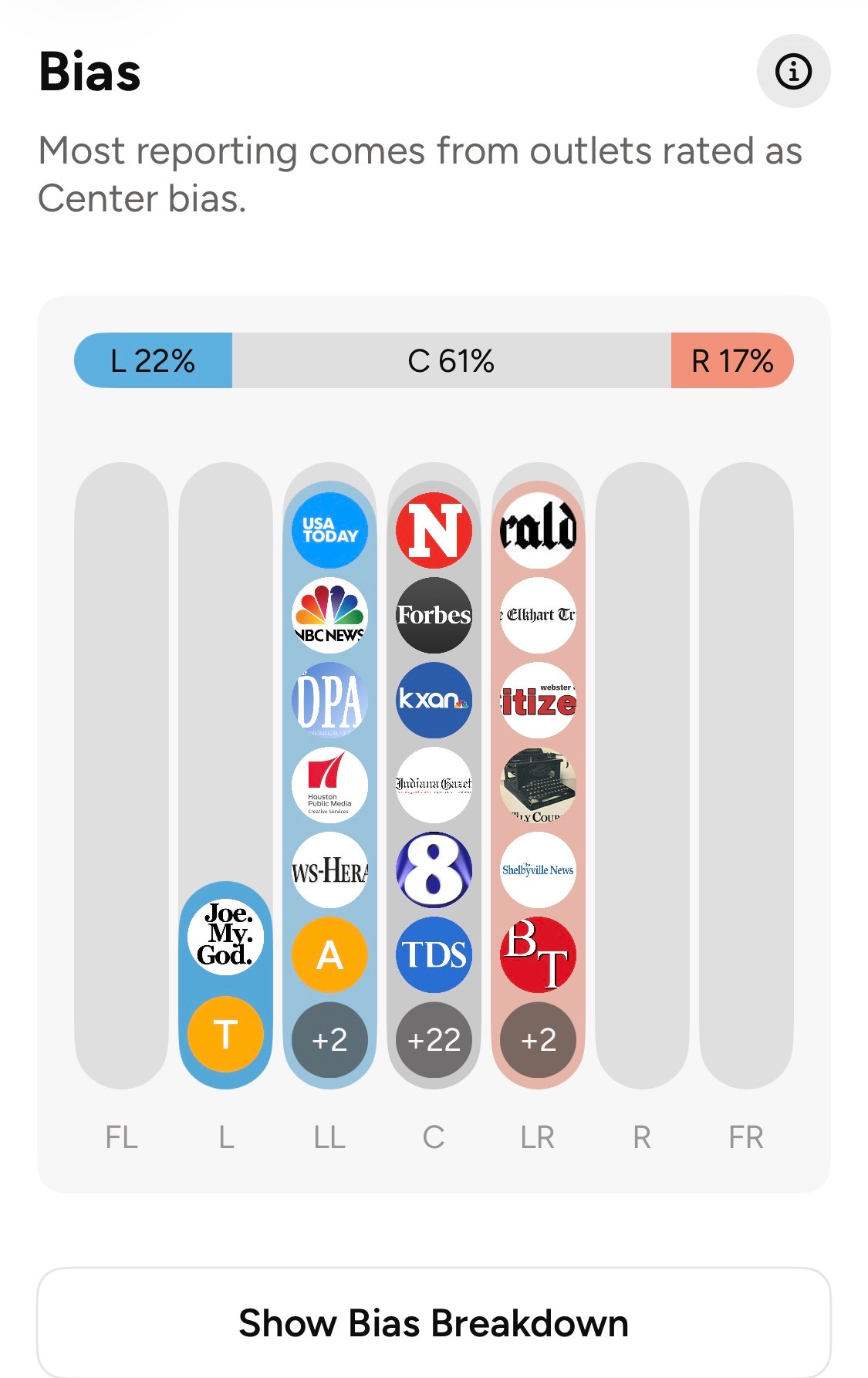
Just 24 hours after the latest round of polling has been out and it remains objectively covered by credible news sources and the Left wing media eco-system is covering it slightly more than the right - where its essentially non-existent. This will change as more news sources pick it up - so its critical that you be aware!
Know what you’re consuming. Know what you’re being fed. Please.
I’ve been overwhelmed by the response of so many Great Transformation followers who were already subscribers who told me how much the loved this tool - read the comments, I’m not kidding - and if you’re one of those followers in our community already getting the benefits of it please leave comments letting others in our community here know how important it is to get information on the best media literacy platform around during these times.
Sign up today and use this link to get 40% off - Ground News
No posts
Comments
Nothing yet. Say the first thing.
Sign in to join the conversation.