
Jacob Bryant wrote (Analysis of Ancient Mythology, pp. 490-91), “After many adventures, and long wandering in different parts, the Argonauts are supposed to have returned to Iolcus: and the whole is said to have been performed in four months; or as some describe it, in two.

“The Argo upon this was consecrated to Neptune; and a delineation of it inserted among the asterisms of the heavens. But is it possible for fifty persons, or ten times fifty, to have performed such might operations in this term; or indeed at any rate to have performed them? They are said to have built temples, founded cities, and to have passed over vast continents, and through seas unknown: and all this in an open boat, which they dragged over mountains, and often carried for leagues upon their shoulders.

“If there were any truth in this history, as applied by the Grecians, there should be found some consistency in their writers. But there is scarce a circumstance, in which they are agreed. Let us only observe the contradictory accounts given of Hercules. According to Herodotus he was left behind at their first setting out.

“Others say, he was left on shore upon the coast of Bithynia.

“Demaretes and Diodorus maintain that he went to Colchis: and Dionysius Milesius made him the captain in the expedition.


“In respect to the first setting out of the Argo, most make it pass northward to Lemnos and the Hellespont: but Herodotus says, that Jason sailed first towards Delphi, and was carried to the Syrtic sea of Libya; and then pursued his voyage to the Euxine.

“The æra of the expedition cannot be settled without running into many difficulties, from the genealogy and ages of the persons spoken of. Some make the event ninety years, some seventy-nine, others only forty years before the æra of Troy.

“The point, in which most seem to be agreed, is, that the expedition was to Colchis: yet even this has been controverted. We find by Strabo, that Scepsius maintained, that Æetes lived far in the east upon the ocean, and that here was the country, to which Jason was sent by Pelias.

“And for proof of this he appealed to Mimnermus, whose authority Strabo does not like: yet it seems to be upon a par with that of other poets; and all these traditions came originally from poets. Mimnermus mentions, that the rout of Jason was towards the east, and to the coast of the ocean: and he speaks of the city of Ætes as lying in a region, where was the chamber of the Sun, and the dawn of day, at the extremities of the eastern world.
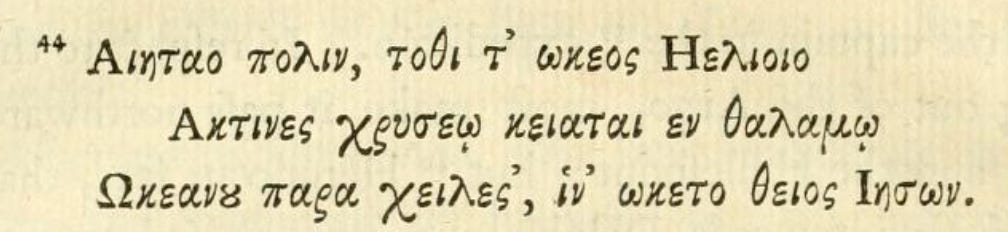

This looks like the Greeks, being situated in Alexandria, had access to many cultures far and wide, acquired their mythology and legends, and then reimagined them. Subsequently, due to the religious institutions of Europe, this was foisted upon people as history, which begat naming locations in the physical world after these fables so that it’d corroborate the narrative which was passed off as history.
Bryant wrote (Ib. pp. 492- .), “How can we after this trust to writers upon this subject, who boast of a great exploit being performed, but know not whether it was at Colchis, or the Ganges? They could not tell satisfactorily who built the Argo. Some supposed it to have been made by Argus: others by Minerva. Possis of Magnesia mentioned Glaucus, as the architect: by Ptolemy Hephæstion he is said to have been Hercules.

“They were equally uncertain about the place, where it was built. Some said, that it was at Pagasæ; others at Magnesia; others again at Argos. Εν Αργει εναυπηγηθη, ώς φησιν Ήγησανδρος ό Σαλαμινιος.

“In short the whole detail is filled with inconsistencies: and this must ever be the case, when a people adopt a history, which they do not understand, and to which they have no pretensions.
“I have taken notice, that the mythology, as well as the rites of Greece, was borrowed from Egypt: and that it was founded upon ancient histories, which had been transmitted in hieroglyphical representations. These by length of time became obscure; and the sign was taken for the reality, and accordingly explained. Hence arose the fable about the bull of Europa, the fish of Venus, and Atargatis, the horse of Neptune, the ram of Helle, and the like. In all these is the same history under a different allegory, and emblem. I have moreover taken notice of the wanderings of Rhea, of Isis, of Astarte, of Iona: and lastly of Damater: in which fables is figured the separation of mankind by their families, and their journeying to their places of allotment. At the same time the dispersion of one particular race of men, and their flight over the face of the earth, is principally described. Of this family were the persons, who preserved the chief memorials of the ark in the Gentile world. They looked upon it as the nurse of Dionusus, and represented it under different emblems. They called it Demeter, Pyrrha, Selene, Meen, Argo, Argus, Arcas, and Archaius (Αρχαιος). And although the last term, as the history is of the highest antiquity, might be applicable to any part of it in the common acceptation; yet it will be found to be industriously introduced, and to have a more immediate reference.
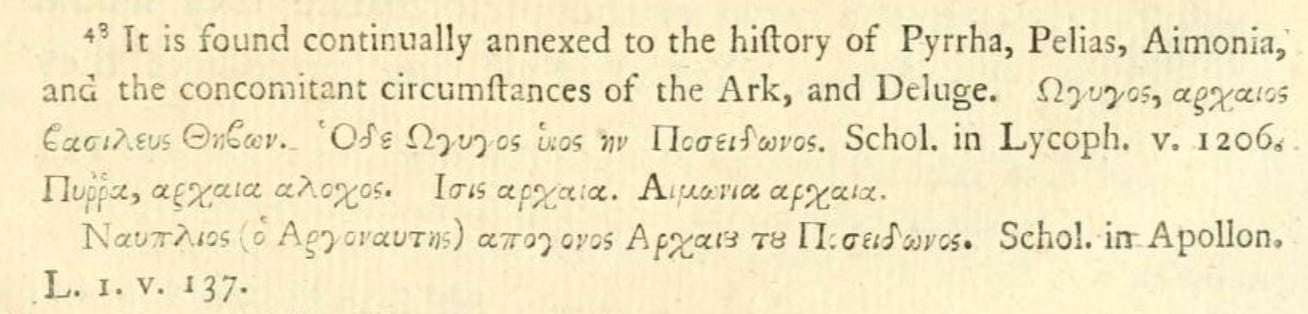
“That it was used for a title is plain from Stephanus Byzantinus, when he mentions the city Archa near mount Libanus. Αρχη, πολις Φοιινικης. το εθνικον Αρχαιος. (Arche, Phoenician city. The ancient nation, or nationality, or nation state.) Upon one of the plates backwards is a representation from Paruta of the Sicilian Tauro-Men with an inscription ΑΛ ΑΡΚΑΙΟΣ, Al Arkaios.”

For the record, I do not accept that this is an authentic Greek inscription, primarily because it looks like a mixture of Arabic or Hebrew, written in Greek letters. That being said, if there is any truth to it, the fact that is called a Phoenician city, may be indicative to Etruscan descent if William Bethem’s suspicion turns out ot be correct: that the Phoenicians were some offshoot of Etruscan navigators.
Bryant continued (Ib. pp. 493-94.), “This is remarkable; for it signifies literally Deus Arkitis: and the term Αρχαιος above is of the same purport, an Archite. (Al is literally the archaic name for the sun, transliterated as El in Hebrew, but is actually Al: אל. It is the root of Elohim, which is accurately Aleim.) The Grecians, as I have said, by taking the story of the Argo to themselves, have plunged into numberless difficulties. What can be more ridiculous than to see the first constructed ship pursued by a navy, which was prior to it? But we are told, to palliate this absurdity, that the Argo was the first long ship.

“If we were to allow this interpretation, it would run us into another difficulty: for Danaus, many generations before, was said to have come to Argos in a long ship: and Minos had a fleet of long ships, with which he held the sovereignty of the seas.

“Of what did the fleet of Æetes consist, with which he pursued the Argonauts, but of long ships: otherwise how could he have been supposed to have got before them at the Bosporus, or overtaken them in the Ister? Diodorus indeed omits this part of the history, as he does many other of the principal circumstances, in order to render the whole more consistent. But at this rate we may make any thing of any thing. We should form a resolution, when we are to relate an ancient history, to give it fairly, as it is transmitted to us; and not try to adapt it to our own nations, and alter it without authority.”
The reason I go through this material is to bring reality back to everyone’s assumptions about history, so you don’t accept what people say rather than look at the sources from which they derive their claims. You will find that most people talk nonsense, at all levels of academia and at all mainstream levels of success. To learn more about priestcraft, and the historical implications that are relevant even in the present day, read or listen to the Spirit Whirled series, and then The Real Universal Empire.







Comments
Nothing yet. Say the first thing.
Sign in to join the conversation.