
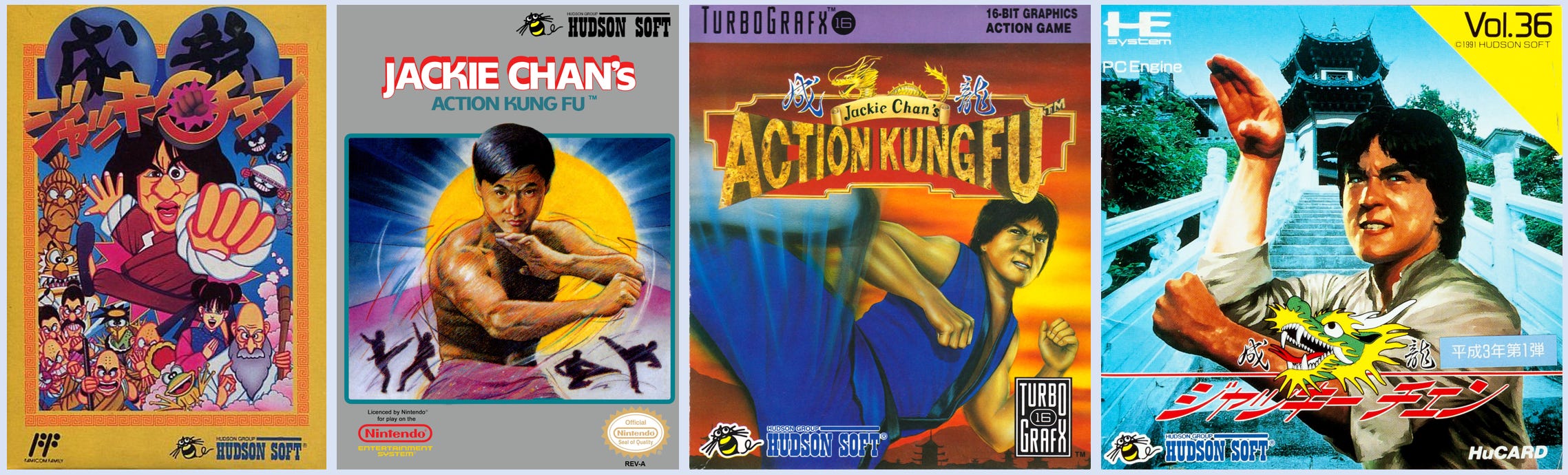
RELEASE DATE: 1990
DEVELOPER / PUBLISHER: Hudson Soft
BEST VERSIONS: Turbo-Grafx 16
Bruce Lee has had an obvious inspiration on video games since the early 1980s, but Jackie Chan’s influence on video games goes a lot deeper than many people may realize, and certainly further back than the games bearing his name. The original sidescrolling beat ‘em up and brawler, Spartan X, known elsewhere in the world as Kung-Fu Master, was loosely based on the Japanese version of his Hong Kong comedy action film Wheels on Meals. Without Kung-Fu Master, many of the things we take for granted in the beat ‘em up genre might have evolved differently. And Jackie Chan’s own game, Jackie Chan’s Action Kung-Fu, might have also played quite differently, because it’s essentially the action of Kung-Fu Master merged with the platforming of developer Hudson Soft’s Adventure Island series.
Jackie Chan himself didn’t become a household name until later in the 1990s when Rumble in the Bronx broke through in 1996 and inspired a wave of re-releases of his old films and starring roles for him in new Hollywood movies and even a 2000-2005 kids’ cartoon show where he was voiced by James Sie (only appearing himself in the live action segments). The NES game, by contrast, came out when Jackie Chan was a major star in Asia but hadn’t broken out as a Western martial arts movie star yet. In Japan, it was simply known as Jackie Chan – no need to say any more to an audience who knew him! But in North America and Spain, where it was also released on the NES, the longer title was needed because it was a near-certainty that gamers would think Jackie Chan was a fictional character rather than the comedy equivalent of Bruce Lee.
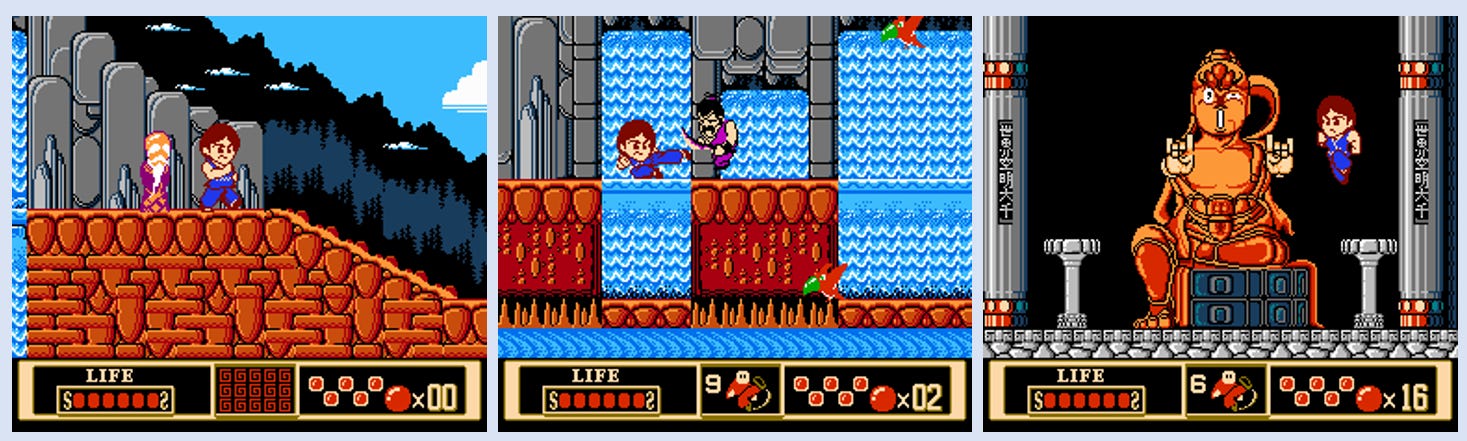
For a licensed title, the NES game is actually quite good, with big sprites that have expressive characteristics, imaginative monsters and boss encounters and surprisingly lengthy and varied levels for Jackie Chan to voyage across. The hero looks absolutely great with a nice range of facial expressions, memorable poses and one of the most determined walking animations I’ve ever seen in a chibi-sized character.
The basic premise of the game is that an evil three-eyed wizard named the Sorcerer, arch-enemy to Jackie’s martial arts Master, has kidnapped Jackie’s twin sister Josephine. Jackie has to battle his minions to get her back. Along the way, he’ll also encounter helpful frogs who vomit up items when they’re punched and he’ll also stumble across bells he can ring that will summon his Master on a cloud and take him to some sort of points-scoring challenge bonus area where he’ll get rewarded for jumping on clouds, grabbing fish out of a waterfall, defeating falling wooden training dummies or battling bubbles away from some sort of floating mouth.
While Jackie is equipped with some basic martial arts moves, he can also fire five psycho wave attacks or pick up charges for a tornado attack, a 180-degree spin kick, a 360-degree spin kick or an upwards kick attack. And unlike Taito and KID’s Kick Master, which came out a year later on the NES, none of this is complicated – if you have the special move in question, you push up and attack to trigger it, and you fire your psycho wave by first holding down attack to charge it. The other specials are replenished by picking up items, but the psycho wave count is only reset when you pick up 30 bonus jades, which fall from nearly every enemy you destroy.
Since the game is more or less a scrolling action platformer with the typical jumps, hazards and settings and you’ll see in many games from the era (including fire fields, mountain passes, ice caverns and castle-like temples), the main way in which Jackie Chan’s Action Kung-Fu differentiates itself is in presentation and polish. The graphics do a very good job of establishing the various settings and make use of the Chinese theme to deliver some distinctive visuals, and the enemies, while not always the most imaginative, are large and well-animated. There’s even an enormous pouncing tiger foe you’ll have to dispatch along with bats, snakes, birds, rocket-powered turtles and human guards. The music by Masakatsu Maekawa is also excellent and suits the stroll through the nebulously-defined ancient Chinese world (not based on any particular film, but evocative of the setting). And the controls and overall experience are pretty high in quality for a NES game from 1990.
One particular highlight is the boss battles, which almost all feature a large character built into the background whose weak spot tends to be the head. But there’s also a winged frog, a master martial artist and a giant spider to battle.
The game’s also pretty easy to pick up and play thanks to a generous life bar and easily-replenished continues (which serve as live). Timing jumps can be a bit tricky until you get a feel for the game, and there are some forced scrolling sections, but nothing’s so difficult you’ll want to break your controller in half in frustration. The manual even provides you with a cheat code for 99 continues if you need them.
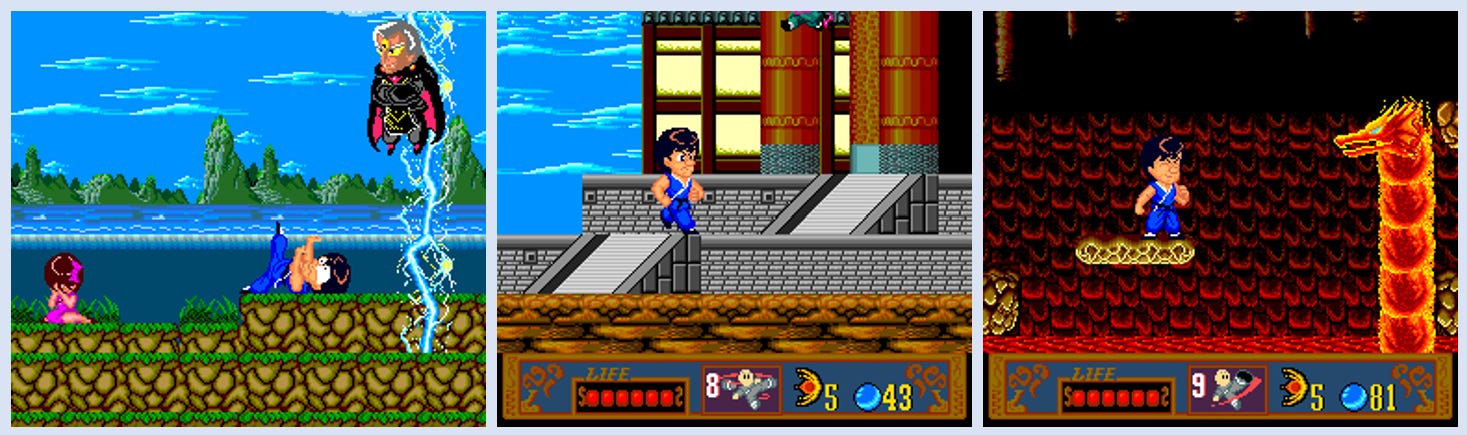
So far, I’ve been discussing the NES version of the game, and if you can get your hands on it, do so by all means – it’s quite good. But if you’re going to be playing on an emulator anyhow or you have the means to collect the TurboGrafx-16’s library, Hudson Soft released an updated version of the game on the newer console and it’s superior in just about every way. The graphics are better, the music is even catchier and the levels have been tweaked to remove minor annoyances. But best of all, the boss battles are significantly upgraded, and while I wouldn’t describe them as being more challenging, necessarily, they’re just more fun, particularly with the game’s villain, who feels a lot more like a sorcerer this time around.
Also, for reasons that probably don’t matter, Josephine is supposed to be Jackie Chan’s girlfriend in the TG-16 version, and this does sort of explain her smitten face in this version’s ending. But speaking of endings, the TG-16’s upgrade of the already fun NES credits sequence (which rolls like a Jackie Chan movie blooper reel, though with still frames) adds in the heads of the developers on some of the game’s enemies and bosses. It’s really something, and adds a memorable conclusion to a great action game!
We’re moving on to the 1990s console and arcade games to cover one of the golden eras of video gaming as gaming shifted to 16 bits at home and true 3D in the arcades!
We’ll cover shoot ‘em ups, run and guns, fighters, brawlers, RPGs, platformers and, of course, strategy games, sports games and more. Take some time learn about great games you may have missed like Power Blade, Ranger X, Thunder Fox, Liquid Kids, Alligator Hunt, Arabian Fight, Crystalis, Popful Mail, Alisia Dragoon, Kid Dracula, Little Samson, The Space Adventure, Rocket Knight Adventures, Rolo to the Rescue and even oddities like The Haunting Starring Polterguy and The Ooze!
If you missed my series on the hundreds of 1980s PC, console and arcade games you probably never played, you can find the entire archive at https://greatestgames.substack.com.
Anything I don’t share here will be in my upcoming book, tentatively titled The Greatest Games You (Probably) Never Played Vol. 3. Subscribe to this newsletter so you won’t miss it!
If you missed my previous series on the hundreds of 1980s console, arcade and PC games you probably never played, you can find the entire archive at https://greatestgames.substack.com.
Anything I don’t share here will be in my upcoming book, tentatively titled The Greatest Games You (Probably) Never Played Vol. 3. Subscribe to this newsletter so you won’t miss it!
No posts
Comments
Nothing yet. Say the first thing.
Sign in to join the conversation.