
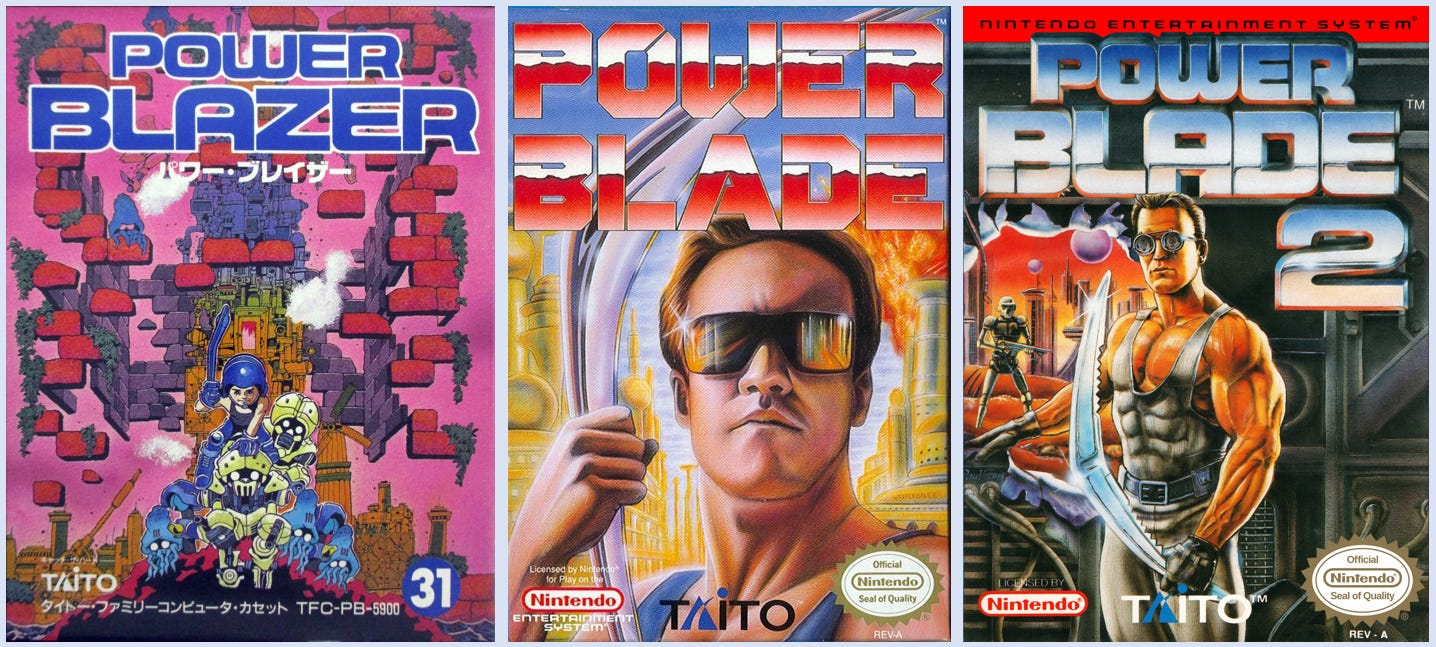
RELEASE DATE: 1991
DEVELOPER / PUBLISHER: Taito
BEST VERSIONS: NES
Power Blade is one of those 1990s games that’s likely nobody’s favorite but which still has a following today. It also has a tremendously silly premise and wins you over by completely committing to it.
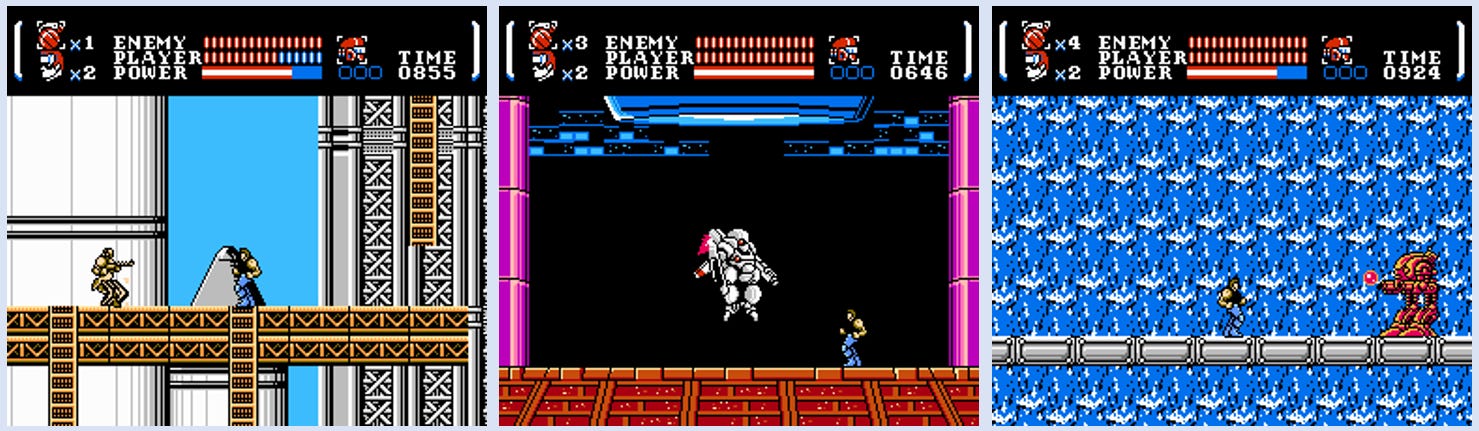
In this case, you’re a buff dude in a tank top and sunglasses named NOVA, the Master Computer’s Chief Security Officer and master of the Power Blade, a bladed boomerang. When the Master Computer is taken offline by an alien attack, NOVA is tasked with retrieving six backup tapes from six different sectors and then heading into the computer to restore its data. The game is structurally similar to Capcom’s Mega Man in that you can play the six sectors in any order and Bionic Commando in that you need to find an agent somewhere on each of the fairly open stages to give you an ID card that allows you to open the door to the boss’s chamber, but it plays like a Castlevania-style action platformer where you run, jump and toss your boomerangs at robotic sentries as you move between different scrolling screens.
Somehow, those components blend well enough together to make a pretty decent NES action game, and while boomerangs aren’t the best choice of weapon for an action game (since they’re slow and you have to wait for them to return), Power Blade makes it work by keeping the action zippy and its action star-style protagonist capable of cutting through anything that gets in his way.
But it’s worth mentioning that Power Blade could have been so much more. You see, the Japanese Famicom version of the game, Power Blazer, was retooled into Power Blade to try to make the game appeal to a Western audience. The original game is far more obviously meant to be a Mega Man-style adventure, with an anime-style hero, cartoony graphics, more exciting platforming and far more imaginative enemies and boss battles. In this game, you’re a guy named Steve Treiber who has to destroy the master computer, and though it’s light on story, there’s a certain sense of pluck and spunk in the game that’s missing from Power Blade.
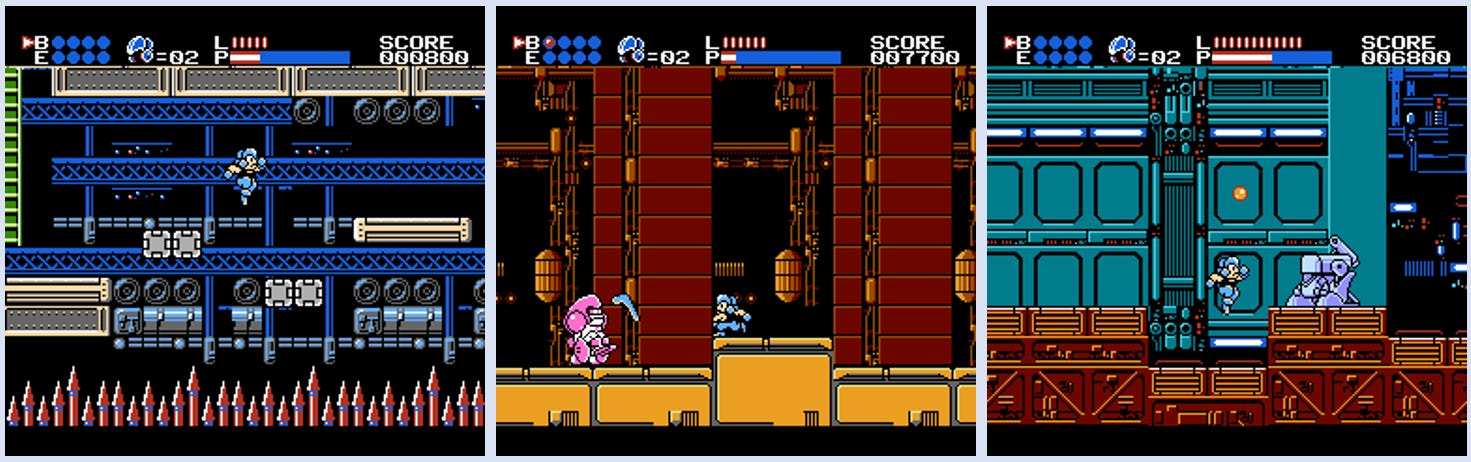
That’s not to say Power Blazer is a great game, however. Compared to the likes of Mega Man, it feels very limited because you don’t grow and evolve as the game goes on. You’re just stuck with your boomerang weapon and a consumable smart bomb. There’s the kernel of a fun game there that the localization team tried to draw out and improve upon with Power Blade, but in doing so, they made an action game that’s hard to take seriously despite its really earnest attempts at being early 90s cool.
Yet that’s actually part of what makes Power Blade so endearing, and exactly why I recommend giving it a shot.
The game’s structure is pretty standard for an early 90s action platformer – you move horizontally and vertically through various scrolling rooms bigger than a single screen, climb ladders, jump on ledges and battle bad guys with your trusty boomerang. You can charge the boomerang up for more power and range, and you can also earn upgrades that make your boomerangs stronger and more numerous. If you’re on foot, you can also throw the boomerangs in 8 directions, while ladders limit you to simply throwing side to side. You can pick up consumable grenades to clear the screen, but the really desirable power-up is the metal power suit, which encases NOVA in armor and turns his boomerang into a wave-like blast. It also gives NOVA some limited protection from damage before it disintegrates and returns him to losing sections of his health bar.
One of the best-liked aspects of Power Blade is that most of the levels are slightly explorable, much like the stages in Bionic Commando or Disney’s DuckTales. Some folks go as far as to describe this game as being akin to Metroid, but that’s not accurate, and the main reason for the exploration mechanic is because of the need to find the agent who helps you unlock the door to the boss. Missing that agent can actually make for a tedious and frustrating experience in clearing the level, and if you’re not going to play with a map, be ready for a little bit of trial and error.
If Power Blade has a weakness, it’s that defeating the enemies requires some patience as you learn their patterns and moments of vulnerability. Once you understand how different foes work, it’s not too bad, but like the hard hat-wearing Metalls in Mega Man, there are several enemies that are only vulnerable when attacking, and you have to time your blades just so to hit them before they hit you. Having the power armor makes these encounters a lot easier, but being careless will cost you that armor pretty quickly.
The boss battles in Power Blade aren’t quite up to the caliber of Mega Man or Castlevania, but they’re decent. You’ll battle mechanical suits and buzzsaw dragons and a beehive and a fat green robot in what appears to be wearing a tire around his midsection and who shoots lightning bolts at you. Though the bosses are the same, the encounters themselves are actually an area where Power Blazer outshines the retooled game a bit, because the boomerang weapon works a little differently in the original and you can use its return path to inflict extra damage. Power Blade makes your character sprite taller and narrower and really encourages you to bring that power armor to the fight, changing the entire dynamic.
The final boss fight is also pretty disappointing in both games, and in each, you battle a large robotic head and then a machine. In Power Blazer, the machine is a volcano-like contraption on the ground. In Power Blade, it’s a floating computer with a sphincter in the middle and a brain bubble on the bottom. The ending sequences are likewise anticlimactic, but hey – it was rare for games in the NES era to go all out like Mega Man 2 did with a meaningful credits sequence.
All in all, Power Blade’s a decent game, and certainly one of the better third party action games on the NES. If you can track down a fan translation of Power Blazer, you should also give it a try, especially if you can play the two back and back and see how Taito’s development teams retooled elements from the Japanese game to appeal to westerners.
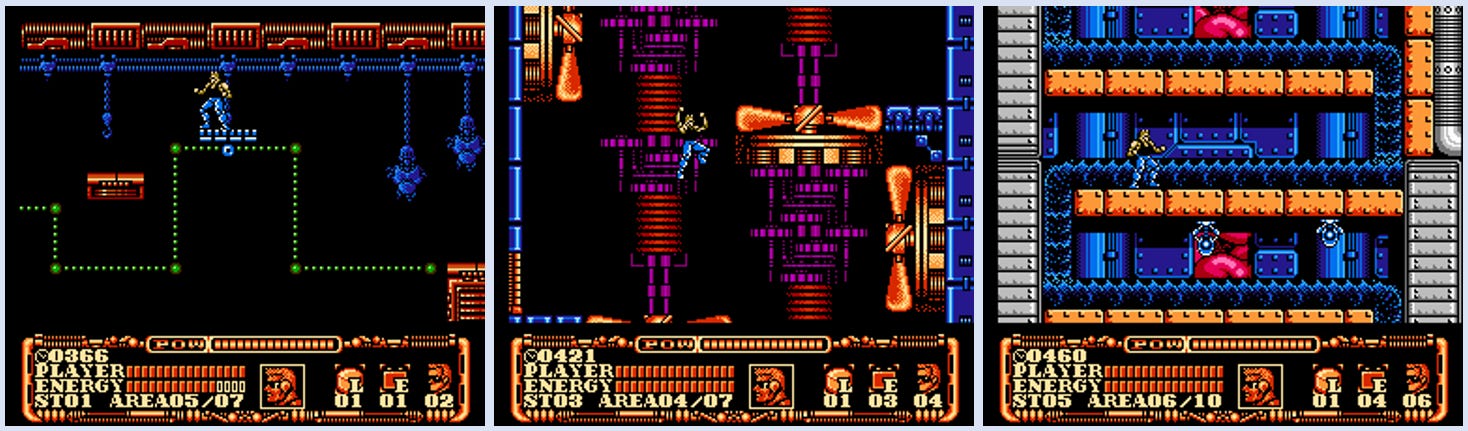
There’s also a 1992 sequel called Power Blade 2 on the NES. As you might expect, this one’s a sequel to the Western version rather than Power Blazer, and so it was released as a standalone game called Captain Saver on the Famicom in Japan. One of the big changes is that NOVA receives a slide move to enhance his mobility, and that’s good, because this one’s platforming hews a little closer to the linear action of a game like Contra than the mild exploration of the earlier game. Even so, you can still select which level you want to play, at least from the first four.
Probably the biggest change is that you pick up suits earned from the buzzsaw dragon mid-boss in each stage that give you specialized powers, sort of like you’d see in Altered Beast. The Newt Suit in Stage 1 lets you walk on walls and ceilings. The Wet Suit in Stage 2 lets you swim more capably in watery areas. The Rocket Suit in Stage 3 gives you a jet pack. And the Patriot Suit in Stage 4 gives you option-like satellites that absorb damage. If you wish, you can play the stages out of order and pick up different suits, but I really don’t recommend doing so. The last two stages are played once you’ve completed these four, complete with a boss rush before the final boss fight. To Power Blade 2’s credit, the final boss encounter is better overall, though this time, you’re fighting a knockoff of the Alien xenomorph.
Unfortunately, Taito has never re-released these games, and playing Power Blade, Power Blade 2 or even Power Blazer today requires either tracking down the cartridges or playing with a game ROM. They’re worth the trouble, and there’s definitely a lot to like about this series. I’d love to see a modern remake, re-release or true spiritual successor, and I hope one day, we do!
We’re moving on to the 1990s console and arcade games to cover one of the golden eras of video gaming as gaming shifted to 16 bits at home and true 3D in the arcades!
We’ll cover shoot ‘em ups, run and guns, fighters, brawlers, RPGs, platformers and, of course, strategy games, sports games and more. Take some time learn about great games you may have missed like Power Blade, Ranger X, Thunder Fox, Liquid Kids, Alligator Hunt, Arabian Fight, Crystalis, Popful Mail, Alisia Dragoon, Kid Dracula, Little Samson, The Space Adventure, Rocket Knight Adventures, Rolo to the Rescue and even oddities like The Haunting Starring Polterguy and The Ooze!
If you missed my series on the hundreds of 1980s PC, console and arcade games you probably never played, you can find the entire archive at https://greatestgames.substack.com.
Anything I don’t share here will be in my upcoming book, tentatively titled The Greatest Games You (Probably) Never Played Vol. 3. Subscribe to this newsletter so you won’t miss it!
If you missed my previous series on the hundreds of 1980s console, arcade and PC games you probably never played, you can find the entire archive at https://greatestgames.substack.com.
Anything I don’t share here will be in my upcoming book, tentatively titled The Greatest Games You (Probably) Never Played Vol. 3. Subscribe to this newsletter so you won’t miss it!
No posts
Comments
Nothing yet. Say the first thing.
Sign in to join the conversation.