

The image is familiar by now: a fleece vest, a quarter-zip, Bloomberg terminal in the background, and a confident 25-year-old talking about his portfolio. The “finance bro” has become a recognizable stereotype that says a lot about how the finance industry has historically seen itself and who it assumed belonged in it. But more women are entering the field, and that is starting to change things, not just in terms of headcount, but in how firms make decisions and what they value in leadership.
The more important question is not whether women are entering finance—they are. It is what happens after they get there. Women are still underrepresented in senior roles and investment decision-making positions, and the cultural environment can make it harder to advance. The data points to a consistent pattern: the industry has made real progress at the entry level but has been much slower to change at the top.
Where the “Finance Bro” Comes From
The finance industry’s cultural identity has real historical roots. During the 1980s economic boom, Wall Street grew rapidly and produced a specific type of professional, the young urban professional, or “yuppie”, whose identity was tied to wealth, ambition, and a certain exclusivity. This identity was just as much a cultural phenomenon as an economic one, and finance became closely associated with a competitive, status-driven masculinity that proved difficult to shake.
Films reinforced that image. American Psycho (2000) and The Wolf of Wall Street (2013) both depicted finance as a world defined by status, excess, and a certain disregard for the rules. A recent study in a business ethics journal found that these kinds of representations do not just reflect industry culture, they actively shape it by signaling what gets rewarded and who is expected to thrive. Today, that same identity has moved onto social media. The Financial Times has noted how finance influencers on TikTok, the Patagonia quarter-zip aesthetic, and “grindset” content all continue to reinforce the same cultural image that Wall Street has projected for decades. The medium changes, but the message stays largely the same.
How Finance Culture Shapes the Pipeline
More women are entering finance than ever before. Women now hold 29% of C-suite positions across U.S. companies, up from 17% in 2015, but in financial services specifically, that figure falls to 21%, and women hold only about 5% of CEO positions in the sector. Meanwhile, women make up more than half of entry-level banking roles. The gap between those two numbers is the core of the problem.
Table 1: Women’s Representation Across the Finance Career Pipeline
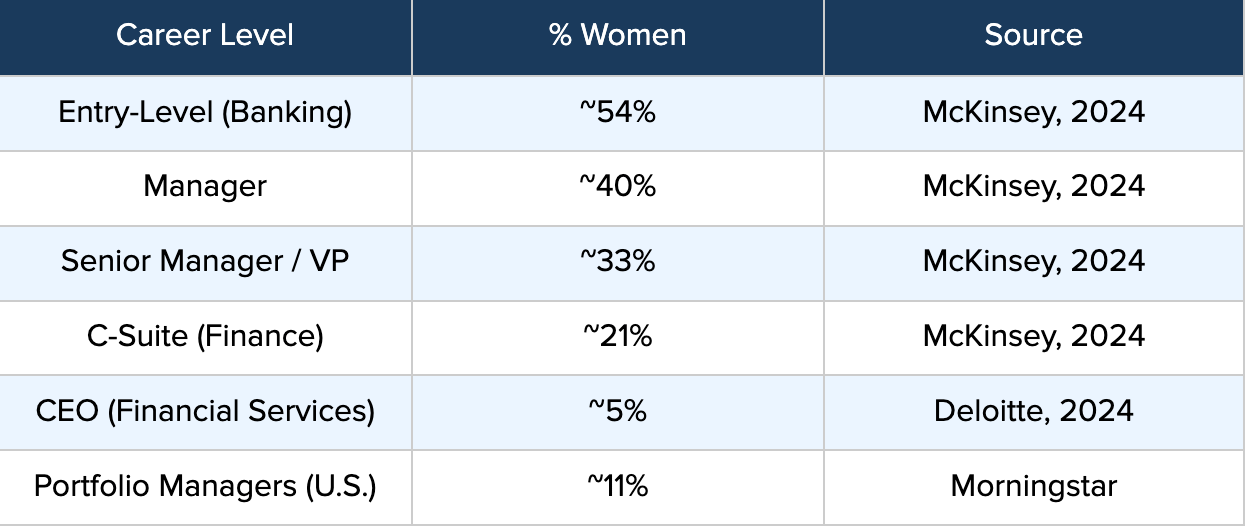
Sources: McKinsey Women in the Workplace 2024; Deloitte Global Gender Diversity in Financial Services; Morningstar.
The picture is even more stark in investment management, where only about 11% of U.S. portfolio managers are women. The CFA Institute’s 2024 report finds the gap is sharpest in roles that carry actual decision-making authority over capital allocation, which is exactly where it matters most.
What makes this pattern more complicated is that women are not leaving the industry at higher rates than men. In fact, attrition rates for women in financial services are equal to or lower than those for men at almost every level. The problem is not that women are dropping out, it is that they are being promoted less. Women in finance are 24% less likely to receive their first promotion than male peers who are requesting advancement at similar rates, and for women of color that number rises to 34%. This gap forms early and gets harder to close at every level after, which is why representation looks so different at the top than it does at the entry level.
What Diversity at the Top Actually Changes
This gap is not just an equity issue, it has measurable implications for firm performance. Companies with more women in leadership tend to perform better. The Credit Suisse Research Institute’s Gender 3000 report found that gender-diverse leadership consistently corresponded with stronger financial performance and lower risk profiles. McKinsey’s research puts a number to it: companies in the top quartile for gender diversity in executive teams are 25% more likely to outperform financially than those in the bottom quartile.
For investment teams, the argument comes down to decision quality. When everyone on a team thinks similarly, assumptions go unchallenged and blind spots go unnoticed. In a field where overconfidence has historically contributed to systemic risk, a wider range of perspectives can make a real difference. That point is worth keeping in mind given that women-owned firms currently manage less than 2% of mutual and hedge fund assets and about 8% of private equity assets, even though female-managed funds have shown comparable and, in some cases, stronger risk-adjusted performance.
Deloitte has also documented a “multiplier effect” at financial services firms: each woman added to the C-suite corresponds to roughly three more women in senior leadership roles, and firms with women in the C-suite had nearly twice the share of women on their boards. Change at the top does not stay at the top. It reshapes the pipeline below it.
Culture as a Structural Issue
The numbers show what is happening, but culture helps explain why. The “finance bro” image has been built up over decades through media, workplace norms, and now social media. Over time, it has created an informal standard for who is seen as a natural fit in finance and who has to work harder to be taken seriously. That affects how women experience the industry on a daily basis.
More than 53% of women in financial services report experiencing at least one microaggression in the past year, things like being interrupted, having their judgment questioned, or not getting credit for their work. On top of that, women tend to take on more “invisible labor,” meaning the team coordination, emotional support, and inclusion work that keeps organizations running but does not show up in performance reviews. Entry-level women in financial services are 2.6 times more likely than men to organize team-building activities, yet entry-level men are 67% more likely to have that kind of contribution formally recognized.
Over time, these experiences add up and influence how women assess their own future in the industry. Only 26% of entry-level women in financial services say they want to reach the C-suite, compared to 40% of their male peers and 31% of entry-level women in other industries. That is not a gap in ability or ambition. It is a gap in what people believe is realistic for them based on what they see around them every day.
Looking Ahead
The “finance bro” stereotype has lasted as long as it has because the industry faced little pressure to move away from it. That is starting to change. More diverse leadership is increasingly linked to better financial performance, stronger risk management, and more stable long-term outcomes, and firms are beginning to take that seriously.
Progress is real but slow. Women now hold 29% of C-suite positions across U.S. companies, up from 17% a decade ago, but at the current rate it will take close to 50 years to reach full parity. In financial services, where the gap between who enters the industry and who ends up leading it is one of the widest of any sector, that timeline is hard to accept.
Closing the gap will take more than good intentions. It requires structural changes like clearer promotion criteria, real accountability metrics, and sponsorship programs that actually move women into decision-making roles. It also requires firms to honestly examine the cultural environment that has shaped the industry for decades. That conversation is happening. Whether it leads to real change depends on whether firms follow through or treat diversity as something to talk about rather than act on.
Comments
Nothing yet. Say the first thing.
Sign in to join the conversation.