
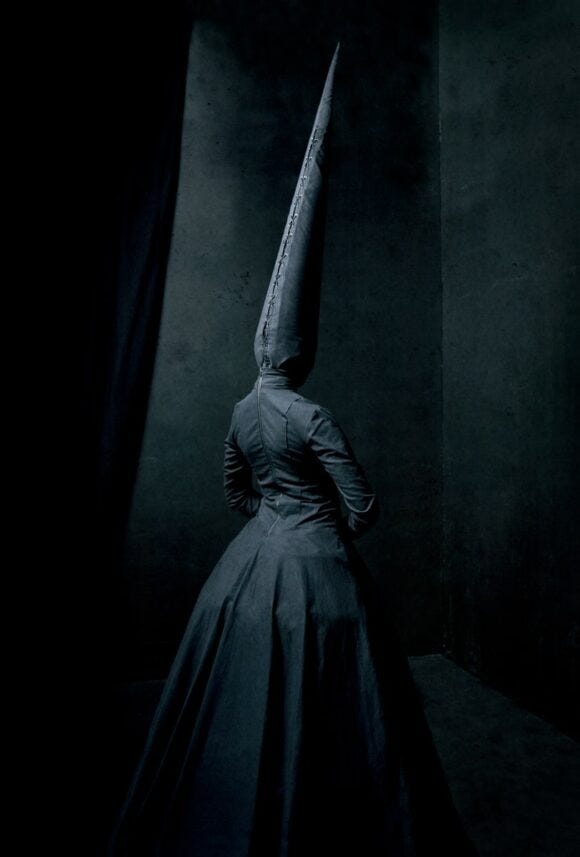
In their 1962 article “Two Faces of Power,” American political scientists Peter Bachrach and Morton S. Baratz argue that political power does not operate only where we most readily see it, in open decisions, conflicts, or acts of coercion (perhaps best exemplified by Robert Dahl’s classic formulation: “A has power over B to the extent that he can get B to do something that B would not otherwise do”). This visible arena – where one actor compels another to do something against its will – constitutes the first face of power. This produces the dramaturgy of domination (and the arts of resistance), the stage on which commands are issued, compliance compelled, and punishments displayed. In its starkest literary form, this is Orwell’s world: “a boot stamping on a human face – forever,” the very image of coercion stripped down to its most brutal essence. Somewhere, at every moment, at least someone is being beaten.
This highly theatrical image of power can be extended profitably. If the boot stamping on the face is the emblem of naked domination, we might imagine a more grotesque variation: a face stamping on another face, an intentionally perverse take on le rapport de face à face, a formally reciprocal violence churning ceaselessly in the fecund void of history. The recursive quality of this image suggests how domination reproduces itself through human bodies, institutions, and narratives, each reiterating the founding act in different forms. The primordial fratricide of Cain and Abel, or the cycle of divine rapacity and violence that structures Hesiod’s Theogony, offer archetypes of this drama, providing almost pictographic scenes in which originary violence inaugurates order. From there, the pattern proliferates across history, the oscillating cyberneticism of lordship and bondage (Herrschaft und Knechtschaft) and the ceaseless struggle for recognition. Power, in this first and most visible sense, appears as a sequence of blows, a chain of conflicts extending from mythic (and real) prehistory to the present. The first face of power is most legible, though by no means exhausted, in all its grimdark spectacle.
Even more important in Bachrach and Baratz’s account, however, is the second face of power, which is the capacity to shape the agenda itself. They write:
Of course power is exercised when A participates in the making of decisions that affect B. But power is also exercised when A devotes his energies to creating or reinforcing social and political values and institutional practices that limit the scope of the political process to public consideration of only those issues which are comparatively innocuous to A. To the extent that A succeeds in doing this, B is prevented, for all practical purposes, from bringing to the fore any issues that might in their resolution be seriously detrimental to A’s set of preferences propose a deceptively simple insight about power.
As such, this second, largely invisible face of power operates earlier and more quietly - in the night, in the dark - deciding which issues will be discussed, which options are imaginable, and which conflicts never appear in the public at all. By organizing the field of what can be seen and said, of what can be rendered legible, this invisible power prevents certain challenges from arising. It is exercised not simply through managing choice architectures, but through the more general management of visibility, or what Jacques Rancière later calls the distribution of the sensible. This phrase refers to the historically specific configuration of perception that determines how the world can appear, who can be visible within it, and whose speech counts as meaningful. As Rancière writes, “The distribution of the sensible reveals who can have a share in what is common to the community based on what they do and on the time and space in which this activity is performed.”
He continues:
There is thus an ‘aesthetics’ at the core of politics that has nothing to do with Benjamin’s discussion of the ‘aestheticization of politics’ specific to the age of the masses’. This aesthetics should not be understood as the perverse commandeering of politics by a will to art, by a consideration of the people qua work of art. If the reader is fond of analogy, aesthetics can be understood in a Kantian sense - re-examined perhaps by Foucault - as the system of a priori forms determining what presents itself to sense experience. It is a delimitation of spaces and times, of the visible and the invisible, of speech and noise, that simultaneously determines the place and the stakes of politics as a form of experience. Politics revolves around what is seen and what can be said about it, around who has the ability to see and the talent to speak, around the properties of spaces and the possibilities of time.
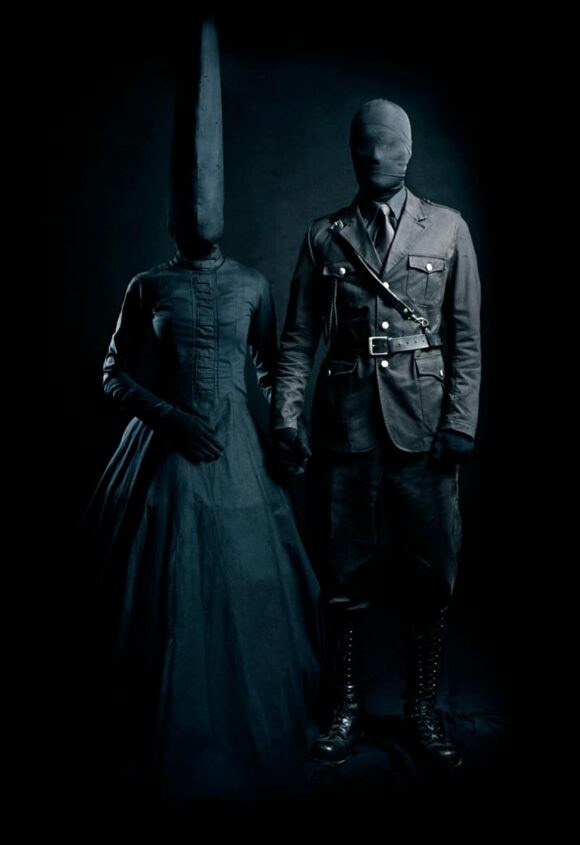
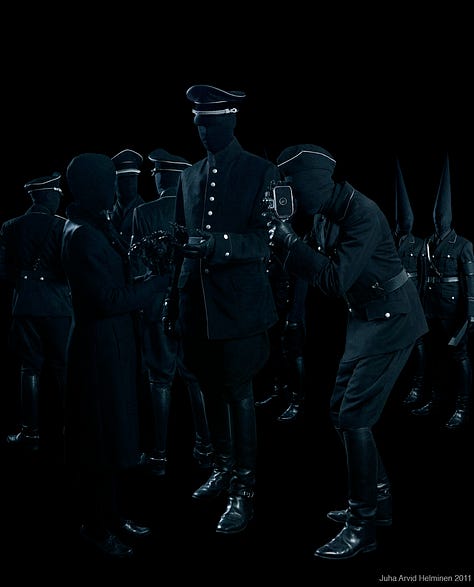
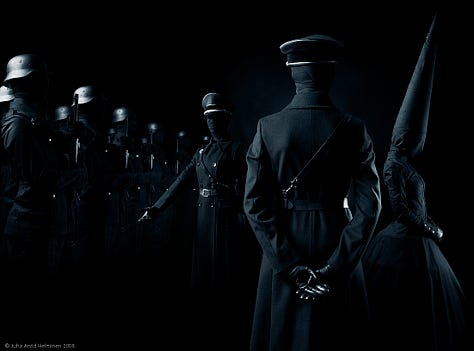
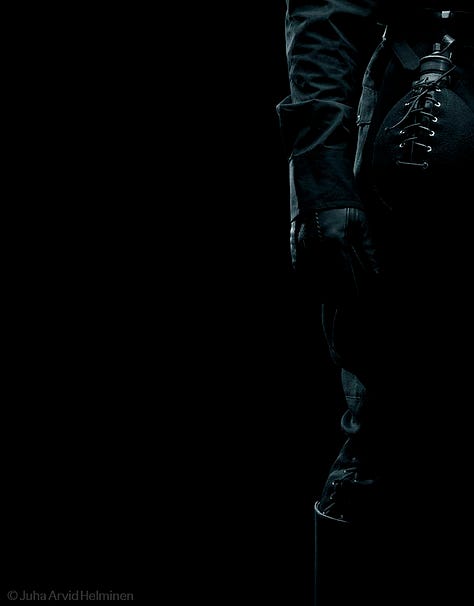
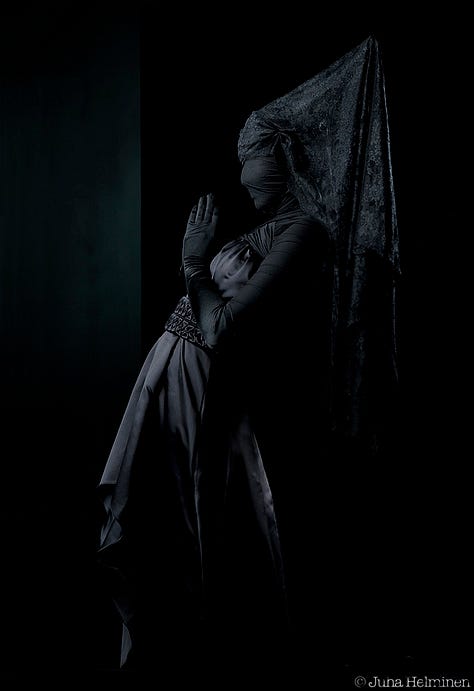
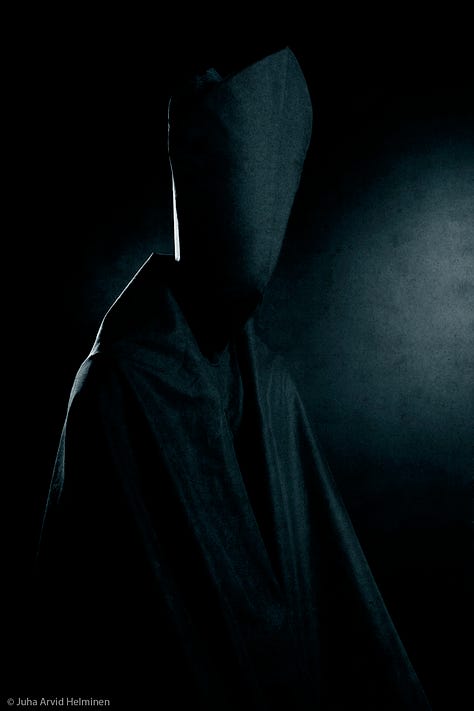
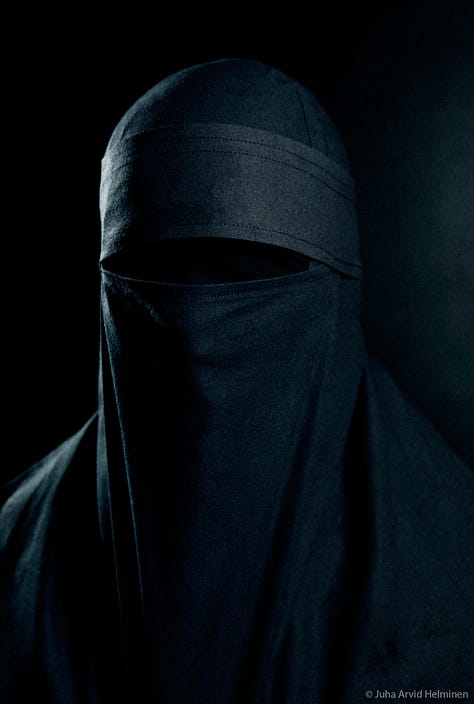
If politics rests upon such aesthetic arrangements of visibility, then it follows that power also possesses some visual grammar. It is precisely this aesthetic infrastructure of authority that the Finnish artist Juha Arvid Helminen probes in his photographic series The Invisible Empire.
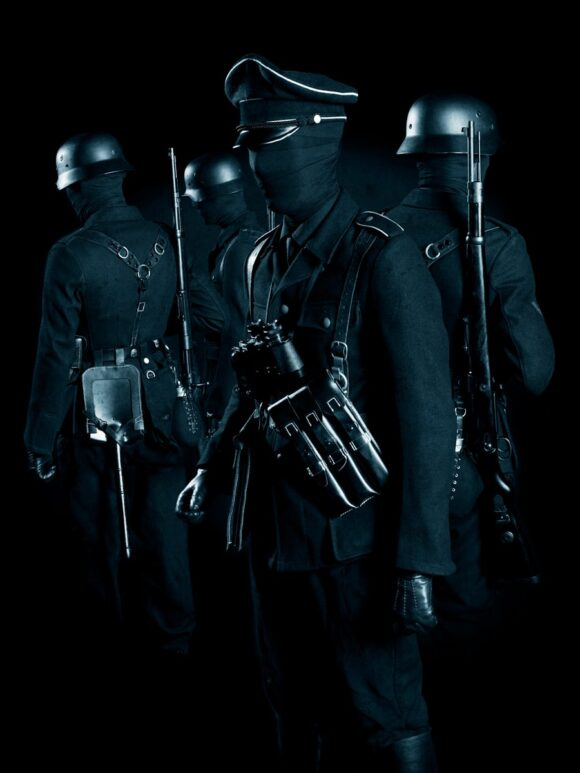
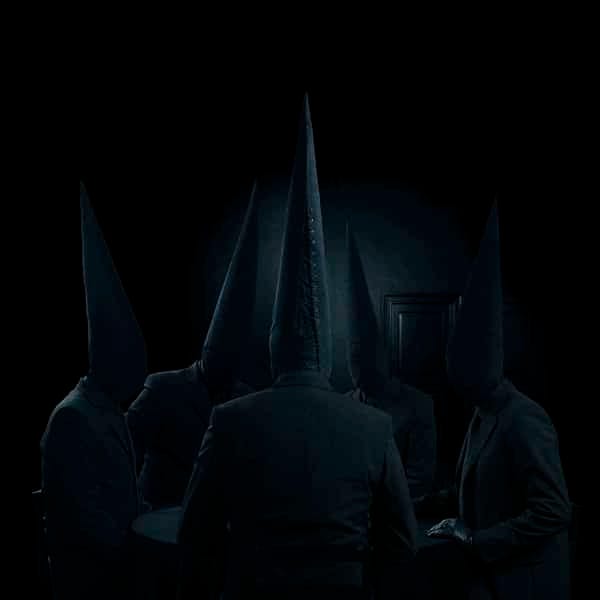
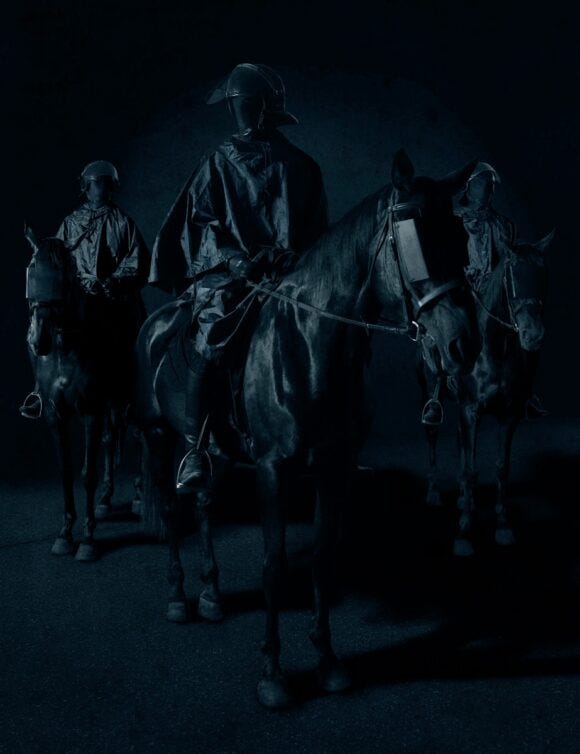
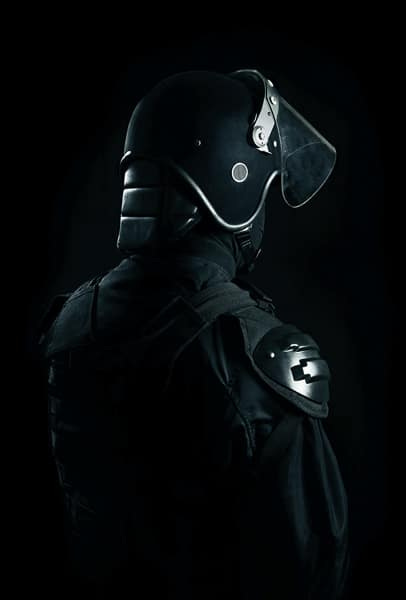
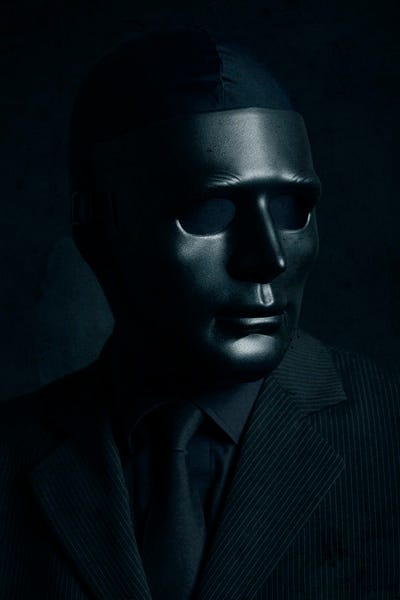
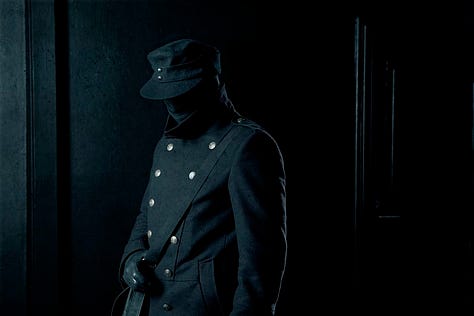
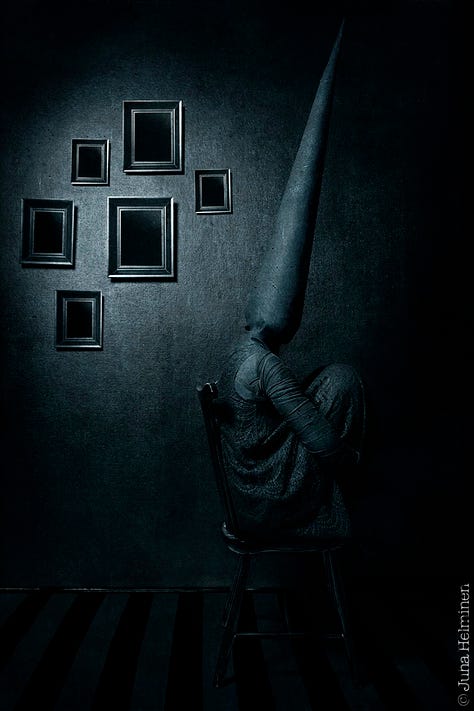
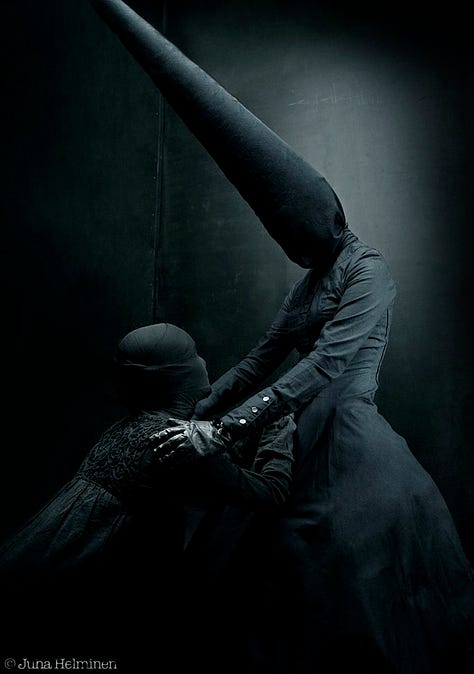
In The Invisible Empire, anonymous authority figures clad in midnight black stage abstract tableaux of domination and submission (“Black is, par excellence, the colorless color of fetishes”). They bear no insignia, nor any other signifiers of belonging, identity, or purpose - despite the relatively explicit parallel to the aesthetics of Nazi German uniforms (by Hugo Boss). Indeed, as blackened figures posed in ritualized configurations against backdrops of nearly equal darkness, they appear less like merely masked individuals than as the silhouettes of power itself made manifest.
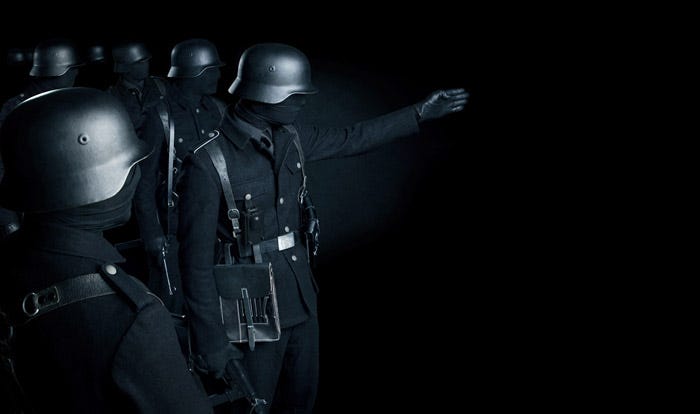
Their gestures - arms raised, bodies congregated, figures kneeling or standing in hyperstylized postures of mute command or subtle threat - evoke very familiar scenes of domination even while withholding the contextual markers that would normally render them tractable or even legible. They are subject positions without subjects in them. Uniforms dissolve into shadow; faces vanish into masks; any institutional context becomes amorphously sable vapor. What remains is no particular police force, army, church, or state, but the formal grammar of power stripped down to its essentials, just bodies arranged hierarchically in space, violence implied in frozen gestures, presence conveyed entirely through posture: pace Giorgio Agamben, the whatever authority.
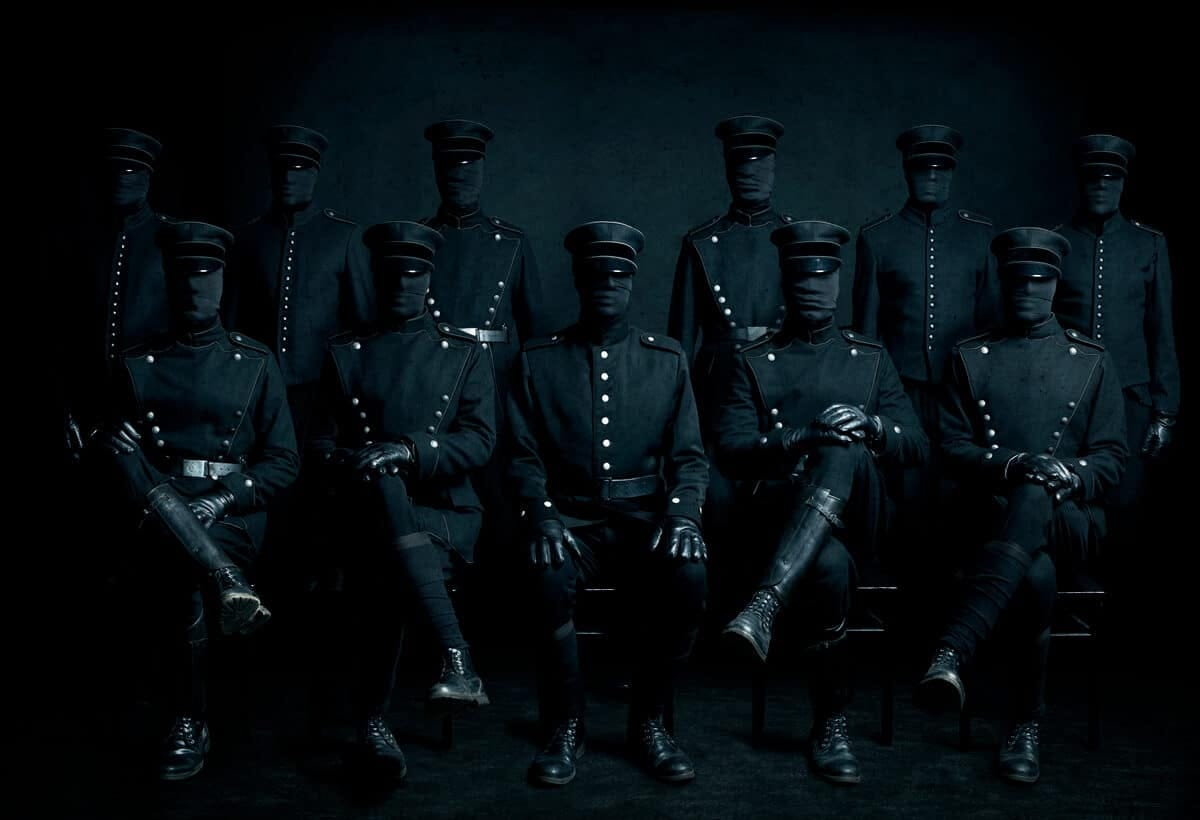
In this sense, the photographs perform what might be called a kind of geopolitical degloving. The term is deliberately stark, but it captures the operation precisely. The symbolic skin of power - the ideological and imagistic state apparatus that so often clothes authority in many-colored mantles of glory and inevitability - is peeled away, leaving behind only pellucid black abstraction (what are you seeing when you look at the blackness that surrounds the stars in the night sky?). Power appears here not as the visible insignia of office or the spectacle of military regalia, but as a kind of anonymous choreography. Helminen’s images stage domination as a set of repeatable poses, positions which any body might occupy.
In this sense, the photographs visualize precisely the dynamic suggested by Bachrach and Baratz’s second face of power: authority that does not announce itself openly but instead takes shape behind and through the structuring of perception as such. By removing the signs that would ordinarily identify who is acting (or in whose name, be it the People or the President, God or the God Emperor), Helminen exposes something more abstract, eerie, and unsettling - the aesthetic infrastructure through which power operates and becomes visible in the first place.
Another way to understand Helminen’s work is through what Alain Badiou calls the operation of subtraction. For Badiou, subtraction names a procedure by means of which a truth withdraws from the dominant forms of representation that organize a situation. Rather than confronting those structures directly, subtraction suspends their authority, refusing the coordinates through which the situation ordinarily counts and classifies its elements. What emerges from such a subtraction is not a new representation but a different relation to what the situation contains, a way of interfacing with the same field of meaning no longer governed by any particular myth of the given. He writes:
Philosophy must indeed subtract Truth from the labyrinth of meaning. At its core is a lack, a hole; is the fact that the category of Truth and its escort in time, that is, eternity, do not refer to anything in presentation. Philosophy is not an interpretation of the sense of what is offered to experience; it consists in the operation of a category subtracted from the category of presence. […] Philosophy is above all a rupture with both narrative and commentary on narrative.
Elsewhere, Badiou states his point differently:
A truth punches a ‘hole’ in knowledges, it is heterogeneous to them, but it is also the sole known source of new knowledges. We shall say that the truth forces knowledges. The verb to force indicates that since the power of a truth is that of a break, it is by violating established and circulating knowledges that a truth returns to the immediacy of the situation […]
In this sense, Helminen’s photographs do not depict power so much as subtract it from its usual representations, allowing something new and strange to appear.
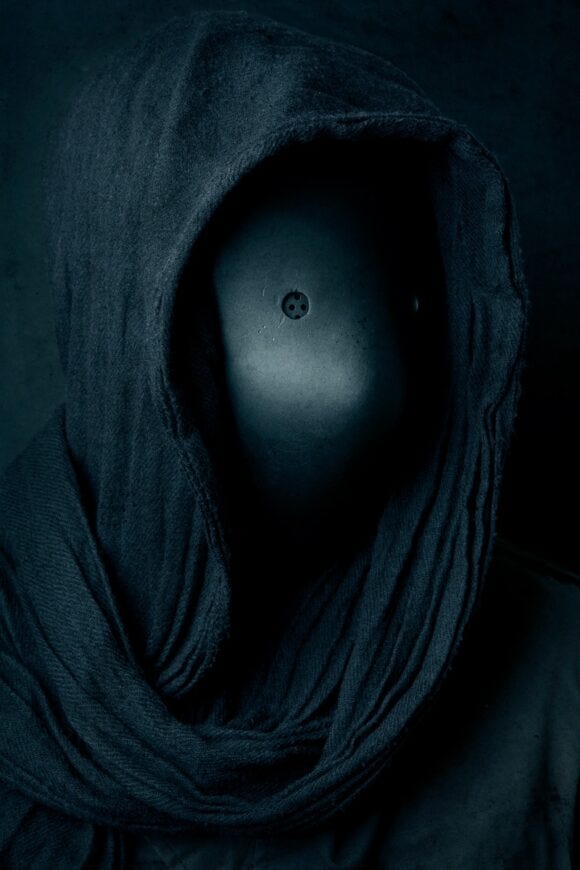
So, on the one hand, Helminen’s images expose the aesthetic infrastructure of authority. By stripping away identities, insignia, and institutions, they reveal what ordinarily remains hidden beneath the visible spectacles of power and glory: a diagrammatic set of positions, gestures, and relations that organize domination long before any sovereign name or office enters the frame. The choreographies of compulsion preexist and persist.
On the other hand, as these representational skins are peeled away, something stranger begins to emerge. Against their fields of near-total darkness, the figures of The Invisible Empire seem less like actors in any local political drama than stark silhouettes arranged within some deeper, more impersonal constellation - a black ballet of stars tracing the inescapably gravitational fields of power itself. Here the face of self and other is precisely the absence of any such thing, exposing the Carcosan logic at the center of every order, where revelation arrives not in the unveiling of some hidden ruler (who conquers, founds, or returns) but in the discovery there was never a mask to remove in the first place.
In The Invisible Empire, the regime of the sensible becomes foreign to itself.
Camilla: You, sir, should unmask.
Cassilda: Indeed, it’s time. We all have laid aside disguise but you.
Comments
Nothing yet. Say the first thing.
Sign in to join the conversation.