

“A government is a criminal enterprise.”
So begins an essay (“Renditions”) written at some earlier point in his career by Richard Elster, a retired academic and “defense intellectual without the usual credentials,” who serves as the focal point of DeLillo’s novel. The plot is simple and stark, if affectively and conceptually dense. Jim Finley, a filmmaker, is visiting Elster in his rundown home far off in the desert of the American Southwest, with the goal of filming a long-form interview with Elster. Black and white, one unbroken take, no cuts, no script, no editorial intrusion.
Think Errol Morris’ The Fog of War (2003) or The Unknown Known (2013), but stripped down to the barest essentials; or Trevor Paglen’s installation YOU’VE JUST BEEN FUCKED BY PSYOPS: Doty (2024) (featuring Richard Doty, a former AFOSI counterintelligence agent involved in disseminating disinformation to UFO researchers in the early 1980s), but without Doty’s by turns sinister or playful strangeness. Just a man against the wall.

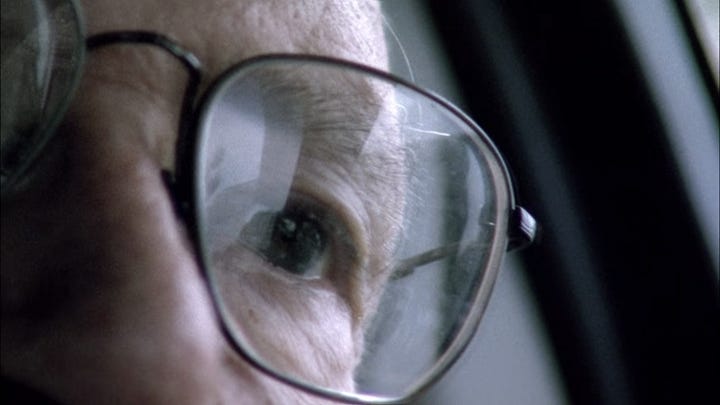
Once there, Finley ultimately shoots no film, but he stays for weeks, enmeshed in gnomic dialogues with Elster, who meditates with sterile intensity on the death drive (“We want to be the dead matter we used to be”), on the phenomenology of time and the desert, on the polymorphous self-justifications of selves and states. Perhaps seeing like a state means you can truly see nothing beyond the circumscribed horizons of the self, after all; perhaps only certain griefs or losses can change this. Elster is terminally self-involved; “I’m not sure he understood the fact that she was not him.”
Eventually, the two are joined by Jessie, Elster’s daughter, a withdrawn and faintly unreal character whose opacity (and capacity for mute, amorphous trauma: “She wasn’t a child who needed imaginary friends. She was imaginary herself”) culminates when she disappears into the desert. Her disappearance is never resolved at the level of plot. Like Anna in Michelangelo Antonioni’s L’Avventura (1960), Jessie’s absence haunts the novel (compare this to how the structured emptiness of any architecture’s interiority, even fictional ones, makes a building what it is). Elster wastes away: “All the man’s grand themes funneled down to local grief, one body, out there somewhere, or not.”
“Renditions” does not exist as a full text in Point Omega, only as a relatively brief characterization in its own right:
a study of the word rendition […] a walled enclosure in an unnamed country and a method of questioning, using what he called enhanced interrogation techniques, that was meant to induce a surrender (one of the meanings of rendition - a giving up or giving back) […] The essay concentrated on the word itself, earliest known use, changes in form and meaning, zero-grade forms, reduplicated forms, suffixed forms. There were footnotes like nested snakes. But no specific mention of black sites, third-party states or international treaties and conventions. […] Toward the end of the commentary he wrote about select current meanings of the word rendition - interpretation, translation, performance. Within those walls, somewhere, in seclusion, a drama is being enacted, old as human memory […] and what ensues is a revenge play that reflects the mass will and interprets the shadowy need of an entire nation, ours.
There is, of course, nothing radically new about the assertion or insight with which “Renditions” begins. Consider Augustine’s recapitulation and use of a story probably deriving from a lost fragment of Cicero’s De republica:
Justice being taken away, then, what are kingdoms but great robberies? For what are robberies themselves, but little kingdoms? The band itself is made up of men; it is ruled by the authority of a prince, it is knit together by the pact of the confederacy; the booty is divided by the law agreed on. If, by the admittance of abandoned men, this evil increases to such a degree that it holds places, fixes abodes, takes possession of cities, and subdues peoples, it assumes the more plainly the name of a kingdom [...] Indeed it was an apt and true reply which was given to Alexander the Great by a pirate who had been seized. For when that kind had asked the man what he meant by keeping hostile possession of the sea, [the pirate] answers with bold pride, “What thou meanest by seizing the whole earth; but because I do it with a petty ship, I am called a robber, whilst thou who dost it with a great fleet art styled emperor.”
Accentuate this illustrative fable with another, recounted by Plutarch in his Parallel Lives (“The Life of Caesar,” Chapter 2). There, the young Julius Caesar, en route by sea, is captured by Cilician pirates near Pharmacusa. They demand twenty talents; he laughs and tells them to ask for fifty, insisting they do not know whom they have taken. During roughly thirty-eight days in captivity, he behaves less as a prisoner than a compatriot, joining in their exercises, reciting poems and speeches, rebuking their indifference, and repeatedly warning them he will return to revenge himself. They treat it as mere bravado: “The pirates were delighted at this, and attributed his boldness of speech to a certain simplicity and boyish mirth.” Once ransomed, however, Caesar raises a small force, captures the pirates, and carries out the threat, having them all crucified.
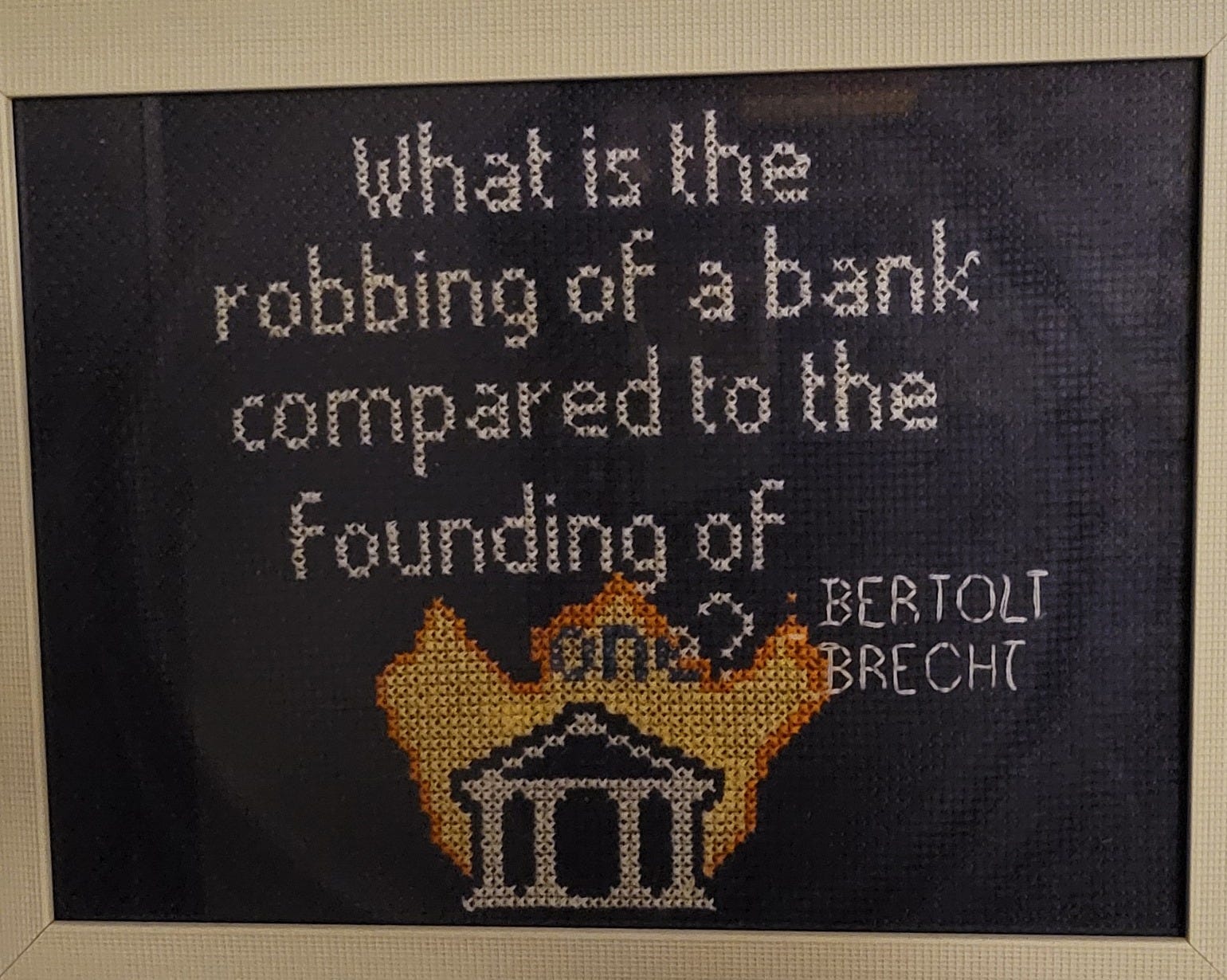
As Bertolt Brecht later comes to write, “What is the robbing of a bank compared to the founding of one?”
Back to Elster, who oscillates between roles as conceptual engineer (“He was there to conceptualize, his word, in quotes, to apply overarching ideas and principles to such matters as troop deployment and counterinsurgency”) and as renegade metaphysician (“We need to retake the future” / “Do we have to be human forever?”): part systems theorist of managed violence and part geopolitical mystic, part Herman Kahn cross-pollinating abstraction and imaginaries of mass death and part Jim Channon rehearsing superficially woo-woo aphorisms against the inhuman blankness of the desert sky. Elster is a strange animal, a hybrid product of late imperial thought. He is a man who once believed that sufficient conceptual altitude could master events, and who now speaks as though only a mutation of the species itself might suffice.
He is an icon of conflict (“Elsewhere, everywhere, my day begins in conflict, every step I take on a city street is conflict, other people are conflict”), of existential self-division as much as conflict with the world that he serves, that he endeavors to justify, with bombast or laconism, and to escape, with words, into words, building invisible (because, for DeLillo, inexistent) lines of flight from the order of things, seeking out “a protective hollow, womblike and world-sized, free of the leveling tendencies of events and human connections.”
Hence, the theorist’s specific predicament, promise, lament, tragedy: theory as a form of magic, or theory as a form of magical thinking? If this dilemma does not excruciate you, perhaps you aren’t really thinking:
No map existed to match the reality we were trying to create. […] Human perception is a saga of created reality. But we were devising entities beyond the agreed-upon limits of recognition or interpretation. Lying is necessary. The state has to lie. There is no lie in war or in preparation for war that can’t be defended. We went beyond this. We tried to create new realities overnight, careful sets of words that resemble advertising slogans in memorability and repeatability. These were words that would yield pictures eventually and then become three-dimensional. The reality stands, it walks, it squats. Except when it doesn’t.
DeLillo frames Elster and Finley’s narrative, the bulk of the novel, with two bracketing passages involving an anonymous, obsessive enthusiast of the (actually existing) art installation 24 Hour Psycho (1993) by Douglas Gordon. In the installation, Alfred Hitchcock’s 1960 film is dilated until it ceases to behave like cinema at all, instead playing silently in a dark room over the course of precisely twenty-four hours. Plot dissolves into gesture; gesture into posture; posture into grain and light. The installation stages a certain theory of time to the effect that events, slowed sufficiently, relinquish their narrative alibis altogether. The enthusiast, enthralled by this, ruminates endlessly over the kinetic and visual details of the film, which unfold so slowly as to estrange the viewer fundamentally from its meaning - or, perhaps, to reveal the film’s true meaning: “Suspense is trying to build but the silence and stillness outlive it.”

Elster and Finley intrude upon the installation, then depart (“He said it was like the contraction of the universe”). Are they fleeing some obscure truth encoded in this tortured temporal crypt, or are they returning to the real, to “the strange bright fact that breathes and eats out there, the thing that’s not the movies”? Either way, something exits the darkness with them, or perhaps ahead of them: the enthusiast, a figure who treats duration as fixation rather than contemplation, who mistakes proximity to an image for proximity to its object (he “separates himself from the wall and waits to be assimilated, pore by pore, to dissolve into the figure of Norman Bates, who will come into the house and walk up the stairs in subliminal time”).
It is, after all, more than heavily implied that the enthusiast (maybe named “Dennis,” Jessie’s mother recollects to Finley) is a disturbed young man who first meets Jessie at the installation and later stalks her to Elster’s desert hideaway, then either murders her or (possibly, however unlikely) escapes with her. Is there any egress from the byways of time, from history’s slow violence? “The mother. She remembers his name in her sleep”: it’s as if “Dennis” crawls up from the unconscious - a space, like Elster’s desert, where time supposedly does not penetrate. Elsewhere, we find another clue. Of Jessie: “She was her father’s dream thing.”

“Extraordinary rendition” names a certain practice of extrajudicial transfer with bureaucratic placidity. Indefinite detention, “enhanced” methods, black sites - these carefully obscuring words were designed to move bodies around without appearing to move them at all, to displace violence into procedure, to recategorize sovereign spaces into mobile assemblages. Rendition: the term itself performs what it describes. For Elster, “Renditions” widens the aperture further. It is not only the obscure transfer of people across borders but the transfer of reality into language, the attempt to rebuild events out of sheer phrasing (“major combat operations,” “special military operations”), to create a world that will stand, walk, and squat as commanded. If pirates and emperors differ only by scale, then so too do the art gallery and the empty desert, the enabling memo and the torture cell. Violence can be slowed down, archived, translated into euphemisms, metrics, or slogans, but it doesn’t go away.
It waits, in the dark, for playback; it waits, in the future, for review.
Like all things, renditions end; “Renditions” ends:
In future years, of course, men and women, in cubicles, wearing headphones, will be listening to secret tapes of the administration’s crimes while others study electronic records on computer screens and still others look at salvaged videotapes of caged men being subjected to severe physical pain and finally others, still others, behind closed doors, ask pointed questions of flesh-and-blood individuals.
If we’re lucky.
Comments
Nothing yet. Say the first thing.
Sign in to join the conversation.