
19 When it was evening on that day, the first day of the week, and the doors were locked where the disciples were, for fear of the Jews, Jesus came and stood among them and said, “Peace be with you.” 20 After he said this, he showed them his hands and his side. Then the disciples rejoiced when they saw the Lord…
24 But Thomas (who was called the Twin), one of the twelve, was not with them when Jesus came. 25 So the other disciples told him, “We have seen the Lord.” But he said to them, “Unless I see the mark of the nails in his hands and put my finger in the mark of the nails and my hand in his side, I will not believe.”
26 A week later his disciples were again in the house, and Thomas was with them. Although the doors were shut, Jesus came and stood among them and said, “Peace be with you.” 27 Then he said to Thomas, “Put your finger here and see my hands. Reach out your hand and put it in my side. Do not doubt but believe.” 28 Thomas answered him, “My Lord and my God!” 29 Jesus said to him, “Have you believed because you have seen me? Blessed are those who have not seen and yet have come to believe.”
John 20:19-20, 24-29
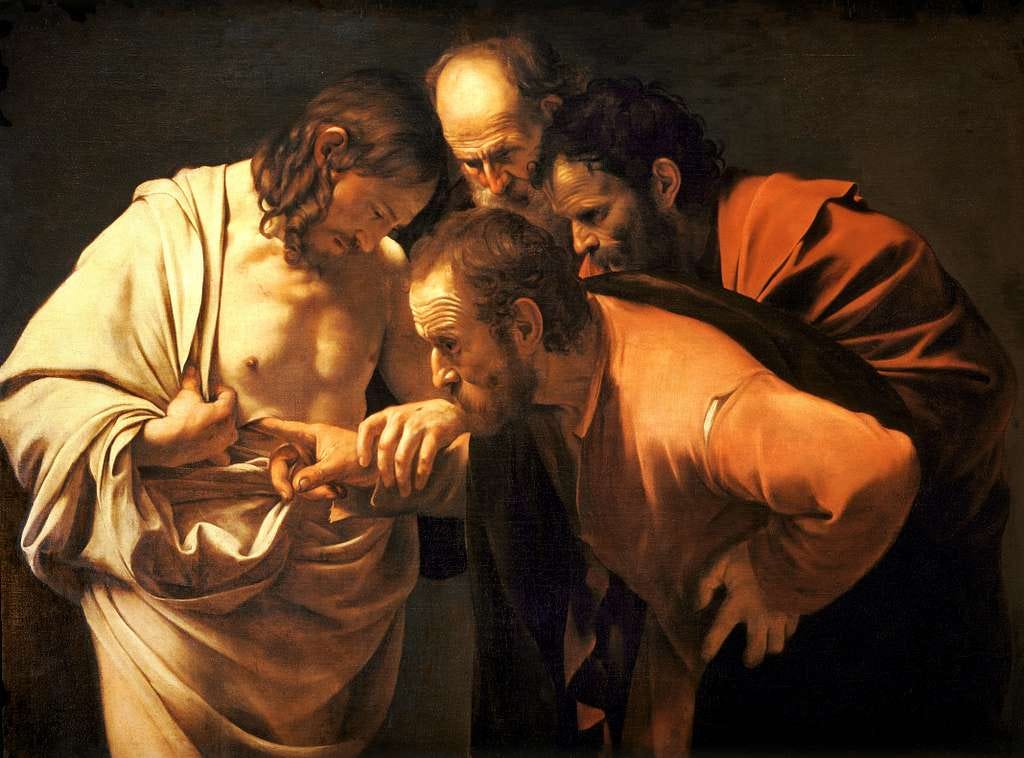
I have few thoughts about the John 20 story about Thomas (who I think should be nicknamed Honest Thomas rather than Doubting Thomas). Rather than a “clobber” passage for those who doubt, I read this story as a hopeful account of moving through doubt.
I cannot emphasize enough how normal it was for Thomas to not believe them. None of the other disciples believed without seeing, either! Resurrection from the dead was not a normal occurrence in the 1st Century! So, when Thomas missed the Resurrected Christ sighting, doubt is not a crazy response.
Can we acknowledge the fact that Thomas was still chilling with the homies a week after he honestly voiced his doubt in their testimony?! That is significant! The disciples made space for Thomas, and Thomas was confident to be himself without leaving. Did they try to convince him? The text is silent about this. But, it appears that Thomas’ doubt did not cost him his belonging. How many Christians are still rocking with someone a week after they question the resurrection? Let’s sit with that.
This whole story changes depending on the tone we imagine Jesus speaking with. Is he vindictive, loud, or angry? Or is he lovingly inviting Thomas into belief? Notice that Jesus actually answers Thomas’ request exactly: see the hands, put your finger on them, and put your hand in his side. I think this is a sign of Jesus love for Thomas. “What do you need to believe? I’ll do it.” There may be a blessing to those who believe without seeing, but there is no curse on Thomas for seeing before believing.
Upon encountering Jesus, Thomas makes this profession of faith: “My Lord and my God!” In addition, tradition states that he spent the rest of his life sharing the gospel, even journeying to modern day India. Honest Thomas represents the power of moving through a doubt. If he had bypassed or stuffed it, this encounter with Jesus would not have been so powerful or so uniquely shaped for him. By openly doubting and waiting on Jesus to lead him, Thomas was marked for life.
Thanks for reading Redemptive Imagination! Share it with someone who will be encouraged.
Comments
Nothing yet. Say the first thing.
Sign in to join the conversation.