
By Julie Essenberg
After Donald Trump was reelected, I found myself wondering what one person could do in a deeply divided country. I live in a rural, conservative area, where houses are spread apart and neighbors do not necessarily see one another every day. It would have been easy to remain quiet and feel alone.
Instead, I put signs in my yard.
They were not all campaign signs. They carried messages about protecting our climate, defending the Constitution, preserving democracy, and caring for one another. I chose signs that reflected the values I feared were being lost.
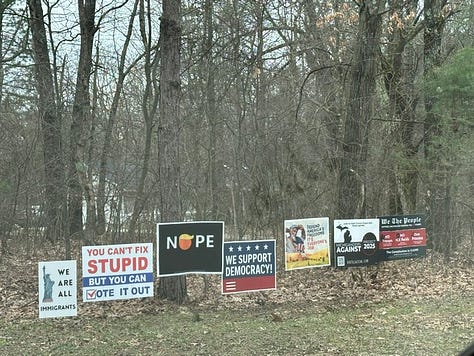
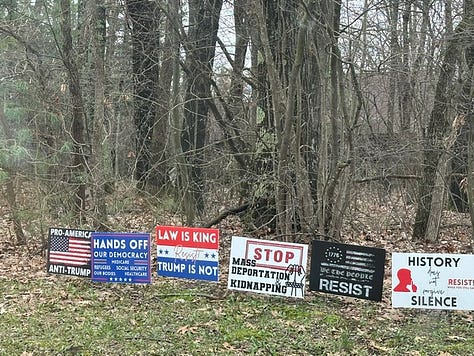
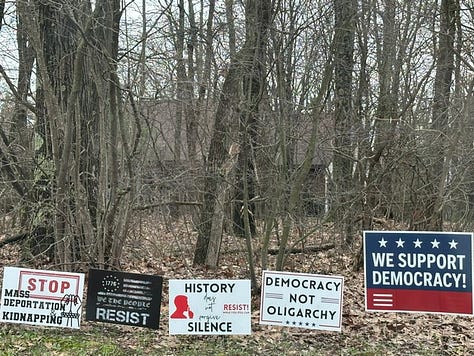
My purpose was not to anger anyone or tell my neighbors how they should vote. I wanted to start conversations—or at least let people know that someone in their community was willing to speak openly about these concerns.
People began stopping to look at the signs. Some slowed down as they drove past. A few spoke with me about their own concerns. The signs became a way of saying, “You are not alone, and it is safe to talk here.”
Then something unexpected happened.
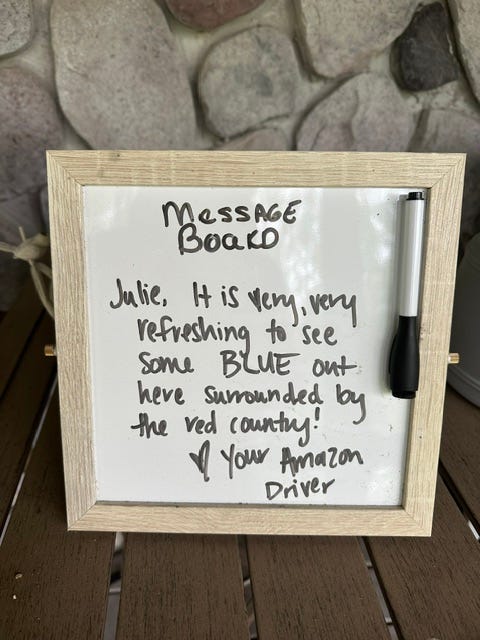
Because I receive packages regularly, I put up a small message board for delivery drivers. When they left a package, they could write a greeting or comment, and I could write something back the next time they came.
What began with simple messages such as “Hello” and “How are you?” gradually became something more meaningful.
One driver wrote that it was good to see a “blue dot” in a red area. Another thanked me for keeping my signs up. Someone else wrote that the signs made them feel safe delivering to my home.
Those messages stayed with me. The drivers were not stopping for a political debate. They were doing their jobs, often under pressure and on tight schedules. Yet seeing a few words in a yard gave them hope and reassurance.
It reminded me that we never know who may need to see a message of welcome, courage, or solidarity.
I was raised in the church and have long considered faith an important part of my life. I grew up in a fairly conservative environment and once held many conservative views myself. But over time, I began paying closer attention to what was happening to other people.
I saw immigrants being treated as though they did not belong. I saw people judged because of their race, religion, or sexual orientation. I saw LGBTQ people, including young people, being used as political targets. I saw cuts proposed for programs that children, older adults, people with disabilities, and struggling families depend upon.
I began asking myself difficult questions. How could I claim to care about my fellow human beings while remaining silent when they were being harmed? How could a faith centered on love and compassion be used to exclude people?
Those questions changed me.
They also made me curious about how our country became so divided. I wanted to understand how people who often share the same basic concerns could see one another as enemies. Most of us want our children to be safe. We want our families to have health care, food, housing, good schools, and opportunities. We want older adults to live with dignity. We want our communities to be secure and our government to work for ordinary people.
We may disagree about how to accomplish those things, but our concerns are often more alike than our politics suggest.
That is why conversations matter.
A conversation does not require us to abandon our principles or pretend that harmful policies do not hurt real people. It does require us to listen, ask honest questions, and recognize the humanity of the person standing in front of us.
These conversations can happen at community meetings, on front porches, across fences, or beside a package left at the door. Sometimes they begin with nothing more than a yard sign or a handwritten note.
We may not change someone’s mind in a single conversation. That should not always be our goal. Sometimes the first step is simply creating a place where another person feels safe enough to speak.
Our country’s divisions did not appear overnight, and they will not disappear overnight. But silence allows fear and mistrust to grow. Conversation creates the possibility of understanding—and understanding can become common ground.
I put up my signs because I wanted people to know where I stood. What I did not expect was how many people needed to know they were not standing alone.
Now, more than ever, those are the conversations we need to have.
Julie Essenberg is a West Michigan community organizer and writer who promotes civic participation, democracy, and respectful dialogue through Common Ground Community of White Lake.
Comments
Nothing yet. Say the first thing.
Sign in to join the conversation.