

By Nick Bromell and Mickey Rathbun
As the U.S. heads into the most significant election of our lifetimes, grassroots organizers are hard at work. Thousands are leaders of Democratic county committees (commonly called “parties”). Because many people are unaware of their work, we decided to ask five county party chairs from five different states to explain how they practice grassroots activism at this challenging moment.
The chairs we spoke with are: Rosa Sims of Cabarrus Co. NC, Tim Kubik of Larimer Co. CO, Erin Kelley of Beaver Co. PA, Marcia Myers of Hancock Co. ME, and Cathy Jorgensen of Kings Co. CA. Their five counties cover the spectrum from red (Cabarrus, Beaver, Kings) through purple (Hancock) to blue (Larimer).
We weren’t surprised to learn that for the next three months, these chairs and their committees will be canvassing for candidates, especially for Congress. But we were struck by how many emphasized that this canvassing surge is the culmination of work they’ve been doing all year, every year. In other words, phrases like the “most significant election” and “challenging moment” impose too narrow a time frame on their grassroots activism. As Larimer County’s Tim Kubik put it, the work “is not just about voter turnout. It’s not just about electing Democrats. It’s about building a community that will elect Democrats.”
Finding “Common Sense”
Kubik’s words have a deeper significance than one might at first suppose. They underscore that the work county parties do includes community organizing. The best county chairs try to find common ground among multiple different groups, what Kubik calls “the common sense of the community.” It’s not just data collection, it’s a method of political transformation. Once people learn that they are not the only ones worried about, for example, a data center being planned for the county, they are transformed from individuals with a fear or gripe into a collective force with a common grievance and a shared purpose. That shared purpose can transform them into a community that elects Democrats.
Cathy Jorgensen, chair of the Democratic party in vast and sparsely populated King’s County, California, sees personal outreach as the best way to get a sense of her community. Jorgensen travels long distances to meet with potential Democrats. In two small towns, Corcoran and Kettleman City, both poor and mostly Hispanic, her face-to-face meetings helped residents feel connected with Democrats in the county, the state, and nationwide.
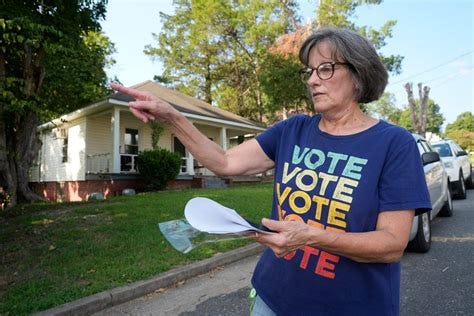
Most often, county parties leaders use canvassing to discover what’s on people’s minds. In all their door-knocking, they try to include broad questions like, “What are you most concerned about?” The results are sometimes surprising.
Last year, Larimer County’s Tim Kubik told us, his canvassers assumed “affordability” would be the top concern. The surprising answer they got most often was “safety” – not from crime, but from aggressive and unlawful federal efforts to deport undocumented residents. Larimer Dems, Kubik said, sometimes use this information to formulate ballot initiatives that shape the community that gets behind them. Most people who care about an issue supported by Democrats, for example, clean water, will become part of the “community that elects Democrats.”
Thinking Politically, Acting Locally
Marcia Myers of the Hancock Maine Dems stressed that local volunteers can do canvassing much better than “outside canvassers.” “It has to be done by local people. There’s the element of trust at the local level that doesn’t work when outside canvassers come in.” All county party chairs we spoke with carefully train their volunteers, emphasizing, as Myers put it, that “canvassing is about listening, not arm-twisting.” The recruiting and training of volunteers is itself a way of building a community that elects Democrats.
In Cabarrus County, NC, Dems hold regular “Breakfasts with Democrats.” These events, Rosa Sims said, introduce new volunteers to longstanding volunteers and to the broader community of Democrats. Once introductions are made, volunteers are immediately put to work. “I strongly believe that people will come if you give them things to do,” Marcia Myers said. “It’s important that you are well-organized and efficient so that volunteers feel they’re not wasting their time. And they want to be actively involved, not just listen.”
Democrats Care
From Maine to California, the chairs we spoke with agreed — we must show local residents that Democrats are active and caring members of their own community. That’s why Kings County Dems staff a soup kitchen every two weeks. Beaver County Dems serve a “manna dinner” four times a year at the local food bank and regularly collect money for the local women’s shelter.
Having a headquarters, an office, a physical presence in the community is also vital, especially in places where MAGA hyper-visibility has discouraged many Democrats from even showing themselves. An HQ can also be an alliance-building tool; some Dem committees offer the use of space to local organizations that share Democratic values and objectives.
After talking with these five county party chairs, we’ve decided that Larimer County chair Tim Kubik’s phrase is our takeaway. "By finding the common sense of their county through canvassing that asks and listens; by showing their neighbors that Democrats care about ordinary Americans; and by having a physical headquarters that hosts community events and makes Democratic values visible, county parties are “building communities that elect Democrats.”
Nick Bromell and Mickey Rathbun are co-organizers of We Stand Together: Empowering Grassroots Democrats Across America.
Comments
Nothing yet. Say the first thing.
Sign in to join the conversation.