
I’ve been on a bit of an experimental fiction kick recently. I could tell you why, but I think you would find it boring. Enough 22 year old semi–college dropouts have waxed poetic about post-postmodernity. I’m just going to write about the books, which I have enjoyed reading immensely, in the hopes that they might pique some interest in you, and you will read it, and you will enjoy them immensely too.
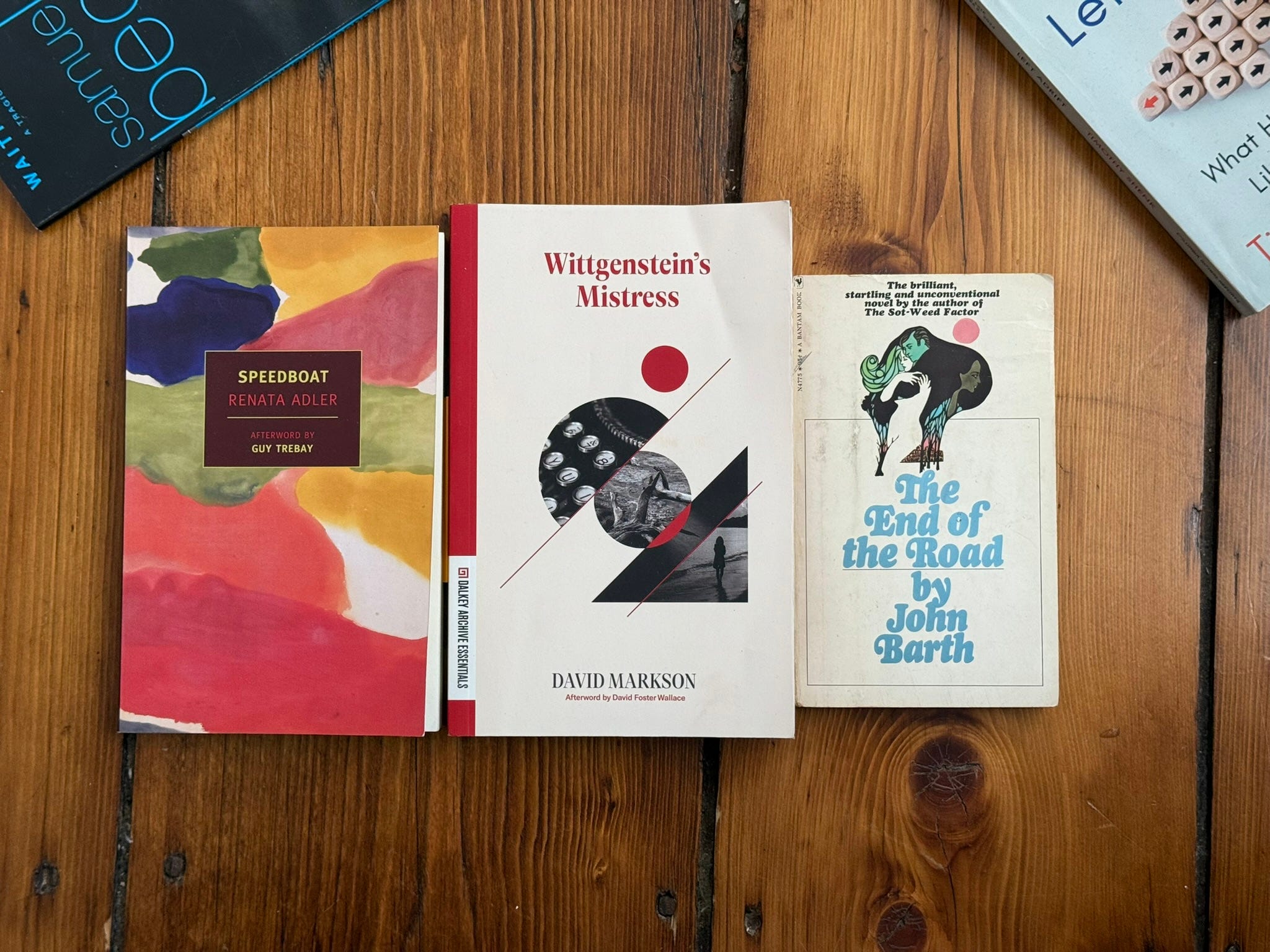
I read this, because I am strange, for its afterword. Or perhaps I’m not that strange, really. Maybe that happens a lot. It’s about a woman who believes she’s the last woman on Earth. The afterword was written by David Foster Wallace. It was originally published in the *Review of Contemporary Fiction*, Vol. X, No. 2. I’ll begin with that, since it’s where I began, though of course I waited to finish the book before I began it proper, not wanting spoilers. Plus it’s an afterword, and anyways you get the point regardless. I will try my best to avoid spoilers in this, too, by the way—though one perk of experimental fiction is how un-spoil-able so many of them are.
Wallace’s afterword is very good, which is to say not immediately disappointing to read after you finish the book. I actually think that’s hard, especially because of how good Wittgenstein’s Mistress (henceforth, WM) was. A novel gets time to make you like it, whereas an afterword gets less space and is by necessity, derivative of the thing you just wrote. The last thing anyone needs after they finish the book is a summary. Wallace avoids this because his prose, like in his fiction, carries you through his technical criticisms and dialectic.
Markson manages to achieve the same effect in WM. You don’t need to have read Wittgenstein or Heidegger. You’re only better off if you have because you can enjoy some extremely absurd philosophy jokes. (At one point, the protagonist Kate notes:
On the other hand there were no less than seven book by Martin Heidegger [in the carton]. I had no way of indicating the title of any of these, of course…
[I could] not understand one word of the German in any event.
A word that certainly did catch my attention was was the word Dasein, however, since it seemed to appear on practically every page I opened to.
Martin Heidegger himself remaining somebody I know no more about than I know about Sor Juana Inés de la Cruz, on the other hand.
Except for now knowing that he was certainly partial to the word Dasein, obviously.
If you find that funny, you will like the book). No, what really makes the book work is Kate’s character, compelling in it is madness. She is mad too, the book is not shy about expressing.
The book is not shy about anything, really. Wallace writes that WM is a certain kind of novel. “Certain novels not only cry out for critical interpretation but actually try to direct them.” The direction is not subtle, but it’s not authoritarian. Fully aware, somehow, that this is a book that was written and being read, you nonetheless forget, with Kate, that anyone else exists.
It feels particularly pseudo-intellectual to write about *Speedboat*. It was one of the break-out successes of the New York Review of Book’s line of out-of-print literary greats, and there was, I’ve been told, a time in New York City during the 2010s in which Renata Adler was Joan Didion for the in the know. But I’ve been told sometimes you have to worry a little bit less about what other people think, so.
Avant-garde wrapped in thriller wrapped with lyrical New Yorker+ prose, Speedboat is fucking awesome. It is unbelievable pleasure to read. It is a book which cannot help but remind you that novels are art. There are sentences in it which could be displayed in museums on their own and stared at. Like a good painting, new intricacies show themselves every time you look. When you’ve finished reading it, you are reminded that we only consume content. Art consumes us. And I know that’s trite, but I still think it’s true.
The book as a whole is where it shines the brightest. Speedboat is written so well it doesn’t need a plot, and a careless reader could walk away believing it doesn’t have one. But the book has an utterly compelling story, not any less so because of its unorthodoxy or lack of clear chronology. And what’s more, it has motion. It has momentum. Like a whodunnit, you cannot help but read on to find out what happens. That it achieves this without the typical devices of plot is what makes the book truly a masterpiece.
I found this book, with Speedboat, at a used bookstore. I also bought Jacques Derrida by Jacques Derrida and Geoffrey Bennington and Memory and Matter by Henri Bergson. It was one of those used bookstores with stacks covering stacks, shelves stacked several books deep, and aisles cut off by book tower avalanches. When I checked out, the owner of the store told me I had “a good eye for books.” I can’t prove it, but I’m sure he said that because of this book. Is that recommendation enough?
No posts
Comments
Nothing yet. Say the first thing.
Sign in to join the conversation.