
It all started with this X post essay

Haseeb >|<@hosseeb
https://t.co/x7wAw22WMn
7:55 PM · Feb 25, 2026 · 405K Views
140 Replies · 115 Reposts · 1.29K Likes
Read it. It’s good.
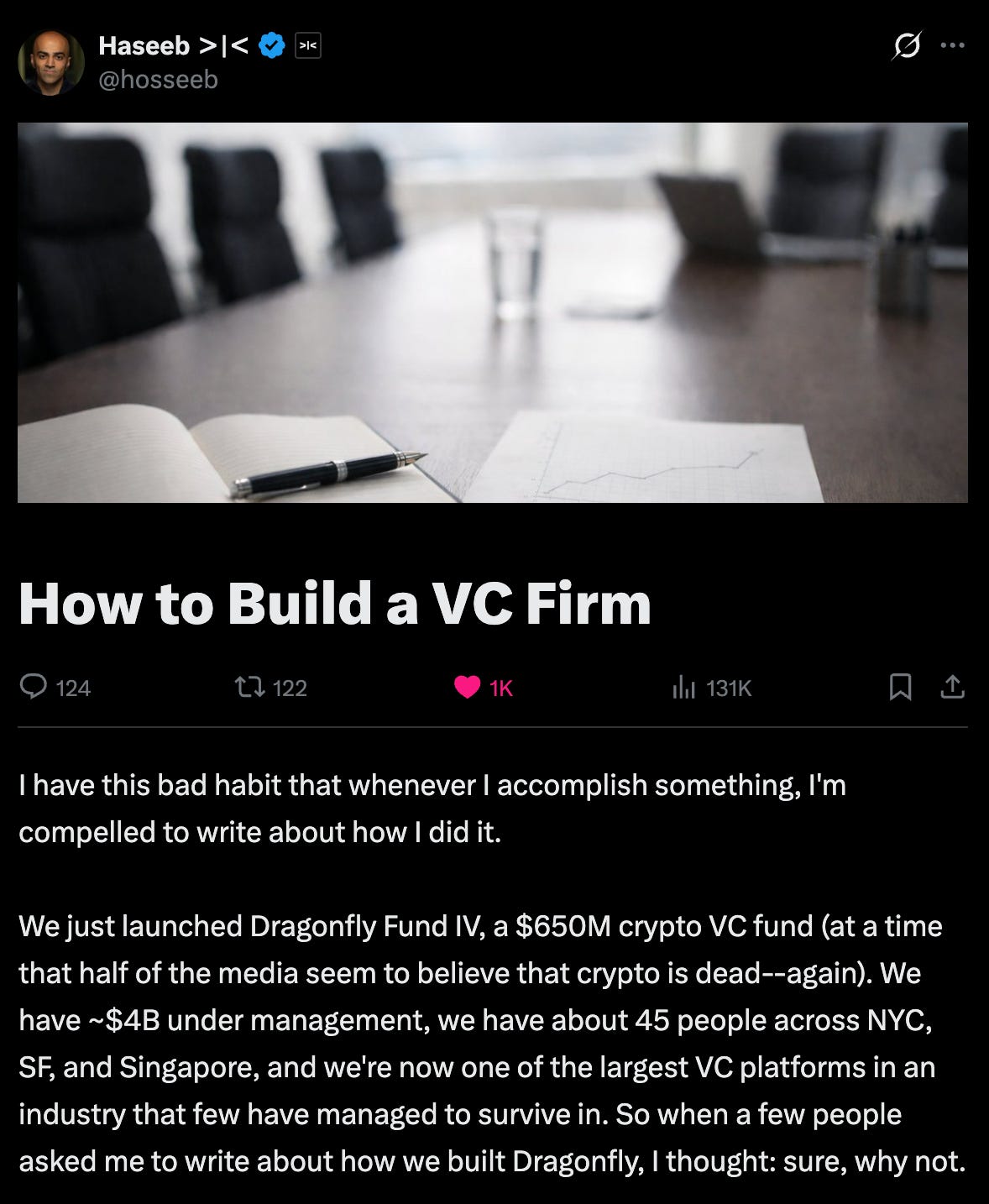
In his essay he never mentions the back office, operations, IR, or any of the building blocks of the firm that power the compounding capital in the funds. He was right not to.
I have highlighted my takeaways below, and also published an interactive version of this essay here. This is what we do at GraphAdvisors as a Fractional CFO and Forward Deployed Engineering firm for VC + PE firms.
Haseeb frames the VC value chain as four stages:

LPs pay a GP to do this job and do it over and over and over again. Find deals, pick the right ones, convince founders to take your money, then help them win. Every dollar returned to LPs is a result of how well a GP executes that loop.
Everything outside of that loop else you could argue is a step away from generating that alpha for investors. Every minute a GP spends reconciling fund accounting, chasing down K-1s, formatting quarterly reports, or wrangling service providers is a minute not spent on the only things that actually generate returns.
And at the emerging manager stage, where most funds live, the GP is often doing all of it themselves.
Part of Haseeb’s post is about talent, but the money paragraph is:
"A badly managed company will eventually collapse or be outcompeted. But venture is a power law business, and usually only a few people are making that power law happen. So long as those few people are able to do their work, a VC can continue to survive even while being poorly managed. But being managed well is an edge in the long run."
Correct. And then he adds:
VC firms famously struggle with generational transfer and elevating existing talent, and partners are often afraid to hire juniors who are smarter than they are.
That’s been the structural problem in venture for decades. The business runs on a handful of people. Those people can’t scale themselves. And the traditional solution, hire smart juniors, develop them, hand off responsibility, runs headfirst into ego, economics, and the raw difficulty of knowledge transfer in a business where so much is tacit.
But here’s what changes in an agentic world: you don’t have to worry about hiring juniors who are smarter than you. The AI is smarter by default. It doesn’t have ego. It doesn’t leave for a competitor. It doesn’t need two years of ramp time before it’s useful.
That reframes the entire problem as well as provides leverage, meaning that as the firm continues to scale, both in deal flow, deals, and outcomes the system itself gets better.
When people talk about AI in venture, they usually mean deal sourcing tools or market research copilots. Surface-level stuff. The real unlock is much deeper.
Think about what a VC firm actually accumulates over five funds and ten years: investment memos, IC notes, portfolio company updates, LP letters, valuation models, post-mortems on deals. Thousands of decisions with outcomes attached. Most of this lives in email threads, Google Docs, and someone’s head. If they are lucky its in a collection of Google Drive or Microsoft Folders or luckier still, some Airtable base.
An agentic system that integrates across all of that (your last five funds’ libraries of data, your internal publications, your deal flow pipeline, your portfolio metrics) doesn’t just automate tasks. It creates compounding network effects for the firm.
Each time you use the system, it gets smarter. Each deal you close, each portfolio update you log, each LP report you generate feeds back into that model that understands your firm’s specific thesis, pattern recognition, and operational rhythm. The system gets better, and suggests improvements along the way. Not because you hired a brilliant 26-year-old out of HBS who might leave in 18 months, but because the institutional knowledge of the firm is actually being captured, structured, and compounded in a way that’s never been possible before.
And it lets GPs do the thing they’re uniquely suited to do: sit across the table from a founder, understand the vision, make the bet, and then go to bat for them.
That’s not getting automated. Their time is getting freed up to do more of it.
One of the Tweets says “Raise when the raising’s good.” What Haseeb really describing is ABF, Always Be Fundraising, the reality that for GPs fundraising never stops. You close Fund I and immediately start building the track record and relationships for Fund II. The window to raise is unpredictable and often short, and when it opens, you need to be ready.
What does “ready” look like to an institutional LP running diligence? It’s not just your deal memos. They assume you can pick. What they’re actually stress-testing is whether you can run a durable business. Clean, auditable books going back to inception. Notes and memos that show the IC process and your thinking. Consistent LP reporting with actual information. Documented processes around valuations, capital calls, distributions. Evidence that the fund operates as an institution, not afterthought.
This is the barrier between emerging managers and institutional capital. Family offices might wire money because they like you over dinner. Endowments and pension funds wire you money because your operations survive diligence. That’s a completely different bar.
Many Fund I and Fund II managers fail this test, not because their returns are bad, but because their back office is a mess. The spreadsheets don’t reconcile. They aren’t telling a legible story. The reporting is inconsistent. The ownership and TVPI/DPI/IRR are in someone’s head. An LP’s diligence team shows up and finds duct tape where they expected infrastructure.
I can almost hear the counter to this argument which is “I know a fund that has $XXX of AUM and has no systems whatsoever!” Good for them! They also get to be the exception proving the rule.
For everyone else theres my firm Graph Advisors.
Go back to the value chain: Sourcing, Selection, Winning, Supporting. Think of it as a flywheel. The faster it spins, the more deals you see, the better your firm gets, the more founders choose you, the better your reputation becomes, which feeds back into sourcing. Haseeb describes this exact compounding loop, how one happy founder becomes your best salesperson for the firm and its partners.
But every flywheel needs a hub. Something at the center holding the whole thing together while the wheel spins. That hub is your firm itself: your fund administrator, your accounting firm, your LP reporting, your compliance, your cap tables, your K-1 timeline. The boring, invisible, absolutely essential machinery that lets the GP-facing flywheel turn without friction.
Another way to put it is that if this stuff is taken care of the GPs can focus on the things they are uniquely great at.
See the interactive version of this over at ericfriedman.co or exactly what we do at https://graphadvisors.com/fractional-cfo
The GP From Flywheel (h/t Haseeb’s post)
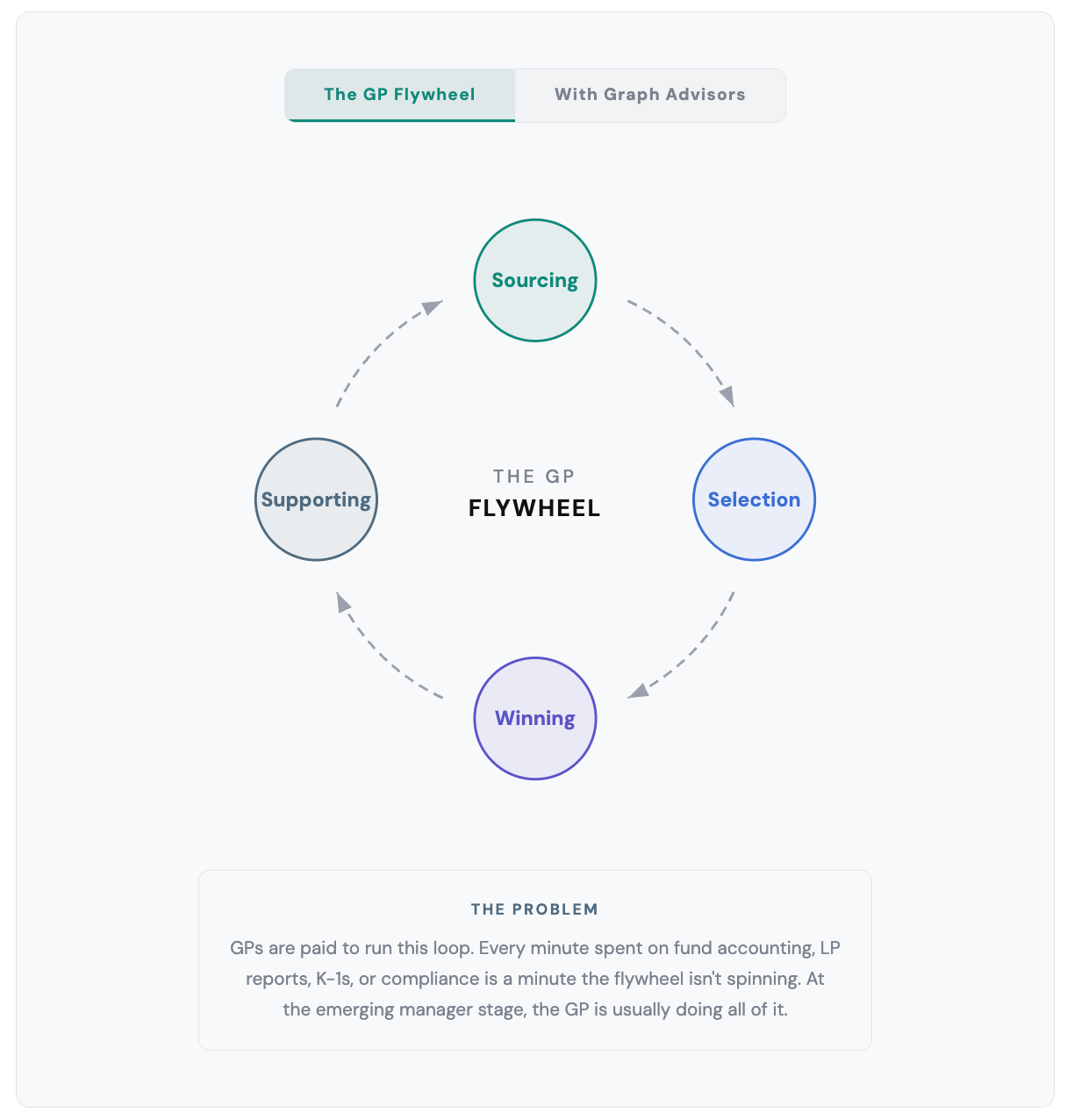
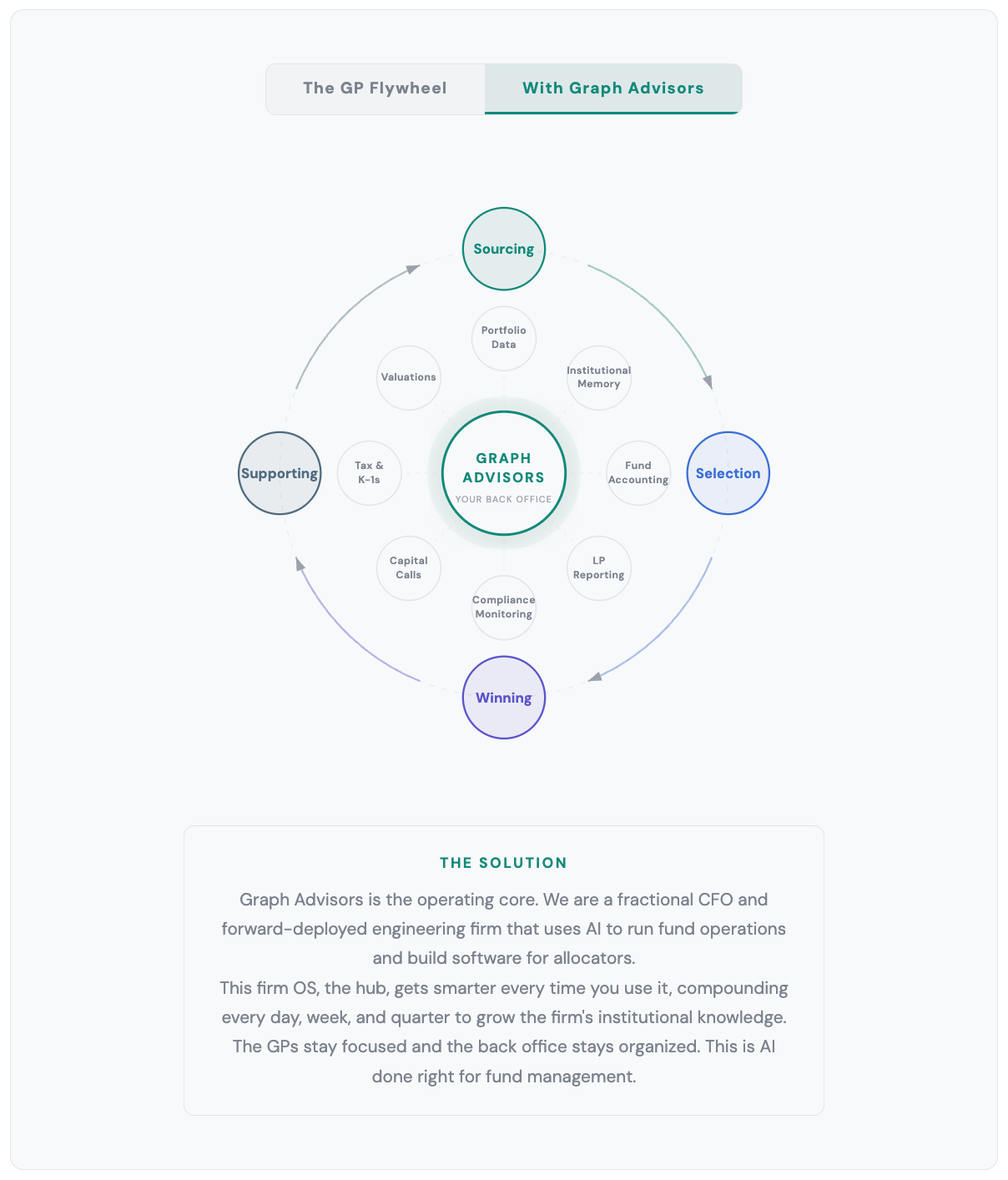
When the hub is wobbly, when your books are a quarter behind, when your LP letters are inconsistent, when your admin is split across eight service providers who don't talk to each other, the whole flywheel develops drag. GPs get pulled into ops. There are service provider inbox requests that go unanswered for weeks, then everyone wonders why the K-1s didn't go out on time. Fundraising is disorganized and lack of progress gets blamed on an LP "not understanding what we do". When you have everything organized and running well, you can focus on the things that matter most; finding venture scale companies to invest in and driving great returns. This means using the fees from LPs to work on the things you are uniquely suited to to do. Most VC partners are forced to run a business behind the scenes, but hate the ops work.
The AUM/Fee structure is too small to have a Full Time developer so they can barely keep up with all the tools, services, and methods at their disposal. Having a Claude Code or OpenAI subscription isn't enough, and dragging/dropping all your deal memos into a chat doesn't scale.
This is the problem Graph Advisors was built to solve. We work as a Fractional CFO. We work as Forward Deployed Engineers specifically for allocators. Sometimes both. We pair a team up with GPs to leverage AI tools, software, and services for fund operations and leverage. We work specifically with VC and PE firms that need to bring this expertise in house. We have been building these systems for allocators for years and we do so in the background so the GPs never have to think about it.
The expectation is that every firm will be leverage AI in some way. The story that you can tell LPs can be that you spent 3-6 months identifying an incredible engineer, somehow convinced them not to join Anthropic or your latest AI portco. and join you instead - now managing them, giving them a salary, and incentive (carry!) and hoping they can produce. The alternative is to bring on Graph as a Forward Deployed Engineer specific to VC/PE and all the expertise we have already.
We learn your system agentically. It integrates your data across funds, across service providers, across years. The reporting gets faster. The next fundraising cycle gets stronger. Every time you use the system it gets smarter.
The operational edge doesn’t depend on finding and retaining the perfect ops hire. It’s built into the system. We build on your firms rails within services you own.
Existing managers get the most out of what they have spent years building. Emerging managers get institutional-grade operations from day one, not after they’ve scaled enough to afford a full-time CFO and a fund admin and an accountant and a compliance officer. So when the LP diligence team shows up, they find infrastructure, not duct tape. And when the fundraising window opens, because it will and it’ll be brief, the house has been in order the whole time.
That’s the whole point. The series Haseeb wrote is the GP playbook. We write the Operations playbook
It’s about the art and science of venture. But behind every great GP is an operation that lets them focus.
If you’re running a fund and spending your time on anything other than Sourcing, Selection, Winning, and Supporting, let’s talk.
No posts
Comments
Nothing yet. Say the first thing.
Sign in to join the conversation.