
Hi all,
Here are a few Bitcoin-related topics I’ve been thinking about this week.
James Lavish lays out 4 honest risks for STRC. (I wrote up a short explainer of STRC here, pointing out the significant risks and critiques, but its success is hard to ignore).

James Lavish@jameslavish
If you’ve been wondering about investing in STRC and/or SATA as an individual, I wrote all about the new class of Digital Credit in this morning’s Informationist. Super easy to understand and today’s issue is free to everyone. Enjoy!
jameslavish.com
💡Bitcoin-Backed Yield: A Boring Chart and a Beautiful Coupon

1:30 PM · May 10, 2026 · 163K Views
115 Replies · 228 Reposts · 1.6K Likes
1. A multi-year Bitcoin drawdown
The biggest risk to STRC is a Bitcoin drawdown that remains low for years. STRC pays its ~10% dividend from STRC capital raises. If BTC enters into a prolonged bear market and investors lose interest, raising additional capital via STRC becomes more difficult (see #2).
Right now, Strategy holds $1.488 billion in annual dividend and interest obligations across all preferreds and convertibles. To cover these obligations, it holds a $2.25 billion USD reserve (18.1 months coverage) and about $66 billion in Bitcoin (44 years of coverage).
2. Capital markets access
If Strategy is not able to issue STRC into the market, its ability to pay the dividend from raising new capital slows. In this case, they have to dip into the cash reserves or BTC asset base.
Risks #1 and #2 are a negative reflexive flywheel, the main risks to STRC and the entire Bitcoin ecosystem. However, Strategy is taking measures to address this negative relexivity (cash reserves, ability to lower the yield, ability to pause dividends, and more).
3. Cumulative deferral
Strategy can defer the STRC dividend whenever it chooses. These deferred payments accrue and compound monthly. If you’re an STRC investor who relies on the interest payment for your operations, this is a real risk. James Lavish calls this a last-resort action.
4. Tax classification
The STRC dividend is classified as a return of capital. This is a favorable tax treatment, as investors do not pay income tax on a ROC. Strategy can change this tax treatment if it chooses, which would reduce the total yield.
Bitcoin-backed lending is one of the primary financial services built on top of Bitcoin.
The question I’ve always wondered — does this activity happen within the existing financial infrastructure (banks), or does it happen in a crypto-native DeFi ecosystem?

Harsha Goli@arshbot
Yea, thinking about this more. Banks will adopt bitcoin (and stablecoins) much sooner than crypto. I think exposure to things like @aave are going to be very tough for bank committees to get comfortable with, even crypto native ones. So the problem: When a bank is

Harsha Goli @arshbot
There are so many upstream banks opportunities in crypto. Funny enough, bitcoin really does shine here comparatively to crypto.
11:33 PM · May 11, 2026 · 2.84K Views
3 Replies · 2 Reposts · 12 Likes
The data on the DeFi side looks positive per recent Galaxy reports — the dollar-denominated value of outstanding DeFi loans hit $40 billion in Q3 2025.
However, the banks are coming for Bitcoin-backed lending. SAB 121 was repealed in January 2025, allowing banks to custody Bitcoin. Since then, JPMorgan, BNY Mellon, and others have started to custody Bitcoin and offer Bitcoin-backed loans. Over $50 billion in new Bitcoin-backed credit lines were extended in late 2025 alone, according to a report by PwC and Kaiko Research.
DeFi has properties that banks cannot match (speed, accessibility, low cost). DeFi must lean into these properties to beat out strong incumbents.
Charles Schwab writes the report, “Adding Cryptocurrency to a Portfolio? 2 Approaches.” They are clearly more cautious than Fidelity Digital’s “Getting off Zero” report. However, their framing and tone have changed. I remember reading about Bitcoin during the 2017/2018 bull market, and I could not find a single institution with a positive position on Bitcoin.

Cointelegraph@Cointelegraph
🔥 UPDATE: Charles Schwab says 1–3% allocation to Bitcoin or Ethereum can reshape portfolio risk. Suggests up to 8.8% Bitcoin allocation in aggressive portfolios at 15% return assumption.
4:10 PM · Apr 7, 2026 · 46.2K Views
68 Replies · 187 Reposts · 943 Likes
The fact that Charles Schwab — whose 47 million clients own over $12 trillion in assets — is positioning Bitcoin/crypto as even a potential allocation to a standard portfolio is important. This report also coincides closely with Charles Schwab adding options to buy Bitcoin and Ethereum to their platform.
To summarize the framing in their report, they do not outright recommend allocating to Bitcoin. They put that decision on the investor. But they give a few tools for investors who decide to allocate to crypto. This approach allows Charles Schwab to construct portfolio analyses based on individual investors' views of Bitcoin’s future performance.
This leads to the chart shown below. Here’s the interpretation with a simple example: “If an investor with a moderate risk tolerance thinks that Bitcoin will return 15% a year, they should allocate 6.6% of their portfolio to Bitcoin.”
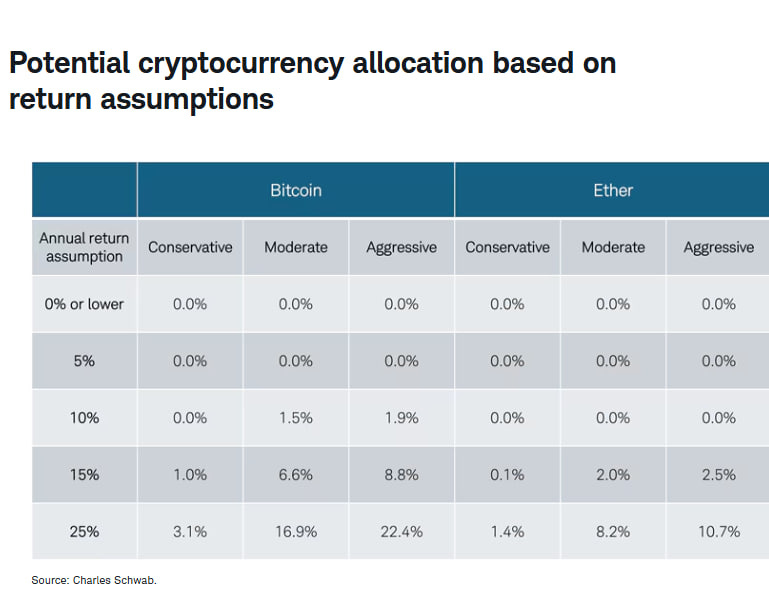
Past results don’t equal future performance, but a 15% return is historically very low for Bitcoin — even if you bought Bitcoin at the euphoric top in 2018, it returned a ~25% CAGR over 8 years.
In all, Charles Schwab has around ~40 million clients who own ~$12 trillion in assets. Their report and reframe isn’t as prescriptive as Fidelity, but it’s a big step forward.
Disclosure: I work for Stacks Labs, a company that contributes to Stacks.
Stacks released the Bitcoin Staking whitepaper this week. It aims to deliver BTC yield to Bitcoin holders without the typical tradeoffs: giving up custody, wrapping BTC and bridging it to another ecosystem, earning yield denominated in dollars or another token, or getting slashed.

stacks.btc@Stacks
Hold BTC. Earn BTC. That's what Bitcoiners want. Today we're publishing the Bitcoin Staking whitepaper. Self-custodial. BTC-denominated yield. Here's what it is and why it matters 🧵

3:21 PM · May 13, 2026 · 53.4K Views
59 Replies · 128 Reposts · 404 Likes
Here’s how it works — over a 6-month bonding period,
1. Lock BTC on Bitcoin’s L1. You maintain custody of your BTC with your own keys for the 6-month term. The locking mechanism is a standard Bitcoin script called OP_CHECKLOCKTIMEVERIFY.
2. At the same time, lock STX (at a ratio of about $100 of BTC to $5 of STX).
The design is simple.
So where does the yield come from? It’s using Stacks’ Proof of Transfer consensus mechanism that has distributed 4,200 BTC through miner activity since January 2021.
Bitcoin staking is a product of countless investor interviews over the years. It aims to serve a market that wants to earn a yield on their BTC, without taking on the typical risks of Bitcoin financial products.
Thanks for reading Grant's Writing! This post is public, so feel free to share it.
No posts
Comments
Nothing yet. Say the first thing.
Sign in to join the conversation.