

David Foster Wallace wrote this line. I think about it often. The line holds a troubling narrative tension. The beginning of a love inherently holds its end. No matter how eternal a love might feel, you will eventually be haunted by it, whether by death, departure, rejection, the “je ne sais quoi” of abandonment, or who knows what else.
But, at the same time, thinking about the ending is one reckoning best to ignore because there is a recklessness that is part of every love—a beautiful abandon. A recklessness and abandon that might even be necessary for love.
Our lives are ghost stories in so many ways. That’s why Sigrid Nunez said that every story is fundamentally about loss. “What we miss—what we lose and what we mourn—isn’t it this that makes us who, deep down, we truly are. To say nothing of what we wanted in life but never got to have.”
I’m thinking about this because we just interviewed the beautiful writer and beautiful thinker Siri Hustvedt about her new memoir Ghost Stories on the Memoir Nation podcast. Ghost Stories is an intimate meditation on grief, memory, and enduring love written in the aftermath of the death of her husband, the writer, poet, and filmmaker Paul Auster.
Siri describes grief as the experience of “the body experiencing absence as a presence.”
We often try to hold something that is already gone. We’re like a medium through which a story is told, but we’re also conjuring something from another realm at the same time, unearthing stories.
The ghost isn’t just the person who is gone, but who you were before your love made you who you are. It’s such an interesting kind of haunting because our love, our capacity for love, the way we love, is all shaped by past loves, so most of us are living with multiple ghosts of some sort.
Our love could be said to be a gathering of ghosts.
Siri actually writes about herself in the third person: “Siri Hustvedt walks around the house and talks to herself.” As if she’s describing a character in a novel. As if she’s a ghost to herself.
Ghost Stories is a patchwork-quilt of a book that stitches together memories through journal entries Siri wrote from the beginning of her love to the day of Auster’s funeral; emails she sent to friends during his cancer treatment, from “Cancer Land”; notes Auster sent her over the course of their relationship; and three love letters she wrote to him in 1981.
The book also contains Paul Auster's last ever piece of writing—the first thirty-five pages of what he hoped would be a small book of letters to their grandson, Miles.
All hauntings.
The definition of a ghost is someone who is in two places at once: a person who won’t leave to go to the other side because they have unfinished business, or they can’t leave because they are held back because someone or something is holding them back.
I’ve been thinking about how that phrase ghost stories applies to memoir more broadly because I think every memoir, in some sense, is a ghost story.
We write about our losses to reckon with them, to rebuild ourselves, to give and receive grace. As Maggie Nelson writes in Bluets: “I have been trying, for some time now, to find dignity in my longing.” The dignity she’s looking for is the dignity of loving what is already gone.
Being haunted is about the intrusion of what was into what is. Which is actually a pretty good working definition of memoir itself.
Consider the many different ways you can be haunted:
The haunting of the unfinished conversation—the thing you never said, or the thing that was said to you that can never be unsaid.
The haunting of a person who is still alive.
The haunting of the self you abandoned.
The haunting of a place.
The haunting of the body you used to have—before the illness, the accident, the surgery.
The haunting of the life you didn’t choose.
The haunting of inherited trauma.
The haunting of a belief you can no longer hold.
The haunting of joy—the summer you were twenty-two and everything was possible, the early days of a love before it got complicated.
The haunting of the thing you saw that you cannot unsee—an act of violence, a moment of cruelty.
Your ghosts form the negative space that gives everything else its shape.
Think about the story you’re writing. Ask yourself:
What would this story be if nothing had been lost?
And then: Who would I be if this ghost didn’t exist?
The answer to those two questions tells you something essential about why your story needs to exist and why you are the person who has to tell it.
Make a list of your ghosts, using the different kinds of hauntings from above. Give each ghost one sentence—not a story, just a door.
Then choose the ghost that pulls hardest. The one that felt like a small shock when you wrote it down. Write toward it without trying to resolve it or explain it. Let it stay a ghost. See what it wants to say.

“There is no present or future, only the past, happening over and over again, now.”
—Eugene O’Neill, A Moon for the Misbegotten
I stumbled on this poem by Robert Sward, and loved it and thought, I bet this is my fellow Substack friend Hannah Sward’s (Summer of Men) father. It is. Its obliqueness is an invitation to the ineffable, which is the way we experience ghosts.
Text within this block will maintain its original spacing when published
Ghosts
Believing in them, none even near me,
Abruptly, irrelevantly, at a local tavern
                            I introduce
One after the other, shadows,
I can, Jesus Christ help me, see through walls
                               watch now
Ghosts—
beyond, what else, conversation dies. 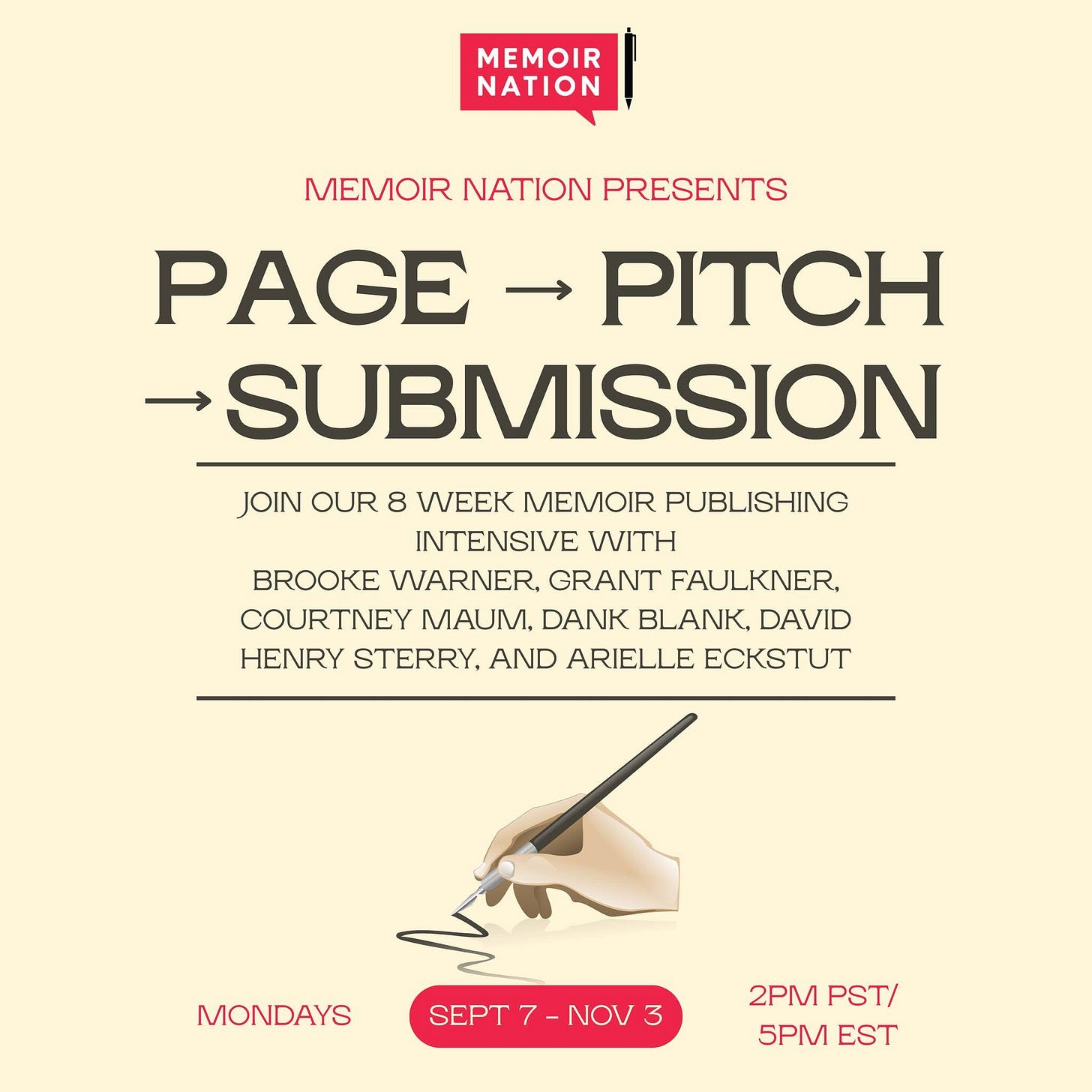
This 8-week proposal course runs September 7-November 3. What’s it entails:
Write and polish your pitch
Draft your query letter
Finish your book proposal
Develop a “submission mindset”
Participate in Pitchapalooza!
Meet for three Sundays to pitch and submit (in real time and with support)
Join: Brooke Warner, Courtney Maum, Dan Blank, David Henry Sterry, Arielle Eckstut, and me for this very special opportunity!
Thanks for reading Intimations: A Writer's Discourse! This post is public so feel free to share it.
Comments
Nothing yet. Say the first thing.
Sign in to join the conversation.