
In my day job, I’m a 22-year veteran of the financial advisory industry, a Certified Financial Planner™, and co-owner of Generation Wealth. I spend most of my time helping clients navigate investment markets while also thinking through the political and economic forces shaping those markets. These are conversations I have every day, and from time to time I bring them here to share a broader perspective.
At the start of 2025, I laid out a balanced view of the economy. We had real tailwinds—strong consumer spending, a resilient labor market, and the early impact of AI—but there were also clear risks building in the background. Tariffs, immigration policy, and geopolitical instability weren’t getting much attention at the time, but they had the potential to change things quickly.
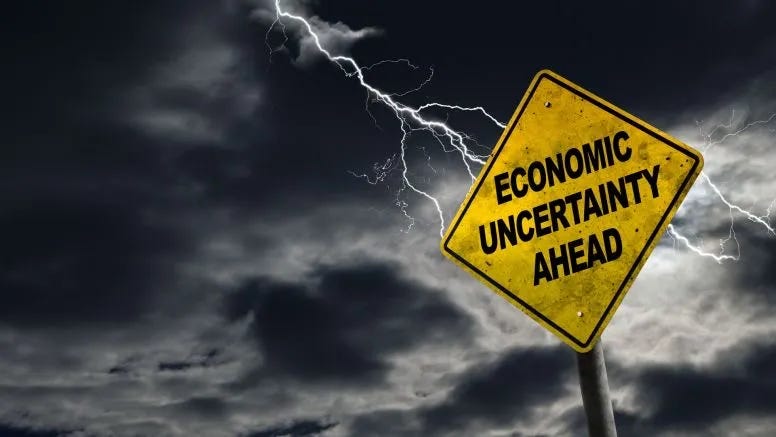
For a while, the stock markets focused on the positives. That worked. AI carried valuations higher, consumers kept spending, and the economy held together better than most expected.
But sitting here now in 2026, the tone is changing. The risks I outlined aren’t theoretical anymore. They’re starting to show up, and more importantly, they’re starting to interact with each other in ways that make the system more fragile.
One of the more interesting dynamics right now is that stock markets still don’t seem to fully believe these risks will play out. There’s a growing assumption that when policies get too aggressive, they’ll be walked back before real damage is done—the TACO: “Trump Always Chickens Out” mindset that’s quietly embedded in pricing.
That thinking has held up so far, but it’s not something you can rely on indefinitely. At some point, either the policy follows through or it goes far enough to matter. When that happens, markets don’t adjust slowly. It tends to happen all at once.
It’s also worth noting that while stock markets have remained relatively stable, other areas like gold and precious metals and credit markets have been telling a different story, reflecting rising uncertainty underneath the surface.
On the surface, the economy still looks relatively stable. Underneath, it’s becoming more fragile.
Job creation has slowed dramatically and, by some measures, has been essentially flat over the past year. That’s an alarming signal this late in an economic cycle.
At the same time, the structure of the workforce has shifted. There’s more contract work, more gig labor, and less stability than we’ve had in prior cycles. That works fine when everything is moving in the right direction, but it doesn’t hold up well under pressure.
Companies are already leaning on AI as a reason to reduce headcount. No one wants to go first, but once layoffs begin in a meaningful way, they tend to build on themselves.
Tariffs are now having the kind of impact I warned about last year.
They function as a direct tax on the economy, raising costs for businesses and ultimately for consumers. Many of these tariffs have been legally challenged and declared unconstitutional, but in the meantime they are costing millions of Americans thousands of dollars per year unnecessarily.
We had made real progress in 2024 on inflation coming down, and that trend has reversed. Tariffs are a key reason why.
That’s putting the Federal Reserve in a difficult position. Rates are likely higher than they need to be based on economic conditions, but inflation isn’t cooperating, so the Fed is stuck.
On top of that, we’re now seeing renewed political pressure on the Fed’s independence. If that pressure leads to premature rate cuts, it risks reigniting inflation even further. That’s a dangerous combination—policy pushing inflation up while also pushing for lower rates at the same time.
AI has clearly been the strongest part of this cycle. It’s real, and it’s driving productivity and stock market performance.
But there’s a second layer to it that deserves more attention.
AI requires massive infrastructure—data centers, energy, water, and financing. Much of that buildout is being supported by private credit and interconnected capital between other AI companies, creating a higher valuation mirage.
Systems like that work well when everything is expanding, but they don’t need a major shock to create stress. They just need something to go slightly wrong and public opinion is now changing swiftly on the drawbacks of data centers near communities.
Private credit is one of the more underappreciated risks in the system right now.
In simple terms, private credit is lending that happens outside of traditional banks—large investment firms and funds making loans directly to companies, real estate projects, and infrastructure. It has grown rapidly because it operates with fewer constraints than the traditional banking system.
That growth has raised concerns. Analysts are increasingly sounding alarms that parts of this market are becoming overextended and difficult to unwind—a structure that can look stable until it isn’t.
At the same time, the vast majority of Americans are also taking on more debt, from credit cards to auto loans to housing costs. That combination—rising consumer debt alongside growing leverage in private markets—is not something to ignore.
We’ve seen how credit cycles play out before. In 2008, problems in one part of the credit system spread and brought down much larger parts of the financial system, including large insurance companies.
The fact that major areas of growth, including AI and data center expansion, are being financed within this same ecosystem should at least raise some caution.
What we’re seeing now is a clear K-shaped economy.
A relatively small portion of the population—primarily the top 10% of income earners—is driving a disproportionate share of consumer spending. Meanwhile, consumption for the majority of Americans is flat or declining as they deal with higher costs and tighter budgets.
At the same time, wealth inequality has reached extreme levels. The top 1% now holds more wealth than the bottom 90% combined, surpassing levels seen during some of the most unequal periods in modern history.
That kind of imbalance creates pressure. Economic pressure turns into political pressure, and over time that instability feeds back into markets.
Global tensions are rising again, and the situation with Iran is now playing a major role.
In the short term, the Iran conflict has actually strengthened the U.S. dollar. As global energy markets tighten, the world becomes more reliant on U.S. energy production, and oil continues to be priced in dollars. That reinforces the petrodollar system and has temporarily supported the dollar while slowing the rise in gold.
But that support may come with consequences.
When geopolitical conflict reshapes global trade flows, it also accelerates long-term shifts. Countries that feel exposed to U.S. policy decisions begin looking for alternatives. If tensions escalate further and pull in larger players like China, that process could speed up.
The U.S. has benefited enormously from the dollar being the world’s reserve currency for decades. If that status erodes over time, it could lead to a very different global economic order—one where the U.S. has less control and fewer built-in advantages than it has today.
When I talk about U.S. national debt, I’m not talking about it the way it’s usually discussed politically.
The national debt is the total amount the U.S. government has borrowed, and it also represents assets held by investors, institutions, and foreign governments. It’s a core part of how the global financial system functions.
On its own, that isn’t the problem. The U.S. has been able to sustain high levels of debt because the world trusts the system—our currency, our markets, and our alliances.
Where it becomes a problem is if that confidence starts to weaken.
If growth slows, inequality rises, and global trust begins to erode—especially alongside any shift away from the dollar as the reserve currency—demand for U.S. debt could fall. That would push borrowing costs higher and turn something manageable into a real constraint over time.
From a portfolio standpoint, this is not a time for big emotional moves, but it is a time to be more intentional.
We’ve been raising cash in portfolios. That’s not about calling a top—it’s about having flexibility. Cash cushions volatility and gives us the ability to take advantage of opportunities if markets move lower.
We’re also rebalancing. Markets have had a strong run, and when valuations are elevated and risks are increasing, it’s a good time to consider lowering equity exposure and increasing fixed income.
At the same time, gold and other precious metals can play a role as a hedge against uncertainty, inflation pressure, and a weakening dollar.
Different asset classes behave differently in different environments, and that matters more now than it has in a while.
I don’t think this is a moment to panic, but it is a moment to pay attention.
There are more moving pieces than usual, and they’re starting to line up in ways that increase risk. I’ve been through enough cycles to know you don’t wait for everything to break before you adjust.
You make changes when you can see the pressure building.
Right now, the pressure is building.
-Dustin Granger, CFP®
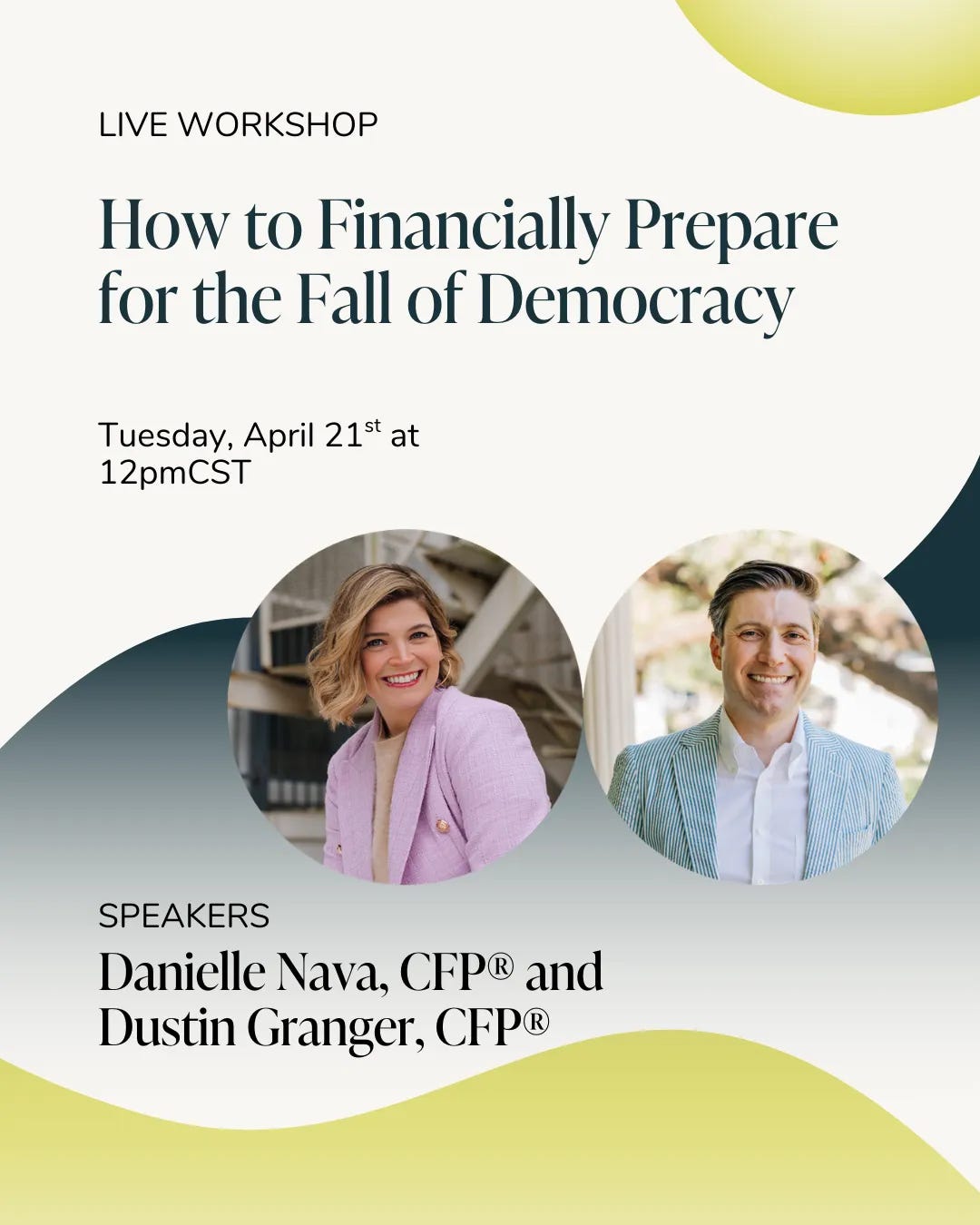
On behalf of Danielle Nava, CFP® and I, we’d like to cordially invite you to our upcoming free, live workshop: Financially Preparing for the Fall of Democracy.
Details:
When: Tuesday, April 21st at 12pmCST
Where: Zoom
Hosts: Danielle Nava, CFP® and Dustin Granger, CFP®
All registrants will receive the recording, so don’t worry if you can’t make it live.
In this session, we’ll walk you through:
What’s actually happening in the economy (without the noise)
What we’re looking out for & what we’re hopeful for
How to think about your cash, investments, and long-term plan in uncertain times
A behind-the-scenes look at the customized shifts we’re making in client portfolios and why
Simple steps you can take immediately to feel more calm, prepared, and in control
Disclosures:
Securities offered through LPL Financial. Member FINRA/SIPC. Advisory services offered through NewEdge Advisors, LLC, a registered investment adviser. NewEdge Advisors, LLC, doing business as Generation Wealth, are separate entities from LPL Financial.
This presentation is for educational purposes only and should not be considered individualized investment advice. Investing involves risk, including loss of principal. Past performance is not indicative of future results. Any strategies discussed may not be suitable for all investors.
What can you do to help change Louisiana?
Set up a $5 monthly contribution to the Louisiana Democratic Party here
We have to get back to nuts and bolts of what built Democratic domination in the past. Sign up your interest to become a Louisiana precinct organizer here.
Who’s running for Congress in 2026? Check out Jamie Davis (*Jamie is the state party endorsed candidate), Nick Albares & Gary Crockett running for U.S. Senate against Bill Cassidy, Conrad Cable (*state endorsed candidate) & Matt Gromlich against Speaker Mike Johnson (LA-4), Lauren Jewett (*state endorsed candidate) against Steve Scalise (LA-1), John Day (*state endorsed candidate), Tia Lebrun, and Caleb Walker against Clay Higgins (LA-3) and Rubia Garcia (*state endorsed candidate), Jessee Fleenor, Dan McKay & Larry Foy against Julia Letlow’s successor (LA-5). Re-elect Democrats Cleo Fields (LA-6) and Troy Carter (LA-2).
No posts
Comments
Nothing yet. Say the first thing.
Sign in to join the conversation.