
A weekly newsletter on what I’ve written, read, and otherwise enjoyed.
At the link above, Mary Jane Eyre’s L’Albvm Zvtique is free to download, a collaborative multilingual extravagantastic fantasia on (let’s say) the feminine in the arts. I am there in the pourquoi il faut lire section on why you should read George Sand and Anne Carson. (MJE asked for 200 words. I don’t remember the last time my prolix ass wrote 200 words about anything, but I held myself to it and am proud of how many ideas in defense of the novel-qua-romance I managed to compress into so small a space. As wicked Ezra Pound1 said, quoting a German-Italian dictionary, Dichten=Condensare.) See also such Substack faves as Gnocchic Apocryphon on Clarice Lispector, James Tussing on Alice Munro, Henry Begler on Janet Malcolm, Paul Franz on (cherchez l’homme) Philip Roth, et plus.2 Thanks to our host(ess)!

The screenshot above is a garland I very gratefully pluck from a reader and listener on Substack Notes. If you’d like to listen, there’s The Invisible College, my literature podcast for paid subscribers. We are biweekly in August, so the next episode will drop this Friday on Gabriel García Márquez’s One Hundred Years of Solitude. Among the questions we will consider: what was magical realism? and does magical realism remain a viable aesthetic? While you wait, a paid subscription wins you access to an archive of over 100 episodes of two or more hours on powerful literature from Homer to Toni Morrison. I am especially happy with the last episode, which was about Clarice Lispector’s stunning and disturbing rewrite of the entire western religious tradition in The Passion According to G.H. If you enjoyed my Albvm Zvtique contribution, you could always listen to the one on George Sand and the one on Anne Carson. Plus multi-part reading guides to such monumental novels as Ulysses, Middlemarch, Moby-Dick, The Magic Mountain, Anna Karenina, and The Brothers Karamazov and such major poets as William Blake, John Keats, Charles Baudelaire, Emily Dickinson, W. B. Yeats, and Rainer Maria Rilke, not to mention sequences on the plays of Shakespeare, the works of John Milton, ancient Greek literature, The Divine Comedy, and much, much more. Thanks to all my current and future paid subscribers!
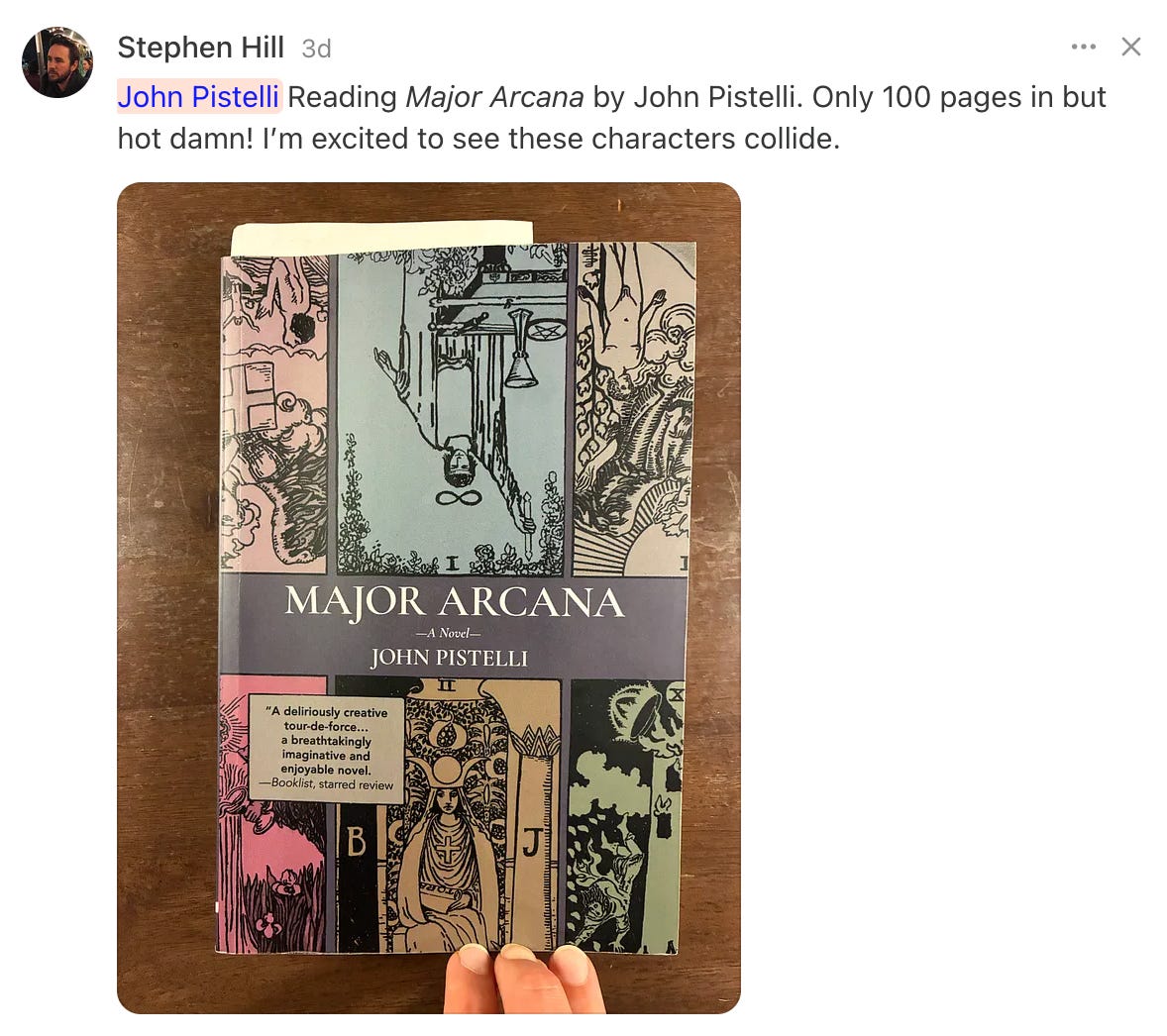
Finally, if you’d like to read: as indicated by the screenshot above, my recent novel Major Arcana continues its implacable journey through the culture as controversial cult object and spectacular summer’s entertainment. If you’d like one more novel to lose yourself in as this fiery summer wanes, Major Arcana is available in all formats (print, ebook, audio) here; you can also find it in print wherever books are sold online. You can buy it directly from Belt Publishing. You might also suggest that your local library or independent bookstore acquire a copy. Please also leave a (constructive) Goodreads, Amazon, or other rating and review. Thanks to all my readers!
For today, late summer is lazy, so just a few links with commentary to things I’ve encountered online this week, this lowest-effort post I could possible manage. Please enjoy!
Of “THE infernal machine”—you know, the one we’re on right now—Brother Matthew declares: “We need prophets of this extremity—darker, more oracular, more enigmatic than even Heidegger and Nietzsche.” (And of Matthew’s new novel Stranger Beauty I will have something to say soon; I just need to find a spare moment to read my advance copy.) I read that request a few days after I listened to the new episode of the Wake Island podcast, wherein guest Teodor Mitew explicated his recent essay “The Gated Age.” This may answer Matt’s mandate:
The liberal world first promised universal man, then universal rights, then universal markets, then universal connectivity. The next promise is universal intelligence. This is why AGI will be the last failed universal. AGI is arriving precisely as the institutions that might host such universality are losing legitimacy. So the contradiction sharpens. The more technically possible a planetary cognition layer becomes, the less politically acceptable it becomes.
The stronger AI grows, the stronger the incentive to territorialize it. Oh, the great irony. The dream of universal reason returns at the exact historical moment when the world ceases to trust any universal.
On Mitew’s theory, with the collapse of modernity and its will-to-the-universal at the precise moment when the first truly universal technology emerges, we will live (or maybe we won’t) to witness the full return of the gods Pound prophesied. “Nick Land is wrong,” says Mitew: in other words, we have not built God but rather a portal through which the old gods will return, demanding propitiation in situ, as if they’d just been biding their time. For the materialist, consider this a trope for the decomposition of modernity’s liberal international order into archaic or medieval multipolarity—a true multiculturalism, by its nature illiberal, as if multiculturalism could be anything else, given that most cultures are not liberal. As in the medieval period, though, whose warring fiefs and kingdoms arrayed themselves under the aegis of Christendom, I tend to think the new particularisms will legitimate themselves by claiming each to be the true heir of this or that bygone universalism (will I sound like John Podhoretz or something if make a remark about the encroachment into the political center of ever more Catholic and Muslim forms of socialistic solidarity on both left and right?).3
Speaking of multiculturalism: I bought On Morrison but haven’t read it yet. Still, I enjoyed Namwali Serpell’s ingenious Yale Review argument about Toni Morrison’s Indians. Like all ingenious arguments, it’s not totally persuasive, but I appreciate Serpell’s ongoing effort to take Morrison off the political pedestal and put her onto the aesthetic one. That’s why I’m not sure Serpell should have tried to rescue Morrison’s politics at the end of the piece. I grant the beauty of the aesthetic design Serpell discloses re: the reversal of figure and ground, but, politically, what is the difference in the end between this—
We know this logic well, and still use it all the time in our discourse on race: there’s white America, and then there’s everybody else, fighting over, assimilating into, or forging solidarity against it. If we were to represent this model visually with regard to European, African, and Native Americans, it might look like a “white” background against which the “black” and the “red” encounter one another, whether in competition or communion. I want to suggest that, with her aesthetic choices in depicting Native American figures, Morrison swaps this schema around. What results is a “red” background over which “black-white” racial relations play.
Morrison does this precisely by leveling the Native American presence in her novels to a figural flatness over which silhouettes are inscribed, an originary backdrop that evokes the land, the natural world, the weather—or, rather, what has always been there: the sky. In this way, she transforms the Native American figure into a ground, then elevates it so that it becomes the default against which black and white racial figures come into conflict.
—and Noble Savage or Vanishing Indian tropes? The native figures are left part of the landscape rather than subjects. (The more tantalizing because more pervasive question Serpell raises early on—that of Morrison’s strange and strained relationship to anything we might call queer—remains to be answered. See here.) In the meantime, they keep finding cities in the Amazon, more evidence for my own pet thesis that no human being has ever been very good at remaining “native” to nature, that consciousness transcends and consciousness invents and consciousness builds wherever consciousness finds itself—in short, that we are all in our essence not the passive indigenes but rather the active artificers of this place. We have always been settler colonists—of the planet.
Finally, speaking of the aliens that we are, my former colleague Mike pays beautiful tribute to Ray Bradbury on the anniversary of “There Will Come Soft Rains” and that story’s own near-miss of a Hiroshima commemoration. I wrote here about my own history with Bradbury. In my science-fiction-reading adolescence, he was part of an unholy trinity that I now recognize as forming part of my mature aesthetic. We can imagine what I learned from these three SF romanciers around the age of 13 as a series of injunctions à la Stevens’s Notes Toward a Supreme Fiction. From Robert A. Heinlein, that novelist of ideas himself reared on Wells and Shaw, I learned that It Must be Ideological, which is to not to say that the supreme fiction should preach, though papa Heinlein certainly did preach, only that it should concern itself with the nature and destiny of humanity in the aggregate. From Harlan Ellison I learned that It Must Be Controversial, i.e., that anybody can say the expected or the demanded thing, but that the supreme fiction will countermand both the idiot’s commonplace and the intellectual’s bien-pensance. And from Ray Bradbury I learned that It Must Be Beautiful, that style and mood are values of their own, agents of meaning and pleasure as active as character or plot or setting in any supreme fiction, sometimes more active. The most beautiful part of Mike’s essay comes at the end when he reflects on Bradbury’s preservation of beauty amid destruction:
At the same time, “There Will Come Soft Rains” itself serves as an archive. It preserves intact the forgotten poem by Sara Teasdale from which Bradbury took the story’s title.
Teasdale is gone from the canon—I don’t even think she has any feminist advocates—but, like the church fathers who tended the archive of gnosticism in refuting the gnostics’ heresy, Bradbury has preserved in his immortal story one of her poems; his own affirmation of the poem’s worth proves decisive in a meta-reflection on what stray artworks survive the wreck of civilization. Imagine them 2500 years hence, the robots or aliens or whomever, reading Teasdale’s poem in Bradbury’s story as the only one of our poems they know at all. Imagine them forming a theory about love and everything else from it, the way Anne Carson does with Sappho’s only intact lyric in Eros the Bittersweet. “[N]ot one / Will care at last when it is done”? Teasdale killed herself, and no wonder. But I, like the well-named Ray, try to look on the light side: I’m sure there will be one, at least, and, to save you, one is all it takes.
After my review, which preceded several more rounds of controversy including Emily Wilson’s multiple “based more correct” critiques of Nolanic moralizing, I deliberately decided not to engage in any more Odyssey discourse—I thought the monoculture was supposed to be over!—but I enjoyed Victoria’s thorough explication of Pound’s first Canto, an English translation of a Latin translation of the Odyssean nekya. (This, one of the only Cantos I have read or understood, is also discussed on—and in fact lends a title to—the IC Pound episode.) It reminds of what I love about the poets, what I envy as a novelist: their ability to float freely across languages and above history. Pound takes totally for granted that he is the peer of Homer. (He may have been a fascist, but he would have found quite bizarre the contemporary right’s fixations on “historical fidelity.” Didn’t he once tell Frobenius there ought to be a chair of African literature at Harvard? Where did I read that? Poundians, please assist.) The novel—we novelists—is/are so much more densely situated in this or that time, place, and language. It’s probably our fault that fake disciplines like psychology and sociology were smuggled as a conquering army into the literature departments inside the Trojan horse of “theory.” What novelists do looks so much like psychology and sociology, even though it is both far richer (because unhostaged to method) and far safer (because openly contrived) than these totalizing fictions; whereas the poets just keep reinventing ways to invoke the gods. I am attracted to such theories of the novel as Anne Carson’s (vide my Albvm Zvtique contribution above) or Margaret Anne Doody’s because in granting the novel an ancient, global, and mythic lineage—the novel was not merely an ideological vehicle of the English middle class’s political aspiration after all!—they put us into the same aether as the poets occupy by their very nature. Dialectics, though: attractive as this proposition of an ancient and sacred (rather than a modern, secular) novel is, the novel’s greater grounding must be part of its strength, a rugged soil from which to run-and-leap to the heavens, and if we get to challenge the social sciences on their own ground, as it were, all the better. Isn’t this why Ulysses and not The Cantos is the definitive modern epic? (But let me not undersell the severity of my worldview: I am a vulgar postmodernist in this respect, a New Age Foucauldian, a dinergoth in a crystal shop: science is a locally effective myth, some of whose effects we must be grateful for and others we must fear, antibiotics and A-bombs, but the reason the psychologists and sociologists cannot replicate their “studies” is not because the “studies” are so ill-designed, though they probably are, but because the universe is inherently protean and will not permit itself to be pinned down in that way by anyone, not least by the vocationally unimaginative. The minute we think we know, the world will surely disabuse us.)
Intriguing to me is the pointed reversal in gendered stereotype among some of these contributions: for Paul, Roth becomes, more than any female writer, proof of “the radical notion that women are people,” while Gnocchic and James make the authors’ in-text or extratextual “evil” part of their appreciation, reversing the still-operative Victorianism assigning morality uniquely to women. We already know “every woman adores a fascist,” but, to tweak Freud, what does a man want? The illustration to this week’s post, by the way, reflects only that I watched this very good movie this week at the insistence of Netflix’s algorithm, which really seemed to think I’d like it and which was in fact correct (it’s artificial, it’s intelligent, what can I say?); as a Francophone film by a female filmmaker, Atlantique also fits the Albvm Zvtique paradigm.
I used to make controversial political remarks on here all the time, back when I had about 300 subscribers. But famous authors and publishing-industry operatives subscribe now, so I feel I must keep it mellow. For now—for now, I emphasize—writers-qua-professionals in America remain more or less a client class of the Democratic Party; far be it from me to ruin what remains of, if not a good deal, then still the only deal in town. (Where did your fabled bux go, Peter Thiel? Enjoy having your assets seized by Hasan Piker, dumbass! Meanwhile, as we await Woke 2.0, the aforementioned Piker promises “Marxist-Leninist” forms of “punishment”—it’s nice to have something to look forward to.) Still, I wanted to issue one provocation in response to this Note from Gnocchic Apocryphon: as someone not actually born into any of the Democratic Party’s post-1960s client classes—this primordially déclassé status is why people like Gasda and me “smell” right-wing to some of you, though there’s not always anything you can put your finger on—I have always been fascinated by what we might call a minoritarian-neoconservative position favored by those who can’t and/or don’t identify totally or at all with certain forms of race-and-gender normativity (and are therefore not at home on “the right” for any definition of “the right”) but also go in fear of the left’s true nature (beneath its tribune-of-the-oppressed guise) as occasionally murderous and often oppressive expert-class state-cult. One motif of these peculiar politics, visible early in Invisible Man and late in The Closing of the American Mind, is a startling identification of the Confederacy and its ideological sequelae with socialism as similar if not institutionally continuous forms of totalizing managerialism hostile to all forms of free enterprise. (Insert tendentious reference here to George Fitzhugh’s pro-slavery apologetics as the institution of American sociology. Or we could quote Zora Neale Hurston on Marxism as an anti-modern philosophy “at least a thousand years old. The social devices of the Middle Ages, when the serf was bound to his master.” Or Marjorie Perloff’s review of Franco Moretti’s Marxist study Modern Epic, which I have been re-perusing for its pages on García Márquez, with her reproof of Moretti’s nostalgia “for the ‘organized whole,’ for a pre-Capitalist world in which there is not yet the necessity for the bricolage/polyphony paradigm” and his hostility to “the aporias of the modern metropolis and modern commodity culture.” To certain sensibilities, something about so-called progressivism reeks, while we’re invoking the olfactory instinct, of the Middle Ages or earlier, as Gothic as the Old South, appropriately enough considering Mitew’s prophecy of our political neomedievalism.) I don’t have time to develop the argument here, nor am I a(n) historian, but please do listen at the link to the IC episode on Invisible Man, whose protagonist’s experience with the racists in the South in the novel’s first half is systematically doubled in the second by his experience with the leftists in the North. I was reminded of it by One Hundred Years of Solitude: now that I’m revisiting it for the first time in over 20 years, I find that, though I think of its author as a leftist, the novel has little good to say about either the left or the state qua challenge to what it otherwise identifies as a hemispheric condition of inequality centered on a Caribbean running from Faulkner’s Mississippi to Gabo’s own Colombia. Anyway, I hope my longtime readers, those to whom I appear alongside Camille Paglia in their very dreams, are now satisfied I can still do “contrarianism” at this late and inconvenient hour, on the eve of the techno-feudalist millennium.
No posts
Comments
Nothing yet. Say the first thing.
Sign in to join the conversation.