
On Thursday, July 30th, Japan made a move that shocked global markets.
Japan holds so much of their money in US dollars that any significant movement on their part affects us. If they’re forced to sell to prevent their own currency from collapsing, that could trigger an enormous reversal across global markets. The thing is, it’s already started. Japan may have already dumped nearly $59 billion worth of US dollars in its latest attempt to support the yen. Now, the situation has gotten so much worse that the United States has joined them.
So today, I’ll break down exactly what happened, why the US is trying to save Japan before they bring down the rest of the market, and what history tells us is most likely to happen next. If you’re new here, join 41,000+ smart investors who get these updates in their inbox for free by hitting subscribe:
It all comes down to global economies being extremely connected. What happens in Korea affects the US (as we saw last week), the interest rates in one country can affect the demand of another, and when a currency is ‘weak’ money tends to flow into other assets that are deemed safer. Typically, that safe asset is the US dollar.
The dollar is the reserve currency of the world, after all. The more other countries buy into it, the less interest we have to pay to attract more money. There’s no shortage of demand to buy as much of our money as possible. But this also creates an arbitrage opportunity. Every country has its own currency, interest rate, and inflation that’s constantly being compared against the US dollar. You might be able to borrow cheap in one currency, earn a higher interest rate in another, and then profit from the difference. But while you can make a killing this way, you can also get killed when this happens in reverse. That’s what’s happening with the Yen collapse.
Since 2012, the value of the Japanese Yen has been declining steadily. Their financial system was riddled with decades of deflation and an aging population that created weak demand. To incentivize spending, borrowing, and trade, they kept interest rates near zero. Until recently, they could get away with that.
Over the last few years, something changed though. The United States was battling record-high inflation throughout 2022 and 2023. To deal with it, they were forced to raise interest rates at the fastest pace in the last few decades, and all of a sudden, the United States was now paying much more in interest than any other developed economy, creating “risk-free return.”
This brought about the opportunity for the Yen Carry Trade.
Traders could borrow the Yen at a low interest rate, buy US treasuries paying a high interest rate, and pocket the difference. If you could borrow money at 1% and a treasury is making 5%, why wouldn’t you just sit back and collect money on the spread? Add to this the fact that the Yen has also gone down in value relative to the US dollar, which means that by the time your loan comes due, you’ll need fewer dollars to pay it back.
Here’s how the math works:
You could borrow 1.6 Million Yen at 1% interest, giving you about $10,000.
You could buy a 12-month treasury earning 4% with that $10,000.
If everything stays the same, after 12 months, you have about $10,400, equivalent to 1.664 Million Yen.
You pay back the original loan with 1% interest, and now have roughly $300 worth of profit.
A great idea that works, until it begins to unwind one day.
On Friday, July 31st, Japan made a move that completely shocked the markets. They announced an emergency intervention to buy back their own currency with US dollars, in an effort to prevent the Yen’s value from crashing. The concern was that their falling currency could trigger even more selling. So they stepped in and dumped the US dollar in an attempt to rescue the Yen from collapsing.
If you think this is Japan’s problem and has nothing to do with us, you are wrong.
Japan is the single largest foreign holder of US treasuries on the planet. So when they sell dollars to buy back the Yen, they’re flooding the market with treasuries. This pushes interest rates higher, and that extra cost falls back on everyone else. How?
Even though the Federal Reserve controls the short-term borrowing rates between banks, they don’t control the longer term rates, like 10-30 year treasuries. These are dictated by market supply and demand, and those rates dictate the price of everything — from mortgages, to loans, to corporate borrowing, to stock valuations. Treasury yields are driven by supply and demand, so when countries buy our treasuries, yields go down because there’s already plenty of demand. But when they sell, buyers have to be offered a higher return.
Now that other countries have begun selling those treasuries to protect their own currencies, interest rates have shot up, and 30-year treasury yields are now at their highest level since 2007.
So when Japan sells $53 Billion, the US must act too. If not, Japan could take everyone else down with them.
One way to solve this problem would be to buy Yen with US dollars. This isn’t ideal, but it would hopefully help. How?
Imagine it like this: Say my friend and I both own shares of the same stock. One day, he desperately needs cash, and if he sells all of his shares at once in a fire-sale, he doesn’t just hurt himself. He drives down the value of my shares too. So to stop him from dumping everything on the open market, I raise some cash myself and buy part of his position. I’m not doing it purely to help him, but also because preventing the fire-sale could protect the value of what I own.
That’s what the US did with Japan. But the reality is that this is just a symptom of a larger problem. Demand for our bonds has fallen to 10-year lows.
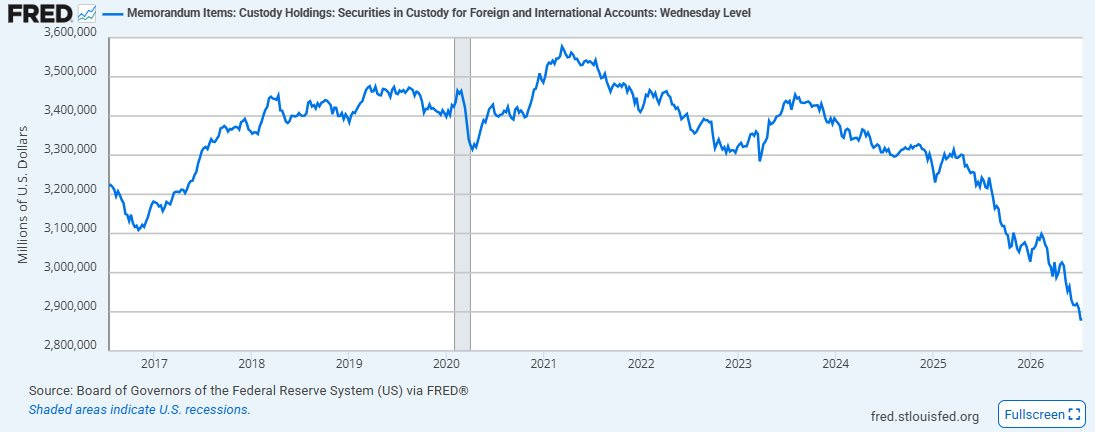
Even if we do nothing wrong, other countries are facing higher inflation and they need to raise more cash to pay for the increased cost. They raise that cash by stashing and selling our treasuries, and this is also why our 10-year treasury just crossed its 100-year moving average, a century-level technical event that’s basically happened for the first time.
So knowing all this, how has the US intervened, and what does this mean for you?
The United States finally stepped in alongside Japan and bought Yen in a coordinated intervention. This was the first time the US had intervened in foreign exchange markets since 2011. But instead of selling dollars to buy the Yen, the Treasury sold euros. By doing this, the US sent a signal — the dollar stays strong, but they can still support the Yen. Scott Bessent said the US would be willing to participate in another joint intervention if necessary.
Meanwhile Japan’s central bank might have gone further, spending another $36.58 billion and bringing the total up to almost $100 billion supporting its currency in just 48 hours.
All this might be a temporary patch, because this isn’t the first time such a crisis has rolled out. Back in 2024, Japan ran this identical strategy. We saw two rounds of emergency intervention, nearly 10 Trillion Yen spent defending their currency, and it kind of worked... For about three weeks. The Yen bounced roughly 5% off a 34-year low, and then kept falling until it hit a 38-year low a few weeks later.
Compare that to what just happened: A couple of weeks ago, Japan spent a record 59 billion dollars. The Yen ripped down from 163.65 to 157, its biggest weekly gain since February, and then by that Friday afternoon, traders had already shoved it back toward 160. The impact had barely last for a day. Why?
It’s the same reason it failed in 2024 — the intervention fixes the symptom, but doesn’t cure the underlying problem. The root cause of the problem is that the Bank of Japan is holding their interest rates at 1%, the United States is holding at 3.5-3.75%, with 3 members voting to go even higher. Until that gap closes, every dollar Japan spends is only kicking the can further down the road.
So this can end in one of two ways:
The Bank of Japan keeps hiking while the Fed eventually cuts rates, and the issue deflates over a year. Nobody gets hurt this way.
It closes fast. That’s bad. If the currency trade unwinds all at once, we could see a quick reversal throughout the markets, similar to 2024.
The next real checkpoint is going to be September 16th, when the Fed meets again. If they raise rates once again, it could make this gap wider than it is now, forcing Japan to intervene again.
In terms of my own thoughts, here’s what I think: We aren’t paying enough attention to the coordination between The United States and Japan. The US has intervened twice in the last 30 years with regards to Yen — once back in 1998, and again in 2011. Now that this has happened a third time, this isn’t a small problem.
But I think the most likely way this plays out is that people panic in the short term and trigger a lot of volatility as interest rates spike. Over the long run, we’d see a slow grind back to normalcy until the Bank of Japan hikes enough for the carry trade to stop being worth it.
In the worst case scenario, investors get pushed to the point where it all unravels at once. But given how closely Washington is monitoring the situation, this is unlikely to happen.
Meanwhile, I’ve been using this as an opportunity to buy the dip. When stocks drop, I buy a little more, and as long as we don’t see the economy implode from all of this, the best thing to do is stay the course.
If you enjoyed reading this, like, restack, and share it with a friend who needs to read this:
I’ll see you next week!
— Graham
No posts
Comments
Nothing yet. Say the first thing.
Sign in to join the conversation.