
There’s a script that we’ve been brought up with since childhood: Get a stable job, work diligently, save regularly, and once you have a nest egg saved up, you don’t need to worry about retirement. This story worked well, for a while.
But now the ground is shifting, and the story might be falling apart. While a lot of it was vibes earlier, we now have the exact numbers:
How much money does everyone have in 2026?
Where do you rank?
Who is falling behind?
Vanguard just released a brand new report that tracks the retirement accounts of nearly 5 million people. On the surface, Americans are richer than ever — the average person now has $167,970 stashed away for retirement. Except, that number is only a half-truth. If you torture the data long enough, it’ll tell any story you want it to.
The reality is that the person standing right in the center has just $44,115. Worst of all, 1 in 4 people have less than $10,000 and 1 in 10 have zero or negative net worth to their name!
The next crisis won’t be people losing money in the stock market, but people in their 20s and 30s slowly realizing that they can’t afford a house or kids, can’t pay to handle emergencies, and despite all of this, they still can’t afford to stop working in their old age. Today, we’ll break down how much money people actually have, the strategy that is quietly turning normal people into multi-millionaires, and the exact moves you can make today to come out ahead.
If you’re new here, join 40,000+ subscribers who get these weekly reports in their inbox and become smarter investors – for free:
Every year, Vanguard analyzes the real accounts of nearly 5 million Americans to put together a financial X-ray of the entire country and puts out a report. This year’s report was pretty shocking.
The good news is that we have a “retirement revolution”: 86% of workers now participate in their 401k as opposed to 65% of them 25 years ago. Also, only 5% of people panic sold during the tariff scares, and everyone else just stayed the course and bought the dip.
The bad news is this: Even though the average person has a 401k balance of $167,000, the average is skewed toward the wealthiest people. If I was in the same room as Elon Musk, our average net worth would be $550 Billion, though I’m much closer to 0 than to a billion. That’s why we need to look at the median savings — you arrange everyone’s incomes in order, and look at the savings of the person standing right in the middle. The median person has a less than a third of the average, at $44,000. What’s worse is that 75% of Americans have less than the average balance. So headlines like “Americans have record 401k balances” are really describing a wealthy group at the top and ignoring everyone else.
But where are people actually investing their money?
70% of people are in a “professionally managed” allocation.
61% of people are in a single target-date index fund
79% of all the money invested is going straight into stocks
So most people are not out there gambling on meme stocks, crypto, and IPOs with their retirement money. The average person is basically on autopilot, diversified, and buying consistently — which is statistically still the best thing to do. That’s where things get disappointing though, because when you break it down by age, the reality of the average-versus-median gap becomes huge.
For people between 55-64, the median 401k balance is only around $95,000. That doesn’t seem so bad, but usually the safe amount you can pull out of your savings every year without running out of money is about 4%. With a $95,000 balance, you can only withdraw $3,800 per year, which is roughly $317 a month to live on, in retirement, after working for 40 years.
For the typical American across all ages, that median 401k balance is just $44,000. This would give you just $147 per month at 4% a year. That amount would barely cover your electricity bill. Most Americans are arriving at retirement with a fraction of what they’re going to need. They’re leaning on Social Security to fill the gap, which currently pays the average person only about $1,900 a month.
As if that weren’t enough, here’s another fact: 40% of Americans have zero retirement savings in any account — no 401k, no IRA, nothing at all. When you zoom out even further, 42% of workers don’t even have access to an employer-sponsored retirement plan. While we have been studying people who do have these accounts, there’s a segment that’s starting from absolute zero.
In terms of how you compare at every age, let’s do a quick check as to how much you should be saving up to assure a safe future:
According to the Fed, the median American household has about $8,000 in their checking and savings accounts combined, and that number gets worse the younger you are. Between a median of $8,000 in the bank and $44,000 in retirement, a huge chunk of Americans are one ER visit, one busted transmission, or one layoff away from going into debt or digging into their retirement accounts.
According to Vanguard, 6% of pulled money out of their 401k hit 6% this year – and that’s the sixth straight year it’s gone up, triple what it was before the pandemic. 13% of people also have a loan against their 401k, meaning people are borrowing from their future selves to survive the present. While the savings rate is collapsing, the market has increased 28% over the last year — this seems like a contradiction, but it’s a picture of a K-shaped economy. Those at the top are doing incredibly well, while everyone else can barely scrape by – 31% of American households are considered upper middle-class, and 4% are “truly rich” (12x higher than it used to be 47 years ago). But everyone else is getting squeezed by rent, groceries, insurance, and childcare that have outpaced their paychecks.
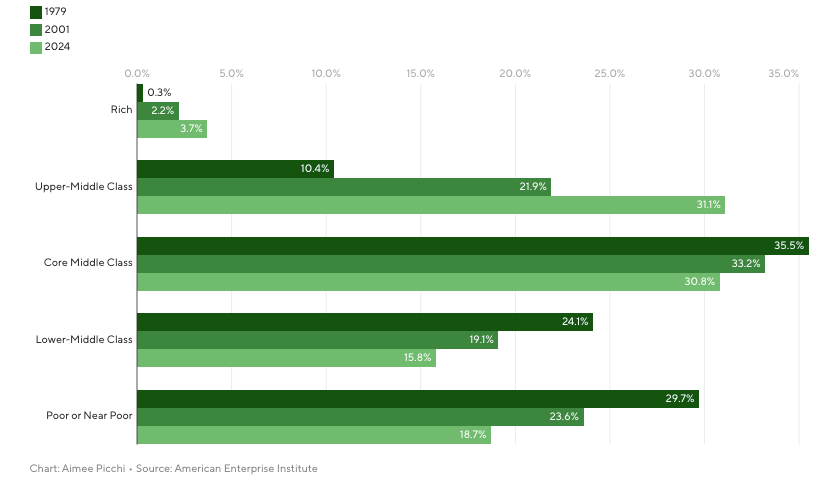
Thankfully, there’s a cheatsheet for anyone wondering how much money you need to have saved up at every age:
By 30, you need 1x your salary saved.
By 40, it’s 3x.
By 50, it’s 6x.
By 60, it’s 8x.
When you retire at 67, you need to have 10x your annual salary saved.
So if you make $80,000 a year, the goal is to save roughly $80,000 by 30, $240,000 by 40, and so on. Now that’s enough to hit the “safe” amount for every category, but if you want to be in the top 1%, Yahoo Finance tells you how much you need to have saved up:
18-24 years: $150,000
25-34 years: $365,000
35-39 years: $730,000
40-44 years: $1,234,600
45-49 years: $1,397,000
50-54 years: $2,311,000
55-59 years: $3,105,000
60-64 years: $3,550,000
65-69 years: $4,574,000
If looking at those numbers makes you feel anxious, remember that the median 45-54 year old has saved only about $87,000 against a benchmark of $140,000. You’re not the exception, but in the same boat as everyone else. It isn’t hopeless, as long as you have…
Here’s a step-by-step breakdown of what needs to be done.
If you have a 401k, get the full employee match – always. If you don’t you’re literally turning down free money.
Use auto-escalation. Those who set up a default 401k contribute more to their portfolio, and contribute more frequently. If possible, set your contributions to automatically increase by 1% every year. You won’t feel it, but the difference adds up.
If you’re over 50, max out catch-up contributions. The IRS lets you put away an extra $7,500 a year on top of the normal limit once you hit 50. Done consistently for 15 years, that can add about $193,000 to your balance by retirement.
This is the one that matters most: Watch your fees! An index fund might charge you 0.03% while an active fund charges 0.75% or more. That sounds like a tiny difference, but over 30 years, it can cost you tens of thousands of dollars.
Don’t get discouraged if you’re behind. Almost everyone is falling short of these benchmarks, so you’re in good company. The worst thing to do is to feel hopeless, and then do nothing. The people who win aren’t the ones who started ahead but rather the ones who started from where they were and didn’t stop.
Overall, the economy does seem to be getting better in general. More people are contributing to their retirement, and participation in the market is going up. But the typical person is still dangerously underprepared and under-saving for what they need.
My honest take is that the people who win at this are almost never the smartest, or the highest earners, or the ones who timed something perfectly. They’re just the ones who started early, automated it, and then kept going. That’s it.
In terms of where we go from here, unfortunately, I tend to think that the financial gap will continue getting wider before it gets better. The people who own assets keep pulling away, while everyone living paycheck to paycheck falls further behind. Obviously, this isn’t fair. But it is predictable, and the thing you have some control over is to make sure you’re on the right side of the chart. So:
Keep a little cash so the next emergency doesn’t wipe you out.
Hold that in a high-yield account so you gain some interest along the way.
Grab every dollar of your employer match.
Automate it so that you never rely on willpower
Buy something simple like a low-fee index fund without doing anything different.
You don’t need to be rich to fix this, you don’t need to time the market, or to pick the next Nvidia. You just need to start with what you have, as soon as possible. If you found this useful, please like, restack, and share it with a friend who could use the help:
I’ll see you next week.
— Graham
No posts
Comments
Nothing yet. Say the first thing.
Sign in to join the conversation.