
It was not an easy task to walk with our living children through the loss of their sibling while we faced the loss of our daughter. At the time of Aurelia’s transition to heaven we had a three year old and a baby due before the end of the year. Today, over two years since our loss, we’ve learned at lot. The goal of this post is not to tell you the right way to parent grief, but to share what we have learned and how we have dealt with sorrow in our home when it comes to our young children. I hope this post will encourage you as a parent, in any stage, as you face the road life has set before you: the joy, the sorrow, and everything in-between.
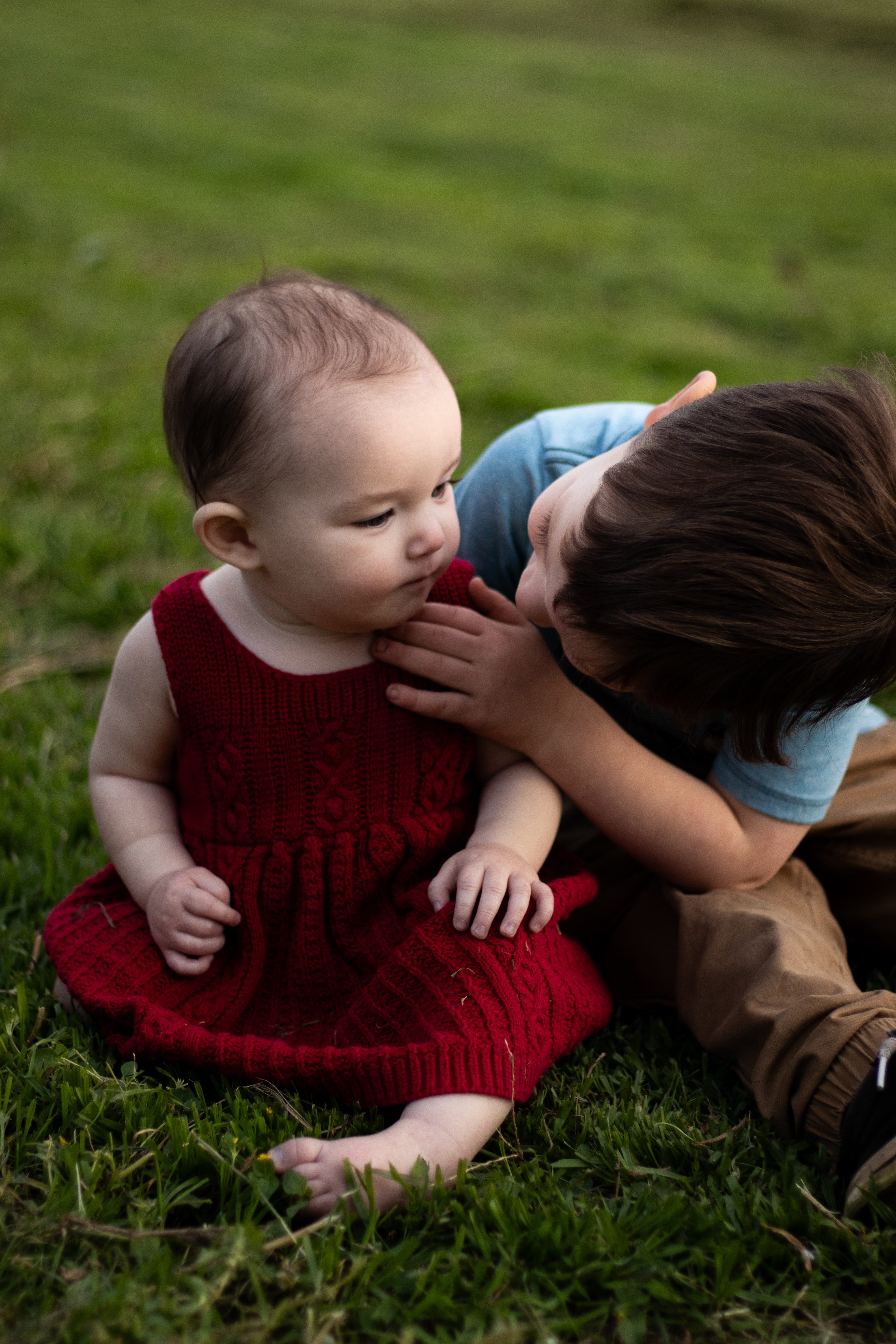
Earth has no sorrow that heaven can’t heal.
Isaiah 35:10
No one is immune to grief and children are no exception.
There was no question that our sweet three year old was grieving the loss of his sister. He was confused by permanence, he couldn’t understand that heaven was not a place we could drive too, and over the years we have seen the grief induced rage that comes all to easily for those of us who face intimate losses.
The day we lost our daughter, Isaiah lost his best friend.
When we began our grief journey, we had so many people flippantly say things like, “Maybe Isaiah will forget about all this”, or say, “Kids are resilient, he’ll be fine.”
Yet we had so many questions.
Was it really for the best not to speak of our tragic circumstances and hope he would forget? Are children really resilient or do they just not have the words to express the emotions and the wounds playing out across the story of their lives?
It didn’t take long for Wesley and I to come to the conclusion that (1) there are very few resources for young children walking through tragedy and (2) children desperately need their parents to help them name and process their grief—which is hard, because even as an adult we struggle to make sense of our own losses.
I think this is why so many wished the memories away. No one wants to watch a child face difficult questions. We want to bubble wrap our children and pretend the sorrows of the world are not their problem. However, we had to face the truth that to develop in a healthy way Isaiah had to learn how to process and cope now with the story our family faced.
Wesley and I often find ourselves discussing the fact that the tragedy we faced is not a burden or sorrow carried solely by us as a couple, but a story our family carries together. We have learned not to fear our children’s suffering, but instead, ask the Lord to give us courage to step into the race that has been put before us.
Colossians 1:9-14, “And so, from the day we heard, we have not ceased to pray for you, asking that you may be filled with the knowledge of his will in all spiritual wisdom and understanding, so as to walk in a manner worthy of the Lord, fully pleasing to him...”
Colossians 1 has become personal in our parenting journey. I rephrase it this way:
“And so, from the day his sister died, I have not ceased to pray for Isaiah, asking that God may fill him with knowledge of his will in all spiritual wisdom and understanding, so that he may walk in a manner worthy of the Lord, fully pleasing to him…”
Let me add this: May God give Wesley and I all the wisdom, understanding, and knowledge to raise our children, sharing with them, in word and deed, that there is no darkness that the Lord cannot overcome.
I don’t know all the hardships my children will face, I don’t know how they will “turn out” in adulthood, but I am certain that these are not the worries God wants constantly churning in my heart and mind.
I believe God is far more concerned with how we steward the hearts and minds of our children today as we raise them in a home that acknowledges the Lord and power of the gospel in their lives.
Deuteronomy 6:7, “You shall teach them [the laws] diligently to your children, and shall talk of them when you sit in your house, and when you walk by the way, and when you lie down, and when you rise.”
This leads me to the argument that “children are resilient”.
I have come to find most of us are resilient in our circumstances—but resiliency does not mean a wound has been processed and dealt with in a healthy way. We have all found ways to cope and survive the things we thought impossible. There are many adults with wounds from their childhood that have left them unable to cope with different aspects of their life. Our wounds have great power for good or for bad. They not only impact us, but have the power to impact our children’s children.
It didn’t take us long to decide that we wanted more for our children than resiliency because our goal as parents is not to raise resilient children, but to raise children who are dependent and obedient to Christ.
We want them to live their day by Joshua 1:9 and go face their nights in light of Psalm 3:5-6.
Joshua 1:9, “Have I not commanded you? Be strong and courageous. Do not be frightened, and do not be dismayed, for the Lord your God is with you wherever you go.”
Psalm 3:5-6, “I lay down and slept; I woke again, for the Lord sustained me. I will not be afraid…”
In our daily lives we try to live this out practically by creating a home where our children feel safe to bring the concerns on their heart to us. We ask questions and give them the opportunity to share their wounds. We try to find answers to their questions when we have none. We’ve committed ourselves to teaching and sharing the gospel with our children through word and deed, and skills or hobbies that will serve them throughout their lives.
During the past couple of years Wesley and I have come to the conclusion that raising children who carry sorrow is a beautiful opportunity for us to fully rely on the Lord as He equips us to share the good news of the gospel and to walk with our children through any circumstance they may encounter.
On Aurelia’s gravestone we have engraved the words, “He turns graves into gardens” paired with Matthew 19:14 across the bottom of her stone.
Matthew 19:14, “Jesus said, “Let the little children come to me, and do not hinder them, for the kingdom of heaven belongs to such as there.”
When we visit, I am reminded that Aurelia is with the Lord. God did not hinder her from entering the kingdom. He met us there, in that moment, and carried our daughter home, while still holding our hands through impossible hardship.
Still, Aurelia was not the only child we gave up to the Lord that day.
We walked out of that hospital still parents to living children. Could we give them up to the Lord as well? We had to choose that day to give the Lord all our children, because in the end they were never ours anyways. They are a gift the Lord has given us to steward well.
While I watch my children stand in the middle of a cemetery, I know that the graves God is turning into gardens are here on Earth. It is through those gardens Jesus is drawing in the hearts of my living children. They will never by forgotten or forsaken.
There is a freedom in our parenthood journey as we acknowledge that we don’t know what the end of the story is for our children. We have no idea the mistakes they’ll make, the trials they will walk through, or the legacy they will leave. It is not our job. It is simply our every day task to faithfully walk with the Lord, stewarding our children and guiding them through the stories of life they are walking through.
The good news is this: God will not be surprised by a single bit of it. Each day He gives us new mercies, equipping us to be the best we can for the tiny souls He has placed before us.
And what a honor and privilege it is.
Subscribe for free to receive new posts as we share about our journey of grief. Consider becoming a paid subscriber if you would like to support our grief resources.
Comments
Nothing yet. Say the first thing.
Sign in to join the conversation.