
I DO NOT CLAIM my deed to be any sort of chivalrous feat, but today I rescued a damsel in distress.
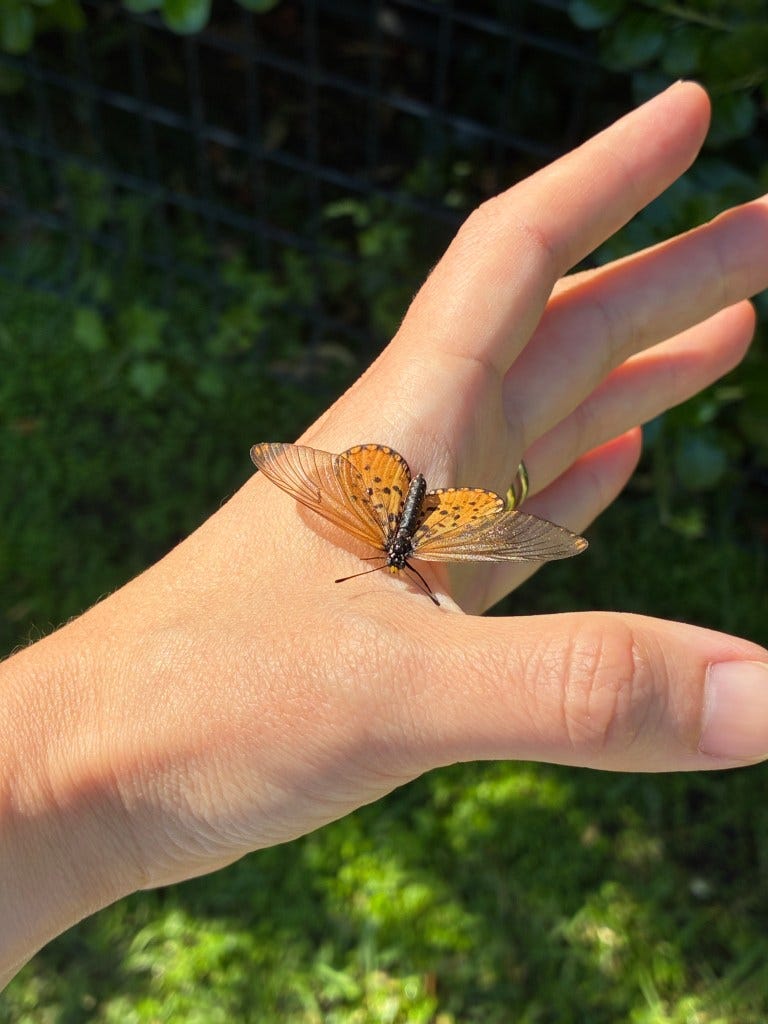
A beautiful specimen of the Acraea Horta butterfly — native to South Africa and Zimbabwe — was floating, nearly lifeless in the deep end of a swimming pool in Cape Town, South Africa. She was definitely in over her head.
I ran into the little lady — the females are identified easily since one pair of their wings are translucent — while doing my daily laps. At first, I thought she had already met her Maker, as she bobbed with the waves. I gently placed my hand under the water, slowly scooped the small creature out, and placed her on the bricks bordering the pool.
She lay there, immobile, but then showed a hint of life with a twitch of her antennae. I have encountered many a bee while swimming and learned through trial and error that they need to be transported to dry land where a special kind of CPR must be applied. To be sure, you can’t press on their thorax or abdomen to expel water from their tiny lungs, since they have no lungs. And they wear their skeleton on the outside, so any force applied would result in a very crunchy experience. It goes without saying that mouth-to-mouth resuscitation is inadvisable.
But what they do need is to dry their wings. This presents the diminutive beings with a conundrum. They are essentially paralyzed because their wings are so waterlogged they cannot extend them to dissipate the liquid residue.
So with today’s patient, I applied my form of insect resuscitation, pursing my lips and exhaling a steady stream of breath on its aerial appendices. At first, she didn’t seem to react, and then I detected movement again in the antennae. With each breath, I saw a bit more animation, until the wings began to flap just slightly. After a dozen or so times, the wings extended out to their farthest range.
It was a touching moment. We seemed, Madame Butterfly and I, to be communicating in a kind of sign language.
Me: “Whoosh.”
Mme. Butterfly: “Again, please.”
Me: “Whoosh.”
Mme. Butterfly: “And now a little to the left, thanks.”
The prognosis for a full recovery appeared promising, but she was still unable to achieve liftoff. My better half, Sherry, was reading poolside and so I called for her to take over. The creature rested comfortably upon Sherry’s hand for a while, drying in the warm South African sun. After just a few minutes, the butterfly was able to flutter by, soaring once again. And I swear I could hear strains of Puccini’s “Un bel dì, vedremo” in my head. Indeed, Madame Butterfly, one fine day we’ll see.
Of course this was a very happy, feel-good moment. It reminded me of all those random-act-of-kindness YouTube videos, in which animals — invariably cute ones — are saved by good-hearted folks. There’s a variety of them, but here’s a few examples:
A delicate little fawn has fallen through the ice into some frigid lake waters and is then rescued by a group of fishermen.
A baby elephant is struggling to climb the muddy bank of a crocodile-infested river and is tenderly scooped up by a guy operating a backhoe with the finesse of a surgeon.
A beached dolphin, entangled in a fishing net, is unable to move until it is emancipated by some seaside vacationers, who then lovingly nudge the grateful fellow back into the water.
All so heart warming and such a resolute reaffirmation that deep down, humans are good.
WE, AS HUMANS, relish our role as the superior species. The Abrahamic faiths — Islam, Christianity, Judaism — all believe in the collection of stories known as Genesis, specifically Chapter 1, Verse 26, where it is written that our job is to:
“…rule over the fish in the sea and the birds in the sky, over the livestock and all the wild animals, and over all the creatures that move along the ground.”
Hinduism, Buddhism, and Janism all subscribe to the concept of Karma, that what goes around comes around. And since their collective belief also includes reincarnation and the possibility that any one of us can return to the physical world as any one of the millions of other species on the planet, best to be nice to all creatures big and small, if even for selfish — dare I say future selfish — reasons.
Taoism teaches harmony with all living things.
Confucianism applies the concept of “stewardship,” but not as aggressively as the Abrahamic opinion of “dominion.” Many African cultures are in line with Confucianism, that humans have a role as caretakers.
The Shona of Zimbabwe tell stories of humans undergoing metamorphosis, becoming other animals, which, perhaps, aligns with reincarnation.
Some, such as the Bantu peoples of West-Central Africa, believe that all animals have a “life force.”
The first people that settled the Americas take the “life force” idea a bit further with animism, the thought that all living things and even natural inorganic things such as rivers and rocks — possess spirits. The role of humans is to unify with, rather than master over, those other spirits.
Yet none of these religions or beliefs espouse exploitation of other species and certainly none advocate the desecration of the very habitat that all creatures great and small — including humans — need to survive.
SO HERE WE ARE, with all these lofty pronouncements regarding our beneficent-caretaker role, doing the exact opposite, voraciously and indiscriminately chewing through the planet and everything in its path like a swarm of locusts. The bitter irony is that even a lowly parasite knows more than the self-proclaimed smartest species: that you don’t kill off a host unless you have another host nearby. And despite what the Billionaire Bros say, Mars ain’t a “Planet B.” Not in our lifetime and unlikely in any lifetime.1
Here on our one and only planet, just today — this day in which I’m basking in the glory of my good deed — humans were responsible for:
— 150 to 200 species going extinct
—The loss of 45,479 acres of rainforest
— The degradation of 676,373 acres of topsoil, which is literally blowing away because of irresponsible tilling, forest clear-cutting, and over-grazing. (An excellent book on this topic is Dirt: The Erosion of Civilizations).2
— The deaths of 34,520 people, who succumbed to air and water pollution, or died from heat caused by global warming, or from diseases that are proliferating as a result of human-provoked climate change. Toxic chemical exposure from factories belching and spewing noxious gases, liquids, and fumes took its toll, as well.3
Yes, all in a day’s work.
It’s easy for each of us to hide in the anonymity of the vast number of 8 billion members of our species. People — other people, not us — do crazy things, selfish things. And we have non-people — big corporations — that can throw millions, even billions of dollars toward legal fees to defend their rights to pollute the environment. They then will spend millions more on marketing to green-wash their brand.
So who is responsible if no one is responsible?
This is what economists call the “Tragedy of the Commons,” the concept that humans are too selfish to share common resources responsibly.4
All this got me to thinking about my personal role. I’d like to think I’m not one of those egregious offenders. But I’m here, I’m consuming resources. In fact, I come from the most privileged of society — the so called “Developed Nations,” the “Western World” — which consumes 3.5 times the global average.
So I thought I would do a little calculating5 to figure out how I did in the past 24 hours. Here’s my personal balance sheet for the day:
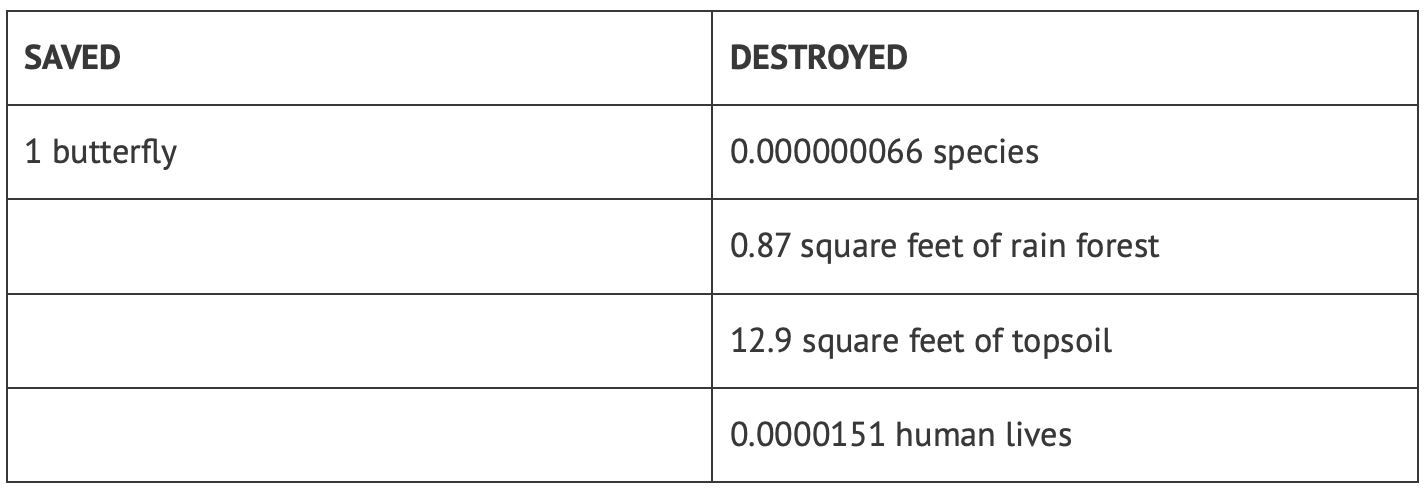
I don’t think I’m coming out as a net-positive contributor to the well-being of the planet in this exercise.
WAY BACK IN THE 1960s, mathematician and meteorologist Edward Lorenz was running a computer simulation to determine how tornadoes formed. He noticed that even the slightest variation in the model could drastically change the outcome. This became known as the “butterfly effect,” that one tiny data point, as small as the flapping of a butterfly’s wings, could have unforeseen and unintended consequences.
In her brilliant and beautifully written novel The God of Small Things, author Arundhati Roy pursues a similar theme: that the smallest, most mundane, prosaic actions of everyday life can add up to very big things.
So, the excitement of my “heroic deed” today and my subsequent reflections that forced me to be truthful about it all, got me to thinking that this could be the start of the “Madame Butterfly Effect.“
Those tiny wings flapping today had an effect on me that caused me to sit down to write and post this essay and that might influence others to act and who knows where this could lead? I know a data scientist who also has proven to be a pretty good assistant butterfly-rescuer. I might ask her to model this. All the small things could add up to something serious.
But if not, well, hey, I did save a butterfly today. Pretty cool, huh?
Elon Musk promised in 2016 to land humans on Mars by March 2026. That deadline has transpired unfulfilled, obviously. He now has “pivoted” his space efforts to colonizing the moon rather than the Red Planet.
Links to books I have read will take you to goodreads.org, a nonprofit website that links independent book sellers.
The daily figures provided are based on scientific reports from the WHO and World Resources Institute.
The Tragedy of the Commons was first proposed in the 1800s as a way to prove that land should be in private ownership to “protect” this resource for the greater good. Political scientist Elinor Olstrom proved just the opposite, that communities can come together without private or even government intervention, to preserve common assets. She won a Nobel Prize for her work.
Calculation for my personal daily “contributions” to the destruction of the planet are based on a simple formula of the global numbers provided, divided by 8 billion, then multiplied by 3.5, the factor that I cited for people in the “developed nations.”
No posts
Comments
Nothing yet. Say the first thing.
Sign in to join the conversation.