
By Alice Marshall
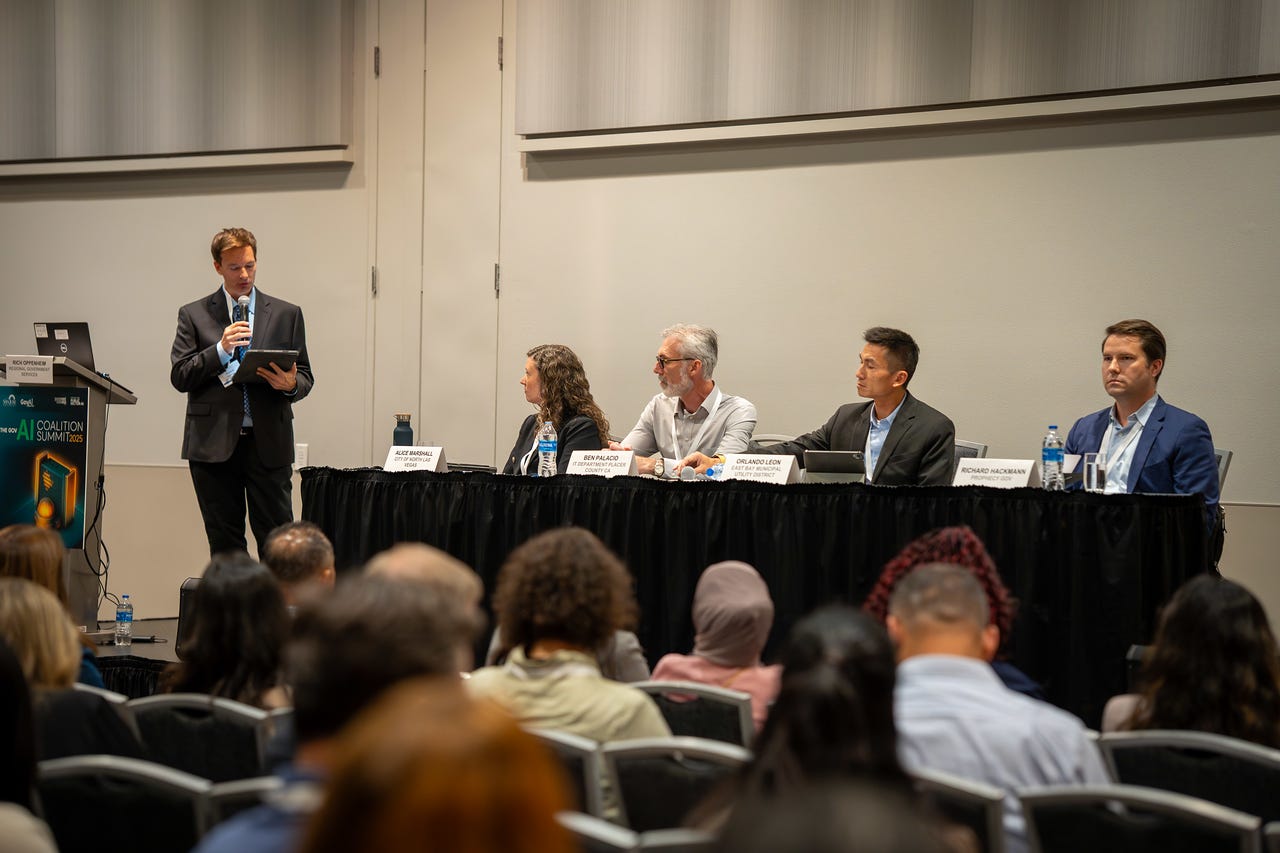
When Rich Oppenheim turned to me at the end of the panel at the GovAI Coalition Summit 2025 on “Expanding Artificial Intelligence (AI) Training for Public Sector Success,” and said, “Well, I think that’s about all the time we have now,” I was genuinely surprised. I couldn’t believe how quickly that hour had flown by.
The panel, which included my co-panelists Benjamin Palacio, Orlando Leon, Richard Hackmann, and moderator Richard Oppenheim, had just spent the past hour deeply immersed in a rich conversation around the theme of AI training.
And let me tell you, AI training is the hot topic right now. There was not a single panel during the entire Government AI Coalition 2025 Summit where I didn’t hear the importance and need for AI training come up.
Which begs the question: where do we start? What do we do?
And that’s where my co-panelists and I come in. As for myself, I have had a great time running five AI training pilots at the City of North Las Vegas, alongside my colleagues Michael Timog and Ron Williams, where I serve as Senior Training Specialist in the HR Department.
At first, our technical trainer, Michael Timog, and I began by asking our colleagues in HR a simple question: “Is there anyone from a couple of different groups within HR who’s interested in AI?”
With that, we assembled five participants from our HR Department. We conducted baseline training on AI and machine learning definitions, including some use cases from the HR industry, as well as risks such as hallucinations and bias. We also included our current work on obtaining AI Policy approval at CNLV, as well as our recent joining of the Government AI Coalition, where I serve as our city’s representative, alongside our IT Security Manager, Ron Williams.
Our participants liked the training so much that they recommended we share it with our entire HR Department, an idea that our HR Director also liked. We updated the training slightly and conducted it for our HR Department, shortening it slightly to accommodate time constraints.
Following this, there was growing interest among City team members in learning more about AI. We therefore collaborated with our IT Security Manager, Ron Williams, to host an AI training session for CNLV employees as part of our Citywide training program, serving as a pilot. We had 25 slots available. The spots sold out in 10 minutes. We updated the content again and offered another pilot class. The spots again sold out in 10 minutes.
At this point, we hadn’t yet obtained our AI Policy approval, and we hadn’t yet initiated our pilot AI Working Group.
Then, while we were working on our AI Policy for the City, one of our Deputy Directors provided feedback that she’d like to see Baseline AI Training for CNLV staff (we have approximately 1,900 full-time employees). With that, we agreed to open more spots for the pilot Baseline AI Training. We opened 120 spots, and we had around 80 attendees. This was the first class where we began covering Copilot Chat, which we had just acquired after transitioning from Google to Microsoft.
My main takeaway from the conference is this: the next stage of AI Training will be tiered. What does that mean, though? (And this, below, is inspired by the City of San Jose’s approach, and what I’ve learned from Leila Doty, and listening to their mayor.)
Here’s an example:
Tier 1: AI Baseline Literacy for All employees (voluntary) – 1 hour, give or take
Tier 2: Department-specific/tool-based training – here, we aim to help specific departments effectively apply AI tools within their unique workflows. We’re taking a closer look at Copilot chat and exploring its usage.
Tier 3: For advanced users & AI Champions, more advanced features include prompt engineering, role-based prompting, prompt chaining, and refinement.
Tier 4: AI for All (inspired by the City of San Jose). AI Literacy training for residents aims to make our residential population as resilient and adaptable as possible for the future.
We have currently implemented Tier 1 so far within my organization. However, I am inspired by all the conversations we had on our panel and at the conference in general, and I look forward to continuing to develop Tiers 2-4, if our Leadership agrees.
Additionally, I was one of likely only two representatives from HR out of 600 attendees at the conference. Other people noticed this, and it was noted in the closing Government Town Hall session that “not all stakeholders are at the table.” The IT Department, CIOs, IT Security Managers, Data Managers, and IT Infrastructure Managers, among others, are the technical experts when it comes to AI, particularly in managing cybersecurity and the risks associated with AI technologies. HR is typically where change management skills are located, and where Learning and Development resides.
These two skill sets – the change management piece and the L&D piece – are critical to upskill our organizations and ensure that everyone can benefit from the General-Purpose technologies that AI represents, which will likely change every aspect of our lives. Additionally, these two components are critical to coping with the inevitable tides of change that are already sweeping our work landscape. Therefore, I will emphasize the importance of partnership here – it is a growth area for collaboration between IT and HR, ensuring that fruitful and valuable conversations take place and that opportunities are not missed.
I look forward to continuing to have these valuable conversations within the GovAI Coalition.
About the author
Alice Marshall is the Senior Training Specialist in the HR department at the City of North Las Vegas.
Note: The opinions expressed in these articles are solely those of the author(s) and do not necessarily reflect the views, positions, or policies of the GovAI Coalition or the authors’ affiliated professional organization(s).
—
This is the blog for the GovAI Coalition, a coalition of local, state, and federal agencies united in their mission to promote responsible and purposeful AI in the public sector.

Comments
Nothing yet. Say the first thing.
Sign in to join the conversation.