
12 Pentecost A, Mt. 15:21-28, August 16, 2026
A couple of weeks ago I saw an Israeli film about a young Palestinian boy from the West Bank who longs to see the Mediterranean. He had missed out on his class field trip to the seaside because his identity papers were not found to be in order, and he was kicked off the school bus. Later, he runs away to try and reach the sea on his own. This is a foolish and dangerous thing to do. He travels through territory where most of the people look on him with suspicion and do not speak his language. Not only that; without the right papers and permissions, his journey is illegal. Along the way, he keeps meeting kind strangers in unexpected places. A pair of construction workers gives him directions to the bus station and a snack. An older woman pays his bus fare when he only has cash instead of the required smart card. One woman teaches him how to say “excuse me, where is the sea?” in Hebrew. A burly, punked-out, scary-looking teenager at a bus stop protects him from a group of bullies. The boy almost succeeds in his quest.
Maybe you have also been surprised by the kindness of strangers when you were an outsider. Or maybe some person who often offends you because of their politics or identity or appearance surprises you with a word of wisdom. Sometimes, we are able to see beyond our stereotypes and discern the humanity and dignity of the person we thought was beneath our notice. This is what happens to Jesus in today’s gospel.
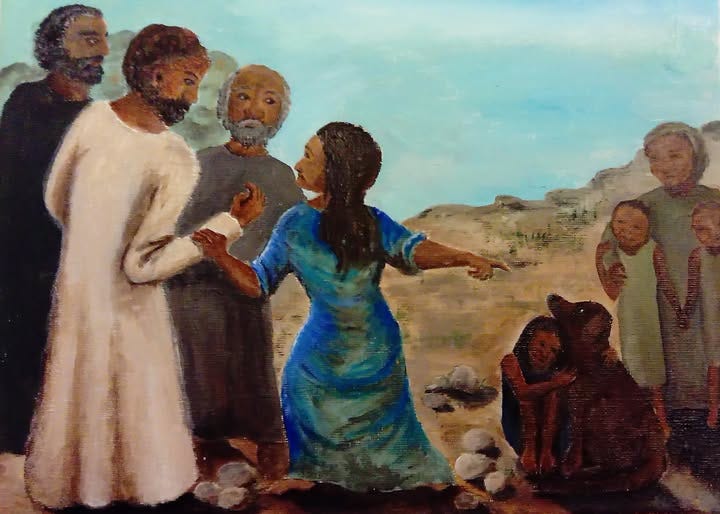
For whatever reason, Jesus decides to go to the seaside, into the foreign territory of Tyre and Sidon. He is the stranger here, the one who doesn’t speak the native language or worship the local gods. He and his friends are the ones who would need help with the local currency and who would need to ask for directions to the beach. This Jewish rabbi and his Jewish followers are on enemy turf, in the homeland of the Philistines, their ancient geopolitical rivals. It is astonishing that the Canaanite woman knows who Jesus is, and even more astonishing that she approaches him for help. This woman has chutzpah; she is bold and assertive. Because she is so desperate to save her demon-tormented daughter, she is willing to take a risk and defy social conventions. Since when does a woman approach a strange man, much less a foreigner? Somehow, she sees through the stereotypes and sees Jesus for who he is. She calls him Lord and Son of David. She knows he has the power to help her.
It is troubling that Jesus seems to ignore her. I know, maybe he’s testing her faith. Or maybe he’s got a lot on his mind. Maybe he’s hangry. Maybe he’s just not interested in seeing beyond the stereotypes right now; maybe he truly believes that she is just not his problem, because she is not one of the lost sheep of the house of Israel. The disciples certainly don’t see the humanity of this woman nor care about her need; they think she is nothing but a nuisance and want Jesus to order her away. But she refuses to be dismissed.
She throws herself at his feet and begs for help. The phrase translated here as “she knelt before him” could equally well be translated as “she worshipped him”. She has just heard him tell the disciples that she falls outside the parameters of his mission, that she is not his problem. Yet she insists on being seen. What Jesus says to her next sounds pretty insulting: It’s not fair to take the children’s food and throw it to the dogs. He implies that there is not enough food and healing and life to go around, that good things are only for some and not for all. And yes, he implies that she is no better than some starving mongrel on the street. He basically calls her a dog. This is not Jesus at his divine best; this is Jesus letting his messy humanity show, and that can be a little uncomfortable. We prefer Jesus meek and mild to cranky Jesus.
The woman does not slink away in shame; she pushes back and owns the insult: “Yet even the dogs eat the crumbs that fall from their master’s tables.” Here, the last and best verse inexplicably vanished from our printed bulletins. So let me read it for you again: “Jesus answered her: ‘Woman, great is your faith! Let it be done for you as you wish’. And her daughter was healed from that moment.” Jesus finally acknowledges her humanity and her need. He finally sees her with compassion. He even praises her persistence; her great faith stands in ironic contrast to the chronic “little faith” of his own disciples.
It is all too human to judge and exclude others, to depend on stereotypes and to see the world in black and white, us and them, good and bad. It has been said that whenever we try to draw a circle to separate us from them, Jesus is always going to be on the other side of the line. As long as someone is still outside the circle, Jesus is going to stand with the outsider and challenge us to draw a bigger circle. I find it comforting in today’s gospel that Jesus is human enough to struggle with the boundaries and that he is divine enough to make the circle larger. I think it is good news that Jesus revises his mission plan to include foreigners and ancient enemies. It takes courage for him to show mercy to this persistent woman. It is a leap of faith for him to recognize her great faith. Imagine a world in which we all could see the humanity of every single other person. Imagine a world in which we all responded with mercy. May it be so. Amen.
Rev. Jean N. Kuebler, August 13, 2026
No posts
Comments
Nothing yet. Say the first thing.
Sign in to join the conversation.