
Note: These are my personal views only and do not constitute investment advice. See full disclaimer below.
Audio embedded below.
0:00
-23:51
I cut my Prudential target over this in 2017. This time the shares have overreacted.
A Chinese crackdown on cross-border investment accounts knocked 17% off AIA and 20% off Prudential at their lows. Both have since clawed back a few points, leaving them down around 12-13% as I write.

On 3 February 2017 I published a cautious note on Prudential and cut my price target, under the title 'New rule expected to reduce sales', which tells you my call and absolutely nothing else. That sell-side title was not built to entertain! The trigger was a piece of Chinese regulation: from 1 January that year, mainland citizens buying their annual US$50,000 of foreign currency had to sign a declaration that the money would not fund property, overseas stocks, or life and investment-related insurance, with a watch list, a fine of around 30% of the sum involved, and a money-laundering probe waiting for anyone who lied. For an industry whose Hong Kong boom was funded by mainland visitors moving money offshore, that was a direct hit on the funding mechanism, and the company pushed back hard on my caution.
The forecast proved broadly right: mainland visitor premiums fell about 30% in 2017, yet when I modelled that genuinely impactful rule my earnings forecast fell by just 0.8%. At the time Hong Kong was only 5% of Prudential group earnings, and the value of a life insurer sits overwhelmingly in the back book, the stock of policies already written and still paying premiums, so a hit to new sales has a slow and shallow impact on profit. The shares barely registered it, underperforming the UK life sector by around 2% before spending the rest of 2017 rising. A real, at-source capital control, followed by a 30% fall in the market it targeted, cost roughly 0.8% of earnings and about 2% of relative share price. In 2026 a rule that has not even been written for insurance took as much as 17% off AIA and 20% off Prudential.
I did not turn bearish at the first sign of Beijing tightening. Four months earlier, when UnionPay barred its cards from buying investment-linked insurance in Hong Kong, I wrote the opposite note, titled “UnionPay ban is not a threat”, because the card was one of seventeen ways to pay and the money would simply travel another route. The skill in this job is telling apart a rule that closes one door, easily routed around, from one that catches the customer at source, and both calls proved right.
The 2026 version comes in three parts. On 22 May the China Securities Regulatory Commission, with seven other departments and State Council approval, launched a two-year campaign to shut down unlicensed cross-border securities, futures and fund business. Three offshore brokers popular with mainland investors, Futu, Tiger and Longbridge, were fined more than RMB 2.2bn and told to wind down their mainland-held accounts, which may now only sell and withdraw; broker estimates put around HK$250bn ($32bn) of mainland money in the affected accounts. Hong Kong’s own regulators moved the same day, requiring that new customers’ funds originate outside the mainland and asking banks to review existing mainland-held accounts.
Then on 1 June Beijing published the document behind the sell-off. State Council Decree 837, the new Regulations on Outbound Investment, takes effect on 1 July. Across all 34 articles, it never once mentions life insurance; its only insurance reference, in Article 8, is to encouraging insurers to cover outbound investors against overseas risk, the opposite end of the business from a Hong Kong savings policy. Its significance lies in two articles: Article 2 brings overseas investment by individual residents inside the approval net for the first time, closing precisely the gap through which personal money flowed offshore, and Article 33 orders officials to draft the specific rules for individuals. That unwritten document is where the fate of Hong Kong insurance will be decided, and the question the market is now pricing is whether investment-linked insurance falls within scope once those measures are written.
The selloff accelerated on 4 June, when the South China Morning Post reported that Bank of East Asia’s Shanghai branch had stopped supporting new Hong Kong account openings and that HSBC staff in Shanghai were warning depositors; Prudential fell 7.6% in London that day and another 4.2% on 9 June. AIA fell in parallel, dropping sharply over the same days as the same headlines hit both names. Over 21 May to 9 June 2026 Pru's share price had fallen 20.0%; AIA fell 17.4% from 21 May to 10 June 2026 (the end dates differ because AIA trades in Hong Kong and Pru in London, so the comparable closing lows fall a day apart across the time zones). The combined market cap hit is around £21bn.
As I read them, the new rules are aimed at one specific thing: stopping fresh money from a mainland bank account being pushed across the border to fund a Hong Kong investment account, the kind used to trade stocks and funds. My understanding is also that this was never permitted in the first place, so most of what has been announced is enforcement of an existing prohibition rather than a new restriction.
The key point I want to make is that the insurers simply do not do the thing the regulation is policing. To my knowledge AIA and Prudential have never written a policy off money wired across the border into a brokerage account, because that is not how the business works. They take premiums from mainland Chinese customers who are physically and legitimately in Hong Kong, paid from a Hong Kong bank account, for a policy bought in person in Hong Kong.
Picture two bridges into Hong Kong (see the cartoon at the top of this article). The first is a money bridge, carrying mainland cash into Hong Kong investment accounts, and the new rules have put a tighter check on it; the insurer never uses that bridge, because its customer is already standing in Hong Kong, spending money that already sits in a Hong Kong account. The second is a people bridge, the one the customer physically walks across to buy a policy in person, and that is the only bridge that has ever actually mattered to AIA and Prudential.
Which bridge matters is not a theory, because we have already run the experiment. The one time this channel genuinely stopped was when the people bridge closed: through COVID the border shut, mainland visitors could not travel, and sales collapsed to a fraction of their peak before recovering to records once it reopened, while the in-force book carried on paying throughout. So the second-order risk worth watching is footfall: whether mainland visitors keep arriving in the numbers they did. Nothing announced in 2026 closes the people bridge: the border is open, and a mainlander can still travel to Hong Kong, hold a deposit account and fund a premium from it. The subtler risk is sentiment. A crackdown that makes mainland buyers wary of being seen to move money offshore could thin the flow of visitors even with the bridge wide open, and that would hit sales harder than any rule on paper.
It helps to see what a decade of this has done to sales, on the Hong Kong Insurance Authority’s own figures. Mainland visitors bought HK$72.7bn of policies in 2016, the all-time record, in the teeth of the UnionPay caps. Sales fell to HK$50.8bn in 2017 and drifted to HK$43.4bn by 2019, though with hindsight I would claim less for the declaration rule than I did at the time, since visitor flows were softening anyway and the 2019 protests cut the number of mainlanders coming at all.
The pandemic then ran the experiment no regulator could: a fully closed border took sales to HK$6.8bn in 2020, HK$0.7bn in 2021 and HK$2.1bn in 2022. The border reopened in February 2023 and sales rebounded to HK$59.0bn that year and HK$62.8bn in 2024, which was 28.6% of all individual new premiums written in Hong Kong. Even a three-year full stop did not impair the in-force book, the dividends or the demand. The record of the decade points one way: paperwork has never stopped this channel, only a border the customer cannot physically cross, and nothing announced in 2026 closes the border.
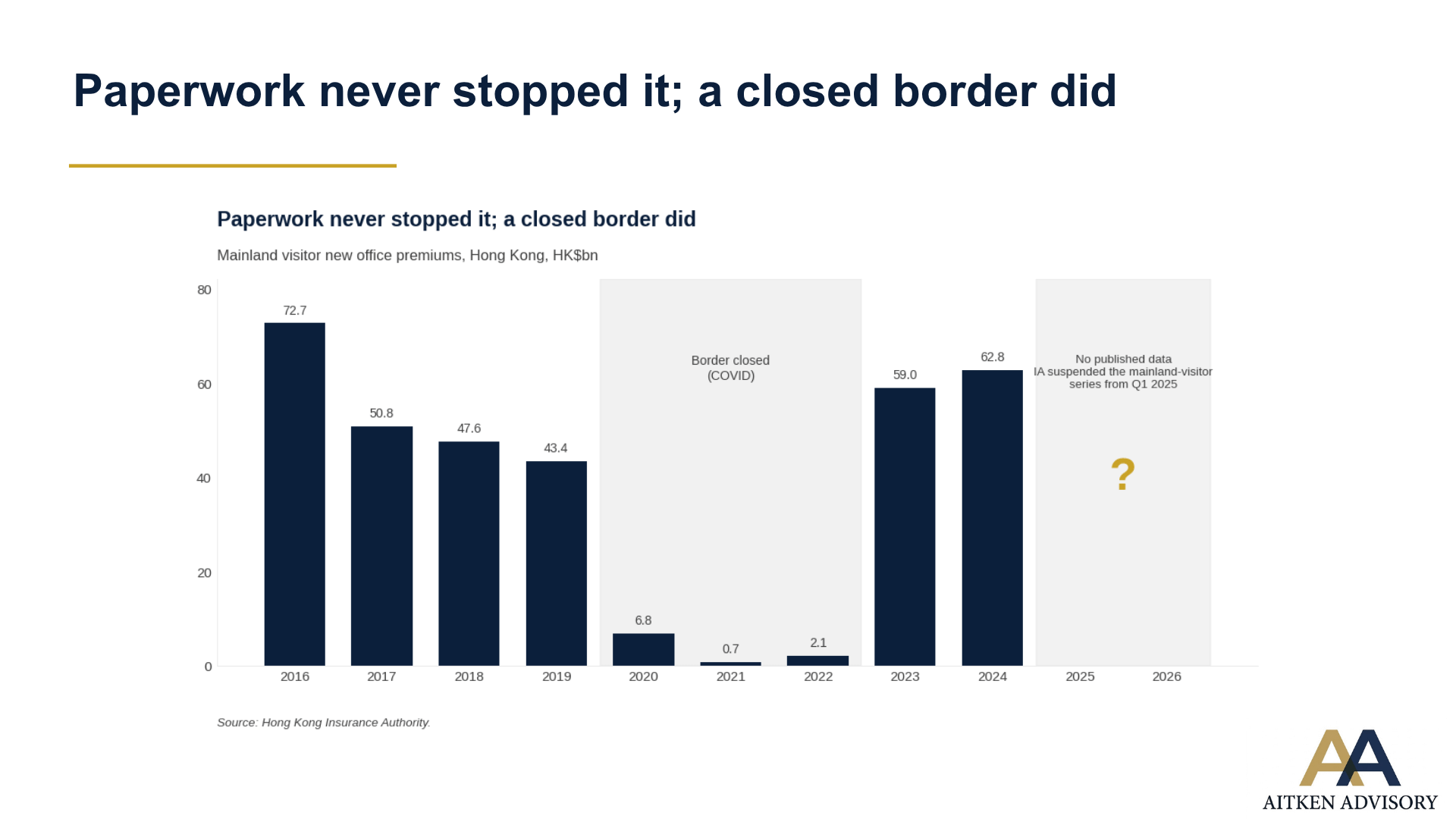
One detail is worth registering. The Insurance Authority stopped publishing mainland visitor statistics from Q1 2025, so 2024 is the last market-wide number we will get for a while.

The distinction the selling has glossed over is the same one I leaned on in 2017. A regulatory hit to the mainland visitor channel threatens future new business; it does not touch the embedded value already on the balance sheet. For readers who do not live inside insurance accounting, embedded value is the present value of profits locked into policies already sold, a stock built up over decades, while the value of new business, which AIA labels value of new business (VONB) and Prudential calls new business profit, is the flow created by a single year’s sales. Beijing can slow that annual flow. It cannot reach back and impair the in-force book already throwing off cash: a mainland customer who bought a whole-of-life policy in 2022 keeps paying premiums whatever the CSRC announces in 2026. Every measure published so far points the same way, with the CSRC plan explicitly stating that existing investors' assets are unaffected and Decree 837 biting on the making of outbound investments, not on the in-force policies a customer already holds.
There is one route by which this could reach the back book, and it deserves a look. Some 97% of mainland visitor policies are regular-premium, so the in-force book depends on policyholders continuing to remit annual premiums across the border, and a harsh payments squeeze could in principle raise lapses. The mechanics argue against it: renewal premiums are overwhelmingly paid from Hong Kong bank accounts, the new measures target investment accounts not deposits, and nothing published closes China’s capital account. The history is reassuring too, with renewals flowing through both the 2017 rule and the closed-border years and the Asian surrender rate, the pace at which policyholders cancel, staying low when I last analysed it.
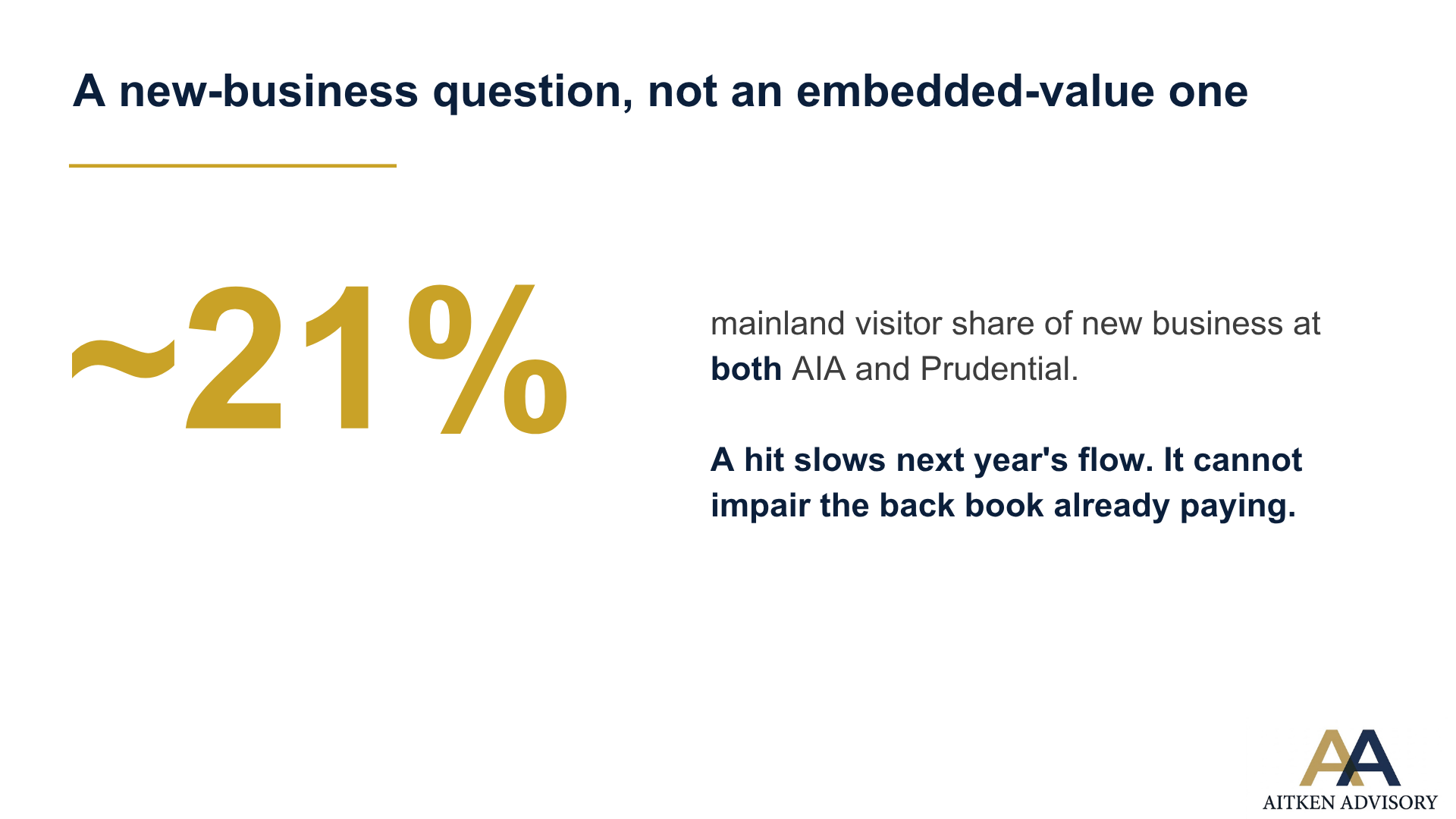
On exposure, the two names are close. AIA disclosed for 2025 that Hong Kong delivered VONB of $2,256m, or 41% of the group. Mainland visitor customers account for around half of that, putting mainland visitor new business at roughly 21% of AIA's group total.
Prudential reported group new business profit of $2,782m in 2025, with Hong Kong its largest market at around 43% and if we estimate a roughly even domestic-versus-visitor split, landing its mainland visitor exposure at a similar circa 21%. One definitional point matters before anyone capitalises these figures: a mainland national who lives, works and banks in Hong Kong is still recorded as a mainland visitor when they buy, so the headline 21% overstates the genuinely cross-border slice.
Even on the worst reading, the directly exposed slice is small. The crackdown’s perimeter is securities, futures and funds, and the insurance product closest to that line is investment-linked assurance (ILAS), only around 5% of Hong Kong’s new premiums in 2024. The mainland visitor book is overwhelmingly protection and participating savings, pure life cover and profit-sharing savings policies, which have nothing in common with a brokerage account, and both insurers have spent two years tilting further that way. The slice genuinely in the firing line is far smaller than the headline 21%.
What Beijing is trying to do is stem the outflow of money from China, and this crackdown is one more front in a decade-long campaign to defend the currency, keep the capital account shut and stop household savings leaking offshore while the economy and the property market stay weak. Hong Kong insurance matters to that campaign only as a side door, because a multi-currency savings policy is one of the few legal ways a mainland saver gets money and cover outside the yuan. The rule is aimed at the brokerage door, not the insurance one, but the intent behind it is not in doubt.
That is the legitimate worry for any insurance investor, and it is the same worry whether you own UK, European or Asian life. Regulation in this area only ever seems to tighten. Nobody is drafting rules to make it easier for a mainland customer to buy a Hong Kong policy, so the risk that matters is not this decree but the next one, and the one after that; even if Article 33 spares insurance, the direction of travel says the channel will be leaned on again.
The record tells a different story. Beijing has leant on this channel at least four times in a decade, through the UnionPay caps, the card ban, the 2017 declaration and now the cross-border crackdown, and each time the money has found another route, because the structural pull has not changed: a weakening yuan, a property market that no longer feels safe, and the bulk of Chinese household wealth still sitting in cash. Beijing has also stopped short of the one measure that ever actually worked, closing the border, because Hong Kong’s standing as an international financial centre matters to China too. The direction of travel is real; the destination has so far never been reached.
I am not arguing the regulation is meaningless, and two things would genuinely damage my case. The first is people, not paperwork. The only variable that has ever actually impacted this channel is whether mainland visitors physically arrive in Hong Kong, and if travel were curbed or sentiment simply kept them away, new business would fall hard, as COVID showed. For Pru, that matters more than it did in 2017, when it was a group which also contained a UK insurer and asset manager (M&G) and a US life business (Jackson). At present Hong Kong is around 40% of both AIA and Pru’s new business, so a multi-year drought would compound into the numbers far faster. Nothing in the 2026 rules touches travel, but it is the risk worth watching above the regulatory detail.
The second is lapses, the one mechanism that reaches embedded value rather than just sales. Embedded value is struck on a best-estimate persistency assumption (how many policyholders keep paying rather than lapse), so if a payments squeeze pushed actual lapses on the 97%-regular-premium book above that assumption, the in-force value would be written down, not merely the new-business line dented. It has never happened, with renewal premiums flowing through both the 2017 rule and the closed-border years, but no previous episode carried State Council weight, so persistency is the number I will read first in the August interims.
I have watched this pattern play out more times than I can count. The sector sells a long-duration promise, its value sits in a back book built over decades, and yet the shares trade on the news of the week, so when a shock lands sentiment moves first and hard while the businesses underneath barely flinch.
I watched it in 2008-09, when life insurers fell by more than half on solvency and default fears and then recovered as the capital proved adequate; in March 2020, when COVID took roughly a third off them in a fortnight before the dividends carried on being paid; and again when the recent US-Iran flare-up sent every risk asset lurching with no lasting mark on a single insurer’s earnings.
Regulation is the most reliable trigger of all, because the worst case is easy to imagine and impossible to disprove until the rules are written. Each time, the gap between the share-price reaction and the eventual hit to value has been the opportunity, and this episode looks like another instance: a sentiment-and-flow shock priced as a permanent impairment.

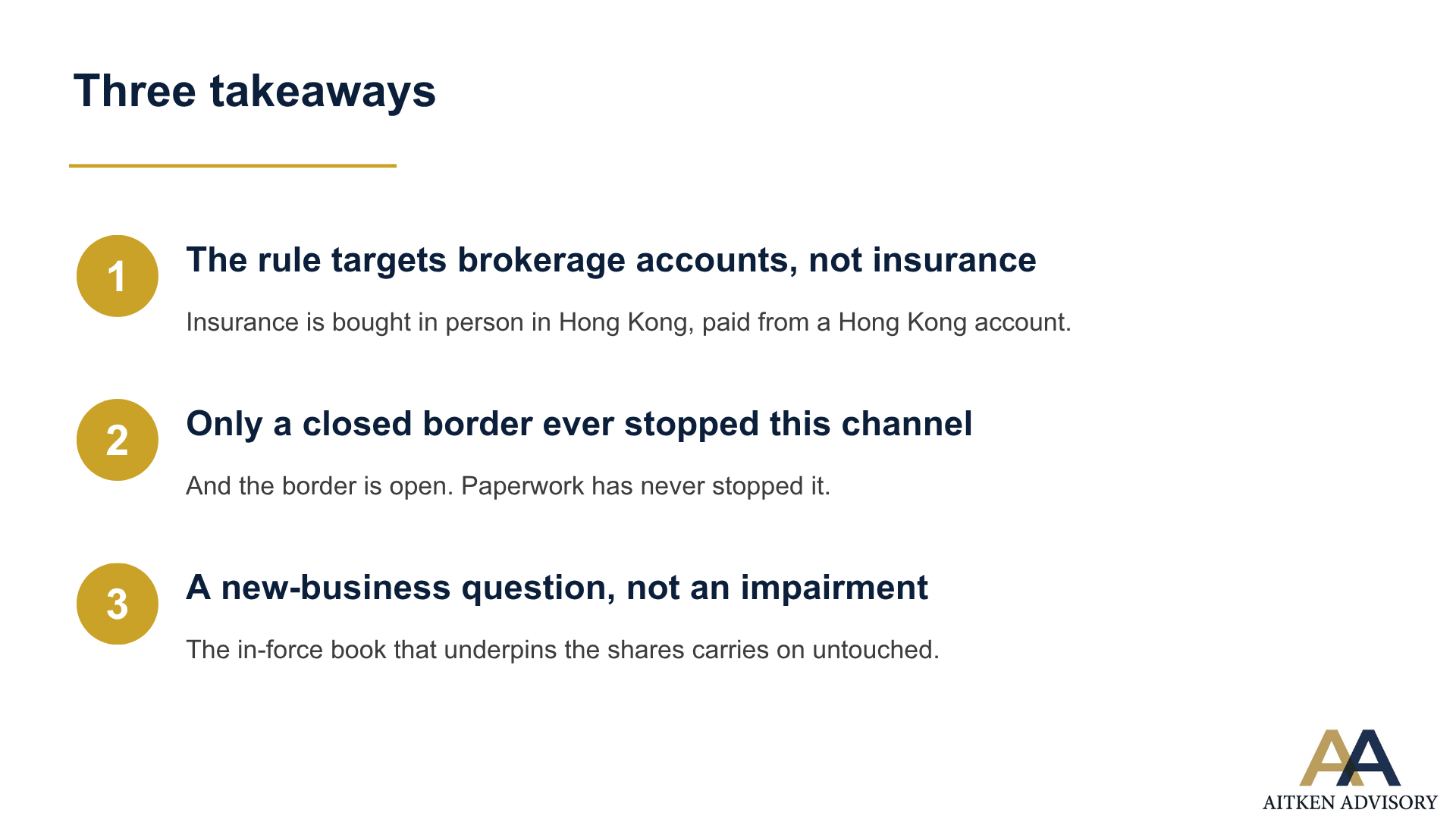
The market has taken a new-business question and priced it as an embedded-value impairment, exactly as it has done repeatedly in the 30 years I’ve been looking at the sector. AIA and Prudential have each shed roughly a sixth to a fifth of their value over a threatened slice of future sales worth about 21% of one year’s new business, of which only the investment-linked portion is even arguably in scope, while the in-force books that actually support the shares carry on untouched.
The people closest to the situation appear to agree: Prudential has kept buying back stock daily through the fall, and chair Sir Douglas Flint bought 12,000 shares on 5 June, and 12,500 shares on 11 June. AIA’s fall had a technical accelerant too, its buyback completing this week as shorts leaned into the vanishing daily bid. At the lows the market was valuing the mainland visitor stream at close to zero in perpetuity, having removed roughly £21bn of combined market value, and AIA and Pru’s small bounce in the last couple of days suggests that arithmetic is starting to be done.
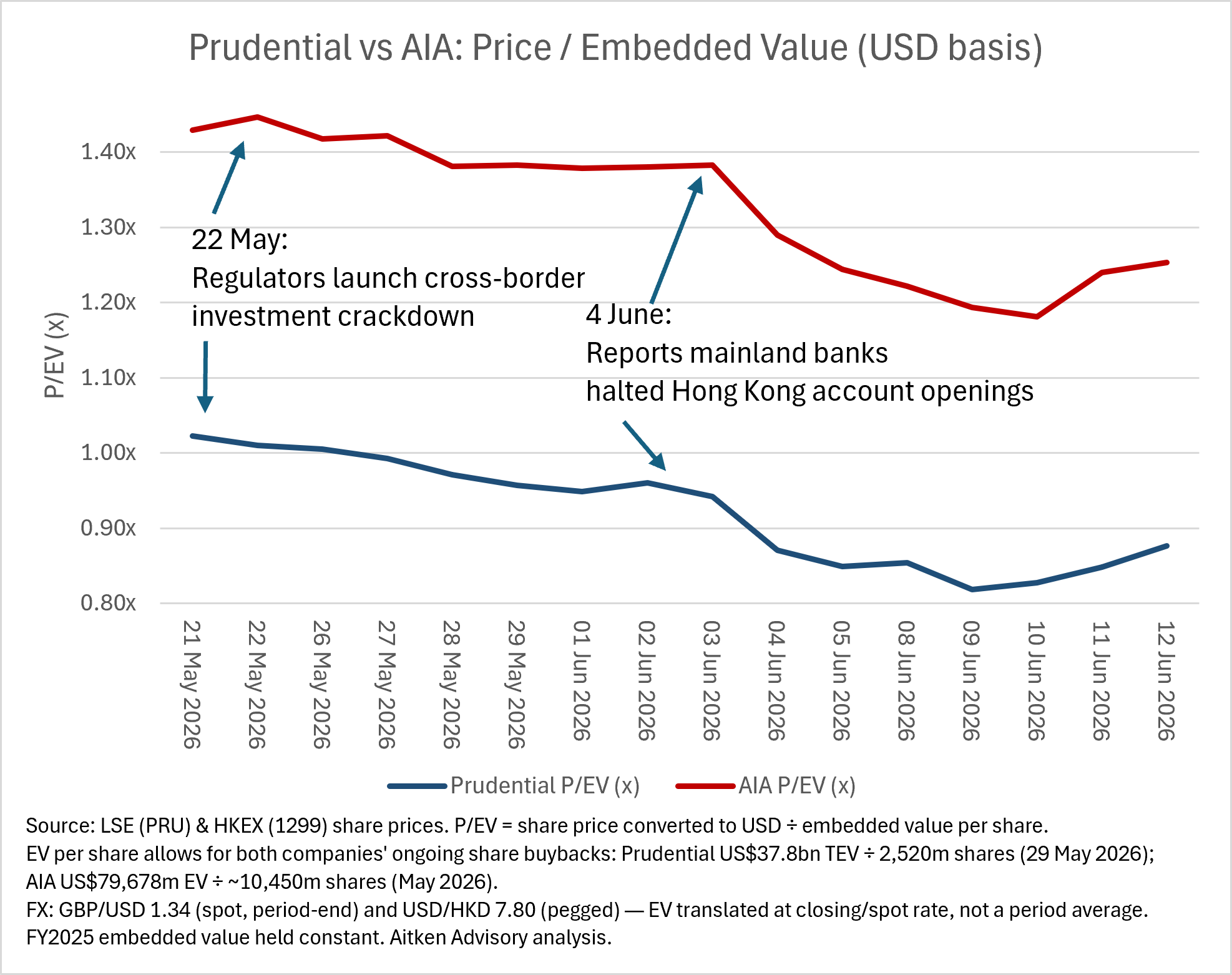
Both AIA and Prudential have been caught in the same downdraft: roughly £21bn of combined market value gone at the lows, on peak-to-trough falls of 17% and 20%, around £13-14bn of which is still off the table as I write. As the price to embedded value chart near the top of this article shows, both now trade at multiples of embedded value that look undemanding set against the growth ahead and the double-digit returns they earn on that embedded value. Neither looks expensive by its own history.
I am not here to tell you which to hold; on these valuations both are attractive for the same reason. The point I hope this piece has made is simpler: the sell-off looks like an over-reaction to a rule that never touches the policies these companies actually sell, and the people closest to the businesses, a chairman buying with his own money, a buyback running daily through the fall, appear to think the same.
Gordon Aitken runs Aitken Advisory, providing strategic advice on life insurers and pension funds. I work with investors, insurers and advisers on transactions, capital strategy and market positioning. As I did throughout my sell-side career, I meet fund managers and investors for one-to-one briefings on the sector. If you would like to arrange a briefing or discuss a potential engagement, click the button below to email me.
Want a deeper dive on UK life insurers, annuity balance sheets, and why markets often misprice them in stress? That is the core theme of my book, Breaking Down the Insurance Black Box.
Disclaimer
The content of this publication reflects my personal views only and is provided for information purposes. It does not constitute investment advice or investment research, and I am not acting in the capacity of an investment adviser. I own shares in some of the companies mentioned. Readers should carry out their own analysis or seek professional advice before making any financial decisions.
If you found this post helpful, feel free to share it with colleagues or subscribe for future updates on UK life insurers and pension funds.
No posts
Comments
Nothing yet. Say the first thing.
Sign in to join the conversation.