

When I walked into Micron in 2021, they were about to announce the largest private investment in New York State history.
$100 billion. 50,000 jobs. A genuine national security story.
And their content looked like this:
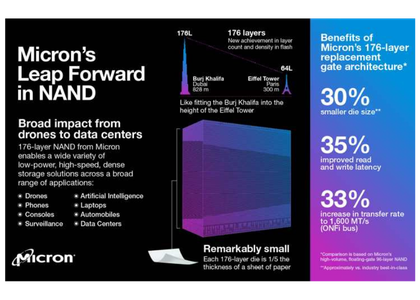
I’m not going to be gentle about it. It was dense. It was produced by smart, dedicated people who understood semiconductors deeply, and their audience not at all.
They had:
The most important manufacturing story in a generation
A CEO with a genuine point of view
A mission that touched national security, American jobs, and the future of AI
But they had a classic brand narrative problem.They had all of the elements they need. But they had a new audience, and they had no one to identify the story to them and how tell it well to them.
This is what was happening at Micron (and I’d bet serious money it’s happening at your company right now):
They were writing for the people who already understood them.
Every press release assumed you knew what DRAM was. Every announcement led with “leading-edge memory manufacturing” and “advanced process technology.” Every piece of content was, to use my new favorite phrase, technically accurate and emotionally inert.
This mistake kills enterprise-level communications. Companies mistake what matters internally for what resonates externally. They lead with the specs, the features, the tech, when they should be leading with the human implication.
Nobody cares about 600,000 square feet of cleanroom space.
They care about 50,000 jobs. They care about American manufacturing. They care about not being dependent on foreign supply chains for the chips that run everything.
Same company. Same investment. Completely different story.
When I dug into why Micron’s content wasn’t landing, it came down to three things (and I see all three everywhere):
They were making themselves the hero. Every piece of content centered on what Micron was building, what Micron was investing, what Micron was achieving.
The audience (communities, policymakers, workers, the American public) was an afterthought. Brands that make themselves the hero always lose the audience. The
customer is the hero. You are the guide.They had no tension. A $100 billion investment in American semiconductor manufacturing in the middle of a national security crisis is one of the most tension-laden stories imaginable.
But it was all getting flattened into press releases. No stakes. No uncertainty. Nothing to make it tangible to their new audience. Without tension, you don’t have a story. You have an announcement (booooringggg.)They had no specific true detail. “Leading-edge memory manufacturing” could be anyone, doing anything, anywhere.
“We produce less than 2% of the world’s DRAM chips, and we’re going to change that.” That’s a story. Specific. True. Hard to ignore.
Filling this gap was ultimately my job. Once we understood the autopsy, we stopped talking about the product and started talking about what the product made possible for our new audience.
First of all, we knew this audience was going to have a lot of influence on policy that determined the future of the semiconductor industry. Second, we knew they were not tech savvy AT ALL. Like, cannot-open-a-PDF level of non-tech-savvy.
That meant that we needed to both educate them about what semiconductors did AND make it clear why it was interesting/important enough to pay attention to at a policy level.
We ran an extremely targeted geo-fenced campaign and focused on writing as clearly as possible for these individuals.
Less “advanced process technology.” More “the chips that make AI possible. The chips that power your phone. The chips that keep military equipment running.”
Not “600,000 square feet of cleanroom space.” But “50,000 jobs in Central New York.”
Not “CHIPS Act compliance.” But “America is rebuilding something we almost lost.”
The results: a public case strong enough to help secure up to $6.44 billion in CHIPS Act funding, $5.5 billion in New York state tax credits, and $65 million in dedicated workforce funding. Alongside that: a 150% year-over-year increase in social following and a 25% improvement in organic SEO — proof the broader public was paying attention too. But
You are probably not building a $100 billion semiconductor facility.
But I guarantee you are making at least one of these three mistakes.
You are making yourself the hero. You are stripping out the tension. You are hiding behind jargon when a specific true detail would do more work than any campaign you’ve ever run.
I know this because these are not Micron mistakes. They are brand mistakes. I’ve seen them at Nike, at Providence Health, at adidas, at scrappy startups with twelve employees and a product that could change everything.
The size of the company doesn’t matter. The pattern is the same.
The point of all this is that the Micron problem isn’t a Micron problem.
It’s yours. It’s your competitor’s. It’s every company that has outgrown its storytelling and doesn’t yet know it.
One week. Discovery, development, delivery. A narrative your team can use across every deck, campaign, and conversation you’ll have in the next year.
And the clarity you’ve been circling for months.
The $300,000 skill is knowing what story you actually have and being ruthless enough to tell it.
If your team has felt stuck, directionless, or just busy with no results, we need to get you back in the storytellers seat.
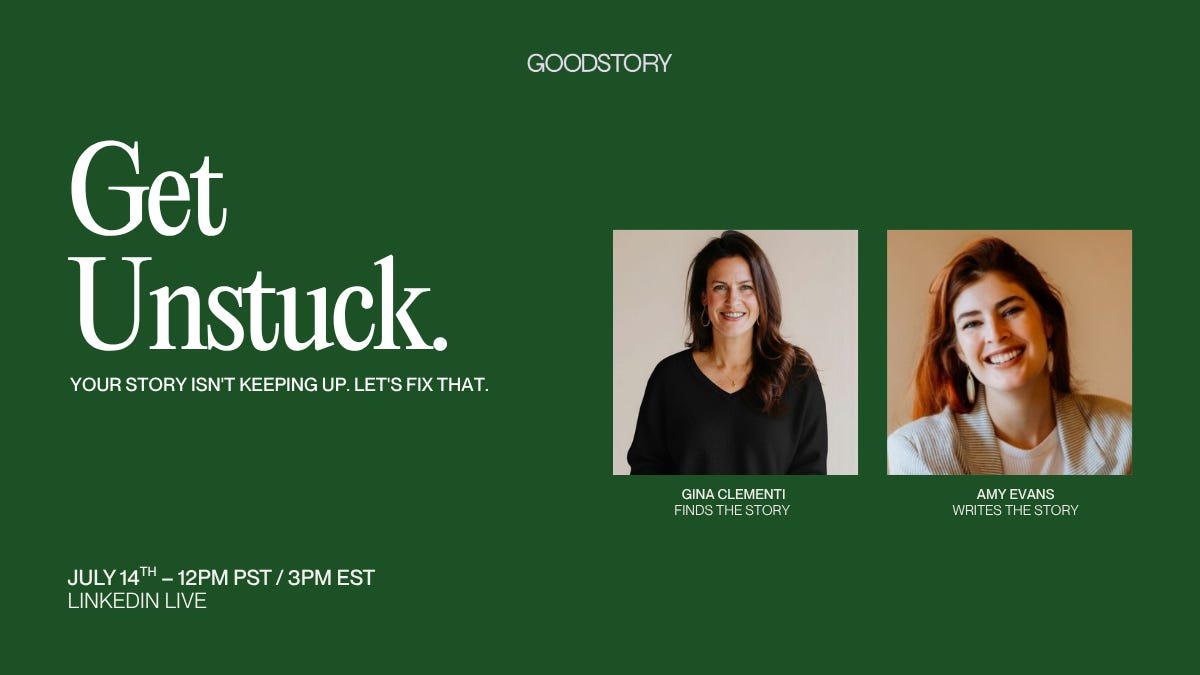
On July 14th, we are hosting a free one-hour LinkedIn Live workshop — Get Unstuck: A Brand Narrative Workshop — for founders and marketing leaders ready to use their story to fuel the next stage of growth. Join us!
Comments
Nothing yet. Say the first thing.
Sign in to join the conversation.