
This essay was originally commissioned for Good Sport Issue 06 - which is still available. And, if you’re any what way connected to Good Sport, you’ll know we just launched Issue 07, with some noise over on our Instagram account - and we flew all the way to Paris to host the launch event.
Melissa McCarthy is a writer based in Edinburgh, Scotland. She first came to our attention after we saw her wildly interesting project* Sharks, Death, Surfers: An Illustrated Companion (Sternberg, 2019). See sharksillustrated.org for more.
You can see more of Melissa’s work over at Exacting Clam too.
On the eve-eve of the World Cup Semi-Finals, there’s a lot of pent up worry, concern? confusion? around the VAR (Video Assistant Referee) and it’s ability to actually work correctly.
Anywho, this essay by Melissa is about some children's football dispute, a rubbish bin, and the strange thread connecting Roman entrail-readers to VAR.
Enjoy.
By Melissa McCarthy
My son got heavily into football when he was eight. I was pleased about this, as I also like to play, and it gave me the opportunity to spend time kicking about in the park with him.
He took to playing before school, every play-time, all through lunch. Then he’d come home and report on the day’s action and new skills. I liked this, too, as I think of sport as something that, while it’s great to do—in the moment, immersively—it’s not reaching its full potential until you add the media/mediated layer of re-telling the event to someone: re-enacting your greatest moments from the match or the wave, how you moved through space and time.
My son and his classmates had a playground pitch, with little goals sculpted out of the fence and random, multi-coloured marking lines. They’d pick the teams, and devise their own solutions for responding to, say, the ball going onto the nursery roof, or to tantrums, or a lost tooth. Most of their footballing activity was based on the established rules, while some had roots in improvisation and adaptation. Quite a lot (I saw this for myself when I began running after-school coaching) relied on imitation and copying—the way they’d seen players on TV manoeuvre, score, and, particularly, celebrate goals.
The kids were tapping in, here, to French sociologist Roger Caillois’ theory of games (from Les Jeux et les hommes, 1958), to his idea that they can be divided into agon—competition, and the kids certainly felt this strongly; alea—that the game is not fully pre-determined, but chance must play a role; mimicry—games can involve impersonation; and ilinx—there can be vertigo, a falling. (French theorists do infiltrate sport; just ask Eric Cantona.)
Caillois identifies six characteristics of play, too: that it’s freely done, in a time and space outside the normal routine; it is of uncertain outcome, and economically unproductive; there are rules, and it’s distinct from real life. I like the interplay between rigidity and expansion, both as described in Caillois’ work, and in the way the children interacted: they agreed together that there are strictures they will all follow, but they can vary them, making the game different or bigger.
One of their elements at first puzzled me. “There was a fight about a goal”, explained my son. “So, we went to look in the bin…”
“Why did you do that?”, I asked, “Had someone put the ball there in a temper?”
“No”, he explained, “That’s what we do if there’s an argument. We look in the rubbish bin.”
This grabbed my attention.
“Why do you look in the rubbish?”
“Because that’s how they do it with the VAR.”
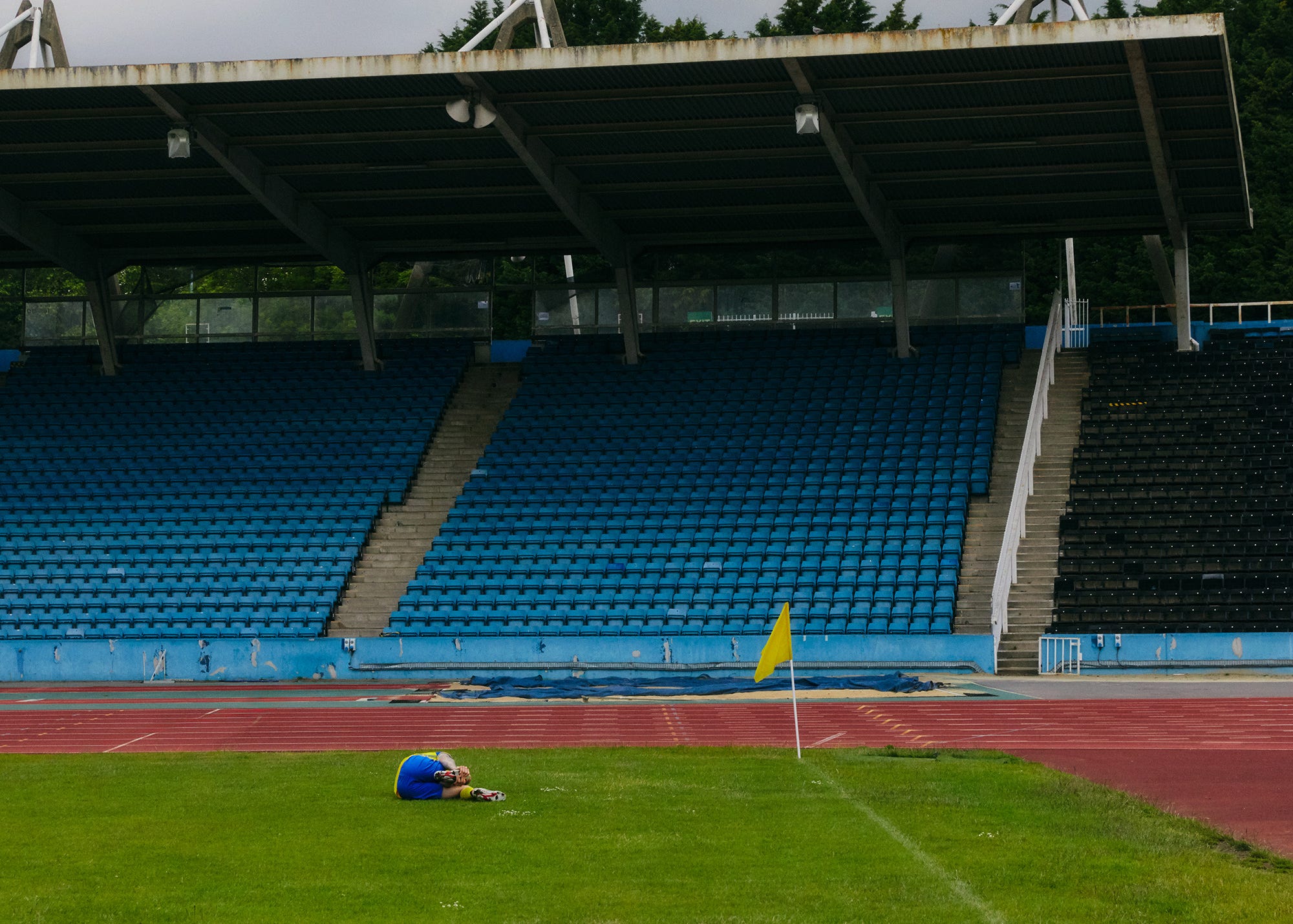
You’ll be aware that the Video Assistant Referee is a technology used in high-level football, whereby the on-pitch referee can check something that’s happened. I’m distinctly uninterested in VAR in relation to its efficacy, or perhaps its ruination of the game; these things come and go. I do like the way that it presents a dispersed media arrangement, with communication flowing between the ref on the pitch; the VAR team watching their bank of screens; the players; the spectators in the stands; the commentators and remote audiences. When things go wrong, later investigators can replay the moments of utmost confusion, as though the media centre is the black box recorder of a crashed plane.
And I am very interested in the fact that my son and his friends have latched onto this media/re-enactment/object-based aspect of the game, to incorporate into theirs.
What they are copying is the action of the ref watching back footage using the Referee Review Area, which is a monitor on the side of the pitch. The exact configuration varies by venue – it might be a screen on extendable arms that he pulls down, or a laptop on a table. Quite often there’s a hatch, with protective sides - a cowling that he sort of leans into.
I can see why the bins in my son’s playground fit the bill for this – they are tall and solid, with a rectangular aperture, and a black, moulded-plastic frame, to post the rubbish into. The children aren’t very tall. They rush up, square-gesturing, then hold onto the top sides of the bin, poke their heads in and stare at the sweet wrappers, broken pencils, and whatever else has ended up inside rather than littered around the playground’s edges. The detritus and the Lego brick-olage. They’re performing the outward patterns of the sport/media ritual perfectly, reading from the receptacle’s depths an interpretation of what has happened before. Then they extract themselves, announce the decision, the other kids concur and the game goes on.
It’s funny, this suggestion that VAR is a load of old rubbish. As is the way that they bring in their beyond-the-pitch performance as part of the broader experience. But it also set me thinking of an arena that I first learned of at around his age, one that I think a lot more about now. Which is, prophesy: the practice of soothsaying, looking for clues. Their grubbing about in the bins reminds me, particularly, of the Roman figure of the haruspex, who examines what we’d think of as gross, discarded stuff—the entrails of sheep and birds— in order to offer an interpretation of the present, a position on how to proceed.
There’s a confusing range of ways the Romans engaged with divination. While the haruspex received information from body parts, the augur had the slightly different task of looking upwards; at the flight patterns and behaviours of birds. The augur’s role was to provide auspices, or readings, that answered a specific request from the magistrate about the state of play: who should captain the army, is this a good plan. This auspice is the deliberate, sought-for reply, but there was also a second type of response an augur could receive, called the oblativa. These messages arrived unexpectedly, un-called-for, and they answered a different question entirely to the one that had been asked, sneaking in just when the augur was debating the main problem, consulting over possible decisions. They were a more rogue manifestation of sign and meaning to interpret. Indirect.
Or, going further back, there’s the oracle in the Greek tradition, who resides in a specific precinct and delivers the god’s pronouncement. The Athenians, for example, could travel to Delphi to consult the Pythian oracle there. The UK Premier League makes do with the VAR Hub at Stockley Park, just outside the M25. Either way, the oracle will issue a reading, after staring into a cavity from which the information emanates, but it’s still then up to the actors, the players, us, to consider the statement, decide how to respond, what we’ll do to bring about (or avoid) the decreed future. A quick re-vision of the past allows a decision on what will happen next.
I find it touching with the little kids because of just this combination of potentiality and immediacy. They’re dashing round—pass, turn, receive—busy, and dizzy, inhabiting their small bodies. And I can see the space they might move into: becoming adults like me who still play, and to some extent shape our lives around, football, though we are ancient. They’ll grow up (barring accidents, things going far wrong), and grow out of this particular game zone. So much of their characters, their opportunities, though, are already set; you can see that by how they behave and besport themselves aged eight. Their adult selves are here, inscribed, interpretable, though they’re open to review; and chance will have a role. But something—the future, perhaps?—has been set in motion.
That’s a goal. Play on.
Comments
Nothing yet. Say the first thing.
Sign in to join the conversation.