
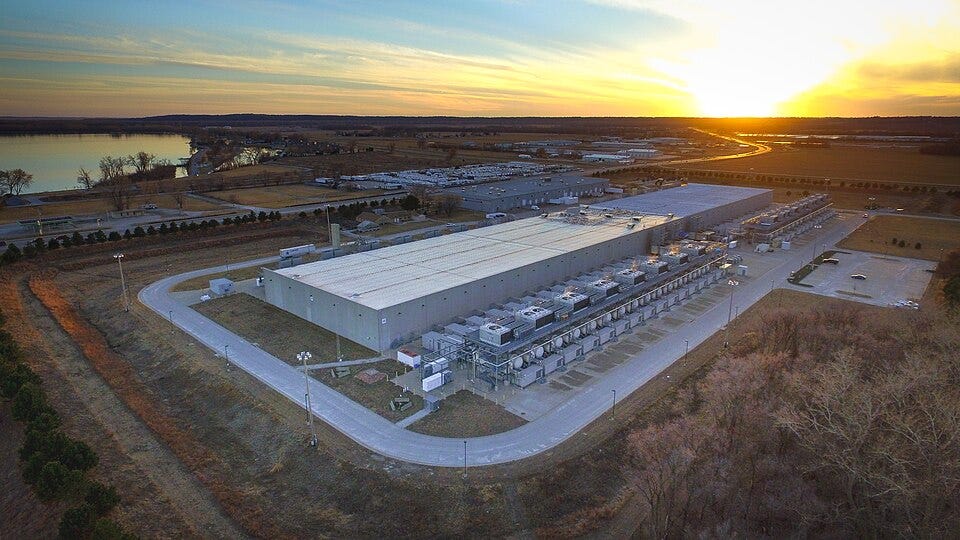
Vermont’s Legislature passed the “Vermont Sustainable Data Centers Act” this week, sending it to Governor Phil Scott to sign or veto. The measure passed 26-3 in the Senate and by a nearly unanimous voice vote in the House, according to those present for the vote. But a late change to the bill caused the Department of Public Service—a key agency of jurisdiction—to oppose it, making the Governor’s looming decision uncertain.
No AI data centers have yet located in Vermont, although one developer apparently explored a potential site in Saint Albans, so the bill was an attempt to proactively create a strong regulatory framework and prevent problems that have cropped up in other parts of the country where data centers have been built under looser laws.
The bill creates a new set of standards that any data center that uses more than 20 MW of electricity at a time must meet, with a goal of preventing some of those harmful impacts, which include sharp increases in electric bills for other customers; huge demand for water and potential pollution of ground and surface water; and both climate and local air pollution due to the increased use of dirty sources of electricity to meet the new demand.
The bill sets up a system of review by both the Public Utility Commission (PUC), of a proposed data center’s impacts to energy reliability and other ratepayers, and by the Act 250 regulators, of its environmental impacts.
Environmental organizations who testified on the bill hailed its passage. “Vermont legislators just sent a clear, tripartisan message: the data center industry will be held to a high standard here - Vermont’s ratepayers and environment and the climate are too important to accept any other outcome,” Ben Edgerly-Walsh of the Vermont Public Interest Research Group said in a statement.
Yet there are still areas of weakness in the law. Let’s look at how the bill tries to address each of the problems that have plagued data centers elsewhere—and what gaps remain.
Energy prices
To prevent a data center from increasing costs for other ratepayers, the bill requires any proposed data center to sign a special service contract with the local electric utility, with terms to ensure that the data center bears all the of the utility’s additional costs to provide it with electricity—including generation, transmission, distribution, and capacity charges. The contract must have a minimum term of at least 10 years and the data center developer will be obligated to pay a minimum amount to the utility each of those years to prevent a situation where the data center pulls up stakes, leaving the utility with a bunch of stranded costs.
Much of the potential cost to other ratepayers from a data center results from the data center adding to peak demand on the electric grid. The different parts of the grid—including generation and transmission—are constructed to handle projected peak demand, with some room to spare. This means that much of the time, there’s some “slack” in the system—plants sitting idle, transmission and distribution lines carrying less power than they are able to. If a data center were simply taking up this slack, it could potentially benefit other ratepayers, as the data center would be paying for a share of the utility’s fixed costs. But given their size and the fact that they run almost 24/7, data centers often increase peak demand in a region, meaning new power plants and/or transmission lines and substations must be built specifically to serve them.
In addition to bearing these new costs, the bill requires data centers to adopt “demand management” infrastructure and practices to help reduce their contribution to peak load. These include on-site renewable energy generation and battery storage, to the greatest extent feasible, and participation in a “virtual power plant” through which those resources share power with other nearby power customers during periods of lower demand.
The “large load equity service contract” required by the bill is a modified version of an approach numerous other states have taken. In those states, the legislature or utility regulator created a special “large load tariff”—a preset rate for electric service and other terms—that would automatically apply to any qualifying data center. Utah is another state that has followed the contract—as opposed to tariff—model, but it may be the only one.
As introduced, H. 727 required the PUC to design a large-load tariff for data centers, but at the PUC’s request, the drafters switched to this contract model. The PUC will still review each large load contract to ensure it serves the public good, provides an economic benefit to Vermonters, preserves stability of the electric grid, and meets a number of other (pretty general) standards.
One of the Senators who worked on the bill, Senator Anne Watson (D-Montpelier), said she thought this contract approach was warranted. “I think it is absolutely appropriate for them to be considered individually,” Watson said, adding, “if you just have a one-size-fits-all tariff, I think you may be losing opportunities to potentially improve the grid, or … to have [the data center developer] pay appropriately for their impacts.”
With freedom to design different structures, utilities and developers could conceivably find creative and cost-effective ways to ensure the goal of full internalization of costs by the data center.
On the other hand, the approach carries a couple risks.
One is that the bill doesn’t actually require the PUC to find that the contract insulates other ratepayers from new costs—it says the contract shall do that, but it’s not one of the PUC’s required findings (I may be over-parsing here; it’s an occupational hazard of an ex-lawyer).
Even if the PUC does review the contract to make sure it insulates ratepayers, it will essentially be looking at different blueprints each time to see if they add up to the same structure, namely a set of rules and rates that prevent data center costs from being passed on. That analysis will feature many judgment calls in each review on potentially complex and novel contract terms.
Another risk is that a smaller utility may be at a bargaining disadvantage with a data center developer. Vermont has many such smaller utilities, owned by municipalities or their members.
To overcome their small size, these utilities purchase power through one larger agency, the Vermont Public Power Supply Authority (VPPSA). Rep. Laura Sibilia, the bill’s lead sponsor, speculated that if a data center wanted to locate in the service territory of one of these utilities, VPPSA might get involved in those negotiations as well, and that in any case, the PUC review would act as a backstop.
“We do have some smaller [municipal utilities], but they do have to engage and have their planning approved by the Department [of Public Service] and have to engage with the PUC,” Rep. Sibilia said. “So, I feel okay about it. We’re not going to get a data center sneaking into the state.”
II. Water usage and pollution
Most of a data center’s water usage comes from cooling servers via evaporation. To limit water usage, the bill requires any data center to use a “closed loop cooling system”—one where any water that evaporates is collected and used again—or an alternative, like air cooling, which uses less water but more electricity. The developer must identify their chosen system as part of the Act 250 process and obtain any permits for water withdrawals and discharges from the state’s environmental regulator.
Such closed-loop systems often use chemicals in gaseous or liquid forms—including, in some instances, the component chemicals of Per- and polyfluoroalkyl substances (PFAs)—as part of the cooling mixture, which leads to fears of potential pollution—especially when the EPA is fast-tracking review of new coolant chemicals.
The bill establishes strict limits on any PFAs in water discharged by a data center. But it does not contain special limits on the use or discharge (beyond those included in the permits a data center would need to obtain) of any other chemicals. Nor does it explicitly address what would happen if a data center tried to claim that the chemical cooling mixture it planned to use was proprietary information and therefore confidential, which has happened elsewhere (fracking flashbacks, anyone?).
Rep. Sibilia acknowledged that more might be done to improve transparency in furture sessions: “I’ll be stunned if we don’t come back to this area of policy in the next biennium,” she said, and also added, “it is our intention that these [permitting processes] are transparent… We are also, like the data center developers, moving quickly. And so, I think we will have an opportunity to further reflect if we have enough in here in terms of transparency, and refine [if needed].”
III. Climate and air pollution
Last, a data center’s climate and local air pollution mostly comes from burning fossil fuels to provide the massive amounts of electricity it consumes. Such combustion might happen in a power plant on or off site or in smaller diesel or gas generators. In some places, these supposedly “backup” generators have run around the clock, leading to lawsuits and investigations.
Vermont has a strong renewable energy standard (RES) that requires utilities to source 100% of their power from renewable sources by 2035. This RES would apply to the power a utility provides to a data center as much as any other customer, and a data center cannot, under the law, independently source its power from off-site generators to work around the RES. However, even under the RES, utilities can still use “Renewable Energy Credits” to offset ongoing reliance on dirty sources of energy.
“It’s not clear that…even with the RES that, you know, the siting of a new data center is not supporting fossil fuel generation somewhere else in this country or contributing to that,” Rep. Sibilia acknowledged.
The bill addresses this gap by requiring a data center to build as much on-site renewable energy generation and battery storage as is “technically feasible.” It also says that data centers can only use fossil fuel burning mobile generators in true emergencies, such as power outages or other disruptions to supply. And it requires a data center to build a system to share waste heat with neighboring buildings, potentially helping reduce emissions from heating in those buildings.
Yet the bill includes “thermal energy plants” in the category of renewable energy, which I believe likely would include a woody biomass plant that produces both heat and electricity (and air pollutants).
The Senate also added on the senate floor another provision that could help counterbalance any remaining greenhouse gas emissions from a data center. The provision requires the data center to pay a hefty amount to support “energy transformation projects” offered by Vermont’s energy efficiency utilities and electric co-ops: things like replacing a gas-powered boiler with a heat pump water heater, or installing a level-2 electric vehicle charger at home. The provision directs that the funds from the data center support such projects chiefly in the communities around it, providing some direct benefit to those most impacted by the data center.
The Department of Public Service opposed this particular provision, calling it “extraction of cash from prospective Vermont businesses,” and said it was enough to make the Department oppose the law entirely. That fact made Rep. Sibilia cautious about predicting whether Gov. Scott will sign a measure that achieved broad support across parties in the statehouse. “It’s very hard to read the tea leaves sometimes,” she said.
The legislature is set to wrap up normal business this coming week, although sources said a veto session to address vetoed bills could come later in June.
No posts
Comments
Nothing yet. Say the first thing.
Sign in to join the conversation.