

What if a history exam wasn’t a test — but a digital product? At Colegio Informático San Juan de Vera in Corrientes, Argentina, that question became reality in 2025, as part of our school’s AI innovation initiative, Vera IA Lab.
In the 4th year History class, students were challenged to move beyond traditional assessments. Their mission: transform their research on the Cold War into fully functional, interactive web platforms — using HTML, JavaScript, and CSS, supported by AI as a creative and technical co-pilot.
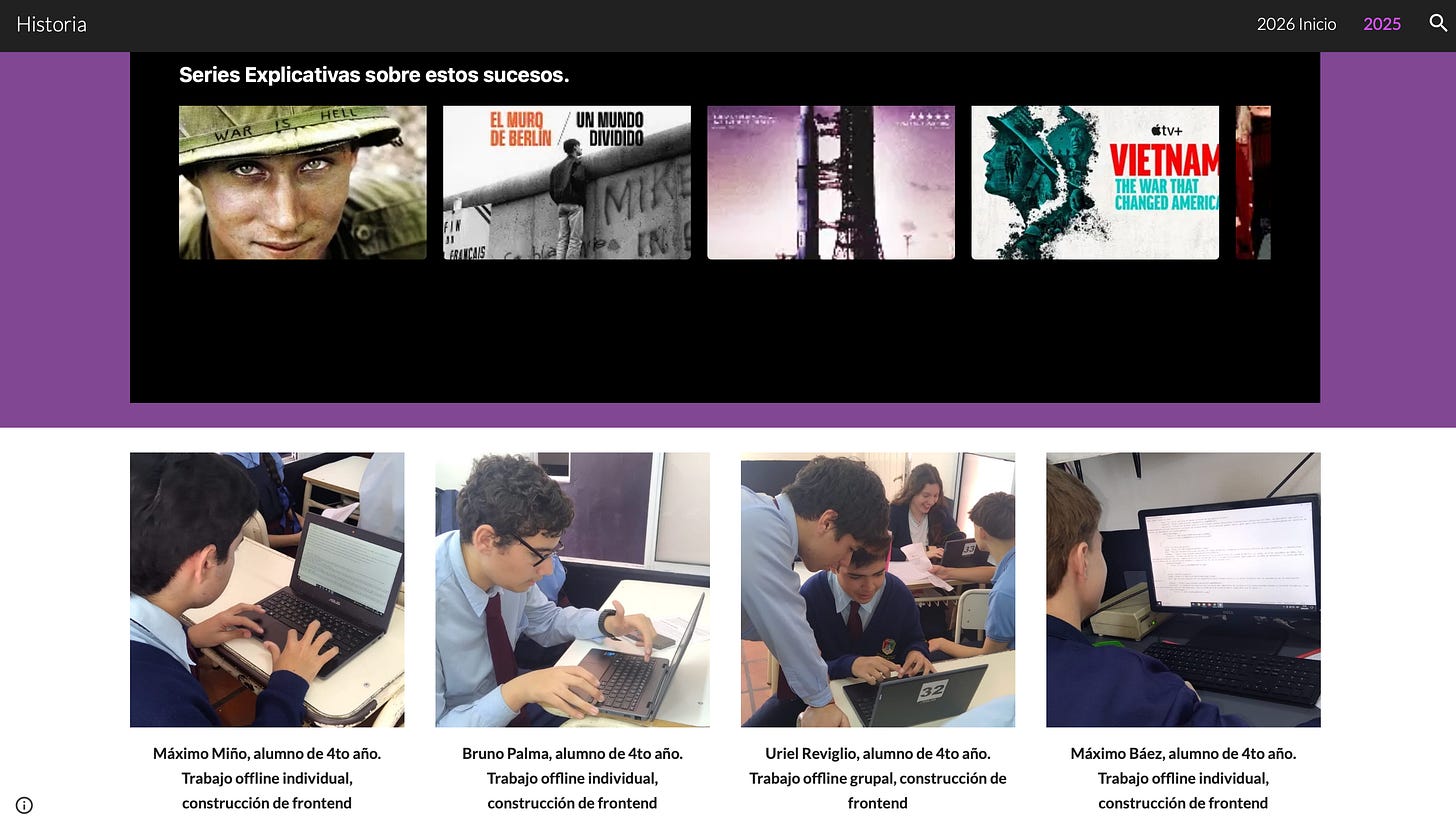
The Challenge: From Passive Learners to Digital Builders
The project, called “From Source to Frontend” unfolded in three stages. First, students conducted deep historical analysis of primary sources, identifying key events and multiple perspectives on the Cold War. Then, guided by a model frontend provided by the teacher, they designed their own digital interfaces — think streaming-style platforms where history becomes visual and navigable. Finally, using AI assistance, they brought their timelines to life through branching narratives inspired by the historiographical concept of Braudel’s multiple timeframes.
This wasn’t just a tech exercise. It was a rethinking of what assessment can look like when we trust students with real tools.
AI as a Learning Partner, Not a Shortcut
One of the most important aspects of Vera IA Lab’s philosophy is that AI is used to amplify critical thinking — not replace it. Students interacted with language models to troubleshoot code, generate interface ideas, and explore historical “what ifs,” but the intellectual work — the analysis, the argumentation, the design decisions — remained entirely theirs.
The results were remarkable. Students who had never written a line of code produced polished, navigable web projects. More importantly, they reported deeper engagement with the historical content itself. When you have to explain the Berlin Wall through interactive branching timelines, you understand it differently.
What Vera IA Lab Means for Our School
Vera IA Lab is the institutional framework through which Colegio San Juan de Vera integrates AI pedagogy across subjects — not just in technology classes, but in History, Language, Science, and beyond. It includes teacher training, curriculum design support, and a shared commitment to ethical, evidence-based AI use in education.
We believe the future of education is not about humans versus machines — it’s about designing learning experiences where technology serves human curiosity, creativity, and connection. The Cold War project is one small proof of that vision.
Comments
Nothing yet. Say the first thing.
Sign in to join the conversation.