
Our couch was enormous.
It wasn’t just a place to sit and watch T.V. It was upholstered geography, a vast yellow landscape plush enough to lose myself in. When I was small, I’d worm myself under the cushions and tunnel my way into any kind of make-believe. If I was sulking, I’d curl into a corner and pretend I was tucked into the crook of Ah Chan’s arm.
Ah Chan was my family’s ahma. In Hong Kong, where I was born and lived until I was nine, an ahma is more than just a housekeeper. An ahma does everything for you. Smiley-faced and fifty-something, Ah Chan was my family’s everything.
She and I didn’t get to say a proper goodbye in the days between my father dying in a smashed-up Toyota and my being swept out of Hong Kong forever. At least, I don’t think we did. The sliver of time between his death and my vanishing into Texas is blank.
My memory of Hong Kong before his accident isn’t much better, just a few fleeting scenes. Maybe more than a few. It’s hard to tell because they’re all torn to pieces. It’s as if the first nine years of my life exploded, leaving specks of confetti suspended midair, snippets of celluloid, shimmering, vivid but mute, all beyond reach.
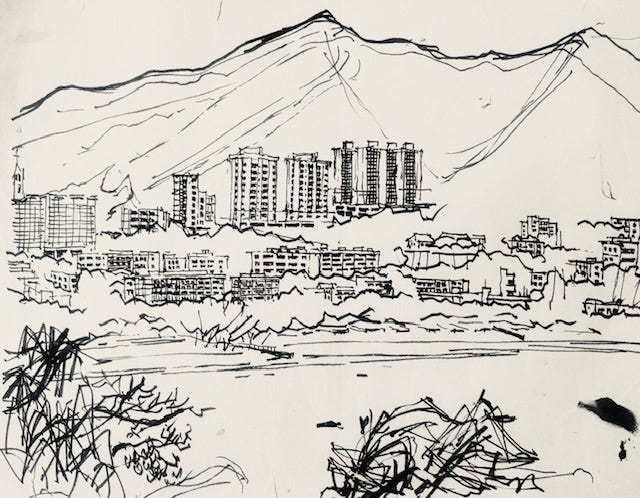
My family lived in Repulse Bay, an enclave on the quiet side of Hong Kong Island. In the 1960s, the coastal community was a respite for expats, executives, and the lazier waves of the South China Sea. It was a remote haven distinguished by a glassy blue building that dwarfed the smaller white flats dotting the coast.
We lived on the second floor of one of those sugar-cube blocks. Our home was a broad lip of balcony with a kitchen, living room, and bedrooms attached. From the day I was born, my window onto the world was a rectangle of untroubled paradise, each day as easy as the one before it, right up until the day a man called Dad disappeared.
Everything I know about this enigmatic parent is rooted in anecdotes. He was drunk when he skidded into a bus, in the dark, in the rain. They say he was impaled on a spike of twisted steel. True or not, once you hear a story like that, it’s hard not to picture your favorite parent dangling from the tip of a monstrous toothpick.
My mother becomes Mum in a collision of high-heeled shoes and overcooked eggs. Here’s how I still see it:
My younger sisters, Abbey and Louise, and I are seated around the breakfast table before school. Abbey sits high in her chair, smearing the tray with jam-sticky hands. Louise is her usual quiet self, staring at the sea beyond the window, fiddling with her stringy, yellow-white hair.
Ah Chan slips into the room, carrying two plates of eggs. She wears a white tunic, black trousers, and grey fabric shoes. She sets the plates in front of Louise and me. Outside, a car crunches over gravel. Exotic birds squawk.
A stiletto steps in from the hall.
Mum, a raven-haired beauty, as a man in a movie might have described her, splices awkwardly into our mellow morning. She circles the breakfast table, silently concerned about the milk and the tea. I’m struck by the emerald sheen radiating from her dress. An arm, the color of hazelnuts, glides over my shoulder to straighten a knife, then sweeps the tablecloth clean. A constellation of breadcrumbs tumbles to the floor.
Then it happens: that small, sharp thing. Mum’s pupils shrink fast, like an afternoon shadow moving quickly over stone. She zeroes in on our boiled eggs, their tops lopped off, ready to eat. “The yolks are hard,” she tells Ah Chan. “That’s what the toasted soldiers are for.” They’re for dipping. Thin strips of toast lie beside each egg cup.
Mum’s fingers scissor the air. Ah Chan lifts our plates and carries them away. Mum circles the table again, then stops to my right.
But I’m wrong.
Mum didn’t wear stilettos that morning or on any other day. I’ve insisted upon this image, fragments of fiction bound up with traces of fact, collateral damage in the crush of time. My mother likely wore a plain cotton dress on that ordinary day. That, and a pair of sandals, clasped with a buckle made of metal and rope. She was elegant, though, that much is true. Whenever she entered a room, I imagined a bronze comet blazing through my thin yellow light. Equally icy. Just as remote.
Real or wrong, the day of the hard-boiled eggs has an end.
The evening air is balmy as I climb up to Ah Chan’s small rooftop home. From up on Repulse Bay Road after dark, her bedroom resembles a cherry plopped on top of a silhouette cake, thanks to the amber glow from a window that bleeds into the night.
A zig-zag staircase is bolted to the back of our building. I hoist myself up, two steps at a time. Mum tells us to leave Ah Chan alone when she isn’t busy working downstairs. I do as I’m told, but not always. I like it up where she lives.
A familiar Chinese ballad buzzes from a transistor radio when I jump the final two steps to the roof. I tiptoe to the back of Ah Chan’s hut, skirt a corner, and peer inside. Her room smells of fish bones and rice. A puff of steam strains at the lid of a bashed-up pot wobbling over something that isn’t a stove. Ah Chan sits on the edge of her bed, cradling a bowl of soup. I want to slouch beside her, like I always do, but I don’t. I lean into her threshold instead and scratch the back of my head.
“I liked my eggs,” I blurt out.
Ah Chan looks up. Everything about her relaxes. Her knees. Her cheeks. Even her spoon. She places her bowl on the floor, pats the mattress beside her, gets up, and walks over to the simmering pot. I do as I’m told, lean back on my elbows, and sink into her bed. I scan a collage of pictures pinned around her room: an elaborate wedding, a serious young man, an array of ivy-smothered shrines. I’ve studied them countless times before, always astonished that Ah Chan has a life somewhere else, without us.
She hands me some soup. I peer into the shrimpy broth. A salty vapor moistens my nose. Ah Chan sits beside me and takes a noisy slurp. I do the same.
It poured with rain the night before I left Repulse Bay forever. But by morning, the storm had gone. The sea had receded for what looked like a mile.
Outside my window, the world is wet. Insects hiss. A bloated pig lies marooned, dead on the beach.
“Hurry up,” Mum says, striding past my bedroom door with the last of our luggage.
“I’m coming,” I tell her, then head in the opposite direction. I hoist myself up the zig-zag staircase one last time, huffing and puffing in trousers and a tie and sensible shoes. The roof is awash with the same plaintive song I’ve heard drifting from Ah Chan’s room my whole life, a whiny, woe-filled opera without end.
Ah Chan is sitting on her cot, her walls stripped of pictures. A suitcase sits at her feet. Her small, black radio is beside it. Unlike our flat below, which looks the same as it did last week and last year, Ah Chan’s once cozy home is packed up and gone. Her fingers fuss with something small in her lap. A cellophane packet tumbles through her fingers, crinkling with each turn. I recognize the hard candy inside. She gave us a box last Christmas. I ate the whole thing.
She hands me the packet.
“For you,” she says. “Sweets for the plane.”
I take it from her and shove it deep into my pocket, just as I hear my name called from below.
Downstairs, a slender man helps Mum into a navy-blue limousine. Abbey and Louise are deep inside, fidgeting. Mum glances over at me, willing me to hurry.
“Quickly!” she says, waving me on.
The engine’s running.
Comments
Nothing yet. Say the first thing.
Sign in to join the conversation.