
My wife Suzy is obsessed with Just Ice Tea.
It’s made by the people behind Honest Tea, which was insanely popular and got purchased by Coca-Cola in 2011. Coke later decided it had too many tea brands, and it spiked Honest Tea and kept some other brands instead, so the founders of Honest Tea resurfaced with this new brand that tastes pretty similar to the original.
Her favorite flavor of Just Ice Tea, the Half and Half (half lemonade, half iced tea), seems to be the most coveted and thus, hardest flavor to find at half a dozen shops we frequent. Whenever we go shopping, we look for the bottles with a half-lemon on them.
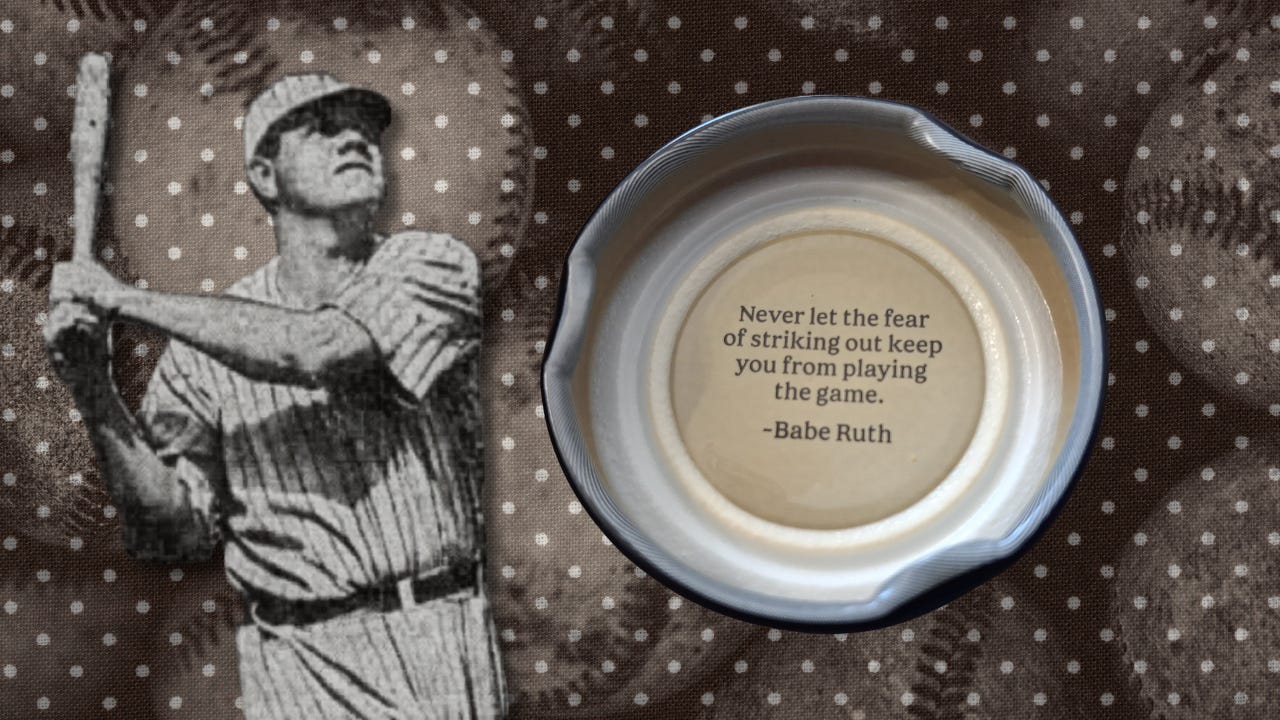
The quirky brand added uplifting quotes to the inside lids of the bottle caps, similarly to how Snapple has its “Real Facts.”
My interest was piqued by the quote under the lid of a recent bottle:
“Never let the fear of striking out keep you from playing the game.” -Babe Ruth
Beyond comparisons to the Michael Scott-Wayne Gretzky quote (you know the one),1 this supposed quote from George Herman Ruth, The Sultan of Swat, The Titan of Terror, The Colossus of Clout, The King of Crash, The Great Bambino, just didn’t ring true to me.
Babe was witty, yes. And he was quick with advice for kids.
But this sort of motivational pep talk language felt more apocryphal than real. Like it was the thing people wanted the Babe to say without being something he was accurately quoted saying.
My B.S. detector for false quotes has been finely tuned by investigating hundreds of quotations in my role as a book writer and editor.
Authors find the perfect quote online, plug it into their book as a chapter opening, and voila!
But is the quote real?
Did the person actually say it or write it?
When I look into flimsy quote origins, the trail often begins with newspaper articles in the late 1900s or early 2000s. Overzealous newspaper columnists or book writers added a quote in print, and then it got attributed to the famous person, got repeated into memory, and then it stuck due to the internet.
The first place I headed to check on the purported Babe Ruth quote was newspapers.com, especially since The Babe played at a time when newspapers were the surest way to preserve quotations.
If Babe gave this quote and it stood the test of time, it should be noted somewhere in the wake of him saying it.
A good comparison came in 1946, when Brooklyn Dodgers manager Leo Durocher was credited with the expression “nice guys finish last.”2
Leo the Lip was quoted at the time discussing the rival Giants, “Nice guys! Look over there. Do you know a nicer guy than Mel Ott? Or any of the other Giants? Why, they’re the nicest guys in the world. And where are they? In last place!”
While Durocher didn’t quite say the phrase the way it was remembered, it was pretty close.
Importantly, there is a trail linking the quote to its origin point.
That isn’t the case with Ruth’s attributed quote, which doesn’t feature a clear source.
In the years after Ruth’s career ended, people noted how he had struck out more than any other player, 1,330 times, at the time of his retirement.3
But the fear of striking out … not so much.
That started to shift in the early 1980s, after author and “Hour of Power” televangelist Robert Schuller included a story about the Babe in his 1981 book “Life Changers.” The story, “The Truth About Babe Ruth,” involves Babe striking out a few times in a game before hitting a home run.
As Schuller wrote, “Yes, Babe Ruth would never have become the Home-Run King if he had feared the failures of strikeouts!” Or, as National Enquirer summarized in a caption promoting Schuller’s lesson, “Babe Ruth never let the fear of striking out get in his way.”4
In the years that followed, the story shifted from the baseball legend not letting the fear of striking out get in his way to telling others not to fear striking out. Babe’s “quote” started popping up in commencement speeches and columns. Just remember what Babe Ruth used to say …
I checked other go-to quote sleuth resources, Google’s books page and Internet Archive, to see if the line was used in any books from George Herman Ruth’s life. I also downloaded a book by the Babe, an as-told-to tome about his life.
Struck out on all counts.
After doing hours of research, I didn’t find an original source for the Babe Ruth quote on the bottle cap.
Which bothers me.
It’s embarrassing and frustrating to see so many people tossing out phony quotes.
And yet, it happens all the time.
Especially in books. As a writer and editor, I regularly see manuscripts passing off flimsy quotes.
Each time, whether it’s Mother Teresa or Gandhi or Ben Franklin or Mark Twain or Helen Keller being quoted, I spend the time to separate truths from untruths.
This problem is only intensifying in the age of AI because Large Language Models hallucinate inaccurate or false quotes all of the time.
It’s exactly what happened for author Steven Rosenbaum with his aptly-named book “The Future of Truth.”
Rosenbaum included a mix of actual and fake, incorrect or hallucinated quotes in his book.
Many of those he misquoted later acknowledged that their quotes were never said, and in some cases not even aligned with the person’s actual stances. Not only were the quotes not real, they in some cases also weren’t accurate to the person’s viewpoints.
There is leeway in capturing the spirit of someone’s quote, as seen with Leo Durocher’s “Nice guys finish last.” Maybe they phrased something a little differently but the essence of the quote rings true.
As Rosenbaum wrote in a statement to the New York Times, “As I disclosed in the book’s acknowledgments, I used A.I. tools ChatGPT and Claude during the research, writing and editing process. That does not excuse these errors, of which I take full responsibility. I am now working with the editors to thoroughly review and quickly correct any affected passages; any future editions will be corrected.”
That approach simply isn’t good enough.
The stakes are too high.
If this one element of your book isn’t up to snuff, and something simple at that, what does it say about the rest of your book?
It’s also example 475,281 as to why I do my own book research instead of relying on AI tools.
We already have enough fake quotes floating around. Now we have machines spitting them out like cracked sunflower seeds.
So what can you do to avoid misusing a fake quote?
Put on your detective hat and do some digging.
Seek out the original source.
If your quote seems too good to be true, if it too cleanly addresses the topic at hand, it’s likely not real.
You don’t want fake quotes to undermine the rest of your message.
Resist the urge!
By uncovering the origins of your book’s quotes, you can proceed with clarity and peace of mind. You don’t have to let fear hold you back.
Just remember what Babe Ruth used to say …
Gretzky told the Hockey News editor Bob McKenzie in early 1983, "You miss 100 percent of the shots you never take.”
Cue the Green Day song of the same name.
In a sign of how far hitting quality has diminished and how much pitching has improved across the generations, the Bambino is now tied for 158th on the all-time list alongside journeyman Asdrubal Cabrera.
The opposite page features a photo spread of couple Robert Wagner and Natalie Wood with the headline “Still a Couple of Lovebirds.”
Comments
Nothing yet. Say the first thing.
Sign in to join the conversation.