
On March 31, 2026, a security researcher noticed something unusual in Anthropic's npm registry — the public database developers use to download software packages. A routine update to Claude Code, Anthropic's popular AI coding tool, shipped with a debugging file containing the full, readable source code for its internal architecture. Over 512,000 lines. Nearly 1,900 files. The proprietary engineering playbook Anthropic had spent years building to make AI models function as reliable coding agents was now public.

Chaofan Shou@Fried_rice
Claude code source code has been leaked via a map file in their npm registry! Code: …a8527898604c1bbb12468b1581d95e.r2.dev/src.zip

8:23 AM · Mar 31, 2026 · 35M Views
3.31K Replies · 7.62K Reposts · 48.4K Likes
Within hours, copies were multiplying. Anthropic's attempt to contain the spread backfired — a developer had already rebuilt the core architecture from scratch in Python, a different programming language, before the takedown notices even landed. The publicity drove even more developers to seek out the code. Anthropic confirmed the leak was real, calling it "a release packaging issue caused by human error, not a security breach." No customer data. No model weights. But as the Wall Street Journal put it precisely: Anthropic's proprietary techniques, tools, and instructions for cajoling its AI models to work as coding agents — what engineers call the harness, because it is what allows users to control and direct those models, much like a harness allows a rider to guide a horse.
Two distinct things leaked, and it’s worth keeping them separate because they mean very different things.
The first is the harness architecture itself — how Claude Code’s tools are wired together, how sessions are managed, how the query engine works, how permissions are handled. Think of it as the structural blueprint of the product, not the intelligence inside it. This is what the Python reimplementation captured. A developer who wants to build a competitive agentic coding tool no longer needs to reverse-engineer Anthropic’s approach. They demonstrated how fast this layer commoditizes by rebuilding it before sunrise.
The second is more subtle: the leaked code contained feature flags — essentially switches for capabilities already built into Claude Code but not yet enabled for users. Think of it like a light switch wired into the wall but not yet flipped on. Among them: an autonomous background mode that operates while users are idle, and a self-improving memory system. These features were not transferred to the Python reimplementation—they depend on Anthropic's own server-side infrastructure and can't be copied directly from the leaked code. What leaked was the knowledge that they exist. Competitors now know what Anthropic is building. They can't replicate it from the leaked code, but they can no longer be surprised by it.
“The leak is embarrassing but not dangerous.”
— Dan Guido, CEO, Trail of Bits (cybersecurity firm)
Guido is right about Anthropic's immediate competitive position — Claude Code is continuously updated, the leaked snapshot quickly becomes obsolete, and the feature-flagged capabilities can't simply be copied. But for the broader market, the leak is enormously consequential on two fronts: it handed the architectural blueprint to every developer on the planet, and it accidentally disclosed a product pipeline nobody knew existed. Both of those things matter — and not just for investors.
In February, I wrote about OpenAI’s acquisition of OpenClaw — an open-source AI agent framework that went viral earlier this year. OpenClaw lets you connect an AI agent to your real-world tools: email, spreadsheets, calendars, messaging apps — and have it execute multi-step tasks automatically across all of them. OpenAI didn’t acquire a product with paying customers. They acquired proven infrastructure with a clear strategic thesis: the value of AI agents lies in cross-platform orchestration, not in any single application or model.
The Claude Code leak is the most powerful accelerant the OpenClaw ecosystem has seen. The harness architecture — the exact layer in which OpenClaw operates — is now public knowledge. The Python reimplementation before sunrise demonstrated how fast this layer commoditizes once the blueprint is visible. Any developer who wants to build a competing agent tool now has the reference. The race to build on it has already begun.
But the commoditization of the harness layer is not the deepest insight from this week. That belongs to Chamath Palihapitiya.
On the All-In Podcast this week, Chamath Palihapitiya — a well-known venture investor and early Facebook executive — built on the feature flag observation to identify what he called the central pricing problem of AI investing right now. It's worth understanding even if you're not an investor, because it shapes what gets built and funded in this industry over the next few years.
Chamath Palihapitiya's AGI Pricing Paradox
If AGI — artificial general intelligence — is real and arriving soon, and the leak suggests these companies are further ahead than anyone knew, then the moats of most software companies are slim to none. An AGI-level system can replicate the functionality of any software product almost instantly. Why pay $50,000 a year for a CRM when an AGI agent builds you a custom one overnight? Every switching cost, every workflow integration moat, every data network effect dissolves. If that’s true, the valuations of traditional software companies should be collapsing right now — not holding steady.
If AGI is not real — if genuine general intelligence is still years away — then the fundraising capacity of companies raising hundreds of billions needs to be questioned. OpenAI at $852 billion on $24 billion in revenue is 35x price-to-sales. Anthropic, at a $380 billion primary valuation, is seeing secondary bids at $600 billion. Those valuations require AGI not just to be real but also imminent.
Both cannot be right simultaneously. The market is pricing durable SaaS moats while also pricing imminent AGI — a logical contradiction. The leak — by revealing how far ahead the frontier already is — made that contradiction impossible to ignore.
Secondary-market data captures where sentiment sits right now. Anthropic — which raised its last primary round at $380 billion — is seeing secondary bids around $600 billion, with $2 billion in demand chasing almost no sellers. For LPs who've been asking about Anthropic secondaries, that appetite is real. But it's worth sitting with Chamath Palihapitiya's paradox before acting on it: those bids are implicitly pricing AGI as both real and imminent. If that's right, Anthropic wins — and the companies in its supply chain win even more. If it's not right, $600 billion on $19 billion in revenue is a very aggressive bet. Either way, the constraint layer sits upstream of that question.
The more important question — for investors and non-investors alike — is: what does this paradox mean for where value actually accrues when the contradiction resolves?
Chamath’s remarks on the pricing paradox start at 24:08
Our thesis at Good AI Capital has been that durable value accrues at the constraint layer — the physical, regulatory, and workflow bottlenecks that prevent AI from being deployed in the real world, regardless of how good the models get. Not the models themselves. Not the harness layer that wraps them. The bottlenecks that stop AI from actually being used at scale.
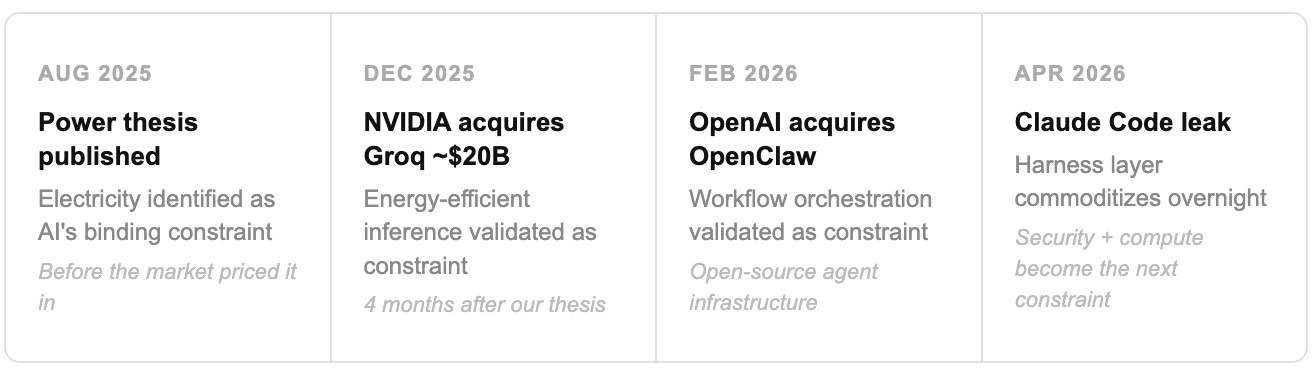
We’ve tracked this pattern through the power infrastructure thesis published in August 2025, NVIDIA’s acquisition of Groq in December for roughly $20 billion (validating that energy-efficient inference is a binding constraint), and OpenAI’s acquisition of OpenClaw in February (validating that workflow orchestration is a constraint layer). The Claude Code leak is the fourth major validation event in the past 9 months.
What makes it uniquely instructive is that it validates the thesis across both resolutions of Chamath Palihapitiya's paradox. Think of it as a two-scenario test:
Think of this as a simple decision tree — the constraint layer wins in both branches:
Scenario A: AGI is real and arriving soon → Traditional software (SaaS) moats collapse → Value migrates away from applications toward infrastructure → Power, compute, physical constraint layer wins → Our thesis: correct
Scenario B: AGI stalls or is further away than priced → AI company valuations correct sharply → But the enterprise agent economy is already real and scaling → Physical infrastructure still required regardless → Our thesis: still correct
No matter which branch the market takes, Fund II is positioned upstream of the resolution.
The leak makes this structural dynamic concrete. The harness layer — the orchestration, the memory architecture, the tool-execution logic — was commoditized overnight. Rebuilt in Python before sunrise. This is what happens to software layers not protected by fundamental scientific IP. They become table stakes. And value shifts to whatever the next binding constraint is.
Right now, those constraints are clear: trust and security infrastructure for enterprise agent deployment; always-on inference economics that the newly revealed background agent capabilities will drive; and deep vertical workflow integration with switching costs that survive commoditization of the underlying architecture. The companies solving those constraints — not the companies building the harness layer that just became public knowledge — are where Fund II is positioned.
The coverage has focused on the embarrassment angle — the timing ahead of Anthropic’s IPO, the overreaching takedown response, what Gizmodo called “vibe coding too close to the sun.” All of that is real.
But the more important story is what the feature flags revealed. Anthropic didn’t just leak its current architecture; it also leaked its future architecture. It accidentally disclosed a product pipeline the market didn’t know existed — capabilities already built and ready to flip on, not just on a roadmap. As Chamath Palihapitiya put it on the All-In Podcast: stack up those feature-flagged improvements, and Anthropic is further ahead than the market had priced in.
The leak didn’t weaken Anthropic’s position. It confirmed that the frontier is moving faster than the market has priced. And if the frontier is moving that fast, the constraint layer — the physical and structural bottlenecks that don’t disappear with better algorithms — becomes more valuable, not less. Because it’s the one thing that can’t be rebuilt in Python before sunrise.
We’ve been investing at that layer since before it was obvious. The events of this week made it very obvious indeed.
References
Wall Street Journal — “Anthropic Races to Contain Leak of Code Behind Claude AI Agent”
Bloomberg — “Anthropic Accidentally Releases Source Code for Claude AI Agent”
Bloomberg — “OpenAI Share Demand Drops on Secondary Market as Anthropic Gets Investors”
TechCrunch — “Anthropic is having a moment in the private markets; SpaceX could spoil the party”
No posts
Comments
Nothing yet. Say the first thing.
Sign in to join the conversation.